
This lesson explores the complexities of operating heavy goods vehicles within dense French urban environments. You will learn how to interpret delivery-specific signage, manage access restrictions, and adopt professional maneuvering practices that are essential for passing your Category C and CE licence theory exam.
Lesson content overview
Operating a heavy goods vehicle (HGV) within dense European city centers is one of the most demanding tasks a professional driver will face. As a candidate preparing for the French Goods Vehicle Licence Theory Course (Categories C and CE), mastering the regulations, signage, and physical challenges of urban delivery zones is essential for passing your exam and ensuring safe, compliant, and efficient operations.
Urban delivery environments require balancing commercial transport needs with environmental preservation, pedestrian safety, and traffic flow. This lesson provides a deep dive into French municipal regulations, specific loading bay structures, environmental restrictions, and safe maneuvering practices.
In France, urban delivery operations are governed by a combination of the national traffic code (Code de la route) and local municipal decrees (arrêtés municipaux). Mayors (maires) have the legal authority to regulate traffic and parking within their municipalities to minimize congestion, noise, and air pollution.
Consequently, while the fundamental rules of the road remain uniform across France, the specific hours, vehicle weight limits, and permit requirements for deliveries can vary significantly from one city to another (e.g., Paris versus Lyon or Marseille). As a professional driver, it is your responsibility to research and understand the local charte de logistique urbaine (urban logistics charter) for your destination city before embarking on your journey.
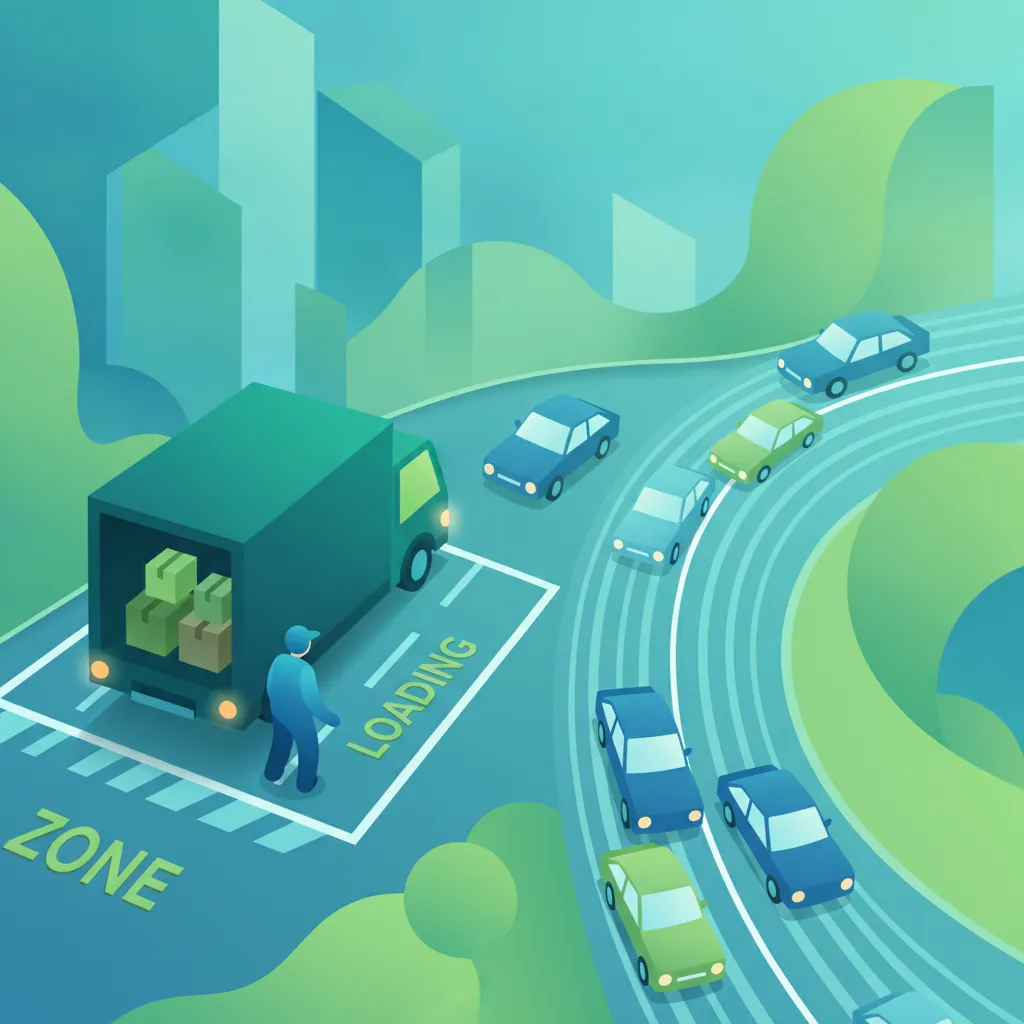
A loading bay (aire de livraison) is a designated space on the public highway reserved specifically for the loading and unloading of goods. Misusing these spaces or failing to follow their rules is a major source of urban traffic obstruction and results in severe penalties.
Under the French Code de la route, it is critical to distinguish between stopping (l'arrêt) and parking (le stationnement):
Loading bays are designed exclusively for active loading and unloading (l'arrêt). Leaving a vehicle parked in a loading bay without continuous loading activity is considered illegal parking (stationnement gênant).
In many French municipalities, loading bays are divided into two main operational categories to maximize the efficiency of urban space:
Loading bays in France are easily identifiable through a combination of paint markings and vertical signs.
A single dashed yellow line indicates a loading bay that may be subject to shared-use regulations depending on the accompanying time plates. A solid yellow line or crossed yellow lines typically signal an absolute prohibition on standard parking at all times, reserving the space entirely for active commercial deliveries.
To combat air pollution in highly populated areas, France has established Low Emission Zones, known legally as Zones à Faibles Émissions mobilité (ZFE-m). These zones restrict access for high-emission vehicles, particularly older diesel trucks.
All vehicles operating within a French ZFE-m must display a windshield sticker called a Crit'Air vignette (certificat qualité de l'air). The Crit'Air system classifies vehicles into six color-coded categories (Green/0 to Grey/5) based on their engine type, fuel source, and European emission standard (Euro class).
As a Category C or CE driver, you must ensure that your vehicle's Crit'Air category matches the current entry requirements of the city you are entering. Many French ZFEs (such as Paris, Lyon, and Grenoble) have phased out or are actively phasing out Crit'Air 3, 4, and 5 vehicles, meaning older commercial trucks cannot enter these zones without facing heavy fines.
Municipalities use restricted time windows (plages horaires) to separate commercial delivery traffic from peak commuter traffic and pedestrian rushes.
When planning routes for heavy vehicles, you must consult the municipal ordinances of your destination city. Common restrictions include:
Time-based restrictions are communicated via supplementary plates (panneaux panonceaux) placed directly beneath standard regulatory signs.
For example, a "No Entry" sign (sens interdit) with an accompanying plate reading "Sauf Livraison 6h-11h" means that goods vehicles are exempted from the entry prohibition only between the hours of 06:00 and 11:00. Entering outside this window constitutes a major traffic violation.
In many dense historic districts, simply meeting emission standards and arriving within the correct time window is not enough. Local authorities may require a physical or digital Delivery Permit (Autorisation de livraison or Disque de livraison).
Some cities require goods vehicles to display a specific delivery disc (Disque de transport de marchandises or Disque de livraison) on their dashboard. This disc is similar to a standard blue parking disc but is tailored for commercial logistics.
Verify Local Requirement: Check if the municipality requires the official delivery disc (e.g., the standard 1.5-tonne or 3.5-tonne delivery disc formats used in cities like Paris).
Set the Arrival Time: Upon parking in the loading bay, adjust the disc to display your exact time of arrival.
Observe the Maximum Duration: Respect the maximum permitted stopping duration, which is typically capped at 30 minutes for standard deliveries, unless a specific local municipal decree allows longer for heavy vehicles.
Conspicuous Display: Place the disc clearly visible behind the driver’s side windshield so parking enforcement officers can easily verify your arrival time.
Operating in these designated zones without displaying a completed disc, using an expired disc, or exceeding the maximum permitted loading time will result in a ticket.
Navigating narrow streets, tight turns, and low arches with a Category C or CE vehicle demands supreme spatial awareness and defensive driving habits.
Before entering a narrow urban street, you must visually assess your path and cross-reference your vehicle dimensions with physical restrictions:
For large rigid trucks and especially articulated vehicles (Category CE), tail-swing is a major hazard when turning in tight spaces. When you turn the steering wheel sharply in one direction, the rear overhang of your vehicle swings out in the opposite direction.
You must monitor your mirrors continuously throughout the entire turn to ensure your tail-swing does not strike pedestrians, vehicles, or buildings.
Urban delivery zones are highly dynamic environments where pedestrians, cyclists, and scooter riders constantly interact with heavy vehicles. Because of your vehicle's mass and limited visibility, the burden of safety falls squarely on you, the professional driver.
Large goods vehicles have extensive blind spots on all four sides. In France, this risk is addressed by specific legislation.
Since January 1, 2021, all vehicles over 3.5 tonnes operating in France must be equipped with official "Attention: Angles Morts" (Warning: Blind Spots) stickers. These stickers must be placed at specific locations on both sides of the vehicle and at the rear, visible to other road users.
To minimize the risk of collisions with cyclists and pedestrians when preparing to turn or maneuver into a loading bay:
French cities feature several types of low-speed, high-pedestrian zones. You must adjust your driving behavior dynamically:
Violating urban delivery regulations in France carries stiff administrative and financial penalties.
| Violation | Legal Status / Classification | Standard Consequence |
|---|---|---|
| Unauthorized Parking in a Loading Bay (Stationnement abusif/gênant) | Class 2 or 4 Fine (Amende forfaitaire) | €35 to €135 fine, potential towing (mise en fourrière) at the owner's expense. |
| Entering a ZFE-m Without a Compliant Crit'Air Sticker | Class 4 Fine | Up to €135 fine for light goods vehicles, up to €375 for heavy goods vehicles over 3.5 tonnes. |
| Exceeding Speed Limits in a Zone de Rencontre (20 km/h) | Speeding Violation | Fine, penalty points deducted from the driver's professional license. |
| Failing to Display "Angles Morts" Stickers | Class 4 Fine | €135 fine per missing or improperly placed sticker. |
| Blocking a Sidewalk or Cycle Lane (Stationnement très gênant) | Class 4 Fine | €135 fine, immediate towing authorization, risk of liability in the event of an accident involving a vulnerable road user forced into the roadway. |
To consolidate your understanding, let us analyze two practical scenarios that you might encounter in your daily operations or as situational questions on the French driving theory exam.
This lesson covers the essential regulations for operating heavy goods vehicles in French urban delivery environments, including the critical legal distinction between stopping for active loading ('arrêt') and parking ('stationnement') at loading bays. Learners must understand the Crit'Air vignette system for accessing ZFE-m low emission zones, the yellow road markings and signage that identify loading bays, and the time-window restrictions enforced through supplementary plates and delivery discs. The lesson also addresses practical hazards like tail-swing ('effet de balayage') and blind spots ('angles morts'), which require mandatory warning stickers on vehicles over 3.5 tonnes, as well as the different pedestrian priority zones (Zone 30, Zone de Rencontre, Zone Piétonne) that require adjusted driving behavior and speeds.
A short set of high-value points that capture the most important learning from this lesson.
The French Code de la route distinguishes between 'arrêt' (active loading/unloading with the driver nearby) and 'stationnement' (leaving the vehicle unattended), and loading bays permit only the former.
All heavy goods vehicles over 3.5 tonnes must display a Crit'Air vignette in ZFE-m zones, with many French cities actively phasing out Crit'Air 3, 4, and 5 vehicles.
Loading bays are identified by yellow road markings with the word 'LIVRAISON' painted on the surface, and shared-use bays have specific daytime delivery windows typically from 07:00 to 20:00.
The 'effet de balayage' (tail-swing) is a critical hazard when turning with large vehicles, requiring continuous mirror monitoring throughout the entire maneuver.
Since January 2021, all vehicles over 3.5 tonnes must display official 'Attention: Angles Morts' warning stickers on both sides and the rear of the vehicle.
Explore all units and lessons included in this driving theory course.
Look for the yellow 'LIVRAISON' road marking and vertical CE22 sign to identify official loading bays; dashed yellow lines indicate shared-use bays while solid or crossed yellow lines indicate exclusive delivery bays.
Supplementary time plates (panneaux panonceaux) beneath signs specify exact delivery windows; a plate reading 'Sauf Livraison 6h-11h' means deliveries are only permitted within those hours.
The French delivery disc (*Disque de livraison*) must be set to your exact arrival time and displayed on the dashboard; the maximum permitted stopping duration is typically 30 minutes.
Zone de Rencontre has a strict 20 km/h speed limit where pedestrians have absolute priority, while Zone Piétonne prohibits motorized traffic except during restricted delivery windows.
Entering a ZFE-m without the correct Crit'Air vignette can result in fines up to €375 for heavy goods vehicles over 3.5 tonnes.
Assuming all loading bays are available for parking between deliveries; in reality, loading bays are for active unloading only, and leaving a vehicle unattended constitutes illegal 'stationnement gênant'.
Relying on national rules alone; municipal *arrêtés* can significantly alter delivery hours, weight limits, and permit requirements from city to city.
Confusing the Crit'Air category requirement; entry restrictions vary by city and change over time, so drivers must verify current local ZFE-m requirements before each journey.
Entering a pedestrian zone (*Zone Piétonne*) without checking if the delivery window still applies when you expect to leave, not just when you arrive.
Failing to perform a complete mirror check and pause before crossing a cycle lane to enter a loading bay, assuming cyclists will yield to the truck.
Lesson content overview
A short set of high-value points that capture the most important learning from this lesson.
The French Code de la route distinguishes between 'arrêt' (active loading/unloading with the driver nearby) and 'stationnement' (leaving the vehicle unattended), and loading bays permit only the former.
All heavy goods vehicles over 3.5 tonnes must display a Crit'Air vignette in ZFE-m zones, with many French cities actively phasing out Crit'Air 3, 4, and 5 vehicles.
Loading bays are identified by yellow road markings with the word 'LIVRAISON' painted on the surface, and shared-use bays have specific daytime delivery windows typically from 07:00 to 20:00.
The 'effet de balayage' (tail-swing) is a critical hazard when turning with large vehicles, requiring continuous mirror monitoring throughout the entire maneuver.
Since January 2021, all vehicles over 3.5 tonnes must display official 'Attention: Angles Morts' warning stickers on both sides and the rear of the vehicle.
Explore all units and lessons included in this driving theory course.
Look for the yellow 'LIVRAISON' road marking and vertical CE22 sign to identify official loading bays; dashed yellow lines indicate shared-use bays while solid or crossed yellow lines indicate exclusive delivery bays.
Supplementary time plates (panneaux panonceaux) beneath signs specify exact delivery windows; a plate reading 'Sauf Livraison 6h-11h' means deliveries are only permitted within those hours.
The French delivery disc (*Disque de livraison*) must be set to your exact arrival time and displayed on the dashboard; the maximum permitted stopping duration is typically 30 minutes.
Zone de Rencontre has a strict 20 km/h speed limit where pedestrians have absolute priority, while Zone Piétonne prohibits motorized traffic except during restricted delivery windows.
Entering a ZFE-m without the correct Crit'Air vignette can result in fines up to €375 for heavy goods vehicles over 3.5 tonnes.
Assuming all loading bays are available for parking between deliveries; in reality, loading bays are for active unloading only, and leaving a vehicle unattended constitutes illegal 'stationnement gênant'.
Relying on national rules alone; municipal *arrêtés* can significantly alter delivery hours, weight limits, and permit requirements from city to city.
Confusing the Crit'Air category requirement; entry restrictions vary by city and change over time, so drivers must verify current local ZFE-m requirements before each journey.
Entering a pedestrian zone (*Zone Piétonne*) without checking if the delivery window still applies when you expect to leave, not just when you arrive.
Failing to perform a complete mirror check and pause before crossing a cycle lane to enter a loading bay, assuming cyclists will yield to the truck.
Explore search topics learners often look for when studying Navigating Urban Delivery Zones. These topics reflect common questions about road rules, driving situations, safety guidance, and lesson level theory preparation for learners in France.
Browse additional driving theory lessons that cover connected traffic rules, road signs, and common driving situations related to this topic. Improve your understanding of how different rules interact across everyday traffic scenarios.
Learn the essential techniques for maneuvering large Category C and CE vehicles in confined environments. This guide explains how to manage tail-swing effects, navigate tight intersections, and assess clearance heights to prevent accidents while maintaining safe driving practices on narrow roads during your professional HGV theory preparation.

In this lesson, drivers will learn best practices for manoeuvring goods vehicles into loading docks and other confined spaces. The content covers the use of spotting aids, guidance markings, and reverse assistance technologies. Learners will understand how to align the vehicle and trailer correctly with dock doors, maintain situational awareness, and use proper signaling for safety. The lesson also emphasizes the importance of communication with dock personnel.

In this lesson, drivers will learn how to plan and execute wide turns with goods vehicles, taking into account turning radius, pivot points, and articulation angles. The content emphasizes the necessity of using the full width of the lane, correctly aligning the vehicle through the turn, and anticipating the movement of the trailer. Learners will also explore road marking guidelines for turning and the importance of giving clear signals to surrounding traffic.
This lesson focuses on maneuvering in extremely crowded areas, passenger terminals, or narrow streets blocked by parked vehicles and obstacles. Drivers will learn to assess clearance distances precisely before committing to narrow pathways. The content teaches steering techniques that maintain stability, optimize space usage, and prioritize public safety during slow-speed, high-difficulty maneuvers.

In this lesson, drivers will learn strategies to avoid conflicts with smaller vehicles, such as cars and vans, which may not be as visible in large vehicle blind spots. The content emphasizes maintaining adequate spacing, using proper lane discipline, and being aware of small vehicles' behavior during lane changes and turns. Learners will also be introduced to communication techniques, such as signalling and eye contact.
This lesson focuses on techniques for reversing safely with a trailer attached, including the use of spotters, mirrors, and backup cameras to mitigate blind spots. Learners will understand the steps for proper trailer coupling before reversing, how to control trailer sway, and the importance of using reverse gear properly. The content also covers safety checks to perform before reversing, such as ensuring the area is clear.
This lesson examines the specific challenges and responsibilities goods vehicle drivers face when interacting with pedestrians and cyclists in urban environments. Learners will understand right-of-way rules, the importance of yielding at pedestrian crossings, and safe turning practices that protect cyclists. The content emphasizes heightened driver vigilance, especially when navigating bike lanes and crowded sidewalks.

This lesson focuses on the importance of recognizing and mitigating blind spots in goods vehicles, especially when towing trailers. Learners will explore techniques such as proper mirror adjustment, the use of blind spot mirrors, and visual checks to ensure that obstacles and vulnerable road users are detected before executing maneuvers. The content also discusses the limitations of blind spot monitoring systems and the need for supplementary visual checks.

This lesson focuses on the unique challenges of performing deliveries in dense urban areas. Learners will explore best practices for loading and unloading safely, navigating traffic congestion, and minimizing risks to pedestrians and cyclists. The content also covers compliance with city regulations for delivery zones, scheduling considerations, and the importance of careful maneuvering to avoid accidents.

This lesson analyzes the various traffic challenges unique to operating large passenger vehicles in historic and modern French urban areas. Drivers will learn to manage narrow street layouts, double-parked delivery trucks, and high-density multi-lane roundabouts safely. The lesson emphasizes defensive driving strategies, route adjustments, and maintaining mental focus under severe schedule and time pressures.

In this lesson, drivers will learn about the relationship between a vehicle’s centre of gravity and its susceptibility to rollover incidents. The content covers how high-center-of-gravity loads, load shifts, and overloading can compromise lateral stability, especially during cornering or evasive maneuvers. Learners will gain insight into calculating safety margins and understanding the impact of cargo weight distribution on the overall stability of the vehicle.
Understand the critical safety requirements for sharing urban roads with pedestrians and cyclists. This lesson provides clear explanations of mandatory blind spot markers, how to navigate low-speed meeting zones safely, and the legal responsibilities of professional HGV drivers in managing risks around vulnerable road users in French cities.
This lesson focuses on the importance of recognizing and mitigating blind spots in goods vehicles, especially when towing trailers. Learners will explore techniques such as proper mirror adjustment, the use of blind spot mirrors, and visual checks to ensure that obstacles and vulnerable road users are detected before executing maneuvers. The content also discusses the limitations of blind spot monitoring systems and the need for supplementary visual checks.
In this lesson, drivers will learn strategies to avoid conflicts with smaller vehicles, such as cars and vans, which may not be as visible in large vehicle blind spots. The content emphasizes maintaining adequate spacing, using proper lane discipline, and being aware of small vehicles' behavior during lane changes and turns. Learners will also be introduced to communication techniques, such as signalling and eye contact.

This lesson teaches specific visual scanning methods to detect vulnerable road users, such as children, elderly individuals, and cyclists near stops. Drivers will learn to anticipate sudden movements, like a passenger running to catch a bus or stepping off a sidewalk unexpectedly. Managing the massive blind spots around the front and right-hand sides of passenger vehicles is highlighted as a critical safety duty.

This lesson details the dangerous blind spots (angles morts) that surround heavy passenger vehicles and explains how to mitigate them. Drivers will master the systematic mirror check sequence (retro-information) before executing any turns or lane changes. It also covers the mandatory French "Angles Morts" warning stickers displayed on the vehicle exterior to alert vulnerable road users of danger zones.
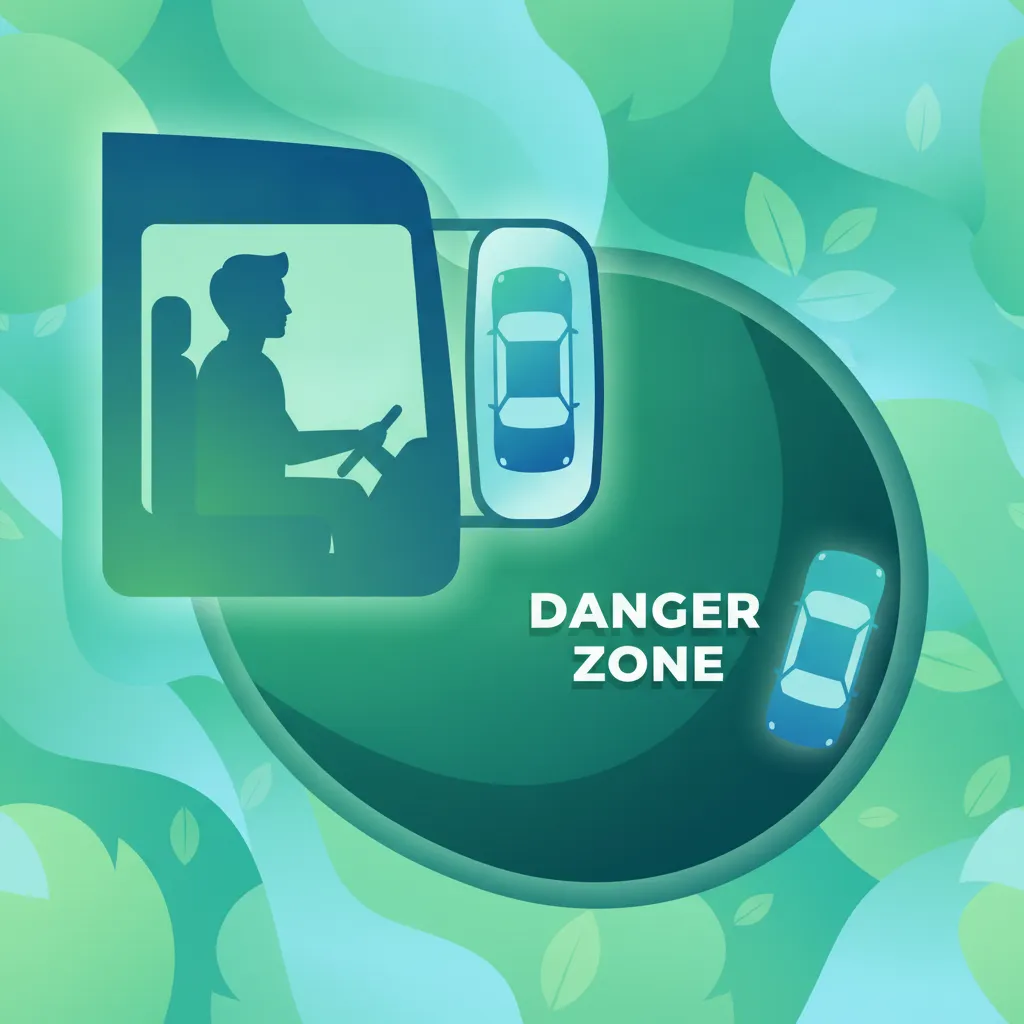
This lesson details the location and scale of blind spots around passenger cars and heavy goods vehicles, often referred to as the 'no-zone' or 'angles morts'. You will learn why truck drivers cannot see you directly behind or immediately adjacent to their cab doors. The lesson provides actionable strategies to minimize the time you spend in these dangerous zones, ensuring you always pass quickly and safely.

This lesson addresses the challenges of positioning near larger vehicles such as cars, vans, buses, and lorries on French roads. Learners will learn to identify blind spots (angles morts), maintain a safe distance, and position themselves to maximize visibility and predictability. Understanding these dynamics is crucial for AM riders to avoid dangerous situations and ensure safe overtaking and lane sharing.
This lesson examines the specific challenges and responsibilities goods vehicle drivers face when interacting with pedestrians and cyclists in urban environments. Learners will understand right-of-way rules, the importance of yielding at pedestrian crossings, and safe turning practices that protect cyclists. The content emphasizes heightened driver vigilance, especially when navigating bike lanes and crowded sidewalks.

In this lesson, drivers will learn how to safely share the road with motorcycles and scooters, focusing on the specific blind spots and speed differentials that create risk. The content highlights proper lane positioning, caution when overtaking, and strategies for predicting motorcycle trajectories. Learners will also be introduced to the importance of being aware of scooter movements, especially in narrow streets.
Find clear answers to common questions learners have about Navigating Urban Delivery Zones. Learn how the lesson is structured, which driving theory objectives it supports, and how it fits into the overall learning path of units and curriculum progression in France. These explanations help you understand key concepts, lesson flow, and exam focused study goals.
Signs regulating delivery zones often specify time windows or vehicle class requirements. You must check if your vehicle weight or dimensions exceed the posted limits for the zone or if specific access permits are required for entry.
Yes, standard urban speed limits (usually 50 km/h) apply, but you must often adapt your speed much lower based on traffic, pedestrian density, and vehicle size to ensure safety and prevent accidents in tight streets.
Always look for signage indicating exemptions for delivery vehicles or weight restrictions. If you encounter a sign prohibiting vehicles over a certain weight, assume you cannot enter unless explicitly permitted for deliveries.
The primary risk is conflict with vulnerable road users such as pedestrians and cyclists. You must maximize your use of mirrors and blind-spot monitors to ensure they are not in your path when turning or reversing.
Ready to focus your study? Use the practice search to find exactly the French driving theory questions you need for the Code de la route and permis de conduire ETG. Refine your knowledge on specific topics or challenging rules to boost your confidence and exam readiness.