
This lesson focuses on the critical lane usage and positioning requirements for articulated vehicles under French traffic law. You will learn how to safely navigate lane changes and manage the unique physical constraints of large goods vehicles in various environments. Mastering these skills is essential for both your professional licence exam and day-to-day safety as a heavy vehicle driver.

Lesson content overview
Operating an articulated goods vehicle (un ensemble de véhicules) under the French Category C and CE licences requires an advanced level of spatial awareness, technical precision, and strict compliance with the French Highway Code (Code de la route). Because of their extreme length, high center of gravity, and articulation joint, these vehicles present unique challenges that standard rigid trucks do not face.
Proper lane discipline is not merely a matter of staying within the white lines; it is a vital safety practice that prevents devastating collisions, preserves traffic flow, and protects vulnerable road users. This lesson detail the legal framework, practical physical concepts, and critical maneuvers necessary to maintain correct lane discipline with a semi-trailer or drawbar combination in France.
The French road network is governed by strict rules designed to manage the coexistence of light passenger vehicles and heavy goods vehicles (HGVs). For drivers of Category C and CE vehicles, these laws are non-negotiable.
Under Article R412-12 of the Code de la route, all drivers must keep their vehicles as close as possible to the right-hand edge of the roadway under normal traffic conditions. However, when lanes are designated by explicit markings, drivers must stay entirely within their designated lane.
Crucially, the law specifies that drivers must not use lane markings as a guide for steering. This means you cannot "ride" or straddle the white lines. Doing so not only incurs penalties but also risks serious collisions with vehicles in adjacent lanes.
Maintaining a safe buffer zone behind the vehicle ahead is a strict legal requirement in France. For heavy vehicles, the law is even more specific to accommodate their immense mass and extended stopping distances.
Under Article R412-14, when two vehicles with a Gross Vehicle Weight Rating (PTAC) exceeding 3.5 tonnes, or a total length exceeding 7 metres, are traveling at the same speed outside of built-up areas, they must maintain a minimum longitudinal gap of 50 metres between each other.
This 50-metre rule applies regardless of speed (as long as both vehicles are moving) and is designed to allow lighter passenger vehicles to safely overtake and slot into the gap between two trucks.
To drive an articulated vehicle safely, you must maintain a central position within your lane. This means ensuring that the tractor unit and, more importantly, the trailer remain centered between the left and right lane markings.
Maintaining a central position is complicated by the physical behavior of articulated combinations when negotiating curves or minor road deviations:
New drivers often make the mistake of steering close to the left lane marking (on right-hand traffic roads) to keep an eye on oncoming traffic, or close to the right lane marking to avoid vehicles on their left. This is highly dangerous for two reasons:
In France, standard articulated combinations (semi-trailers) can reach lengths of up to 16.5 metres, while rigid trucks pulling drawbar trailers can extend up to 18.75 metres. This massive footprint means your vehicle occupies a significant amount of continuous road space.
When navigating any curve, roundabout, or intersection, you must account for the swept path—the total road width required by the vehicle as it turns.
Because the trailer wheels cut inward, you must "deepen" your turn, taking the tractor unit further forward before initiating the steering input. However, you must execute this without prematurely or illegally entering adjacent lanes.
If you must temporarily use an adjacent lane to complete a turn, you must treat this as a highly hazardous maneuver: signal early, verify your blind spots, and yield to existing traffic in that lane.
Safe lane discipline requires maintaining a "space bubble" around your entire combination. This bubble protects you from sudden maneuvers by other road users and accounts for the physical limitations of your heavy vehicle.
While the legal minimum outside built-up areas is 50 metres for HGVs, you must dynamically adjust your following distance based on speed, weight, and weather.
When driving next to other vehicles, especially on multi-lane highways or during overtaking, you must maintain a safe lateral gap.
Changing lanes in an articulated vehicle is a high-risk maneuver due to the extensive blind spots (angles morts) along both sides of the trailer. You must follow a disciplined, systematic procedure every time.
Anticipate and Plan Ahead: Never make sudden lane changes. Plan your maneuvers at least 15 to 20 seconds in advance. Look down the road to identify slow-moving traffic or upcoming merges.
Primary Mirror Assessment: Check your main rear-view mirrors and wide-angle mirrors on both sides to gauge the speed and position of surrounding traffic.
Signal Early (The 5-Second Rule): Under Article R412-15, you must indicate your intention before moving. Activate your turn signal at least 5 seconds before initiating any lateral movement. This gives other drivers time to react, slow down, or clear your blind spots.
Blind Spot Check (Angles Morts): Check your close-proximity mirrors (Class V and Class VI passenger-side and front-view mirrors). If your vehicle is equipped with active blind-spot warning systems or side cameras, check them now. Be aware of the warning stickers (Angles Morts) required on your vehicle to alert external road users of your limited visibility.
Confirm the Lateral Gap: Ensure there is a gap in the target lane that is at least twice the length of your entire combination (minimum 35 to 40 metres) to allow a safe buffer in front of and behind your vehicle.
Smooth and Gradual Merge: Steer gently into the target lane. Avoid abrupt steering inputs, which can induce trailer sway or activate the Electronic Stability Control (ESC).
Deactivate Indicator and Re-Center: Once the entire trailer has fully entered the new lane, turn off your signal and establish your central lane position.
Urban driving in France often forces Category C and CE drivers into lanes that are far narrower than the standard 3.5-metre highway design. Historic city centers, active roadworks (travaux), and residential streets present extreme physical limits.
When encountering lanes narrower than 3.5 metres:
Your ability to maintain proper lane discipline is heavily influenced by external environment factors and the mechanical state of your vehicle.
The high lateral surface area of a box-type or curtain-side semi-trailer makes it a massive sail. Under high winds, you will experience lateral drift:
The distribution of your cargo radically alters how your vehicle behaves within the lane:
Understanding the direct consequences of your positioning decisions is key to passing your Category C/CE theory exam and driving safely:
| Driver Action | Immediate Physical Effect | Road Safety Consequence |
|---|---|---|
| Hugging the left lane marking | Trailer off-tracks into the adjacent left lane during right-hand curves. | Risk of sideswipe collisions with overtaking vehicles. |
| Maintaining active 50m HGV gap | Provides safe stopping distance and space for overtaking cars. | Compliance with Article R412-14; prevents chain-reaction rear-end crashes. |
| Changing lanes without 5s signal | Surprises adjacent motorists in your blind spots. | Forceful braking by other cars, potential jackknife or side-impact. |
| Steering close to faint markings | Driver over-corrects steering based on unreliable visual cues. | Wandering within the lane, confusing other drivers, risk of run-off-road. |
| Maintaining low speed in narrow lanes | Minimizes trailer swing and maximizes reaction time. | Safe transit through tight urban environments without structural damage. |
Proper lane discipline for articulated vehicles under French Category C and CE licences extends far beyond staying within white lines; it requires understanding how trailers behave differently from rigid vehicles, particularly the off-tracking phenomenon during turns and outswing on curves at speed. The French Code de la route enforces strict positioning rules (Article R412-12) and mandatory following distances of 50 metres between heavy vehicles (Article R412-14), while lateral clearance requirements protect vulnerable road users including a 1-metre minimum for cyclists inside built-up areas. Successful lane changes demand systematic procedures including a 5-second advance signal, mirror checks covering Class V and VI blind spot mirrors, and ensuring a gap at least twice the vehicle length in the target lane. Environmental factors such as crosswinds, tunnel exits, and cargo loading conditions all dynamically alter how the vehicle responds within its lane, requiring continuous adjustment rather than static positioning.
A short set of high-value points that capture the most important learning from this lesson.
Articulated vehicles must remain centrally positioned within lane markings; you cannot use white lines as steering guides under Article R412-12.
Trailers exhibit off-tracking (cutting inward on low-speed turns) and outswing (swinging outward at high speed), requiring you to anticipate where the rear wheels will actually travel.
The minimum 50-metre longitudinal gap between heavy vehicles over 3.5t or 7m applies outside built-up areas regardless of speed, allowing cars to overtake safely.
A loaded trailer raises your center of gravity, increasing rollover risk on sudden steering inputs, while an empty trailer bounces more and is more vulnerable to wind drift.
When changing lanes, the gap in the target lane must be at least twice your vehicle length (35-40 metres) to accommodate the full combination safely.
Explore all units and lessons included in this driving theory course.
Article R412-14 mandates 50 metres minimum between HGVs over 3.5t outside built-up areas; increase to 70-80m (3 seconds) in dry conditions and 150m (6 seconds) in wet conditions.
Cyclist lateral clearance is 1 metre inside built-up areas and 1.5 metres outside; vulnerable users have legal protection requiring these margins.
Class V and VI mirrors are mandatory for viewing close-proximity blind spots on the passenger side and front of the cab.
Wind turbulence from overtaking vehicles or exiting tunnels can cause lateral drift; keep both hands on the wheel and reduce speed.
In narrow urban lanes under 3.5 metres, drastic speed reduction and using road edges as visual anchors replaces reliance on faded lane markings.
Hugging the left lane marking to monitor oncoming traffic; your trailer's right side will likely encroach into adjacent lanes due to the off-tracking effect.
Failing to signal for the full 5 seconds before moving laterally, violating Article R412-15 and surprising drivers in your extensive blind spots.
Steering based on unreliable or faded lane markings rather than established central positioning, causing wandering that confuses other road users.
Assuming the cab's left edge aligns with your trailer's right edge; the driver's elevated left-hand position creates a visual deception that puts adjacent traffic at risk.
Neglecting to check Class V and VI mirrors before lane changes, missing detection of motorcyclists or cyclists positioned in the immediate blind zones.
Lesson content overview
A short set of high-value points that capture the most important learning from this lesson.
Articulated vehicles must remain centrally positioned within lane markings; you cannot use white lines as steering guides under Article R412-12.
Trailers exhibit off-tracking (cutting inward on low-speed turns) and outswing (swinging outward at high speed), requiring you to anticipate where the rear wheels will actually travel.
The minimum 50-metre longitudinal gap between heavy vehicles over 3.5t or 7m applies outside built-up areas regardless of speed, allowing cars to overtake safely.
A loaded trailer raises your center of gravity, increasing rollover risk on sudden steering inputs, while an empty trailer bounces more and is more vulnerable to wind drift.
When changing lanes, the gap in the target lane must be at least twice your vehicle length (35-40 metres) to accommodate the full combination safely.
Explore all units and lessons included in this driving theory course.
Article R412-14 mandates 50 metres minimum between HGVs over 3.5t outside built-up areas; increase to 70-80m (3 seconds) in dry conditions and 150m (6 seconds) in wet conditions.
Cyclist lateral clearance is 1 metre inside built-up areas and 1.5 metres outside; vulnerable users have legal protection requiring these margins.
Class V and VI mirrors are mandatory for viewing close-proximity blind spots on the passenger side and front of the cab.
Wind turbulence from overtaking vehicles or exiting tunnels can cause lateral drift; keep both hands on the wheel and reduce speed.
In narrow urban lanes under 3.5 metres, drastic speed reduction and using road edges as visual anchors replaces reliance on faded lane markings.
Hugging the left lane marking to monitor oncoming traffic; your trailer's right side will likely encroach into adjacent lanes due to the off-tracking effect.
Failing to signal for the full 5 seconds before moving laterally, violating Article R412-15 and surprising drivers in your extensive blind spots.
Steering based on unreliable or faded lane markings rather than established central positioning, causing wandering that confuses other road users.
Assuming the cab's left edge aligns with your trailer's right edge; the driver's elevated left-hand position creates a visual deception that puts adjacent traffic at risk.
Neglecting to check Class V and VI mirrors before lane changes, missing detection of motorcyclists or cyclists positioned in the immediate blind zones.
Explore search topics learners often look for when studying Proper Lane Discipline for Articulated Vehicles. These topics reflect common questions about road rules, driving situations, safety guidance, and lesson level theory preparation for learners in France.
Browse additional driving theory lessons that cover connected traffic rules, road signs, and common driving situations related to this topic. Improve your understanding of how different rules interact across everyday traffic scenarios.
Learn how to identify and mitigate blind spots around articulated heavy goods vehicles. This guide explains the use of proximity mirrors and electronic safety systems to increase visibility and avoid collisions with vulnerable road users such as pedestrians, cyclists, and motorcyclists during urban maneuvers.

This lesson focuses on the importance of recognizing and mitigating blind spots in goods vehicles, especially when towing trailers. Learners will explore techniques such as proper mirror adjustment, the use of blind spot mirrors, and visual checks to ensure that obstacles and vulnerable road users are detected before executing maneuvers. The content also discusses the limitations of blind spot monitoring systems and the need for supplementary visual checks.
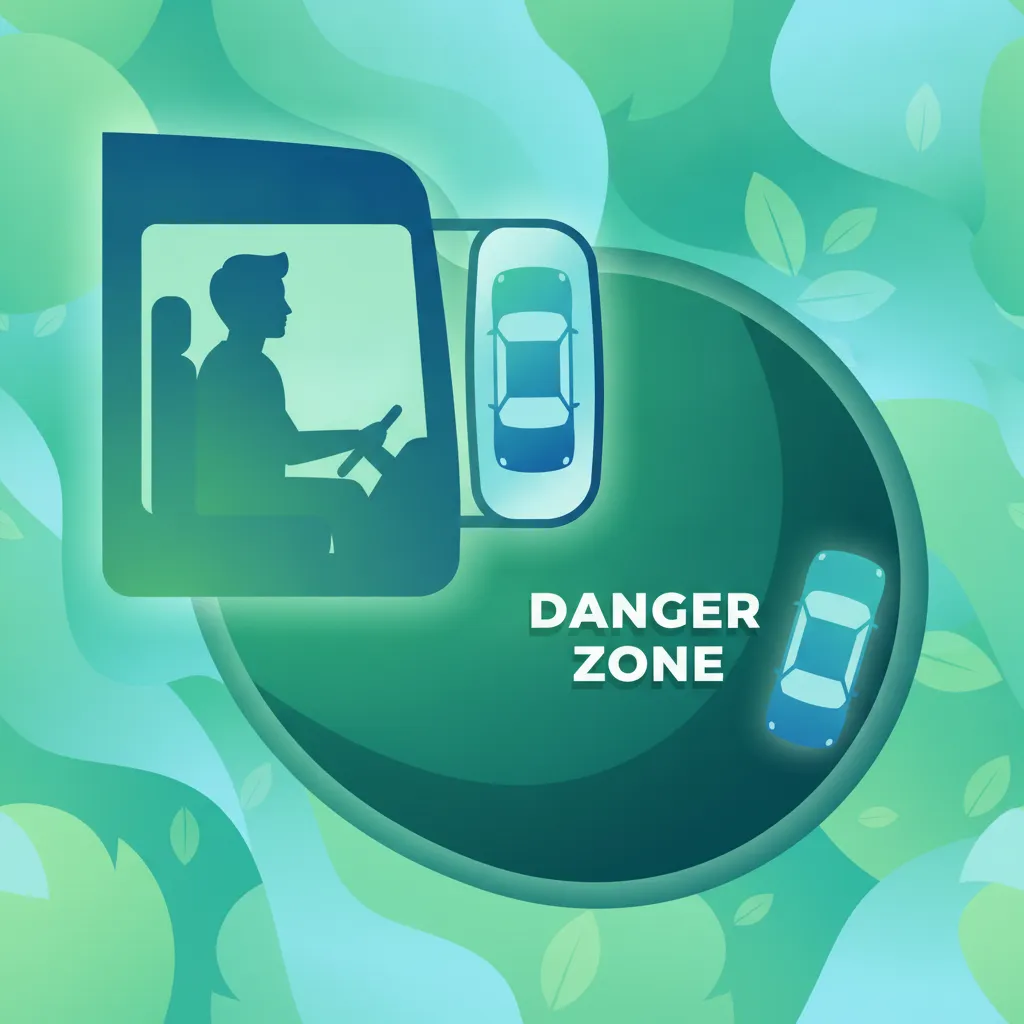
This lesson details the location and scale of blind spots around passenger cars and heavy goods vehicles, often referred to as the 'no-zone' or 'angles morts'. You will learn why truck drivers cannot see you directly behind or immediately adjacent to their cab doors. The lesson provides actionable strategies to minimize the time you spend in these dangerous zones, ensuring you always pass quickly and safely.

In this lesson, drivers will learn strategies to avoid conflicts with smaller vehicles, such as cars and vans, which may not be as visible in large vehicle blind spots. The content emphasizes maintaining adequate spacing, using proper lane discipline, and being aware of small vehicles' behavior during lane changes and turns. Learners will also be introduced to communication techniques, such as signalling and eye contact.

This lesson details the dangerous blind spots (angles morts) that surround heavy passenger vehicles and explains how to mitigate them. Drivers will master the systematic mirror check sequence (retro-information) before executing any turns or lane changes. It also covers the mandatory French "Angles Morts" warning stickers displayed on the vehicle exterior to alert vulnerable road users of danger zones.

This lesson addresses the challenges of positioning near larger vehicles such as cars, vans, buses, and lorries on French roads. Learners will learn to identify blind spots (angles morts), maintain a safe distance, and position themselves to maximize visibility and predictability. Understanding these dynamics is crucial for AM riders to avoid dangerous situations and ensure safe overtaking and lane sharing.

This lesson teaches specific visual scanning methods to detect vulnerable road users, such as children, elderly individuals, and cyclists near stops. Drivers will learn to anticipate sudden movements, like a passenger running to catch a bus or stepping off a sidewalk unexpectedly. Managing the massive blind spots around the front and right-hand sides of passenger vehicles is highlighted as a critical safety duty.

This lesson focuses on the inherent vulnerability of AM vehicles due to their limited mass, exposure, and visibility within mixed traffic flows on French roads. Learners will examine how blind spots, sudden lane changes by larger vehicles, and higher impact severity affect small vehicle safety. The content underscores the necessity for riders to adopt proactive safety measures, maintain safe distances, and be constantly aware of surrounding traffic dynamics.

This lesson examines the specific challenges and responsibilities goods vehicle drivers face when interacting with pedestrians and cyclists in urban environments. Learners will understand right-of-way rules, the importance of yielding at pedestrian crossings, and safe turning practices that protect cyclists. The content emphasizes heightened driver vigilance, especially when navigating bike lanes and crowded sidewalks.

This lesson outlines the step-by-step safety checks and physical controls required to reverse a bus or coach in confined areas. Learners will study the use of rear-view cameras, mirror angles, and acoustic backing alarms to detect obstacles. It highlights the mandatory use of a trained ground guide (guide de manoeuvre) to assist in blind zones, ensuring zero contact with structures or people.

In this lesson, drivers will learn how to calculate safe following distances based on vehicle speed, load, road conditions, and traffic density. The content explains the components of total stopping distance, including reaction time and braking distance, and how these are affected by factors such as wet road surfaces and heavy loads. Learners will also be introduced to French road safety guidelines for maintaining appropriate gaps to ensure sufficient time to react.
Explore the physical concepts of trailer off-tracking and outswing during tight turns and intersections. This lesson covers the theory behind safe reversing practices and trailer coupling procedures, providing technical insights for maintaining stability and control while navigating complex road environments in a heavy goods vehicle.

This lesson provides a detailed guide on the proper procedures for coupling and uncoupling a trailer to a goods vehicle. Learners will explore the different types of coupling systems, including magnetic and pneumatic devices, and understand the critical safety checks required before and after connection. The content also covers the verification of trailer lighting, brake connections, and the use of quick-release mechanisms to ensure a secure hitch.

In this lesson, learners explore the fundamental principles governing load distribution in goods vehicles, focusing on how cargo placement affects the centre of gravity and overall vehicle stability. The content emphasizes the importance of achieving longitudinal and lateral balance to prevent adverse vehicle dynamics such as excessive sway or unintended pivoting. By understanding weight transfer phenomena and the impact of cargo positioning on the vehicle’s pivot point, drivers can make informed decisions to ensure safe loading.
Find clear answers to common questions learners have about Proper Lane Discipline for Articulated Vehicles. Learn how the lesson is structured, which driving theory objectives it supports, and how it fits into the overall learning path of units and curriculum progression in France. These explanations help you understand key concepts, lesson flow, and exam focused study goals.
Articulated vehicles have a much longer wheelbase and a pivoting point, which causes the trailer to 'cut' corners and require more space. Drivers must position their vehicle carefully to ensure they do not strike curbs or endanger smaller vehicles in adjacent lanes.
You must account for your significantly larger blind spots and the time required for your vehicle to clear the lane. Always signal early, use your mirrors extensively, and ensure that the gap is sufficient for both the tractor and the trailer length.
On narrow urban roads, you may need to take a wider approach to turns to prevent the rear wheels of your trailer from mounting the pavement or hitting obstacles. Always observe road markings that indicate lane width restrictions for heavy vehicles.
Yes, understanding how to maintain lane stability and minimize trailer sway is a key part of your C/CE theory knowledge. You will be tested on how proper speed and smooth steering input prevent instability within the lane.
Ready to focus your study? Use the practice search to find exactly the French driving theory questions you need for the Code de la route and permis de conduire ETG. Refine your knowledge on specific topics or challenging rules to boost your confidence and exam readiness.