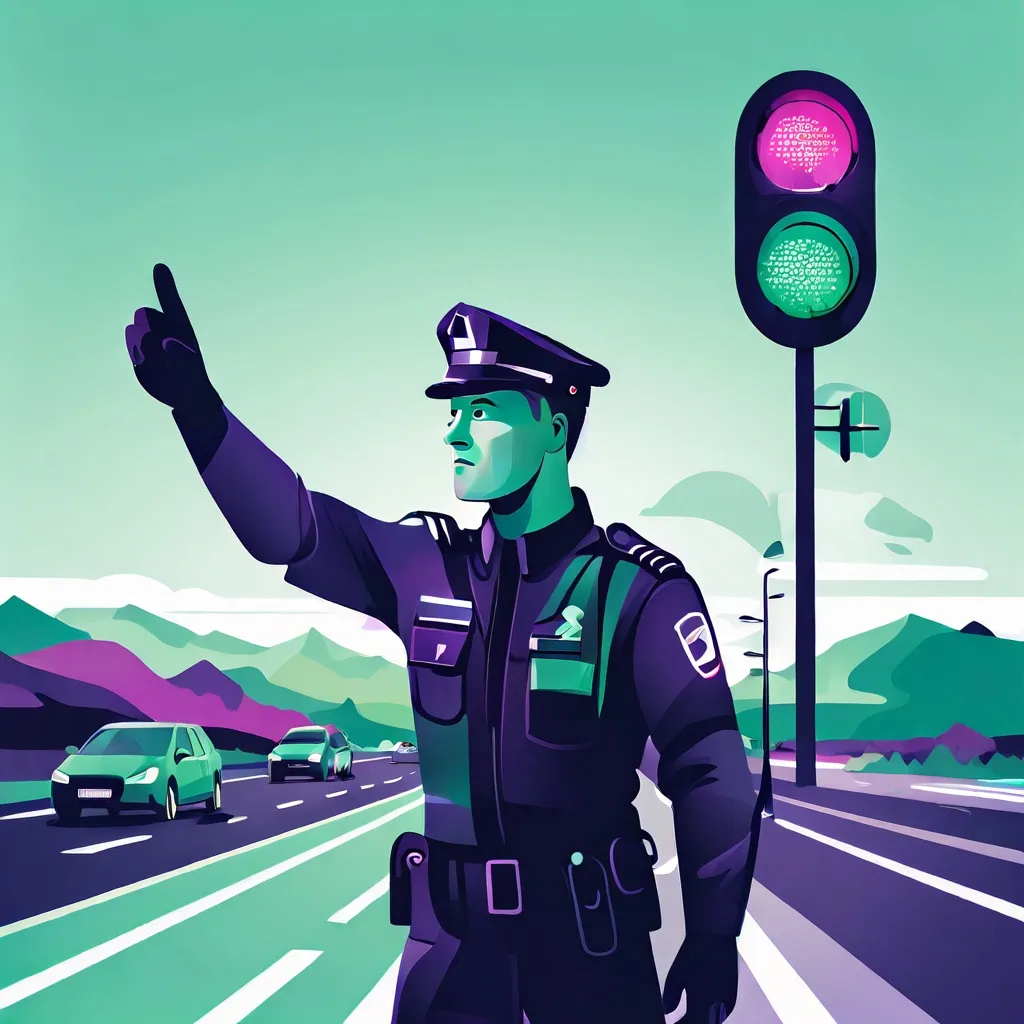
Navigating Icelandic roads requires understanding the hierarchy of traffic control. This article will explain why a police officer's direction is the supreme rule, overriding any traffic light or road sign. Mastering this concept is essential for both safe driving and succeeding in the Icelandic driving theory test administered by Samgöngustofa.
Article content overview
Understanding the hierarchy of traffic control is a cornerstone of safe driving in Iceland, and a frequent subject within the Samgöngustofa driving theory test. While road signs and traffic lights provide constant guidance, there exists a supreme authority that overrides all others: the directions of a police officer. This crucial concept, often a point of confusion for learners, ensures that traffic can be managed dynamically and safely, especially in complex or emergency situations. Failing to recognise and adhere to a police officer's signals can lead to immediate danger and is a clear indicator of insufficient understanding for the Icelandic driving licence theory exam.
In Iceland, like in many countries, traffic control follows a clear order of precedence. This hierarchy is designed to provide definitive instructions to drivers, minimising ambiguity and potential conflict on the roads. At the lowest level are regular road signs and markings, which provide permanent instructions and warnings. Above these are traffic lights, which regulate traffic flow at intersections and other key points based on a timed schedule. However, neither signs nor traffic lights are the ultimate authority when a police officer is present and directing traffic.
The Icelandic Transport Authority (Samgöngustofa) emphasizes that when a police officer is actively directing traffic, their hand signals and gestures are the absolute governing rules. This is a fundamental principle tested in the theory exam, as it reflects real-world scenarios where human intervention is necessary to manage traffic flow more effectively than static signals or automated lights. Drivers must learn to identify and respond to these signals promptly and correctly.
Police officers are empowered to direct traffic for various reasons, including managing congested intersections, responding to accidents, or facilitating special events. Their signals are designed to be clear and unambiguous, and drivers are legally obligated to obey them without exception. This means that if a police officer signals you to stop, even if the traffic light is green, you must stop. Conversely, if an officer waves you through on a red light, you may proceed with caution.
Common police signals include extending an arm horizontally with the palm facing towards oncoming traffic to signal a stop, or moving an arm in a sweeping motion to indicate that traffic should proceed. Understanding these visual cues is vital. The theory exam often presents scenarios where a police officer's directions contradict standard traffic signals, testing a driver's ability to prioritise the officer's instructions. It's not about knowing the sign or the light; it's about knowing who is currently in charge of the situation.
The Icelandic driving theory test is known for its practical application of rules, and scenarios involving police officers directing traffic are a prime example. Learners might be presented with a question depicting an intersection with a green traffic light, but also a police officer clearly signalling traffic to stop. The correct answer will always involve obeying the police officer's signal. Conversely, a scenario might show a red light with an officer waving vehicles through; in this case, proceeding cautiously when signalled is the correct action.
It is essential to remember that these signals are not suggestions; they are lawful commands. Disobeying a police officer's direction can result in penalties, and more importantly, it creates a significant safety risk for yourself, other road users, and the officer. The driving theory exam aims to instill this understanding of authority and responsiveness, ensuring that future drivers are prepared for all possible traffic situations.
While police signals hold the ultimate authority, traffic lights and road signs are the primary regulators of traffic flow for the vast majority of driving situations in Iceland. When no police officer is present to direct traffic, drivers must strictly adhere to the instructions provided by traffic lights and road signs. This includes obeying speed limits indicated by signs, yielding at intersections as dictated by priority signs or the right-hand rule, and respecting prohibition signs that restrict certain actions.
Traffic lights, with their red, yellow, and green signals, provide clear instructions for stopping, preparing to stop, and proceeding. Similarly, a wide array of road signs, from warning signs to mandatory signs, inform drivers about potential hazards, required actions, and restrictions. The theory test extensively covers the meanings of these signs and the rules associated with them because they form the backbone of daily traffic management.
In the absence of police direction, understanding priority rules is paramount. This includes the right-hand rule at unmarked intersections, priority at roundabouts, and yielding to specific vehicles like buses or emergency services. The theory exam often includes questions that test your knowledge of these priority situations, ensuring you know who has the right of way in various scenarios. For instance, at a roundabout, vehicles already within the roundabout have priority.
The distinction between stopping and parking is also critical. For example, you cannot park within five metres of an intersection or pedestrian crossing, but the rules regarding bus stops are even more stringent, typically requiring a 15-metre clearance to ensure visibility and access for public transport. These details are meticulously covered in the driving theory curriculum and are frequently assessed during the ÖR-test.
For anyone preparing for the Icelandic driving licence theory test administered by Samgöngustofa, mastering the hierarchy of traffic control is non-negotiable. Many questions will directly or indirectly assess your understanding of this principle. Look out for exam questions that present conflicting signals, as these are designed to probe whether you prioritise the correct authority.
The app provides comprehensive lessons on all aspects of traffic control, including detailed explanations of traffic signs, traffic light sequences, and the specific hand signals used by police officers in Iceland. By engaging with these lessons and utilising the practice sets, you will build the confidence and knowledge necessary to navigate Iceland's roads safely and successfully pass your theory exam.
In Iceland, police officer signals represent the supreme authority in traffic control, overriding all traffic lights and road signs. When an officer is actively directing traffic, their commands take absolute precedence, meaning a green light does not authorise movement if the officer signals stop, and a red light does not prohibit movement if the officer waves you through. Traffic lights and road signs govern only when no police direction is present, and understanding priority rules such as the right-hand rule at unmarked intersections and roundabout priorities is essential for safe driving. This hierarchy is a key focus of the Samgöngustofa driving theory test.
A short set of high-value points that capture the most important ideas from this article.
Police officer directions always override traffic lights and road signs when an officer is actively directing traffic.
The hierarchy of traffic control in Iceland ranks police signals highest, followed by traffic lights, then road signs and markings.
A green traffic light does not authorise you to proceed if a police officer is signalling you to stop.
Police signals are lawful commands, not suggestions, and must be obeyed without exception.
Real-world traffic management situations sometimes require human authority to override automated signals.
Police officer hand signals have supreme authority over all other traffic control devices in Iceland.
At unmarked intersections, the right-hand rule applies: the vehicle from the right generally has priority.
Vehicles already inside a roundabout have priority over those entering it.
You cannot park within 5 metres of an intersection or pedestrian crossing, and must keep at least 15 metres from bus stops.
Traffic lights and road signs govern traffic flow only when no police officer is present directing traffic.
Assuming a green light always means you can proceed, even when a police officer is directing otherwise.
Failing to recognise and respond to police officer hand signals at intersections.
Believing that a traffic sign or light takes precedence over a police officer's direction.
Confusing the rules for stopping versus parking, especially near intersections and bus stops.
Not watching for police presence at complex intersections before deciding how to proceed.
Article content overview
A short set of high-value points that capture the most important ideas from this article.
Police officer directions always override traffic lights and road signs when an officer is actively directing traffic.
The hierarchy of traffic control in Iceland ranks police signals highest, followed by traffic lights, then road signs and markings.
A green traffic light does not authorise you to proceed if a police officer is signalling you to stop.
Police signals are lawful commands, not suggestions, and must be obeyed without exception.
Real-world traffic management situations sometimes require human authority to override automated signals.
Police officer hand signals have supreme authority over all other traffic control devices in Iceland.
At unmarked intersections, the right-hand rule applies: the vehicle from the right generally has priority.
Vehicles already inside a roundabout have priority over those entering it.
You cannot park within 5 metres of an intersection or pedestrian crossing, and must keep at least 15 metres from bus stops.
Traffic lights and road signs govern traffic flow only when no police officer is present directing traffic.
Assuming a green light always means you can proceed, even when a police officer is directing otherwise.
Failing to recognise and respond to police officer hand signals at intersections.
Believing that a traffic sign or light takes precedence over a police officer's direction.
Confusing the rules for stopping versus parking, especially near intersections and bus stops.
Not watching for police presence at complex intersections before deciding how to proceed.
Explore related topics, search based questions, and concepts that learners often look up when studying Police Signals vs. Road Signs Iceland. These themes reflect real search intent and help you understand how this topic connects to wider driving theory knowledge in Iceland.
Find clear and practical answers to common questions learners often have about Police Signals vs. Road Signs Iceland. This section helps explain difficult points, remove confusion, and reinforce the key driving theory concepts that matter for learners in Iceland.
Yes, in Iceland, directions given by a police officer directing traffic always override all other traffic signals, including traffic lights and road signs.
You must follow the instructions of the police officer. Ignore the red light and proceed only when the officer signals you to do so.
The Icelandic Transport Authority (Samgöngustofa) includes questions on signal hierarchy to ensure drivers understand critical safety rules that override standard signage, preventing confusion and potential accidents.
While specific signs may warn of upcoming traffic control by police, drivers must always be prepared to follow a police officer's directions at any time, regardless of existing signals.
Refine your driving theory knowledge by exploring more focused articles. Use our comprehensive search to find additional detailed explanations on any Icelandic road rule, traffic situation, or driving procedure to ensure complete readiness for your exam.