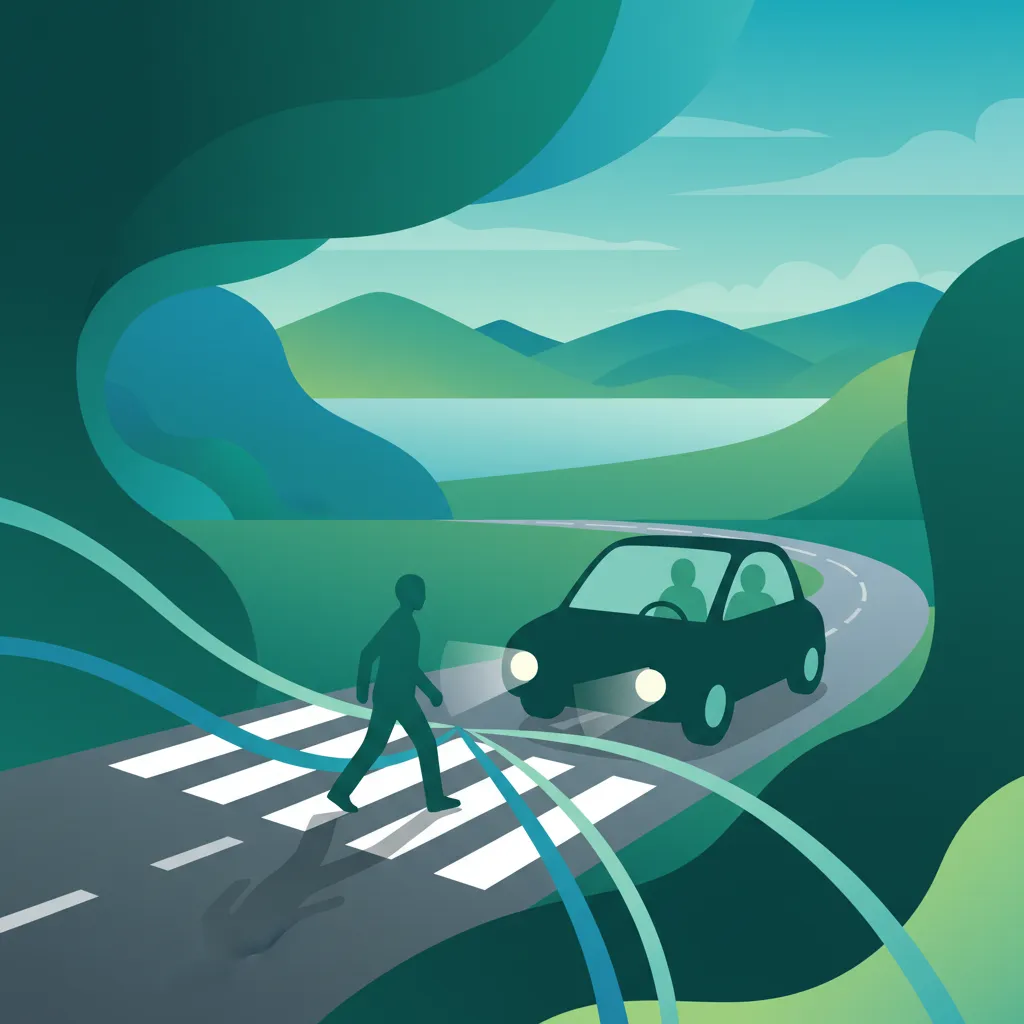
Pedestrian crossings are specifically marked areas designed to allow pedestrians to cross the roadway safely. As a driver in Iceland, it is your legal and ethical responsibility to ensure the safety of pedestrians at these points. This includes recognizing the markings, reducing your speed, and being prepared to stop to give way, preventing dangerous situations with the most vulnerable road users.
Theory topic content overview
Read the full theory topic guide for Pedestrian Crossings with structured, easy-to-scan content built for learners in Iceland. This detailed section explains the exact rule, meaning, traffic context, comparison points, and exam logic behind this Icelandic driving theory topic so you can study faster, understand the concept more clearly, and avoid common interpretation mistakes on the theory test.
Pedestrian crossings are specially designated areas on the road that provide pedestrians with a safe and legal way to cross. In Iceland, these crossings are a cornerstone of pedestrian safety, legally mandating specific behaviours from drivers to protect the most vulnerable road users. Understanding and strictly adhering to the rules at pedestrian crossings is not just a legal requirement but a fundamental aspect of safe driving, crucial for success in the Icelandic driving theory exam and everyday navigation of Icelandic roads.
A pedestrian crossing is a marked section of a roadway where pedestrians have the legal right to cross. These areas are established to manage the interaction between vehicles and people on foot, significantly enhancing safety. In Iceland, the most common type of uncontrolled pedestrian crossing is often referred to as a "zebra crossing," characterized by distinct white stripes painted across the road surface. Other types include crossings controlled by traffic lights or, in rare instances, by police signals.
The primary purpose of a pedestrian crossing is to:
For drivers in Iceland, the rules surrounding pedestrian crossings are of paramount importance. Iceland's urban areas, particularly in Reykjavík and larger towns, feature numerous pedestrian crossings in bustling environments. Even on more rural routes, crossings can appear in unexpected places near schools or villages.
Mastering pedestrian crossings involves a consistent three-step approach: Anticipate, Observe, and Prioritise.
Long before you reach the crossing, consider the surroundings. Areas with shops, schools, parks, bus stops, or residential zones are prime locations for pedestrian activity. Assume that pedestrians may appear.
As you approach, your observation must be continuous and thorough.
The core rule in Iceland is that pedestrians on or about to step onto a pedestrian crossing have priority.
At crossings controlled by traffic lights or police signals, pedestrians only have priority when they have a green light or are signalled to cross by an officer. Drivers must obey the traffic lights or police signals. If a pedestrian crosses against a red light, they are in the wrong, but as a driver, you still have a duty to avoid a collision if possible.
Several factors influence the safe navigation of pedestrian crossings:
Self-Evident Crossings: Some crossings may not have painted lines but are clearly indicated by pedestrian warning signs. These function similarly to marked crossings, requiring drivers to yield.
Learners and experienced drivers alike can make critical errors at pedestrian crossings:
The Icelandic Transport Authority (Samgöngustofa) emphasizes that the safety of pedestrians is paramount. They stress that drivers must always take "special care" with regard to approaching vehicles when pedestrians are crossing, even when pedestrians are themselves advised to use designated walkways, tunnels, or bridges if nearby. This highlights the overarching driver responsibility regardless of how or where a pedestrian chooses to cross, reinforcing the "anticipate and avoid harm" principle.
Furthermore, the Icelandic driving theory exam often presents questions that test your understanding of pedestrian priority under various conditions, including obscured views or seemingly distracted pedestrians. The underlying message is always that the driver is responsible for preventing accidents with vulnerable road users.
The core principle for pedestrian crossings in Iceland is constant vigilance and the unwavering prioritization of pedestrian safety. Always assume a pedestrian might step out, even if they seem distracted or if conditions are poor. Reduce your speed, observe meticulously, and be prepared to stop. Your actions at a pedestrian crossing reflect your understanding of traffic law and your commitment to road safety, defining you as a responsible driver in Iceland.
Pedestrian crossings are marked areas where pedestrians have legal priority in Iceland, and drivers must always be prepared to yield. The recommended approach is to Anticipate by scanning for warning signs and pedestrian activity, Observe by reducing speed and checking both sides, and Prioritise by stopping if needed and waiting until all pedestrians have cleared. Key distinctions include the difference between unmarked road sections (where pedestrians do not have automatic priority) and designated crossings, and controlled crossings with traffic lights (where priority depends on the signal). Weather, visibility, and distraction all reduce safety margin, making the three-step approach even more critical. The Icelandic Transport Authority (Samgöngustofa) places the full responsibility on drivers to prevent accidents with vulnerable road users.
A short set of high-value points that capture the most important ideas from this theory explanation.
Pedestrians on or about to step onto a designated crossing have legal priority; drivers must always yield.
The three-step safe approach is: Anticipate potential pedestrians, Observe diligently by scanning both sides, and Prioritise by yielding.
Speed reduction is the single most important action when approaching any pedestrian crossing.
At uncontrolled crossings, pedestrians have priority only at marked locations; at unmarked road sections they must wait for a gap in traffic.
Drivers have an overarching duty of care to avoid harming pedestrians regardless of whether the pedestrian is acting correctly.
Pedestrian warning signs include a blue square with white triangle and walking person, and yellow diamond with black walking person.
Stop smoothly and well before the crossing lines, leaving ample space between your vehicle and the crossing itself.
Never wave pedestrians across; let them make their own decision based on your yielding.
Never overtake a vehicle that has slowed or stopped at a pedestrian crossing—you may not see the pedestrian they are yielding to.
At traffic-light-controlled crossings, pedestrians only have priority when they have a green light.
Failing to anticipate pedestrians, especially in busy areas or near schools where sudden movement is likely.
Approaching crossings at a speed that makes it impossible to stop safely if a pedestrian steps out.
Not checking both sides of the road thoroughly, only looking straight ahead.
Assuming the pedestrian has seen your vehicle and will wait; always be prepared for unexpected actions.
Stopping on the crossing itself, blocking the pedestrian path and forcing them to walk around your vehicle.
Start with a short, direct summary of Pedestrian Crossings before reading the full explanation below.
Pedestrian crossings are designated areas on the road where pedestrians have priority to cross safely. As a driver in Iceland, you must always approach these crossings with reduced speed, be prepared to stop, and yield to any pedestrians who are on or about to step onto the crossing. Your primary responsibility is to ensure the safety of pedestrians by granting them right of way.
Review the most important terms, rule signals, and traffic concepts linked to Pedestrian Crossings.
Explore related theory topic pages connected to Pedestrian Crossings and continue with the next useful rule explanation.
See the common search queries learners use when trying to understand Pedestrian Crossings in Iceland.

Ready to master Icelandic driving theory? Explore our comprehensive sections. Review road rules, traffic signs, and critical concepts. Build essential knowledge for confident and safe driving in Iceland. Start studying today.
Explore Icelandic Driving TheoryTheory topic content overview
A short set of high-value points that capture the most important ideas from this theory explanation.
Pedestrians on or about to step onto a designated crossing have legal priority; drivers must always yield.
The three-step safe approach is: Anticipate potential pedestrians, Observe diligently by scanning both sides, and Prioritise by yielding.
Speed reduction is the single most important action when approaching any pedestrian crossing.
At uncontrolled crossings, pedestrians have priority only at marked locations; at unmarked road sections they must wait for a gap in traffic.
Drivers have an overarching duty of care to avoid harming pedestrians regardless of whether the pedestrian is acting correctly.
Pedestrian warning signs include a blue square with white triangle and walking person, and yellow diamond with black walking person.
Stop smoothly and well before the crossing lines, leaving ample space between your vehicle and the crossing itself.
Never wave pedestrians across; let them make their own decision based on your yielding.
Never overtake a vehicle that has slowed or stopped at a pedestrian crossing—you may not see the pedestrian they are yielding to.
At traffic-light-controlled crossings, pedestrians only have priority when they have a green light.
Failing to anticipate pedestrians, especially in busy areas or near schools where sudden movement is likely.
Approaching crossings at a speed that makes it impossible to stop safely if a pedestrian steps out.
Not checking both sides of the road thoroughly, only looking straight ahead.
Assuming the pedestrian has seen your vehicle and will wait; always be prepared for unexpected actions.
Stopping on the crossing itself, blocking the pedestrian path and forcing them to walk around your vehicle.
Start with a short, direct summary of Pedestrian Crossings before reading the full explanation below.
Pedestrian crossings are designated areas on the road where pedestrians have priority to cross safely. As a driver in Iceland, you must always approach these crossings with reduced speed, be prepared to stop, and yield to any pedestrians who are on or about to step onto the crossing. Your primary responsibility is to ensure the safety of pedestrians by granting them right of way.
Review the most important terms, rule signals, and traffic concepts linked to Pedestrian Crossings.
Explore related theory topic pages connected to Pedestrian Crossings and continue with the next useful rule explanation.
See the common search queries learners use when trying to understand Pedestrian Crossings in Iceland.
Ready to master Icelandic driving theory? Explore our comprehensive sections. Review road rules, traffic signs, and critical concepts. Build essential knowledge for confident and safe driving in Iceland. Start studying today.
Explore Icelandic Driving TheoryUse this exam-focused revision tip to understand how Pedestrian Crossings is likely to appear in theory questions for learners in Iceland. This section helps you identify the most testable part of the rule, avoid common traps, and remember the concept more effectively during Icelandic driving theory exam preparation.
In the Icelandic driving theory exam, pay close attention to scenarios involving pedestrian crossings. Questions often test your ability to anticipate pedestrian movement and apply the correct yielding rules. Remember, assume a pedestrian might step out, and your primary duty is always their safety, even if they appear distracted.
Read direct answers to the most common learner questions about Pedestrian Crossings in Iceland. This FAQ focuses on rule confusion, practical meaning, comparison with similar concepts, and the exact uncertainties that appear most often in Icelandic driving theory revision and exam preparation.
A pedestrian crossing is a marked area on a roadway, often indicated by white stripes (zebra crossing) or specific signage, where pedestrians are legally permitted to cross and often have priority over vehicle traffic.
Drivers in Iceland must stop if pedestrians are on the crossing, or clearly intending to step onto it, ensuring they have safely crossed before proceeding. Always be prepared to stop when approaching.
At unmarked pedestrian crossings, pedestrians should exercise care. However, at marked pedestrian crossings, drivers must yield and give priority to pedestrians who are on or about to enter the crossing.
A zebra crossing is a specific type of pedestrian crossing identified by distinctive white stripes painted on the road surface, signaling to drivers that pedestrians have priority to cross.
If a pedestrian is waiting at a marked crossing and shows intent to cross, you must slow down and be ready to stop, allowing them to cross safely. Make eye contact if possible to confirm their intention.
Cyclists should typically dismount and walk their bicycles across pedestrian crossings to be treated as pedestrians. If cycling across, they must yield to both vehicles and pedestrians unless a specific cycle crossing is integrated.
Failing to yield to pedestrians at a crossing can lead to dangerous accidents, serious injuries, fines, penalty points on your license, and can result in failing your driving theory or practical exam in Iceland.
Utilize our advanced practice set search to pinpoint the exact Icelandic driving theory topics you need to review. Filter by subject, difficulty, or question type to create a highly effective study plan and ensure you are fully prepared for your official driving licence test in Iceland.