
This lesson details the essential protocols for securing cargo on large goods vehicles to ensure stability and legal compliance. By understanding the forces acting on your load and the correct use of restraint systems, you will be prepared for both critical theory test questions and real-world safety inspections.

Lesson content overview
Properly securing cargo is a fundamental responsibility for any professional goods vehicle driver in Great Britain. This lesson provides an exhaustive guide to the methods, equipment, and legal requirements for securing loads on Category C goods vehicles, ensuring compliance with Driver and Vehicle Standards Agency (DVSA) regulations. Effective cargo security is not merely a legal obligation; it is critical for preventing load shifts, maintaining vehicle stability, reducing braking distances, and ultimately safeguarding all road users.
Understanding the principles discussed here is essential for your Professional Goods Vehicle Theory for Great Britain - Category C Licence. It builds upon foundational knowledge of vehicle dimensions, weight limits, and road space allocation, as well as the physics of forces and the centre of gravity. A solid grasp of terms such as load restraint, tensile strength, anchor point, and pre-tension will be beneficial as you progress through this comprehensive guide.
The main objective of cargo securing is to prevent any movement of the load during transit. This includes sliding forward or backward, shifting side-to-side, tipping, or falling from the vehicle. Even minor load shifts can have serious consequences, impacting a vehicle's handling, increasing the risk of rollovers, extending braking distances, and potentially leading to accidents that endanger the driver and other road users.
DVSA regulations are specifically designed to codify minimum safety standards and ensure that all professional drivers understand and adhere to these critical protocols. Non-compliance can result in severe legal penalties, vehicle damage, and, most importantly, tragic accidents. Adhering to these regulations is a core professional responsibility that supports safe and efficient operation of large goods vehicles on roads across England, Scotland, and Wales.
Securing cargo effectively involves a systematic approach, combining the right equipment with correct application techniques. Several core principles guide this process, each playing a vital role in the overall safety and stability of the load.
Choosing the appropriate type of restraint system is the first critical step in cargo security. This selection must be based on the specific characteristics of the load, including its weight, shape, and form. Different loads present unique challenges; for instance, a pallet of rigid goods will require different securing methods than a container of loose gravel. The correct selection ensures that forces acting on the cargo from all directions—forward, backward, and sideways—are adequately resisted.
Maximum Load Weight (MLW) refers to the total mass of cargo a vehicle can legally and safely carry, taking into account the vehicle's Gross Vehicle Weight (GVW) and individual axle limits. Exceeding these limits not only risks legal penalties but also compromises the vehicle's structural integrity, braking performance, and overall stability. The weight of the cargo directly influences the capacity and placement of the restraint systems needed.
Every securing device, whether a strap, chain, or rope, has a specified tensile strength. However, for practical safety, a more conservative measure called the Working Load Limit (WLL) is used. DVSA regulations typically mandate a safety factor, commonly 5:1, meaning the WLL is one-fifth of the tensile strength. For example, a strap with a tensile strength of 20 kilonewtons (kN) will have a WLL of 4 kN. This safety margin accounts for dynamic forces and potential wear and tear, ensuring the restraint can handle unexpected stresses during transit.
Pre-tension is the initial force applied to a restraint system before the vehicle starts moving. It is crucial for taking up any slack in the straps or chains, ensuring that the restraint system is engaged immediately if the load attempts to shift. Adequate pre-tension, typically achieved using hand ratchets or mechanical load binders, prevents the load from moving even a small distance, which could otherwise allow inertia to build up and potentially overwhelm the restraints.
Anchor points are the designated, fixed locations on the vehicle chassis, frame, or trailer to which restraint systems are attached. These points are specifically engineered and rated to withstand significant forces. Using un-rated or improvised attachment points, such as general floor lugs or temporary hooks, is extremely dangerous as they are not designed to bear the high tension forces exerted by securing equipment. Anchor points must be clearly marked with their load rating.
The minimum number of restraints required and their strategic distribution across the load are determined by the cargo's weight, shape, size, and its centre of gravity. A single restraint, even if adequately tensioned, cannot prevent multidirectional movement. Restraints must be positioned to counteract forces from all directions—forward, backward, and both sides—to prevent the load from pivoting or shifting. Guidelines specify minimum numbers for different load weights and types to ensure balanced and comprehensive security.
Proper load distribution involves placing the cargo evenly across the vehicle's axles and keeping the centre of gravity (CoG) within safe limits. An unevenly distributed load can overload specific axles, leading to tyre failure, accelerated wear on vehicle components, and compromised braking performance. Crucially, a high CoG significantly increases the risk of rollover, particularly during cornering or on uneven terrain. Strategic placement of heavier items lower down and centred on the vehicle is paramount for maintaining stability.
All cargo securing equipment is subject to wear and tear. Regular, systematic visual and functional checks of restraints, anchor points, and fastening hardware are mandatory before each journey. This inspection aims to detect any damage, wear, fraying, corrosion, or deficiencies that could compromise the integrity of the restraint system. Defective equipment must be immediately removed from service and replaced to prevent potential failure in transit.
Cargo comes in many forms, and each presents unique challenges for securing. Categorising loads helps in selecting the most effective restraint systems and techniques.
Rigid loads, such as palletised goods, crates, or sturdy containers, are generally easier to secure due to their stable form. However, they can still shift or tip if not adequately restrained. The primary method for rigid loads involves direct lashing with tensile webbing straps, securing them tightly to rated anchor points on the vehicle bed. Dunnage (timber or plywood) can be used to fill voids between items or between the load and the vehicle walls, preventing lateral movement. For taller rigid loads, multiple straps at different heights may be necessary to prevent tipping.
Flexible loads, including liquids in intermediate bulk containers (IBCs), sacks of cement, or loose materials like sand and gravel, pose a greater challenge because they can easily shift, surge, or flow within their containers or across the vehicle bed. This movement creates dynamic forces that are harder to contain. For these loads, securing nets (load nets) stretched tightly over the cargo and secured to multiple anchor points are often essential, even if the material is contained within bags or containers. Load binders, which are heavy-duty mechanical tensioners, are also commonly used to apply continuous and robust tension. The aim is to create a complete containment envelope that restricts movement in all directions.
Irregularly shaped loads, such as machinery, heavy timber, or unique industrial components, often require customised securing solutions. These items may have uneven weight distribution and unique attachment points. The approach typically involves a combination of direct lashing using chains or heavy-duty straps, often in a criss-cross pattern to secure against multidirectional movement. The use of chocks (wedges placed against wheels or bases) and blocking (rigid barriers) is critical to prevent sliding. Careful assessment of the load's centre of gravity and potential pivot points is necessary to ensure comprehensive restraint. Sometimes, custom cradles or frames are built to support and secure these loads.
A variety of equipment is available for cargo securing, each with specific applications and benefits. Professional drivers must be proficient in using and inspecting these tools.
Tensile webbing straps, often made from polyester, are a common and versatile choice for securing a wide range of loads. They are relatively lightweight, flexible, and easy to handle. Ratchet binders are integrated tensioning devices that allow drivers to apply significant pre-tension to the straps, eliminating slack and ensuring the load is held firmly. Straps come in various widths and WLL ratings. It is crucial to select straps with a WLL appropriate for the load's weight and the dynamic forces anticipated. Straps should be inspected for cuts, fraying, UV degradation, and damaged ratchets before each use.
For extremely heavy or robust loads, such as machinery or large vehicles, heavy-duty steel chains are often preferred. Chains offer superior strength and resistance to abrasion compared to straps. They are typically used in conjunction with mechanical load binders (often lever-type or ratchet-type chain binders) that allow for very high tension to be applied. Chains must be free from stretched, bent, or corroded links, and their hooks must be intact and properly formed. Chain binders should operate smoothly and lock securely.
While less common for primary restraint of heavy goods, synthetic ropes meeting specific WLL requirements can be used for lighter loads or as supplementary securing. Load nets, made from strong mesh material, are invaluable for containing flexible or multiple smaller items. They are stretched over the cargo and attached to anchor points, providing a 'containment' effect that prevents items from spilling or shifting, especially with bulk materials or mixed consignments. Nets must be free of tears, excessive stretching, or damaged attachment hooks.
Dunnage refers to materials like timber, plywood, or air bags used to fill voids, support cargo, or create barriers. It is not a primary restraint but plays a crucial role in preventing movement by blocking gaps and spreading pressure. For instance, timber planks can be placed between layers of stacked goods to distribute weight and prevent crushing, or against the front of a load to prevent forward movement into the headboard. Load barriers, such as robust wooden frames or metal gates, are built to provide a solid physical block against cargo movement, particularly useful for partial loads or loads susceptible to forward shift.
Adherence to specific DVSA regulations is mandatory for all Category C goods vehicle drivers in Great Britain. These regulations ensure a consistent standard of safety across the industry.
Rule Statement: All loads must be secured against movement, including shift, slide, and fall. Rationale: This fundamental regulation underpins all other cargo security rules. Its purpose is to prevent accidents caused by unsecured cargo, which can lead to loss of vehicle control or danger to other road users. Correct Example: A driver uses appropriately rated straps, nets, and dunnage to ensure a mixed consignment of pallets and loose sacks cannot move in any direction. Incorrect Example: A driver relies solely on friction between the load and the vehicle bed, or uses only a single, loose strap on a heavy load.
Rule Statement: Restraints must have a Working Load Limit (WLL) equal to or greater than the load they secure, taking into account a safety factor (commonly 5). Rationale: This ensures that restraint equipment is robust enough to handle the dynamic forces exerted on cargo during acceleration, braking, and cornering, which can be significantly higher than the static weight of the load. Correct Example: For a 1-tonne (1000 kg) load, which may experience dynamic forces up to 8 times its static weight (approx. 80 kN), a strap with a 30 kN tensile strength (WLL = 6 kN) is used. Incorrect Example: Using a strap rated 5 kN WLL for a 1-tonne load, neglecting the safety factor for dynamic forces.
Rule Statement: The load must be evenly distributed across the vehicle’s axles, with the centre of gravity within the wheel base. Rationale: Proper distribution maintains vehicle stability, prevents overloading of individual axles, and reduces the risk of structural damage or tyre failure. Correct Example: Stacking load weight evenly front-to-rear on the trailer, ensuring the centre of gravity remains low and centred. Incorrect Example: Loading all heavy items onto the rear axle, causing the front axle to lift slightly and reducing steering control.
Rule Statement: Restraint methods must be appropriate to the load type; flexible loads require load nets or binders in addition to straps. Rationale: Flexible and irregular loads are more prone to shifting and require additional containment strategies beyond basic strapping to prevent spills or movement. Correct Example: Using a load net and two tensile straps over a large, industrial bag of granular material. Incorrect Example: Only using a single strap around a flexible load, such as a bulk bag of sand.
Rule Statement: All anchor points must be clearly marked, approved, and rated for the forces they will experience. Rationale: This prevents structural failure of the vehicle's frame or detachment of anchor points, which could lead to catastrophic load loss. Correct Example: An anchor point clearly marked with a 15 kN rating is used for straps that collectively exert 12 kN of force. Incorrect Example: Attaching a high-tension strap to an unmarked floor hook or a part of the vehicle's body not designed as an anchor point.
Rule Statement: Pre-tension must be achievable by the driver using appropriate hand-operated or mechanical tensioning devices. Rationale: This ensures that restraints are properly engaged and effective from the start of the journey, preventing initial load movement. Correct Example: A driver uses a ratchet binder to apply a measurable 3 kN pre-tension to each strap. Incorrect Example: A driver relies on manual tightening without a tensioning device, leaving slack in the straps.
Rule Statement: For loads up to 1 tonne, a minimum of two restraints (front-to-rear) are required. For loads over 1 tonne, at least three restraints are needed. For loads over 2 tonnes, at least four restraint points are mandatory. Rationale: This regulation ensures multidirectional resistance against load shift, preventing pivot or unbalanced movement. Correct Example: A 2.5-tonne machinery part is secured with four properly tensioned straps in a rectangular pattern. Incorrect Example: A 1.5-tonne pallet is secured with only a single strap.
Rule Statement: The centre of gravity must not be higher than the rear axle of the tractor unit unless a low-load trailer is used. Rationale: This critical rule directly addresses rollover risk, especially for tall or heavy loads. Keeping the CoG low improves vehicle stability, particularly during cornering and on gradients. Correct Example: A tall refrigeration unit is positioned on a low-load trailer deck, ensuring its CoG remains well below the rear axle height. Incorrect Example: A high-rise crane component is loaded on top of a standard trailer without measures to lower its CoG.
Rule Statement: All securing equipment must be inspected before each journey for wear, damage, or corrosion; defective equipment must be removed from service. Rationale: Regular inspection identifies degraded equipment before it fails in transit, preventing accidents caused by compromised restraints. Correct Example: A driver observes fraying on a strap's edge and immediately replaces it with a new, undamaged strap. Incorrect Example: A driver ignores minor damage to a chain link, assuming it will hold.
Rule Statement: Drivers must keep a record of load securing checks for a minimum of 12 months. Rationale: This provides evidence of compliance for auditing purposes, ensures accountability, and can be crucial in defending against liability claims in the event of an incident. Correct Example: A driver completes the load securing section of their journey logbook, detailing the equipment used and inspection outcomes. Incorrect Example: No formal record is kept of load security checks.
Rule Statement: Loads that cannot be adequately secured must be refused for transport, or divided into smaller loads that can be secured. Rationale: This regulation empowers drivers to prioritise safety above all else, preventing the transport of inherently dangerous loads that cannot meet security standards. Correct Example: A driver assesses a particularly large or unusually shaped item and determines it cannot be safely secured with available equipment, then advises the loading team to either re-package it or split it into smaller, manageable units. Incorrect Example: A driver attempts to transport an oversized or unstable load despite having insufficient or inappropriate securing equipment.
Understanding common mistakes helps drivers avoid them and reinforces best practices for securing goods vehicle cargo.
Ignoring load securing regulations can lead to severe consequences, including hefty fines, licence endorsements, vehicle damage, and potentially fatal accidents. Always prioritise safety over expediency.
Why it’s Wrong: A strap or chain with a WLL below the required safety standard for the load's weight will fail under dynamic forces (braking, acceleration, cornering), leading to immediate load shift. Correct Behaviour: Always verify the WLL of restraints against the cargo's weight and the necessary safety factor. Select equipment that clearly exceeds the minimum requirement.
Why it’s Wrong: Flexible loads, even if in bags or drums, can shift laterally, roll, or spill. A single strap provides insufficient containment against multidirectional movement. Correct Behaviour: Employ a combination of load nets, multiple straps, and possibly blocking or dunnage to contain flexible loads from all directions.
Why it’s Wrong: Slack in the restraints allows the cargo to move freely for a short distance before the straps become taut. This initial movement can cause the load to gain momentum and impose a sudden, high shock load on the restraints, potentially exceeding their WLL. Correct Behaviour: Use a ratchet or mechanical tensioner to apply the recommended pre-tension (typically 2-4 kN), ensuring the restraints are tight before movement begins.
Why it’s Wrong: Standard floor lugs or other non-reinforced parts of the vehicle are not designed to withstand the high tension forces required for cargo securing. They can deform, tear out, or break, leading to total load loss. Correct Behaviour: Always use manufacturer-approved anchor points that are clearly rated for the specific forces that the restraints will exert.
Why it’s Wrong: Overloading individual axles (even if the total GVW is within limits) leads to excessive stress on tyres, suspension components, and brakes. This increases the risk of tyre blowouts, reduces braking efficiency, and compromises vehicle stability. Correct Behaviour: Distribute weight carefully across all axles, using a weighbridge if necessary, to ensure all axle loads are within legal limits. Use load spreaders or rearrange cargo if needed.
Why it’s Wrong: Hidden damage (frays, cuts, corrosion, bent links) can compromise the integrity of securing equipment, leading to sudden failure during transit, often under critical dynamic conditions. Correct Behaviour: Conduct a thorough visual and tactile inspection of every strap, chain, load net, and anchor point before each journey. Replace any defective equipment immediately.
Why it’s Wrong: Lack of documentation makes it difficult to prove compliance with DVSA regulations during audits or in the event of an incident. It also reduces accountability and makes it harder to identify recurring issues with equipment or procedures. Correct Behaviour: Maintain accurate records of all load securing checks, including equipment used, inspection dates, and any identified defects, in a logbook or electronic system for at least 12 months.
Why it’s Wrong: Transporting a load with a high centre of gravity significantly increases the risk of rollover, especially during cornering, on uneven roads, or during emergency manoeuvres. Correct Behaviour: Always verify that the CoG is as low as possible and within safe limits (typically below the rear axle level). If a load inherently has a high CoG, ensure it is positioned centrally and consider using a low-load trailer.
The effectiveness of cargo securing can be influenced by various environmental and operational conditions. Drivers must be prepared to adjust their methods accordingly.
Adverse weather conditions significantly increase the dynamic forces exerted on cargo.
The condition and configuration of the vehicle also play a role in load stability.
In urban environments, where interactions with pedestrians, cyclists, and other road users are frequent, the consequences of load shift are heightened. Even a small piece of cargo falling from a vehicle can cause serious injury or fatality. Therefore, securing loads to prevent any ejection into traffic is paramount. This includes ensuring all items, even seemingly minor ones, are contained and restrained.
Specialised cargo requires additional considerations:
The benefits of proper cargo securing extend far beyond mere legal compliance.
Always treat cargo securing as a dynamic process. Even after initially securing a load, consider re-checking tension and stability after the first few miles of a journey, especially if the load has settled or compacted.
Explore all units and lessons included in this driving theory course.
Lesson content overview
Explore all units and lessons included in this driving theory course.
Explore search topics learners often look for when studying Securing Cargo – Methods and Regulations. These topics reflect common questions about road rules, driving situations, safety guidance, and lesson level theory preparation for learners in Great Britain.
Browse additional driving theory lessons that cover connected traffic rules, road signs, and common driving situations related to this topic. Improve your understanding of how different rules interact across everyday traffic scenarios.
Understand the essential DVSA regulations for securing cargo on goods vehicles in Great Britain. This lesson details legal requirements for load restraint, ensuring driver compliance and road safety for Category C licence holders.

This lesson introduces the statutory limits governing the dimensions and mass of goods vehicles in Great Britain, including gross vehicle weight and individual axle loads. It explains how to calculate a vehicle's loaded weight to ensure it remains within legal parameters, preventing penalties and safety risks. Understanding these regulations is crucial for preventing damage to road infrastructure and ensuring the vehicle's stability and safe operation on every journey.

This lesson offers a deep dive into the specific regulations concerning weight, width, and axle load restrictions for goods vehicles. It covers how to read and comply with the associated road signs to avoid overloading weak bridges and entering restricted areas. Learners will understand the importance of correct load assessment and the serious penalties for non-compliance, which are enforced through DVSA roadside inspections and weighbridges.

This lesson provides a clear overview of the primary goods vehicle licence categories: C1, C, C1E, and CE. It explains the specific vehicle types, weight thresholds, and axle configurations permitted for each classification. You will learn about the DVSA's regulatory framework, including the essential age and medical fitness criteria for eligibility, as well as the steps for obtaining a full licence. Understanding these legal definitions is fundamental for ensuring compliance and safety.

This lesson covers the principles of safe loading to prevent items from shifting or falling and causing a hazard. It explains that any load must be securely fastened and must not obstruct your view. You will also learn how overloading or distributing weight incorrectly can dangerously affect the vehicle's steering, braking, and overall stability.

Gain a comprehensive understanding of the legal repercussions for violating goods vehicle regulations, which can range from civil penalties to criminal prosecution. This lesson details the fines, penalty points, and potential vehicle seizure enforced by authorities like the DVSA and the police. It clarifies how serious offences are handled in court and how repeated infractions can lead to escalating sanctions, impacting both your licence and professional career.

This lesson addresses the serious danger of driver fatigue, a major cause of incidents involving commercial vehicles. It details the complex EU and GB domestic rules on drivers' hours, including driving limits and required rest periods. Learners will be taught to recognize the physical and mental signs of fatigue and understand the importance of taking quality rest to maintain alertness and ensure their own safety and that of others.

This lesson covers the critical legal requirement for accurate record-keeping in the transport industry. It provides detailed instruction on the correct use of both analogue and digital tachographs to record driving time, breaks, and other work. You will also learn about other essential documents that must be carried, such as load manifests and delivery notes, and the importance of keeping these records accurate and available for inspection by enforcement authorities.

This lesson delves into the core principles of correct weight distribution within a goods vehicle to ensure safety and stability. It explains how to balance a load evenly across the axles to prevent overloading and maintain optimal braking and steering performance. Learners will understand how incorrect load placement can dangerously affect vehicle dynamics, reinforcing the importance of careful planning before every journey to ensure stability on the road.

This lesson examines the unique rules and restrictions governing buses and coaches, focusing on bus lane priority, time-based restrictions, and loading zone limitations. Learners will explore the criteria for using bus-only routes and understand the legal consequences of non-compliance. The content also reviews signage indicating bus gate operation and areas where passenger vehicles are prohibited from stopping or loading outside of designated zones, ensuring lawful and efficient urban navigation.

This lesson defines the critical duty of care that professional goods vehicle drivers owe to the public, their cargo, and their workplace. It covers how professional standards and industry codes of practice contribute to accident prevention and a positive safety culture. Learners will understand that this responsibility extends beyond personal safety to include protecting vulnerable road users and maintaining the integrity of the goods being transported, which is crucial for professional trust.
Explore practical methods and equipment for ensuring cargo stability in heavy goods vehicles. Learn about load distribution, managing centre of gravity, and preventing load shifts through effective restraint techniques for professional drivers in the UK.
This lesson covers the principles of safe loading to prevent items from shifting or falling and causing a hazard. It explains that any load must be securely fastened and must not obstruct your view. You will also learn how overloading or distributing weight incorrectly can dangerously affect the vehicle's steering, braking, and overall stability.
This lesson delves into the core principles of correct weight distribution within a goods vehicle to ensure safety and stability. It explains how to balance a load evenly across the axles to prevent overloading and maintain optimal braking and steering performance. Learners will understand how incorrect load placement can dangerously affect vehicle dynamics, reinforcing the importance of careful planning before every journey to ensure stability on the road.

This lesson explains the critical concept of the centre of gravity (CG) and its direct impact on a vehicle's stability and rollover risk. It details how high or unstable loads raise the CG, making the vehicle more susceptible to tipping during cornering or sudden maneuvers. Learners will study techniques to assess and manage this risk, including adjusting speed and driving style, which is especially important for vehicles carrying liquid or hanging loads.

This lesson prepares drivers to recognize and react to a dangerous load shift while the vehicle is in motion. It covers the immediate corrective actions needed to maintain or regain control, and how to bring the vehicle to a safe stop. The procedures for assessing the situation, communicating the hazard to other road users, and correctly reporting the incident are also detailed to ensure safety and proper follow-up action is taken.

This lesson explores how a passenger vehicle’s physical dimensions and weight influence its dynamic stability, handling, and manoeuvring capabilities. It covers the impact of length, width, wheelbase, and turning radius on cornering and route choice. The content also examines centre of gravity, load distribution, and the effects of inertia that influence braking and acceleration, which are essential concepts for safe operation in confined urban environments and at tight junctions.
This lesson offers a deep dive into the specific regulations concerning weight, width, and axle load restrictions for goods vehicles. It covers how to read and comply with the associated road signs to avoid overloading weak bridges and entering restricted areas. Learners will understand the importance of correct load assessment and the serious penalties for non-compliance, which are enforced through DVSA roadside inspections and weighbridges.
This lesson introduces the statutory limits governing the dimensions and mass of goods vehicles in Great Britain, including gross vehicle weight and individual axle loads. It explains how to calculate a vehicle's loaded weight to ensure it remains within legal parameters, preventing penalties and safety risks. Understanding these regulations is crucial for preventing damage to road infrastructure and ensuring the vehicle's stability and safe operation on every journey.
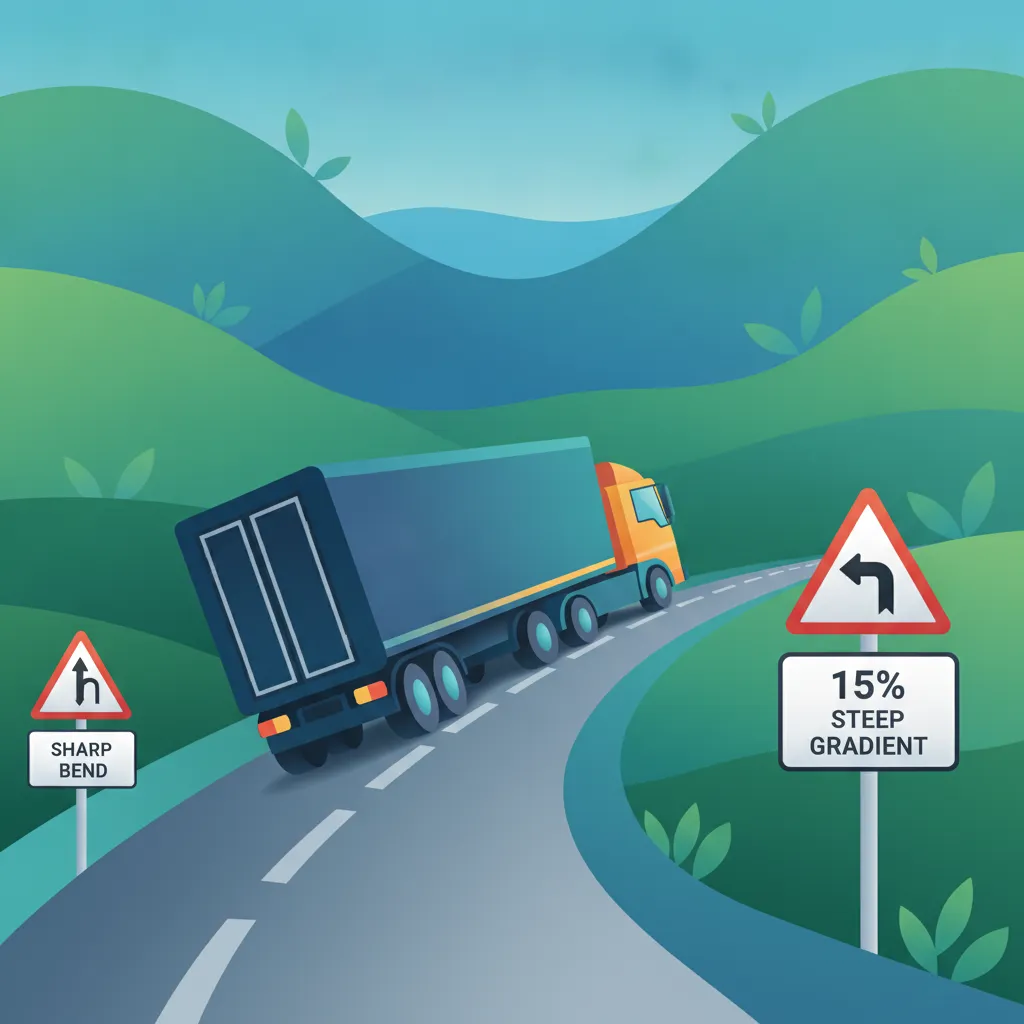
This lesson focuses on the principles of effective speed management for heavy goods vehicles, which extends beyond simply obeying the statutory speed limits. It covers how to adapt speed based on vehicle weight, load stability, road gradients, and prevailing traffic and weather conditions. You will also learn about the function of mandatory speed limiters and how intelligent use of speed and cruise control can significantly improve fuel efficiency and safety.

This lesson equips drivers with strategies for maintaining control of a heavy vehicle during adverse weather conditions like heavy rain, ice, snow, and strong crosswinds. It covers the physics of traction loss, aquaplaning, and skidding, and explains how to use smooth inputs for steering, acceleration, and braking. The function of electronic stability control systems and other driver aids is also discussed as part of a proactive approach to safety in challenging environments.

This lesson provides detailed instruction on the geometry of loading bays and the precise techniques required for safe vehicle docking. Learners will understand how to align their vehicle correctly, manage clearance from structures, and interpret ground markings and signals. It emphasizes safety protocols for protecting personnel in the loading area and preventing damage to the vehicle, trailer, or docking equipment during these critical maneuvers.
Find clear answers to common questions learners have about Securing Cargo – Methods and Regulations. Learn how the lesson is structured, which driving theory objectives it supports, and how it fits into the overall learning path of units and curriculum progression in Great Britain. These explanations help you understand key concepts, lesson flow, and exam focused study goals.
A high centre of gravity increases the risk of your vehicle rolling over during sharp turns or sudden maneuvers. Keeping the heaviest items low and centred ensures your vehicle remains stable and predictable on the road.
The inspection ensures that all straps, chains, and locking mechanisms are in good condition and correctly tensioned before you depart. Failing to check your load is a major safety risk and can lead to immediate prohibition notices from the DVSA.
Yes. Different loads behave differently due to their shape, material, and friction levels. You must use the appropriate combination of blocking, bracing, or lashing to prevent movement in all directions, as per DVSA guidelines.
If a load shifts, it can change the distribution of weight across the axles, which may negatively impact your braking efficiency. It can also lead to loss of control, making it impossible to stop within the expected distances.
Dive into our comprehensive question bank to find exactly what you need for your Great Britain theory test. Use our advanced filters to pinpoint specific subjects or test your knowledge on challenging areas, ensuring you're fully prepared for success.