
This lesson covers the legal necessity of precise record-keeping and documentation for HGV drivers. You will explore the operational use of analogue and digital tachographs to track driving hours and rest periods, ensuring full compliance with Great Britain's transport regulations.

Lesson content overview
Operating a professional goods vehicle in Great Britain requires meticulous adherence to legal documentation and record-keeping standards. For drivers holding a Category C licence, these requirements are not merely administrative tasks but fundamental aspects of road safety, regulatory compliance, and professional conduct. This comprehensive lesson details the legal obligations and practical procedures for maintaining accurate records, covering everything from tachograph operation to essential vehicle and cargo documents, ensuring you are fully prepared for inspections by enforcement authorities.
Accurate documentation and diligent record-keeping form the verifiable audit trail of a professional driver's activities, vehicle status, and load information. These records are vital for demonstrating compliance with statutory regulations, particularly those designed to manage driver fatigue, ensure vehicle roadworthiness, and confirm proper cargo handling. Enforcement authorities rely on these records to assess whether drivers operate within prescribed limits and whether operators meet their safety and legal obligations.
The legal intent behind these stringent rules is multi-faceted: to enforce fatigue management, promote road safety, and ensure fair competition within the transport industry. From a safety perspective, accurate records provide irrefutable evidence that drivers have observed mandatory rest periods, significantly reducing the risk of fatigue-related incidents that can have devastating consequences. Operationally, robust documentation provides transparency, allowing operators, safety managers, and even customers to track cargo movement and understand responsibilities throughout a journey.
This lesson connects directly with several core areas of your Professional Goods Vehicle Theory for Great Britain - Category C Licence curriculum. It builds upon your understanding from the "Fatigue Management and Rest Hours" unit by providing the data mechanisms for monitoring rest periods. It interacts closely with the "Penalties for Non-Compliance" unit, as failures in record-keeping frequently trigger legal sanctions. Furthermore, it supports "Loads, Cargo Security, Stability and Safety Checks" by ensuring load manifests accompany the vehicle for accurate cargo handling and reinforces the principles of professional conduct.
Several foundational principles underpin the legal requirements for documentation and record-keeping in goods vehicle operations. Understanding these principles is key to navigating the complexities of compliance and maintaining a high standard of professional driving.
The primary principle is the unwavering obligation to accurately record all driving, availability, other work, and rest periods. This is predominantly achieved through the use of a tachograph. The purpose of this principle is to prevent driver fatigue, promote road safety, and ensure fair working conditions across the transport sector. Consequently, Category C drivers must meticulously plan their journeys around legally mandated rest periods and ensure their records are always available for immediate inspection.
All required documents must be correct, up-to-date, and readily presentable to enforcement officers upon request. This ensures transparent and traceable freight operations, facilitating effective enforcement and protecting the legal rights of both drivers and operators. Any failure to produce accurate and available documentation can lead to significant fines, penalties, or even prosecution.
Documentation must be retained for specific minimum periods, as defined by legislation. For instance, digital tachograph data must be kept for at least 28 days from the end of the last recorded activity, while analogue tachograph charts must be retained for a minimum of one year. This provides a sufficient audit trail for potential enforcement investigations. Drivers and operators must implement systematic storage solutions, whether digital or physical, and have the means to retrieve these records promptly upon request.
Tachograph data and all supporting documents must be free from any form of tampering, alteration, or falsification. This principle is paramount to preserving the reliability and trustworthiness of the audit trail. Tampering with or falsifying records is considered a criminal offence in Great Britain, leading to severe penalties, including substantial fines and disqualification from driving.
When inconsistencies arise, there is a clear legal hierarchy for documentation. Digital tachograph data, with its secure and automated recording, generally supersedes entries on analogue charts. Similarly, data stored on a driver card takes precedence over any manual driver logs. This ensures that the most reliable and tamper-proof evidence is prioritised during enforcement inspections, with other forms of documentation used to fill any verified gaps.
A tachograph is an indispensable device installed in heavy goods vehicles (HGVs) designed to record crucial operational data, including the vehicle’s speed, distance travelled, and the driver's activities. These activities are categorised as driving, other work, availability, and rest periods. The data captured by tachographs is fundamental to ensuring compliance with drivers' hours regulations and plays a critical role in road safety by preventing driver fatigue. There are two primary types of tachographs in use: analogue and digital.
The Digital Tachograph (DTG) system represents the modern standard for recording driver activities. It comprises an Electronic Recording Device (ERD) fitted in the vehicle and a personal driver card. When a driver inserts their card, the DTG automatically records their activity, eliminating manual logging errors and providing a precise, tamper-resistant record. This system enables enforcement officers to verify driver hours efficiently and accurately.
Digital tachographs are legally mandated for most goods vehicles with a maximum laden weight exceeding 3.5 tonnes operating under EU or UK drivers’ hours rules. They must be operated continuously whenever the vehicle is powered, and the data stored on both the vehicle unit and the driver card must be downloaded at least every 90 days by the operator, and every 28 days for the driver card data. A common mistake is believing the tachograph can be switched off during short stops; it must remain active to record all activities, including 'other work' or 'rest'.
An electronic system that records vehicle speed, distance, and driver activity (driving, other work, availability, rest) onto a smart card (driver card) and internal memory.
Example: A Category C driver begins a shift at 07:00. Before moving the vehicle, they insert their valid driver card into the DTG. The tachograph automatically records 4 hours of driving, followed by a 45-minute break (recorded as 'rest'), then another 3 hours of driving. This entire sequence is accurately stored on the driver card and the vehicle unit, providing a clear record for inspection.
Analogue tachographs are older mechanical devices that use a wax-coated paper chart to record driver activities. As the tachograph runs, styluses on the unit physically imprint markings onto the rotating chart, indicating speed, distance, and selected driver activities. While most new vehicles are fitted with digital tachographs, older goods vehicles may still operate with analogue units.
Drivers using analogue tachographs must manually replace the paper chart after each chart period, typically every 24 hours. These charts must be correctly filled out with the driver's details and vehicle information. Unlike digital records, analogue charts require careful interpretation during enforcement, and any manual edits or incomplete entries can raise suspicion. A frequent misunderstanding is that paper charts can be edited without detection; any tampering is often evident and can lead to severe penalties.
A mechanical device that uses a rotating drum and a wax-coated paper chart to record vehicle speed, distance, and driver activity through physical imprints.
The driver card is a plastic smart card with an embedded chip, specifically designed to store an individual driver's activity data generated by a digital tachograph. It is a mandatory requirement for all Category C drivers operating vehicles fitted with a digital tachograph under EU or UK drivers’ hours rules. The card serves as a personal authentication device and a portable record of a driver's activities.
Drivers must always carry their valid driver card while driving and insert it into the tachograph before commencing a journey. The card must not be shared with other drivers under any circumstances. If a driver card is lost, stolen, or damaged, the driver must report it immediately and apply for a replacement within 7 calendar days. Driving without a valid, inserted driver card (or without a manual record if the card is lost/stolen and awaiting replacement) will result in the tachograph recording "null" entries, which is a serious breach of regulations and subject to enforcement scrutiny.
A personalised smart card containing a microchip that stores a driver's identification and activity data when inserted into a digital tachograph.
Beyond tachograph records, professional goods vehicle drivers must carry several other critical documents. These documents verify the legality of the vehicle, the legitimacy of the cargo, and overall compliance with transport regulations in Great Britain.
A load manifest, often combined with a delivery note, is a document that must accompany the vehicle throughout its journey. This document provides comprehensive details about the cargo being transported, including its type, quantity, weight, destination, consignee, and any specific handling requirements. For hazardous materials, additional declarations and safety information must be included.
The practical importance of a load manifest cannot be overstated. It enables enforcement authorities to verify that the cargo is correctly declared, is not hazardous without appropriate marking and documentation, and that the vehicle's loading does not exceed legal weight limits. Drivers must ensure the manifest is accurate and corresponds to the actual load. Inaccurate weight declarations or missing hazardous material markings are common mistakes that can lead to significant fines and safety risks.
A document accompanying a vehicle that details the cargo being transported, including its type, quantity, weight, destination, and any special handling instructions.
To legally operate a goods vehicle on public roads in Great Britain, drivers must ensure the vehicle carries valid certification documents. The most important of these include:
These documents are crucial for enforcement checks, proving that the vehicle has undergone all necessary inspections and is legally permitted to be on the road.
An annual certificate confirming a vehicle has passed its mandatory inspection for road safety and environmental standards in Great Britain.
The official vehicle registration certificate (often called a 'logbook') proving a vehicle's registration and registered keeper in Great Britain.
The "Hours of Service Record" refers to the complete compilation of a driver's activity data, encompassing all tachograph recordings (digital and analogue), driver card data, and any necessary supplemental manual logs. This holistic record provides enforcement authorities with a comprehensive picture of a driver's activity across various vehicles and periods, allowing for thorough verification of compliance with drivers' hours regulations. It is essential for drivers to understand that inconsistencies or gaps across these combined records will trigger further scrutiny.
Adherence to specific rules and regulations is mandatory for all professional goods vehicle drivers in Great Britain. Understanding these regulations is not just about avoiding penalties but also about upholding safety and professional standards.
Rule Statement: All drivers of goods vehicles with a maximum laden weight over 3.5 tonnes must use a tachograph to record driving, other work, availability, and rest periods.
Applicability: This rule applies universally when operating within Great Britain, with only limited, specific exemptions (e.g., certain agricultural vehicles, or vehicles used solely for private non-commercial carriage).
Rationale: The core purpose is to rigorously enforce drivers’ hours limits and diligently monitor fatigue levels, directly contributing to road safety.
Correct Application: A driver inserts their valid driver card into the digital tachograph, ensuring the device is correctly set to record 'driving' before moving the vehicle. The tachograph automatically logs all subsequent activities.
Incorrect Application: A driver operates a vehicle without a tachograph, or starts a journey without correctly inserting their driver card, leading to 'null' entries or no record at all.
Rule Statement: The driver must carry a valid tachograph driver card at all times while driving a vehicle fitted with a digital tachograph and ensure it is correctly inserted and active.
Applicability: This is mandatory for all Category C drivers operating vehicles equipped with a digital tachograph under EU or UK drivers’ hours rules.
Rationale: To ensure that all activity data is accurately linked to an individual driver, providing a clear audit trail.
Correct Application: Before starting the engine, the driver inserts their personal driver card into the digital tachograph slot, confirming it is registered and ready to record.
Incorrect Application: A driver forgets to insert their card, resulting in the tachograph logging "null" activity. Alternatively, a driver carries or uses another driver's card, which is a serious offence.
Rule Statement: Digital tachograph data downloaded from a driver card or vehicle unit must be retained for a minimum of 28 days from the end of the last recorded activity. Analogue charts must be retained for at least one year.
Applicability: This rule applies to all vehicles equipped with tachographs and their respective drivers and operators.
Rationale: To provide a sufficient and accessible audit trail for enforcement authorities to review driver activities and ensure compliance over time.
Rule Statement: An accurate and complete load manifest or delivery note for the cargo being transported must be carried in the vehicle for the duration of the journey.
Applicability: This is mandatory for all goods vehicles carrying cargo.
Rationale: To facilitate cargo verification, ensure compliance with weight limits, and aid in the safe handling of goods, particularly hazardous materials.
Rule Statement: The driver must have the vehicle’s valid MOT certificate and the V5C/G registration document (or access to its details) readily available for inspection.
Applicability: This rule applies to all vehicles used on public roads in Great Britain.
Rationale: To demonstrate that the vehicle is legally registered, roadworthy, and has undergone required safety inspections.
Rule Statement: It is strictly illegal to tamper with, alter, delete, or falsify tachograph data, driver cards, analogue charts, or any other required documentation.
Applicability: This is a criminal offence with severe consequences for both drivers and operators.
Rationale: To preserve the integrity and reliability of the audit trail, ensuring fair enforcement and preventing dangerous practices driven by non-compliance.
Failure to comply with documentation and record-keeping regulations can lead to significant legal consequences. Understanding common violations helps drivers avoid costly mistakes and maintain their professional standing.
While the core rules for documentation are strict, certain external factors can influence their application or highlight the need for specific actions.
The diligent maintenance of documentation and records has a direct and profound impact on various aspects of goods vehicle operation. Understanding these cause-and-effect relationships underscores the importance of compliance.
Positive Outcomes of Correct Compliance:
Negative Outcomes of Violation or Neglect:
Applying theoretical knowledge to practical situations is essential for mastering documentation and record-keeping. These scenarios illustrate correct and incorrect behaviours.
Setting: John Doe, a Category C driver, is undertaking a delivery from Birmingham to Manchester in a rigid lorry on a clear day.
Relevant Rule: Mandatory use of a digital tachograph; driver card must be inserted and correctly used.
Correct Behavior: John inserts his valid driver card into the DTG before starting the engine at 08:00. The DTG automatically records his 4.5 hours of driving, followed by a 45-minute mandatory break taken at a motorway service area (recorded as "rest"). He then continues his journey, with all activities accurately logged.
Incorrect Behavior: John forgets to insert his driver card before commencing the journey. The digital tachograph logs a "null" entry for the entire period. If stopped by DVSA enforcement, John would face a penalty for failing to use his driver card and produce an accurate record of his activities.
Explanation: Proper driver card insertion links all vehicle activity directly to the driver, ensuring compliance with drivers' hours regulations. A "null" entry indicates a missing or improperly used card, resulting in a breach of regulations and potential fines for both the driver and the operator.
Setting: A driver is starting a night shift in an articulated lorry equipped with an analogue tachograph. The paper chart currently in the unit has been in use for two weeks.
Relevant Rule: Analogue charts must be changed after each chart period (typically 24 hours of driving) and retained for at least one year.
Correct Behavior: At the start of the shift, the driver retrieves the previous day's chart, completes any necessary manual entries, and inserts a fresh, blank paper chart. They accurately fill in their details and the vehicle's registration before starting their journey, ensuring a continuous and complete record of their activity.
Incorrect Behavior: The driver continues to use the same paper chart for multiple days, or fails to correctly fill in the required information. This creates gaps or ambiguities in the records, which could lead to penalties for incomplete or improperly maintained records during an inspection.
Explanation: Analogue charts must be meticulously managed to provide a continuous and accurate record of driver activity. Using an outdated or improperly filled chart compromises the integrity of the record, making it difficult for enforcement officers to verify compliance and potentially leading to fines.
Setting: A delivery van transporting mixed goods approaches a DVSA checkpoint on a regional road.
Relevant Rule: A load manifest or delivery note must be carried throughout the journey and accurately reflect the cargo.
Correct Behavior: The driver presents a complete and accurate load manifest that clearly details all items, their weights, and the destination. The manifest's details match the cargo observed during a visual inspection by the enforcement officer, confirming legal weight and proper declaration.
Incorrect Behavior: The driver is unable to produce a load manifest, or the manifest provided is incomplete and does not match the actual cargo in the vehicle. The officers may suspect undeclared hazardous material, an overloaded vehicle, or illegal goods, leading to a detailed inspection, fines, and potential delays or impoundment.
Explanation: The load manifest is crucial for verifying cargo legality, ensuring appropriate weight distribution, and confirming that no undeclared or hazardous materials are being transported. Its absence or inaccuracy raises immediate red flags for enforcement.
Setting: A Category C driver on a long-haul journey discovers their digital driver card has been lost after approximately 6 hours of driving.
Relevant Rule: A lost driver card must be reported immediately, and a replacement applied for within 7 calendar days. In the interim, the driver must manually record their activities.
Correct Behavior: The driver immediately reports the loss to their operator and begins creating a manual log of all activities, including driving times, breaks, and other work, on a printout from the digital tachograph unit (if available) or a separate log sheet. They ensure this manual record is kept up-to-date and apply for a replacement card promptly.
Incorrect Behavior: The driver continues to drive without their card and fails to keep a manual record. If stopped, they would be unable to provide any verifiable activity data for the period, leading to severe penalties for non-compliance with drivers’ hours regulations and failure to keep records.
Explanation: Maintaining a continuous record of activity is paramount. While a lost card is an unfortunate incident, immediate action to report it and switch to manual logging prevents a breach of regulations and demonstrates a commitment to compliance.
This lesson has underscored the multifaceted importance of accurate documentation and meticulous record-keeping for Category C drivers in Great Britain.
By mastering these documentation and record-keeping practices, you not only protect yourself and your operator from legal repercussions but also contribute significantly to road safety and uphold the high professional standards expected of a Category C goods vehicle driver.
This lesson covers the critical documentation and record-keeping requirements for Category C (HGV) drivers in Great Britain, focusing on tachograph operation (both digital and analogue), driver card usage, and essential vehicle and cargo documents. Digital tachographs automatically record driving, other work, availability, and rest periods when a valid driver card is inserted, while analogue tachographs require manual chart management with strict replacement schedules. Key requirements include maintaining accurate load manifests, retaining tachograph data for specified periods (28 days digital, one year analogue), and keeping vehicle certification documents readily available. Non-compliance risks substantial fines, penalty points, driving disqualification, and criminal prosecution for falsification, making accurate record-keeping fundamental to both legal operation and road safety.
A short set of high-value points that capture the most important learning from this lesson.
Digital tachographs must remain active whenever the vehicle is powered, automatically recording driving, other work, availability, and rest periods.
Drivers must insert their personal driver card before commencing any journey; failure creates 'null' entries which constitute a regulatory breach.
Load manifests must accurately detail cargo type, weight, destination, and handling requirements and must reconcile with the actual load throughout the journey.
Digital tachograph data must be retained for at least 28 days from the driver card and 90 days from the vehicle unit; analogue charts must be kept for a minimum of one year.
Tampering with, altering, or falsifying tachograph data or any required documentation is a criminal offence carrying severe penalties including fines, disqualification, and potential imprisonment.
Explore all units and lessons included in this driving theory course.
Digital tachograph (DTG) stores data on a smart card and vehicle unit; analogue tachograph uses a wax-coated paper chart with physical imprints.
A lost, stolen, or damaged driver card must be reported immediately and a replacement applied for within 7 calendar days, using manual records in the interim.
Vehicle certification documents required include the MOT certificate (valid annual roadworthiness test) and V5C/G registration document proving vehicle registration.
When inconsistencies arise, digital tachograph data supersedes analogue charts, and driver card data takes precedence over manual driver logs.
Specific exemptions from tachograph requirements are limited (e.g., certain agricultural vehicles) and must be verified against current UK Drivers' Hours Regulations.
Believing the tachograph can be switched off during short stops or that the driver card is optional for brief journeys, when it must remain inserted continuously.
Continuing to use an outdated, expired, or improperly filled analogue paper chart instead of replacing it at the end of each chart period.
Providing incomplete or inaccurate load manifests that do not match actual cargo weight or fail to declare hazardous materials, leading to fines and safety risks.
Failing to report a lost driver card within the required timeframe or continuing to drive without producing a manual record of activities.
Sharing driver cards with other drivers or tampering with tachograph records to hide drivers' hours violations, which constitutes a serious criminal offence.
Lesson content overview
A short set of high-value points that capture the most important learning from this lesson.
Digital tachographs must remain active whenever the vehicle is powered, automatically recording driving, other work, availability, and rest periods.
Drivers must insert their personal driver card before commencing any journey; failure creates 'null' entries which constitute a regulatory breach.
Load manifests must accurately detail cargo type, weight, destination, and handling requirements and must reconcile with the actual load throughout the journey.
Digital tachograph data must be retained for at least 28 days from the driver card and 90 days from the vehicle unit; analogue charts must be kept for a minimum of one year.
Tampering with, altering, or falsifying tachograph data or any required documentation is a criminal offence carrying severe penalties including fines, disqualification, and potential imprisonment.
Explore all units and lessons included in this driving theory course.
Digital tachograph (DTG) stores data on a smart card and vehicle unit; analogue tachograph uses a wax-coated paper chart with physical imprints.
A lost, stolen, or damaged driver card must be reported immediately and a replacement applied for within 7 calendar days, using manual records in the interim.
Vehicle certification documents required include the MOT certificate (valid annual roadworthiness test) and V5C/G registration document proving vehicle registration.
When inconsistencies arise, digital tachograph data supersedes analogue charts, and driver card data takes precedence over manual driver logs.
Specific exemptions from tachograph requirements are limited (e.g., certain agricultural vehicles) and must be verified against current UK Drivers' Hours Regulations.
Believing the tachograph can be switched off during short stops or that the driver card is optional for brief journeys, when it must remain inserted continuously.
Continuing to use an outdated, expired, or improperly filled analogue paper chart instead of replacing it at the end of each chart period.
Providing incomplete or inaccurate load manifests that do not match actual cargo weight or fail to declare hazardous materials, leading to fines and safety risks.
Failing to report a lost driver card within the required timeframe or continuing to drive without producing a manual record of activities.
Sharing driver cards with other drivers or tampering with tachograph records to hide drivers' hours violations, which constitutes a serious criminal offence.
Explore search topics learners often look for when studying Required Documentation and Record‑Keeping. These topics reflect common questions about road rules, driving situations, safety guidance, and lesson level theory preparation for learners in Great Britain.
Browse additional driving theory lessons that cover connected traffic rules, road signs, and common driving situations related to this topic. Improve your understanding of how different rules interact across everyday traffic scenarios.
Understand the severe penalties for incorrect tachograph use, falsified records, and breaches of drivers' hours regulations for Category C drivers in Great Britain. Learn about potential fines and legal consequences.

This lesson outlines the serious consequences of failing to comply with road transport law. It details the graduated system of fines and penalties that can be issued by the DVSA and police for offences ranging from drivers' hours violations to vehicle defects. The lesson also explains more severe sanctions, such as vehicle prohibition, licence suspension, and referral to the Traffic Commissioner, which can impact both the driver and their employer.

This lesson addresses the serious danger of driver fatigue, a major cause of incidents involving commercial vehicles. It details the complex EU and GB domestic rules on drivers' hours, including driving limits and required rest periods. Learners will be taught to recognize the physical and mental signs of fatigue and understand the importance of taking quality rest to maintain alertness and ensure their own safety and that of others.

Gain a comprehensive understanding of the legal repercussions for violating goods vehicle regulations, which can range from civil penalties to criminal prosecution. This lesson details the fines, penalty points, and potential vehicle seizure enforced by authorities like the DVSA and the police. It clarifies how serious offences are handled in court and how repeated infractions can lead to escalating sanctions, impacting both your licence and professional career.
Learn the correct procedures for using both digital and analogue tachographs, including driver card insertion, data recording, and manual log completion for Category C operations in Great Britain.
This lesson addresses the serious danger of driver fatigue, a major cause of incidents involving commercial vehicles. It details the complex EU and GB domestic rules on drivers' hours, including driving limits and required rest periods. Learners will be taught to recognize the physical and mental signs of fatigue and understand the importance of taking quality rest to maintain alertness and ensure their own safety and that of others.

This lesson explores the effective use of modern digital navigation tools, including GPS systems and mobile apps tailored for HGVs. It explains how to leverage real-time traffic data, congestion alerts, and dynamic re-routing to adapt to changing road conditions. Importantly, it also emphasizes the need to use this technology safely, cross-referencing information with road signs and maintaining situational awareness to avoid distractions while driving.

This lesson focuses on the principles of effective speed management for heavy goods vehicles, which extends beyond simply obeying the statutory speed limits. It covers how to adapt speed based on vehicle weight, load stability, road gradients, and prevailing traffic and weather conditions. You will also learn about the function of mandatory speed limiters and how intelligent use of speed and cruise control can significantly improve fuel efficiency and safety.

This lesson addresses the serious safety risk of driver fatigue. It explains the warning signs of tiredness and provides strategies for managing it through proper rest and lifestyle choices. The content details the legal requirements under the drivers' hours and working time directive regulations, including the correct use of the tachograph to record rest periods. Maintaining good health, diet, and sleep hygiene is emphasized as fundamental to ensuring a driver is always fit to be on the road.

This lesson focuses on the specific rules and best practices for driving HGVs on motorways in Great Britain. It covers mandatory speed limits for goods vehicles, lane discipline including restrictions on using the outside lane, and procedures for safely joining and leaving the motorway. The lesson also includes up-to-date information on driving on smart motorways, including understanding the signs and using emergency refuge areas correctly.

This lesson provides a clear overview of the primary goods vehicle licence categories: C1, C, C1E, and CE. It explains the specific vehicle types, weight thresholds, and axle configurations permitted for each classification. You will learn about the DVSA's regulatory framework, including the essential age and medical fitness criteria for eligibility, as well as the steps for obtaining a full licence. Understanding these legal definitions is fundamental for ensuring compliance and safety.

This lesson offers a deep dive into the specific regulations concerning weight, width, and axle load restrictions for goods vehicles. It covers how to read and comply with the associated road signs to avoid overloading weak bridges and entering restricted areas. Learners will understand the importance of correct load assessment and the serious penalties for non-compliance, which are enforced through DVSA roadside inspections and weighbridges.

This lesson reinforces the vital safety rule of maintaining an adequate following distance from the vehicle ahead. It explains why the standard 'two-second rule' must be extended for heavy vehicles, especially in poor weather or when heavily laden, to account for longer stopping distances. You will learn practical methods for judging a safe gap in various traffic situations, creating a crucial safety buffer to react to unforeseen hazards.

This lesson teaches a structured approach to effective route planning, a critical skill for any professional driver. It covers the use of specialized HGV navigation software and traditional maps to account for vehicle dimensions, weight limits, low bridges, and delivery time constraints. The goal is to create routes that are not only the most efficient in terms of time and fuel but are also safe, legal, and responsive to potential disruptions like roadworks or traffic.
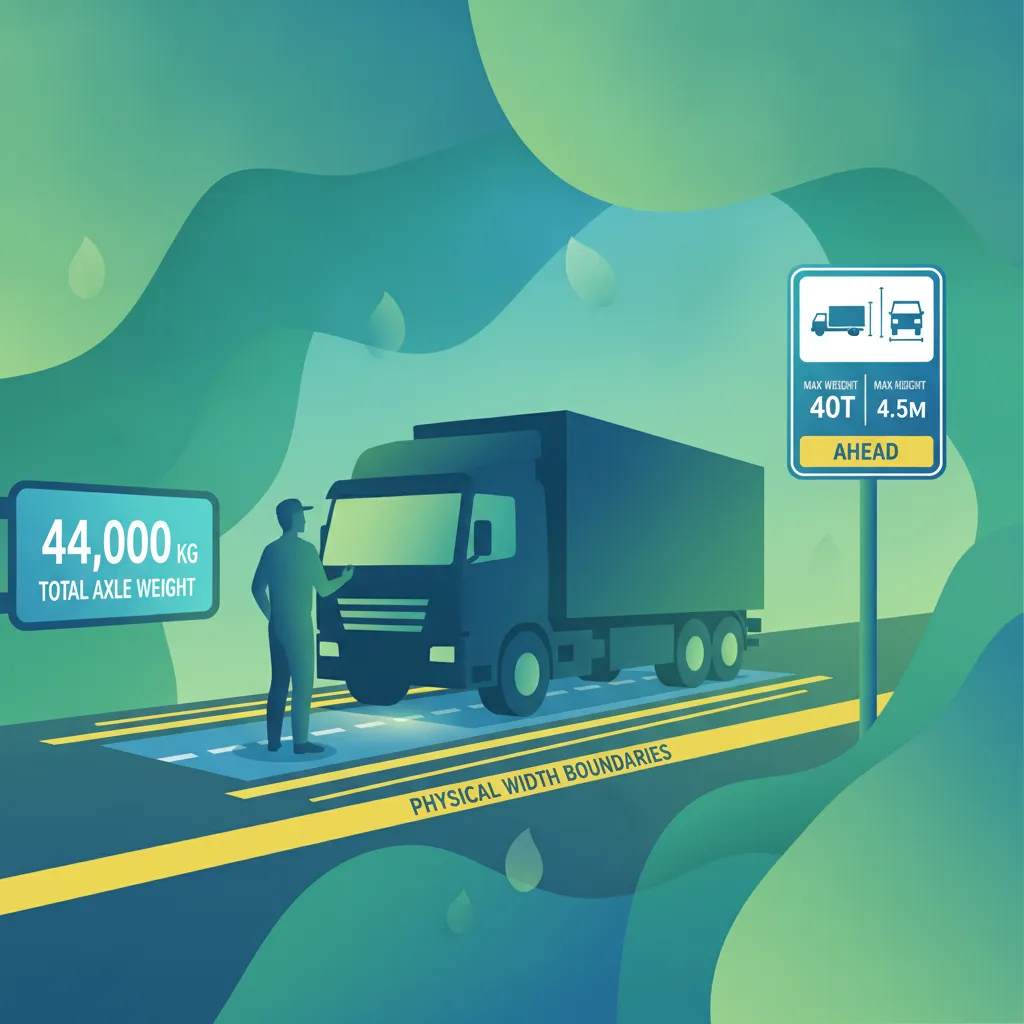
This lesson introduces the statutory limits governing the dimensions and mass of goods vehicles in Great Britain, including gross vehicle weight and individual axle loads. It explains how to calculate a vehicle's loaded weight to ensure it remains within legal parameters, preventing penalties and safety risks. Understanding these regulations is crucial for preventing damage to road infrastructure and ensuring the vehicle's stability and safe operation on every journey.
Find clear answers to common questions learners have about Required Documentation and Record‑Keeping. Learn how the lesson is structured, which driving theory objectives it supports, and how it fits into the overall learning path of units and curriculum progression in Great Britain. These explanations help you understand key concepts, lesson flow, and exam focused study goals.
Yes, under Great Britain and EU rules, you must record all driving, other work, availability, and rest periods. Failure to do so accurately is a serious offence that can lead to heavy fines and potential loss of your operator's or driver's licence.
A load manifest provides a comprehensive summary of all cargo being transported, whereas a delivery note is a specific receipt for an individual drop-off point. Both must be kept accurate and available for inspection by enforcement agencies.
Enforcement agencies like the DVSA check these records to verify that you are adhering to strict drivers' hours and rest period regulations. This prevents fatigue-related accidents and ensures fair competition across the transport industry.
Yes, understanding the principles of digital and analogue tachographs is a key part of the professional theory test. You will likely face questions regarding the legal necessity of keeping these records updated and accessible.
Dive into our comprehensive question bank to find exactly what you need for your Great Britain theory test. Use our advanced filters to pinpoint specific subjects or test your knowledge on challenging areas, ensuring you're fully prepared for success.