
Electric scooters are strictly classified as vehicles under the Austrian Road Traffic Act (StVO), and understanding their specific usage requirements is vital for both road safety and theory exam success. This guide explains the latest legislative changes, including helmet mandates, technical equipment standards, and prohibited traffic zones, ensuring you are fully prepared to answer related exam questions accurately.
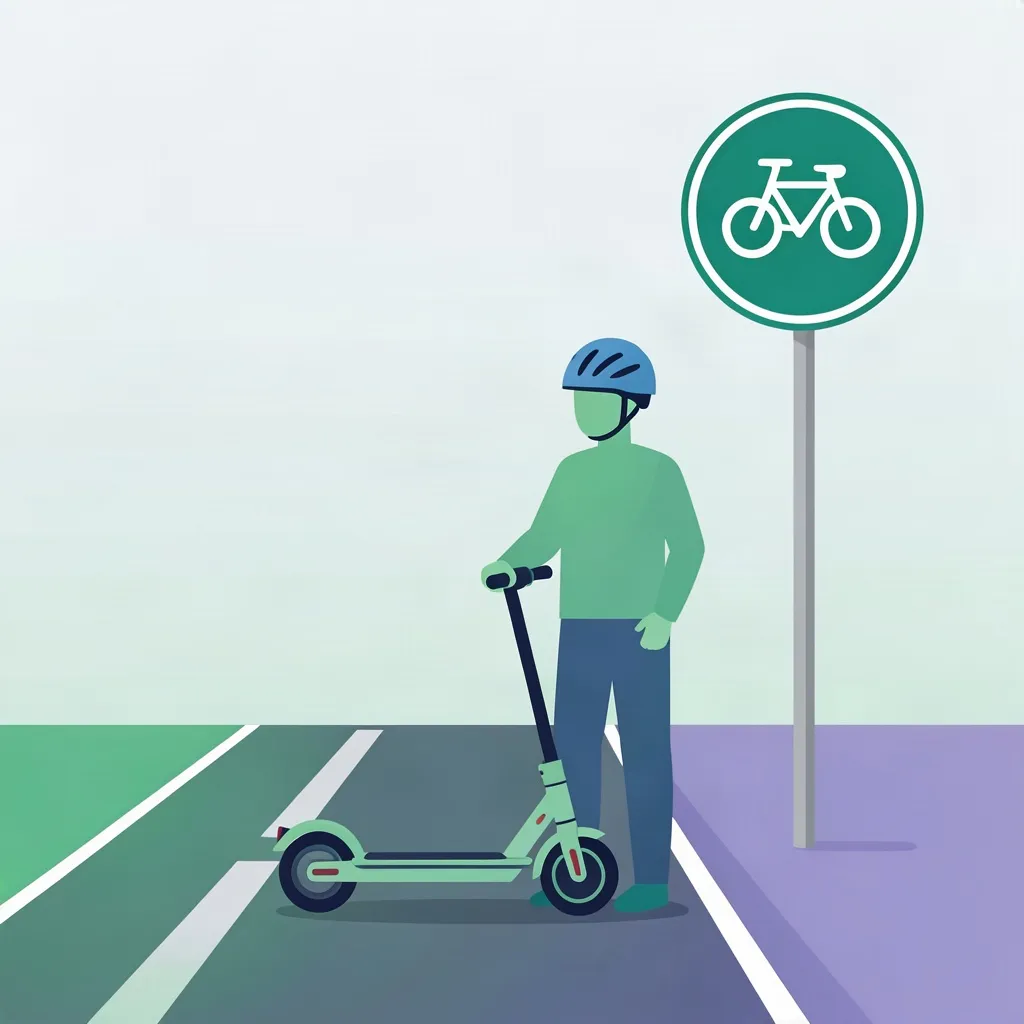
Article content overview
Electric scooters, or E-Scooter, have become a significant part of urban mobility in Austria. To ensure road safety and consistency, Austrian traffic legislation, specifically the Straßenverkehrsordnung (StVO 1960), classifies these devices clearly as vehicles. For your theory exam, it is vital to distinguish between general bicycle rules and the specific legal requirements that have been updated to manage these modern mobility devices effectively.
Under current Austrian law, an E-Scooter is defined as a single-track vehicle without a seat, powered by an electric motor. To avoid being classified as a motor vehicle requiring registration, the device must have a maximum power output of 600 watts and a construction-related maximum speed of no more than 25 km/h.
Since May 1, 2026, technical standards have become more stringent. E-Scooters must be equipped with effective braking systems, white reflectors or reflective films facing forward, and red reflectors or reflective films facing backward. Furthermore, they must feature a bell and functional turn signals at the ends of the handlebars to ensure clear communication with other road users.
A single-track vehicle, without a seat, featuring a handlebar and footboard, driven by an electric motor with a maximum output of 600W and a top design speed of 25 km/h.
When you are operating an E-Scooter in Austria, you are largely subject to the same traffic rules as cyclists. However, there are critical nuances that frequently appear in theory exam questions. For instance, you must utilize designated cycling infrastructure, such as bike paths or cycle lanes. If no such infrastructure is available, you must use the carriageway, but driving on sidewalks (Gehsteige), footpaths, or pedestrian crossings is strictly prohibited.
In shared spaces like residential streets (Wohnstraßen) or encounter zones (Begegnungszonen), you are permitted to ride at a speed adapted to pedestrian traffic. However, in dedicated pedestrian zones, riding is generally forbidden unless specific signage explicitly allows cycling, in which case you must proceed at walking speed (Schrittgeschwindigkeit).
It is a common exam trap to assume E-Scooters can use sidewalks. Remember: E-Scooters are legally vehicles and must stay off sidewalks, just like bicycles.
The legal requirements for riders were updated to reflect the increased usage of these vehicles. Since May 1, 2026, a mandatory helmet requirement applies to all riders up to the age of 16. If you are under 12 years old, you may only operate an E-Scooter in public traffic under the supervision of a person who is at least 16 years old, unless you possess a valid cycling license (Radfahrausweis).
Another critical change concerns the influence of alcohol. For E-Scooter operators, the maximum allowable blood alcohol concentration is 0.5 per mille. This lower threshold is designed to ensure that operators remain fully in control, given the maneuverability and traffic vulnerability of these small vehicles.
| Requirement | Rule/Regulation |
|---|---|
| Minimum Age | 12 years (or younger with supervision/license) |
| Helmet Rule | Mandatory until age 16 |
| Alcohol Limit | 0.5 Promille |
| Prohibited Areas | Sidewalks, pedestrian paths, and crossings |
| Goods Transport | Prohibited (except for small containers) |
As of October 1, 2026, a distinction is drawn between E-Scooters and E-Mopeds. While the former remain classified under specific StVO rules for "light vehicles," E-Mopeds are treated as motor vehicles under the Kraftfahrgesetz (KFG). This means E-Mopeds require proper vehicle registration, mandatory insurance, and are prohibited from using cycle paths. Distinguishing these categories is a frequent focus in advanced theory exam modules, as the regulatory environment for electric micro-mobility continues to evolve in Austria.
This guide covers the legal framework for E-Scooters in Austria under StVO 1960, emphasizing that they are vehicle-classified devices limited to 600W and 25 km/h. Key exam points include mandatory safety equipment updates since May 2026 (turn signals, reflectors, bell), helmet requirements for riders under 16, a 0.5 promille alcohol limit, and the 12-year minimum age with supervision rules. E-Scooters must use designated cycling infrastructure or roads, never sidewalks, and a critical distinction exists between E-Scooters (light vehicles) and E-Mopeds (registered motor vehicles under KFG) that will appear on advanced exam modules.
A short set of high-value points that capture the most important ideas from this article.
E-Scooters are classified as vehicles under StVO 1960 and must not be treated like pedestrians or regular cyclists.
To avoid motor vehicle registration, an E-Scooter must not exceed 600W power output and 25 km/h design speed.
Since May 2026, mandatory equipment includes turn signals, bell, front white reflectors, and rear red reflectors.
E-Scooters must use cycling infrastructure when available; otherwise, they use the road but are strictly prohibited from sidewalks and pedestrian crossings.
E-Mopeds (from October 2026) are classified as motor vehicles under KFG and require registration, unlike light E-Scooters.
Helmet use is mandatory for riders under 16 years old.
The maximum blood alcohol level for E-Scooter riders is 0.5 promille.
Riders must be at least 12 years old; under-12s need supervision (16+) or a cycling license.
In pedestrian zones with no explicit cycling permission, E-Scooters must proceed at walking speed (Schrittgeschwindigkeit).
E-Mopeds are prohibited from using cycle paths and fall under motor vehicle regulations, not StVO.
Assuming E-Scooters are allowed on sidewalks—unlike pedestrians, they are classified as vehicles and must stay off Gehsteige.
Confusing E-Scooter rules with standard bicycle rules without accounting for the specific equipment mandates (turn signals, reflectors).
Forgetting that passengers and goods transport are prohibited on E-Scooters.
Misunderstanding the alcohol threshold—0.5 promille applies specifically to E-Scooter riders, not the standard 0.5 for car drivers.
Failing to distinguish between E-Scooters and E-Mopeds, which have different registration and path-use requirements.
Article content overview
A short set of high-value points that capture the most important ideas from this article.
E-Scooters are classified as vehicles under StVO 1960 and must not be treated like pedestrians or regular cyclists.
To avoid motor vehicle registration, an E-Scooter must not exceed 600W power output and 25 km/h design speed.
Since May 2026, mandatory equipment includes turn signals, bell, front white reflectors, and rear red reflectors.
E-Scooters must use cycling infrastructure when available; otherwise, they use the road but are strictly prohibited from sidewalks and pedestrian crossings.
E-Mopeds (from October 2026) are classified as motor vehicles under KFG and require registration, unlike light E-Scooters.
Helmet use is mandatory for riders under 16 years old.
The maximum blood alcohol level for E-Scooter riders is 0.5 promille.
Riders must be at least 12 years old; under-12s need supervision (16+) or a cycling license.
In pedestrian zones with no explicit cycling permission, E-Scooters must proceed at walking speed (Schrittgeschwindigkeit).
E-Mopeds are prohibited from using cycle paths and fall under motor vehicle regulations, not StVO.
Assuming E-Scooters are allowed on sidewalks—unlike pedestrians, they are classified as vehicles and must stay off Gehsteige.
Confusing E-Scooter rules with standard bicycle rules without accounting for the specific equipment mandates (turn signals, reflectors).
Forgetting that passengers and goods transport are prohibited on E-Scooters.
Misunderstanding the alcohol threshold—0.5 promille applies specifically to E-Scooter riders, not the standard 0.5 for car drivers.
Failing to distinguish between E-Scooters and E-Mopeds, which have different registration and path-use requirements.
Explore related topics, search based questions, and concepts that learners often look up when studying Austrian E-Scooter Traffic Rules. These themes reflect real search intent and help you understand how this topic connects to wider driving theory knowledge in Austria.
Find clear and practical answers to common questions learners often have about Austrian E-Scooter Traffic Rules. This section helps explain difficult points, remove confusion, and reinforce the key driving theory concepts that matter for learners in Austria.
No, driving an e-scooter on pavements (Gehsteige) or pedestrian paths is strictly prohibited.
As of May 1, 2026, the blood alcohol concentration limit for e-scooter riders is 0.5 per mille.
Yes, starting May 1, 2026, there is a mandatory helmet requirement for all e-scooter riders until they reach the age of 16.
E-scooters are legally classified as single-track vehicles without a seat, which must adhere to the same traffic rules as cyclists.
Use the search bar above to delve deeper into any Austrian road rule, traffic sign, or specific driving procedure. Refine your understanding of complex theory concepts and fully prepare for your official driving licence examination. Start your targeted study now.