
Navigating Austrian motorways requires strict adherence to specific safety protocols that are frequently tested in the driving theory exam. This guide explains the legal requirement to form an emergency corridor when traffic comes to a standstill, along with fundamental tips for maintaining safe following distances. You will learn how to prepare for your journey and handle emergency situations, ensuring you remain compliant with local traffic laws.
Article content overview
Driving on Austrian motorways—known as the Autobahn and Schnellstraße—is a key part of your journey, whether you are a learner driver or an experienced motorist. Austrian traffic regulations are designed to maintain high safety standards, and mastering these rules is essential for both passing your theory exam and staying safe in real-world traffic. From maintaining a proper distance to managing emergency situations, understanding the legal requirements of our road network is a responsibility every driver must take seriously.
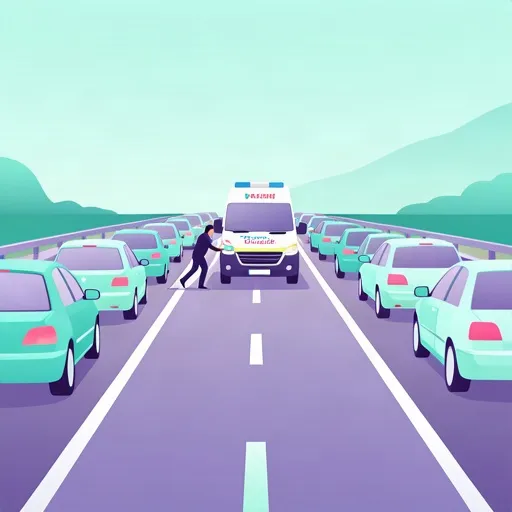
One of the most vital rules for driving on multi-lane roads in Austria is the mandatory formation of the Rettungsgasse, or emergency corridor. Whenever traffic on a motorway or highway with two or more lanes begins to slow down or come to a standstill, you are legally required to create a clear passage for emergency vehicles. This is not just a polite gesture; it is a life-saving obligation that must be initiated the moment traffic starts to congest.
To form the Rettungsgasse correctly, vehicles in the leftmost lane must move as far as possible to the left, often using the hard shoulder if necessary. Conversely, all vehicles in the lanes to the right of the leftmost lane must move as far as possible to the right. This creates a wide, clear path in the middle that allows ambulances, police, and fire rescue vehicles to reach the scene of an accident without delay. Keep in mind that blocking this corridor can result in severe legal consequences and significantly hampers rescue efforts.
Accidents caused by insufficient distance are among the most frequent incidents on Austrian roads. ASFINAG, the company responsible for the management of Austrian motorways, emphasizes the "2-second rule" for safety. Because speed on the Autobahn can be high, your reaction time must be supported by a sufficient gap between you and the vehicle in front of you.
When driving, pick a stationary object on the side of the road, such as a sign or a bridge pillar. Once the rear of the car in front passes that object, count "twenty-one, twenty-two." If you pass the same object before you finish counting, you are following too closely and must increase your distance.
In the theory exam, you will often encounter questions about stopping distances and the effect of poor weather conditions. Remember that when roads are wet, icy, or snow-covered, the standard two-second gap must be increased significantly. Professional driving instructors in Austria always advise that during winter months, you should double or even triple your safety margin to account for reduced tire grip.
If you are involved in a traffic accident on an Austrian road, your immediate priority is the safety of yourself and other road users. Always secure the accident site by switching on your hazard lights and placing your warning triangle at a sufficient distance. If you are on a motorway, ensure that all passengers exit the vehicle safely—ideally on the side away from active traffic—and move behind the crash barriers.
The Austrian theory exam frequently tests your knowledge of highway conduct, specifically focusing on merging, lane discipline, and the Rettungsgasse. Understanding that the right lane should always be favored—even on multi-lane roads—is essential. You should only use the left or middle lanes for overtaking. If the right lane is free, you must return to it, as driving in the middle lane unnecessarily can lead to fines and is a common source of exam-related penalties.
This article covers three essential areas for Austrian highway driving: the mandatory Rettungsgasse emergency corridor which must be formed on multi-lane roads when traffic slows, the 2-second following distance rule with a specific counting method and guidance to increase it significantly in winter conditions, and a step-by-step accident procedure including hazard lights, warning triangle placement, moving behind barriers, and contacting emergency services. Understanding these rules is critical for both passing the Austrian theory exam and navigating real-world motorway situations safely.
A short set of high-value points that capture the most important ideas from this article.
The Rettungsgasse must be formed the moment traffic starts to slow on any multi-lane road, with the leftmost lane moving left and all other lanes moving right.
On a three-lane motorway, the emergency corridor is created between the leftmost lane and the lanes to its right.
The 2-second rule requires counting 'twenty-one, twenty-two' after a stationary object to verify adequate following distance.
During winter or adverse conditions, the standard following distance must be significantly increased to account for reduced tire grip.
After an accident on a motorway, all passengers should exit and move behind crash barriers before other procedures are initiated.
Rettungsgasse formation: left lane goes left, all other lanes go right to create a clear emergency corridor.
Use the 2-second rule: pick a roadside object, count 'twenty-one, twenty-two' after the car ahead passes it.
Wet, icy, or snow-covered roads require doubling or tripling the standard following distance.
The warning triangle must be placed at a sufficient distance before the accident site, not just near the vehicle.
Emergency numbers in Austria are 112 (general), 133 (police), and 144 (ambulance).
Waiting until traffic has fully stopped before attempting to form the Rettungsgasse, when the law requires it to begin the moment congestion starts.
Assuming the 2-second rule applies equally in all weather conditions without adjustment for winter driving.
Forgetting to move passengers behind crash barriers before calling emergency services on a motorway.
Driving in the middle lane unnecessarily when the right lane is free, which can result in fines.
Placing the warning triangle too close to the vehicle rather than at the required safe distance.
Article content overview
A short set of high-value points that capture the most important ideas from this article.
The Rettungsgasse must be formed the moment traffic starts to slow on any multi-lane road, with the leftmost lane moving left and all other lanes moving right.
On a three-lane motorway, the emergency corridor is created between the leftmost lane and the lanes to its right.
The 2-second rule requires counting 'twenty-one, twenty-two' after a stationary object to verify adequate following distance.
During winter or adverse conditions, the standard following distance must be significantly increased to account for reduced tire grip.
After an accident on a motorway, all passengers should exit and move behind crash barriers before other procedures are initiated.
Rettungsgasse formation: left lane goes left, all other lanes go right to create a clear emergency corridor.
Use the 2-second rule: pick a roadside object, count 'twenty-one, twenty-two' after the car ahead passes it.
Wet, icy, or snow-covered roads require doubling or tripling the standard following distance.
The warning triangle must be placed at a sufficient distance before the accident site, not just near the vehicle.
Emergency numbers in Austria are 112 (general), 133 (police), and 144 (ambulance).
Waiting until traffic has fully stopped before attempting to form the Rettungsgasse, when the law requires it to begin the moment congestion starts.
Assuming the 2-second rule applies equally in all weather conditions without adjustment for winter driving.
Forgetting to move passengers behind crash barriers before calling emergency services on a motorway.
Driving in the middle lane unnecessarily when the right lane is free, which can result in fines.
Placing the warning triangle too close to the vehicle rather than at the required safe distance.
Explore related topics, search based questions, and concepts that learners often look up when studying Austrian Highway Safety and Rettungsgasse. These themes reflect real search intent and help you understand how this topic connects to wider driving theory knowledge in Austria.
Find clear and practical answers to common questions learners often have about Austrian Highway Safety and Rettungsgasse. This section helps explain difficult points, remove confusion, and reinforce the key driving theory concepts that matter for learners in Austria.
The Rettungsgasse is a mandatory emergency lane for rescue and emergency vehicles. You must form it as soon as traffic on a highway or motorway begins to slow down or enters a congestion state.
On a two-lane road, vehicles on the left lane move to the left, while those on the right move to the right. On three-lane roads, vehicles on the far left move to the left, while those on the middle and right lanes move to the right.
ASFINAG recommends a distance that allows you to react safely, typically calculated as the distance covered in at least two seconds. This helps prevent rear-end collisions, which are common in dense traffic.
You must secure the accident site, provide first aid if necessary, and call the police. Ensure you document the details of the incident and exchange contact and insurance information with all involved parties.
Use the search bar above to delve deeper into any Austrian road rule, traffic sign, or specific driving procedure. Refine your understanding of complex theory concepts and fully prepare for your official driving licence examination. Start your targeted study now.