
Drivers in Austria face strict obligations under §9 StVO when approaching a designated pedestrian crossing. This guide clarifies the difference between mere vigilance and the legal duty to stop, ensuring you understand how to identify a pedestrian's intent to cross and avoid common exam traps that lead to penalty points or fines.
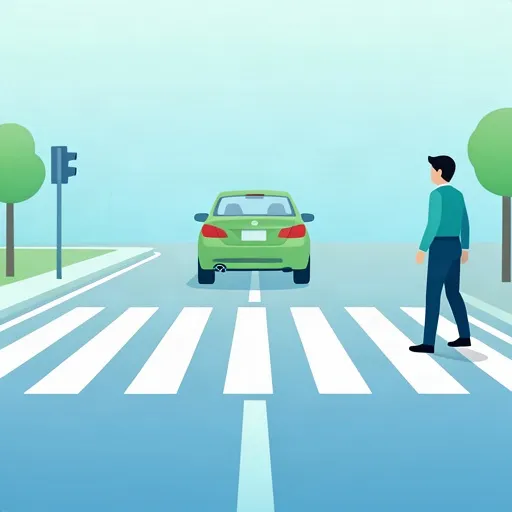
Article content overview
In the context of Austrian road traffic legislation, the Schutzweg—often referred to as a zebra crossing—represents a critical area where the safety of vulnerable road users is legally prioritized. Under §9 of the Austrian Road Traffic Act (StVO), motorists are subject to stringent obligations when approaching these marked crossings. Understanding these rules is not only vital for passing your theory exam but is a fundamental requirement for maintaining safety in urban environments like Vienna, Graz, or Linz.
The core of the Schutzweg rule is the mandatory yield obligation. When you approach a pedestrian crossing, you must ensure that you can stop your vehicle in time if a pedestrian intends to use it. The law requires you to approach at a speed that allows for a safe, controlled stop, ensuring that you do not force a pedestrian to hesitate or change their pace.
A critical turning point in Austrian law occurred with the 2009 reform, which clarified the "intent to cross." Prior to this change, the legal focus was primarily on pedestrians who had already stepped onto the road. Today, the law is explicit: you must yield to pedestrians who are clearly waiting at the curb with the intention of crossing. If a pedestrian is positioned in a way that suggests they are preparing to step onto the Schutzweg, you are legally obligated to stop and allow them to cross safely.
Common Exam Trap: In theory test scenarios, you will often be asked about pedestrians standing at the curb. Always remember that if a pedestrian's body language or position indicates they are waiting to cross, you must yield. Assuming you have priority simply because they have not yet stepped onto the road is a frequent cause of failed theory exam questions and, more importantly, high-risk traffic situations.
Austrian authorities take pedestrian safety very seriously, and compliance is monitored through active enforcement. In many metropolitan areas, police conduct undercover operations using plainclothes officers to simulate pedestrians at crossings. Failing to yield at a Schutzweg is classified as a significant traffic violation.
An Organmandat is a simplified on-the-spot fine (typically €50) used for minor infractions. However, if your failure to yield creates a danger to a pedestrian, you will face a Strafverfügung, a formal penalty notice that can range from €72 to €726 and may lead to a record in the Vormerksystem (the Austrian probationary points system).
While the Schutzweg provides a designated area for priority, the general duty of care defined in §3 StVO extends even further. When children, the elderly, or persons with reduced mobility are involved, drivers must exercise heightened caution. Even if a child is waiting to cross at a location that is not a marked Schutzweg, you are expected to be extra vigilant and prepared to yield. In the eyes of the Austrian theory exam, the "vulnerability" of the road user acts as a multiplier for your required level of care.
| Scenario | Driver Obligation |
|---|---|
| Pedestrian on the Schutzweg | Must stop and yield completely. |
| Pedestrian waiting at the curb | Must stop and yield if intent to cross is clear. |
| Child near the road | Must reduce speed and be prepared to stop. |
| Turning vehicle | Must stop if a pedestrian has already started crossing. |
A notable exception to the general pedestrian priority rule involves trams. Because trams have a significantly longer braking distance and are confined to tracks, they are granted priority even at pedestrian crossings. As a car driver, you must never "shield" a pedestrian by blocking the view of an oncoming tram, nor should you create a situation where a pedestrian enters the path of a rail vehicle.
The Austrian Schutzweg rule under §9 StVO requires drivers to yield to both pedestrians already on the crossing and those clearly intending to cross, a standard clarified by the 2009 legal reform. The critical distinction lies in recognizing pedestrian intent through body language and curb positioning rather than waiting for physical entry onto the road. Enforcement includes undercover police operations, with penalties ranging from €50 Organmandat fines to €726 Strafverfügung notices that may add points to your Vormerksystem record. Special care obligations apply around children and vulnerable users, and drivers must understand that trams have priority due to their extended braking requirements, meaning you cannot shield pedestrians from oncoming rail traffic.
A short set of high-value points that capture the most important ideas from this article.
Under §9 StVO, you must approach every Schutzweg at a speed allowing a safe stop if a pedestrian intends to cross
The 2009 legal reform explicitly mandates yielding to pedestrians waiting at the curb with clear intent to cross, not just those already on the road
Pedestrian intent is determined by body language and positioning, meaning you must stop even if the person hasn't stepped onto the crossing yet
Children, elderly, and mobility-impaired persons require heightened caution under §3 StVO regardless of whether a marked crossing exists
Trams have priority at pedestrian crossings due to their longer braking distance; never block a pedestrian's view of oncoming rail vehicles
Yielding obligation applies when a pedestrian shows clear intent to cross, not only when they have stepped onto the Schutzweg
An Organmandat (€50 on-the-spot fine) applies for minor infractions; a Strafverfahren (€72–€726) applies when pedestrian danger is created, with possible Vormerksystem points
Plainclothes police enforcement operations test driver compliance at crossings in Austrian cities
For turning vehicles, you must stop if a pedestrian has already begun crossing even if they are not yet in your lane
The duty of care under §3 StVO extends beyond marked crossings when vulnerable road users are present
Assuming you have priority because a pedestrian hasn't physically stepped onto the crossing yet
Failing to observe waiting pedestrians' body language and treating the crossing as optional rather than mandatory to yield
Not adjusting speed in advance when approaching a Schutzweg, leaving insufficient distance to stop safely
Believing that reduced visibility or bad weather excuses failure to yield to pedestrians with clear crossing intent
Creating a blocking position that prevents tram drivers from seeing pedestrians who are about to cross
Article content overview
A short set of high-value points that capture the most important ideas from this article.
Under §9 StVO, you must approach every Schutzweg at a speed allowing a safe stop if a pedestrian intends to cross
The 2009 legal reform explicitly mandates yielding to pedestrians waiting at the curb with clear intent to cross, not just those already on the road
Pedestrian intent is determined by body language and positioning, meaning you must stop even if the person hasn't stepped onto the crossing yet
Children, elderly, and mobility-impaired persons require heightened caution under §3 StVO regardless of whether a marked crossing exists
Trams have priority at pedestrian crossings due to their longer braking distance; never block a pedestrian's view of oncoming rail vehicles
Yielding obligation applies when a pedestrian shows clear intent to cross, not only when they have stepped onto the Schutzweg
An Organmandat (€50 on-the-spot fine) applies for minor infractions; a Strafverfahren (€72–€726) applies when pedestrian danger is created, with possible Vormerksystem points
Plainclothes police enforcement operations test driver compliance at crossings in Austrian cities
For turning vehicles, you must stop if a pedestrian has already begun crossing even if they are not yet in your lane
The duty of care under §3 StVO extends beyond marked crossings when vulnerable road users are present
Assuming you have priority because a pedestrian hasn't physically stepped onto the crossing yet
Failing to observe waiting pedestrians' body language and treating the crossing as optional rather than mandatory to yield
Not adjusting speed in advance when approaching a Schutzweg, leaving insufficient distance to stop safely
Believing that reduced visibility or bad weather excuses failure to yield to pedestrians with clear crossing intent
Creating a blocking position that prevents tram drivers from seeing pedestrians who are about to cross
Explore related topics, search based questions, and concepts that learners often look up when studying Austria Schutzweg Crossing Rules. These themes reflect real search intent and help you understand how this topic connects to wider driving theory knowledge in Austria.
Find clear and practical answers to common questions learners often have about Austria Schutzweg Crossing Rules. This section helps explain difficult points, remove confusion, and reinforce the key driving theory concepts that matter for learners in Austria.
Under §9 StVO, you must approach a Schutzweg at a speed that allows you to stop safely. You must yield to any pedestrian who is already on the crossing or who shows a clear intent to enter the crossing.
It means that if a pedestrian is standing at the curb in a position and manner that indicates they intend to cross, you have a legal obligation to yield and allow them to cross safely, even if they have not yet stepped onto the road.
Yes, you must exercise a heightened duty of care toward children and vulnerable road users. Under §3 StVO, this duty of care applies not only at designated crossings but whenever children are visibly waiting or intending to cross the road.
Failure to yield at a Schutzweg can result in an on-the-spot fine (Organmandat) of €50, or a formal penalty (Strafverfügung) ranging from €72 to €726 if there is an associated risk, potentially impacting your license record under the Vormerksystem.
Use the search bar above to delve deeper into any Austrian road rule, traffic sign, or specific driving procedure. Refine your understanding of complex theory concepts and fully prepare for your official driving licence examination. Start your targeted study now.