
Understanding how to correctly load your vehicle and respect dimension limits is a fundamental part of the Austrian theory exam and practical driving safety. This guide covers the specific legal thresholds for load projection, the necessary safety markings for oversized items, and the vehicle dimension limits defined in the KFG that every driver must know to avoid fines and dangerous situations on the road.
Article content overview
Understanding the legal framework for vehicle loading is a critical component of your Austrian driving theory exam. Whether you are driving a small passenger car (PKW) or a larger vehicle, the Kraftfahrgesetz (KFG) and the Straßenverkehrsordnung (StVO) set strict standards to ensure road safety. If you fail to secure your load correctly or exceed authorized dimensions, you risk not only heavy fines but also creating dangerous situations for other road users, including cyclists and pedestrians.
Austrian traffic law defines specific maximum limits for vehicles to ensure they can safely navigate the country’s infrastructure, from narrow urban streets to alpine tunnels and motorways (Autobahn). For most standard passenger vehicles, while manufacturers design them within these limits, it is the driver's responsibility to ensure that any additional equipment—like roof racks, ski boxes, or bicycle carriers—does not cause the vehicle to exceed these maximums.
For larger transport vehicles, the KFG mandates a maximum length of 12 meters for rigid lorries and 18.75 meters for articulated vehicles. The standard width is capped at 2.55 meters, though refrigerated vehicles may reach 2.6 meters. The maximum height permitted on public roads is 4 meters. Exceeding these dimensions without a special permit (Sonderbewilligung) is a serious violation of Austrian law.
The term 'Ladungsüberhang' refers to any load or vehicle attachment that extends beyond the front or rear perimeter of the motor vehicle or trailer.
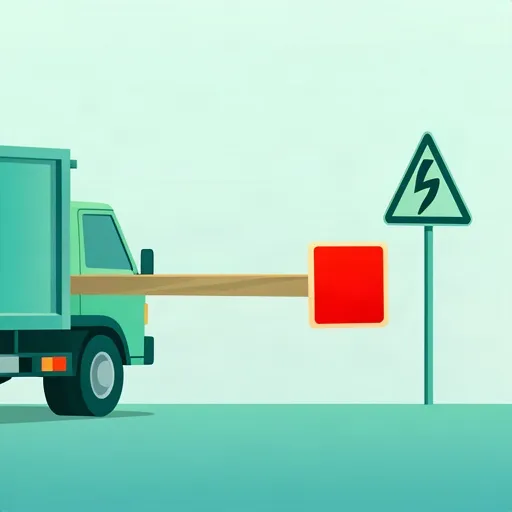
One of the most common topics in the Austrian theory test involves the proper marking of loads that extend beyond the rear of the vehicle. If you are transporting items like timber, pipes, or bicycles, you must strictly follow the requirements set out in §60 StVO.
If your load extends more than 1 meter beyond the rearmost point of your vehicle, you are legally required to mark the end of the load clearly. In Austria, this is typically done using a red cloth or a specialized flag that is easily visible to drivers behind you.
Always remember: for rear load projections between 1 and 3 meters, a red cloth is mandatory at all times. If the projection exceeds 3 meters, you are required to obtain an official special permit (Sonderbewilligung) from the local administrative authority (Bezirksverwaltungsbehörde).
| Load Projection | Mandatory Action |
|---|---|
| Up to 1 meter | No special marking required |
| 1 to 3 meters | Red cloth mandatory |
| Exceeding 3 meters | Special permit required |
When utilizing roof racks or transport boxes, the most important factor is total height. While most commercial ski boxes do not push a standard passenger car anywhere near the 4-meter limit, you must remain mindful of height-restricted environments. Underground car parks (Parkgarage), low-clearance tunnels, and service station roof structures often have clearance bars that are lower than the standard legal maximum. Always check your total vehicle height—including the load—before entering these areas.
Under §101 of the KFG, the driver is primarily responsible for ensuring that the vehicle’s weight and loading condition do not exceed the permitted maximums. This includes the maximum permitted gross vehicle weight (GVW), individual axle loads, and overall vehicle dimensions. Before starting a journey, you must verify that your load is secured so that it cannot shift, fall, or cause the vehicle to become unstable during emergency braking or sharp steering maneuvers.
This guide covers the Austrian legal framework for vehicle dimensions under the KFG and load projection marking requirements under the StVO, essential for theory exam preparation. Key thresholds include the 1-meter and 3-meter rear projection limits requiring red cloth marking and special permits respectively, along with the 4-meter maximum height limit. Drivers are legally responsible under §101 KFG for ensuring loads are secured and dimensions comply, including checking that loads do not obstruct visibility or vehicle lights. Practical considerations include verifying total height with roof loads before entering low-clearance areas such as underground parking facilities.
A short set of high-value points that capture the most important ideas from this article.
Austrian law caps vehicle dimensions at 2.55m width (2.6m for refrigerated vehicles), 4m height, and specifies length limits of 12m for rigid lorries and 18.75m for articulated vehicles.
Rear load projections up to 1 meter require no special marking, but projections between 1 and 3 meters mandate a red cloth visible to following traffic.
Loads extending beyond 3 meters legally require a special permit (Sonderbewilligung) from the Bezirksverwaltungsbehörde.
Under §101 KFG, the driver bears primary responsibility for ensuring load security and that the vehicle stays within all permitted weight and dimension limits.
Always verify total vehicle height including roof loads before entering low-clearance areas like underground car parks and tunnels.
The 'Ladungsüberhang' definition covers any load or attachment extending beyond the vehicle's front or rear perimeter.
Red cloth marking is mandatory for rear projections exceeding 1 meter but not reaching 3 meters.
A Sonderbewilligung (special permit) is required when load projection exceeds 3 meters.
Maximum height limit on Austrian public roads is 4 meters, but local restrictions in parking garages and tunnels may be lower.
GVW (Gross Vehicle Weight) and Achslast (axle load) limits must also be verified before departure.
Assuming no marking is needed for small load projections—just under 1 meter may still cause visibility issues.
Forgetting that roof loads count toward the total vehicle height when calculating clearance restrictions.
Not securing loads adequately, risking cargo shifting during braking or cornering.
Overlooking the requirement to check that loads do not obstruct lights, reflectors, or the driver's view.
Assuming dimension limits only apply to commercial vehicles and not to passenger cars with roof racks or carriers.
Article content overview
A short set of high-value points that capture the most important ideas from this article.
Austrian law caps vehicle dimensions at 2.55m width (2.6m for refrigerated vehicles), 4m height, and specifies length limits of 12m for rigid lorries and 18.75m for articulated vehicles.
Rear load projections up to 1 meter require no special marking, but projections between 1 and 3 meters mandate a red cloth visible to following traffic.
Loads extending beyond 3 meters legally require a special permit (Sonderbewilligung) from the Bezirksverwaltungsbehörde.
Under §101 KFG, the driver bears primary responsibility for ensuring load security and that the vehicle stays within all permitted weight and dimension limits.
Always verify total vehicle height including roof loads before entering low-clearance areas like underground car parks and tunnels.
The 'Ladungsüberhang' definition covers any load or attachment extending beyond the vehicle's front or rear perimeter.
Red cloth marking is mandatory for rear projections exceeding 1 meter but not reaching 3 meters.
A Sonderbewilligung (special permit) is required when load projection exceeds 3 meters.
Maximum height limit on Austrian public roads is 4 meters, but local restrictions in parking garages and tunnels may be lower.
GVW (Gross Vehicle Weight) and Achslast (axle load) limits must also be verified before departure.
Assuming no marking is needed for small load projections—just under 1 meter may still cause visibility issues.
Forgetting that roof loads count toward the total vehicle height when calculating clearance restrictions.
Not securing loads adequately, risking cargo shifting during braking or cornering.
Overlooking the requirement to check that loads do not obstruct lights, reflectors, or the driver's view.
Assuming dimension limits only apply to commercial vehicles and not to passenger cars with roof racks or carriers.
Explore related topics, search based questions, and concepts that learners often look up when studying Vehicle Load Rules and Dimensions. These themes reflect real search intent and help you understand how this topic connects to wider driving theory knowledge in Austria.
Find clear and practical answers to common questions learners often have about Vehicle Load Rules and Dimensions. This section helps explain difficult points, remove confusion, and reinforce the key driving theory concepts that matter for learners in Austria.
A red cloth must be attached to the end of any load projecting more than 1 meter beyond the rear of the vehicle to make the extent of the load clearly visible to other road users.
If a load projects more than 3 meters beyond the rear point of the vehicle, you must obtain a special permit from the responsible district administrative authority (Bezirksverwaltungsbehörde).
The total height of a vehicle, including any roof racks, boxes, or cargo, must not exceed 4 meters, as this is the standard clearance limit for tunnels, bridges, and parking structures.
Yes, roof boxes must be securely fastened to prevent movement and must not cause the vehicle to exceed the maximum legal height of 4 meters or width limits, which could pose a risk in restricted areas.
Use the search bar above to delve deeper into any Austrian road rule, traffic sign, or specific driving procedure. Refine your understanding of complex theory concepts and fully prepare for your official driving licence examination. Start your targeted study now.