
Understanding road access rules is critical for success in your practical driving test in Austria. This guide explains how to identify restricted zones, such as residential streets and service roads, and details when you are permitted to enter them based on an examiner's instructions. Mastering these situational rules will help you maintain compliance and confidence throughout your driving examination.
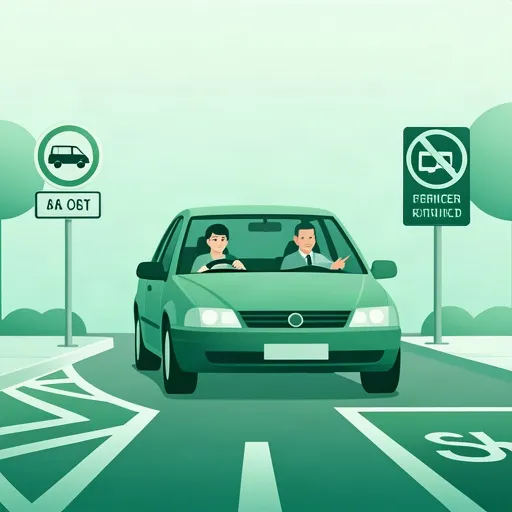
Article content overview
Passing your practical driving examination in Austria requires more than just vehicle control; it demands a deep understanding of road regulations and the ability to interpret signs in real-time. Examiners are specifically looking for your ability to identify and adhere to road access restrictions. Entering a prohibited zone, even for a short distance, is often classified as a critical error that can lead to an immediate failure of the examination.
During your driving test, the examiner will define your route. It is vital to distinguish between roads that are strictly off-limits and those that are only permitted under specific conditions. Understanding the difference between a Fußgängerzone (pedestrian zone) and a Wohnstraße (residential street) can be the difference between receiving your license and having to reschedule.
Pedestrian zones and Schulstraßen (school streets) are generally off-limits to candidates during the practical test. Unless the examiner explicitly commands you to enter an area where you have been granted special permission, you should assume that these streets are forbidden. Driving into a Fußgängerzone or a street designated solely for buses (Busstraße) without clear instruction or signage allowing it is a primary reason for automatic failure.
Some road types are not universally forbidden but are restricted to "arrival and departure" (Zu- und Abfahren). These include Wohnstraßen (residential streets), Fahrradstraßen (bicycle streets), and Nebenfahrbahnen (service roads). While you are technically allowed to enter these areas if you have a destination there—such as finding a parking space—you should avoid driving through them as a shortcut.
If the examiner does not provide a specific instruction to turn into these roads, your safest course of action is to follow the natural flow of the main traffic route. Entering a Nebenfahrbahn simply to bypass a busy intersection is a common mistake that examiners note as a lack of proper route planning and awareness of traffic conventions.
Austria utilizes specific designations for traffic-calmed areas that require careful navigation. A Begegnungszone (shared space) is an area where pedestrians, cyclists, and motorists share the road, typically with a speed limit of 20 km/h. Unlike a pedestrian zone, you are allowed to drive through these, provided you adhere to the speed limit and show extreme consideration for other road users.
| Road Category | Access Rule During Exam |
|---|---|
| Fußgängerzone | Strictly Forbidden |
| Schulstraße | Strictly Forbidden |
| Wohnstraße | Only with specific instruction |
| Nebenfahrbahn | Only with specific instruction |
| Begegnungszone | Permitted (limit 20 km/h) |
At the beginning of your test, the examiner will set the stage for your drive. They often provide a general instruction to follow the natural flow of traffic and avoid unnecessary entry into residential streets, dead ends, or service roads. If you encounter a Sackgasse (dead end), you are legally allowed to enter it; however, experienced instructors advise against doing so unless necessary, as it often forces an awkward three-point turn that introduces unnecessary risk to your test.
Remember that the examiner is evaluating your adherence to local laws. If a sign indicates that an area is for "Anrainer frei" (residents only), you are not permitted to enter that street during your exam, as you do not meet the criteria for entry. Always scan the supplementary signs (Zusatztafeln) carefully, as they define the legal boundaries of your driving environment.
This article teaches candidates how to avoid automatic failure in the Austrian practical driving test by understanding which roads and zones are restricted. The key distinction is between permanently forbidden areas like Fußgängerzone and Schulstraße, versus conditionally accessible zones like Wohnstraße and Nebenfahrbahn that require explicit examiner instruction. Begegnungszone is the only shared-space area where driving is permitted, provided the 20 km/h speed limit is respected and pedestrians and cyclists are prioritised. Candidates should always follow the main traffic route, carefully read supplementary signs, and never enter restricted areas without clear authorisation, as doing so is a primary cause of test failure.
A short set of high-value points that capture the most important ideas from this article.
Pedestrian zones (Fußgängerzone) and school streets (Schulstraße) are strictly forbidden during the Austrian driving test and must never be entered without explicit examiner instruction
Residential streets (Wohnstraße) and service roads (Nebenfahrbahn) are accessible only with specific examiner command, not for shortcuts or avoiding traffic
Begegnungszone (shared space) permits driving through but requires strict adherence to a 20 km/h speed limit and prioritising pedestrians and cyclists
Always follow the natural flow of main traffic unless the examiner explicitly directs you otherwise
Supplementary signs (Zusatztafeln) define the exact legal conditions for entering any restricted area and must be carefully scanned
Fußgängerzone and Schulstraße = absolute prohibition; Wohnstraße and Nebenfahrbahn = conditional entry only
Begegnungszone speed limit is 20 km/h and all road users share equal footing
Anrainer frei (residents only) signs prohibit candidate entry during the test
Dead ends (Sackgasse) are legally allowed but should be avoided to prevent awkward manoeuvres
The examiner's route instructions override default restrictions only when explicitly stated
Entering a Fußgängerzone or Schulstraße without permission, which results in automatic test failure
Using a Nebenfahrbahn as a shortcut to bypass a busy intersection without examiner instruction
Confusing Durchfahren (driving through) rules with legitimate access-to-destination permissions
Ignoring supplementary signs (Zusatztafeln) that specify conditions or exceptions for zone entry
Entering a street marked Anrainer frei because the candidate does not recognise the resident-only restriction
Article content overview
A short set of high-value points that capture the most important ideas from this article.
Pedestrian zones (Fußgängerzone) and school streets (Schulstraße) are strictly forbidden during the Austrian driving test and must never be entered without explicit examiner instruction
Residential streets (Wohnstraße) and service roads (Nebenfahrbahn) are accessible only with specific examiner command, not for shortcuts or avoiding traffic
Begegnungszone (shared space) permits driving through but requires strict adherence to a 20 km/h speed limit and prioritising pedestrians and cyclists
Always follow the natural flow of main traffic unless the examiner explicitly directs you otherwise
Supplementary signs (Zusatztafeln) define the exact legal conditions for entering any restricted area and must be carefully scanned
Fußgängerzone and Schulstraße = absolute prohibition; Wohnstraße and Nebenfahrbahn = conditional entry only
Begegnungszone speed limit is 20 km/h and all road users share equal footing
Anrainer frei (residents only) signs prohibit candidate entry during the test
Dead ends (Sackgasse) are legally allowed but should be avoided to prevent awkward manoeuvres
The examiner's route instructions override default restrictions only when explicitly stated
Entering a Fußgängerzone or Schulstraße without permission, which results in automatic test failure
Using a Nebenfahrbahn as a shortcut to bypass a busy intersection without examiner instruction
Confusing Durchfahren (driving through) rules with legitimate access-to-destination permissions
Ignoring supplementary signs (Zusatztafeln) that specify conditions or exceptions for zone entry
Entering a street marked Anrainer frei because the candidate does not recognise the resident-only restriction
Explore related topics, search based questions, and concepts that learners often look up when studying Road Restrictions for Austrian Driving Test. These themes reflect real search intent and help you understand how this topic connects to wider driving theory knowledge in Austria.
Find clear and practical answers to common questions learners often have about Road Restrictions for Austrian Driving Test. This section helps explain difficult points, remove confusion, and reinforce the key driving theory concepts that matter for learners in Austria.
You should generally avoid entering a Wohnstraße unless you are explicitly instructed to do so by the examiner, for example, to find a parking spot.
Entering a pedestrian zone without a specific exemption sign is strictly prohibited and usually results in an immediate failure of the practical test.
While it is legally permitted to enter a dead-end street, examiners often advise against it. It is best to stick to the main route unless directed otherwise.
Yes, you are permitted to drive through a Begegnungszone, provided you maintain the speed limit of 20 km/h and exercise special caution for pedestrians.
Use the search bar above to delve deeper into any Austrian road rule, traffic sign, or specific driving procedure. Refine your understanding of complex theory concepts and fully prepare for your official driving licence examination. Start your targeted study now.