
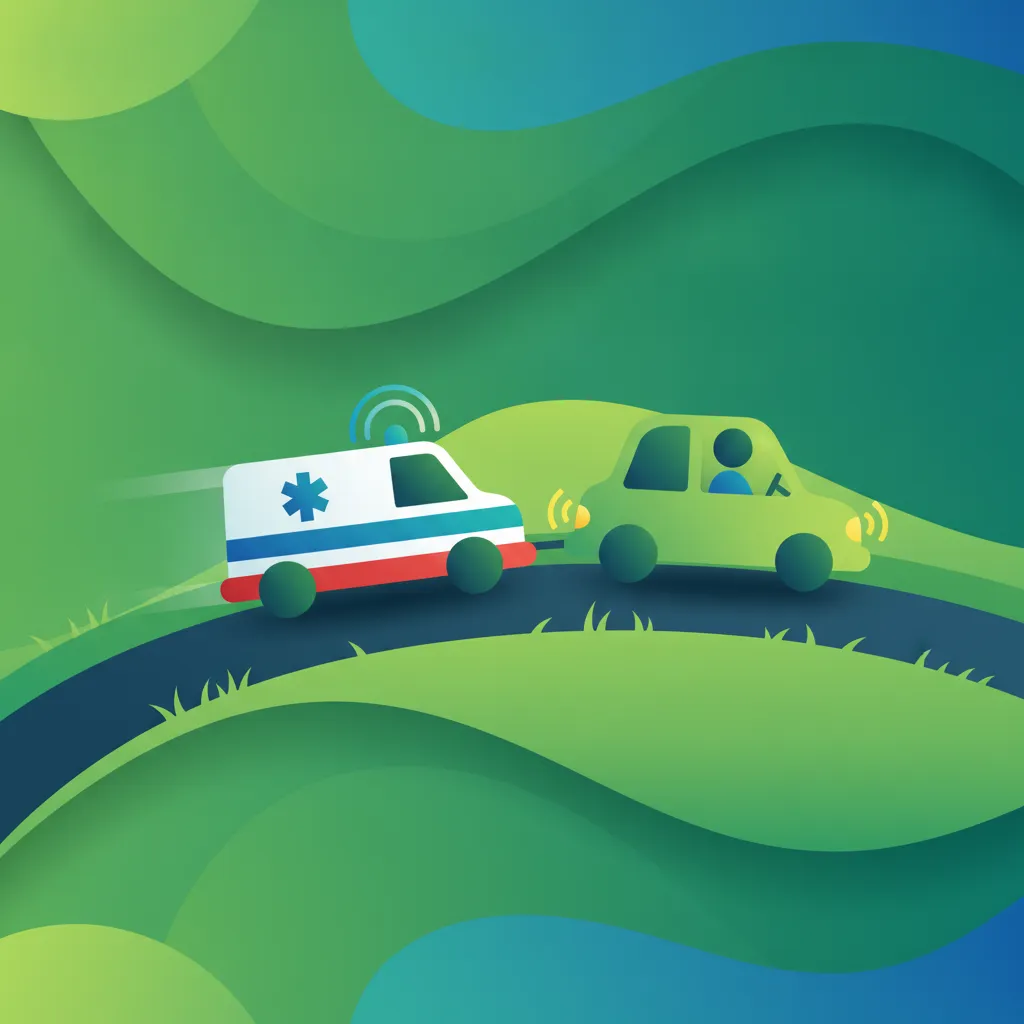
When an emergency vehicle – an Einsatzfahrzeug – such as an ambulance, police car, or fire truck is on an urgent mission, it uses flashing blue lights and often a siren. As a driver in Austria, you have a critical responsibility to react immediately and safely to ensure they have 'Freie Fahrt' (free passage). This page explains exactly what you need to do.
Theory topic content overview
Read the full theory topic guide for Emergency Vehicles with structured, easy-to-scan content built for learners in Austria. This detailed section explains the exact rule, meaning, traffic context, comparison points, and exam logic behind this Austrian driving theory topic so you can study faster, understand the concept more clearly, and avoid common interpretation mistakes on the theory test.
In Austria, the concept of Emergency Vehicle Priority centers around ensuring Einsatzfahrzeuge (emergency vehicles) have Freie Fahrt (free passage) when they are on an urgent mission. An Einsatzfahrzeug is any vehicle used by services like the police (Polizei), fire department (Feuerwehr), or ambulance (Rettungsfahrzeuge) that is equipped with and actively using flashing blue lights and, typically, a siren.
Your legal and ethical duty as a driver under the Austrian Road Traffic Act (StVO) is to react immediately and safely to facilitate their unimpeded progress. This isn't merely a courtesy; it's a critical safety obligation designed to allow emergency services to reach incidents quickly, potentially saving lives and property.
Understanding and correctly applying emergency vehicle priority rules is vital for several reasons:
Einsatzfahrzeuge. Failure to do so can result in significant penalties and points against your driving licence.Einsatzfahrzeuge are common in the Austrian driving theory exam. Knowing the correct procedure is essential for passing.When you perceive an Einsatzfahrzeug approaching with flashing blue lights and a siren, your actions should be immediate, calm, and predictable:
Einsatzfahrzeuge use these signals to indicate their urgent mission and claim priority.Einsatzfahrzeug crew anticipate your actions.Einsatzfahrzeug or other traffic once it passes.Einsatzfahrzeug has fully passed and it is safe to resume your original position or continue driving. Be aware that sometimes a second emergency vehicle may follow.Einsatzfahrzeug. The StVO allows Einsatzfahrzeuge to proceed through red lights (after stopping and ensuring safety) if necessary for their mission. Your duty is to provide Freie Fahrt.Autobahn) or multi-lane roads with two or more lanes in one direction, drivers are often expected to form a Rettungsgasse (emergency corridor).
Einsatzfahrzeuge to pass quickly.Einsatzfahrzeuge are largely exempt from normal traffic rules, they are generally not permitted to drive against the direction of traffic in one-way streets or on opposing lanes of traffic unless there is no other reasonable way to reach the emergency site in time, and only after ensuring no danger to others.Einsatzfahrzeuge converge:
Rettungsfahrzeuge (ambulances / rescue vehicles)Feuerwehrfahrzeuge (fire service vehicles)Polizeifahrzeuge (police vehicles)
This priority matters mainly when their paths conflict directly, and traffic controllers might guide them according to this order. Your primary duty remains to give Freie Fahrt to whichever Einsatzfahrzeug is approaching.It's crucial to distinguish between the exemptions granted to Einsatzfahrzeuge and your responsibilities as a regular driver.
Einsatzfahrzeuge are exempt from certain traffic rules (like speed limits or stopping at red lights) when on an urgent mission, provided they do not endanger people or damage property. However, this does not exempt you from your duty to react safely and give way. You must not assume the emergency driver will magically navigate around unsafe maneuvers you make.Einsatzfahrzeug before reacting if you clearly hear the siren. Sound can travel further and give you more time to prepare.Einsatzfahrzeug: Never follow an Einsatzfahrzeug closely to 'skip' traffic. This is extremely dangerous, illegal, and obstructs subsequent emergency vehicles or regular traffic flow.Rettungsgasse rule if applicable) to create a clear path for the Einsatzfahrzeug, then stop safely until it has passed.Landstraße), you encounter an Einsatzfahrzeug coming from the opposite direction. Slow down significantly, move as far right as possible, and be prepared to stop. If necessary, pull onto the shoulder if it's safe to do so.Autobahn near Salzburg. As soon as you hear a siren or see flashing blue lights, immediately start forming a Rettungsgasse by steering your vehicle towards the appropriate side of your lane (left for the left-most lane, right for all other lanes).Always remember the principle of Freie Fahrt for Einsatzfahrzeuge in Austria. Your immediate, calm, and predictable response is crucial for both road safety and the effectiveness of emergency services. Keep your mirrors checked, signal clearly, move safely to the side, and be prepared to stop. Prioritize the safety of all road users while fulfilling your legal obligation under the StVO to yield to ambulances, fire trucks, and police vehicles on urgent missions.
This topic covers the critical Austrian driving rule of giving 'Freie Fahrt' (free passage) to emergency vehicles equipped with flashing blue lights and sirens. Drivers must immediately recognize these signals, assess their surroundings, use indicators, reduce speed smoothly, and move to the right side of the road—or form a Rettungsgasse on multi-lane roads and Autobahn—stopping if necessary. The StVO mandates this priority absolutely, including at green traffic lights, and defines a hierarchy among emergency services (ambulances over fire trucks over police) when vehicles converge. Common mistakes include panic braking, proceeding on green lights, blocking intersections, and following emergency vehicles too closely, all of which endanger lives by delaying emergency response.
A short set of high-value points that capture the most important ideas from this theory explanation.
Emergency vehicles (Einsatzfahrzeuge) with flashing blue lights and sirens must be given absolute priority under Austrian law (StVO) for 'Freie Fahrt' (free passage).
When an Einsatzfahrzeug approaches, immediately assess your surroundings, signal your intention, reduce speed smoothly, and move as far right as safely possible before stopping if necessary.
On multi-lane roads and Autobahn, drivers must form a 'Rettungsgasse' (emergency corridor): two lanes means left lane moves left and right lane moves right; three or more lanes means outer left moves far left, all others move far right.
Even at a green traffic light, you must yield to an approaching Einsatzfahrzeug; emergency vehicles may proceed through red lights after stopping and ensuring safety.
The StVO establishes a priority order when multiple emergency vehicles converge: ambulances (Rettungsfahrzeuge) first, then fire trucks (Feuerwehrfahrzeuge), then police vehicles (Polizeifahrzeuge).
Recognize both the flashing blue lights and siren sounds as signals to act—do not wait until you visually see the vehicle before reacting.
Always check mirrors and blind spots before making any lane adjustment to avoid creating secondary hazards while clearing the path.
Your actions must remain calm, smooth, and predictable; sudden braking or erratic maneuvers can cause rear-end collisions or block the emergency vehicle's route.
Never follow an Einsatzfahrzeug closely to bypass traffic—this is dangerous, illegal, and obstructs other emergency responders.
On rural roads (Landstraße) with limited shoulders, slow down significantly and move as far right as possible, stopping if needed to allow the emergency vehicle to pass safely.
Proceeding through a green light at an intersection without yielding to an approaching emergency vehicle, assuming the green signal takes priority.
Panic braking suddenly in the middle of a lane, which can cause rear-end collisions and creates an unpredictable obstacle for the emergency vehicle.
Stopping inconsiderately in driveways, at junctions, or blocking potential escape routes for the emergency vehicle instead of finding a safe stopping position.
Waiting to react only when the emergency vehicle is visually spotted rather than acting immediately upon hearing the siren, reducing available reaction time.
Assuming the emergency vehicle's exemptions from traffic rules (such as speed limits or red lights) somehow reduce the regular driver's duty to yield safely.
Start with a short, direct summary of Emergency Vehicles before reading the full explanation below.
In Austria, when an emergency vehicle (Einsatzfahrzeug) approaches with flashing blue lights and a siren, drivers must immediately give way to ensure it has a clear path. This means slowing down, moving to the side of the road, and stopping if necessary, without endangering other traffic. Always remain calm and predictable in your actions, adhering to the principles of the Austrian Road Traffic Act (StVO) to facilitate emergency response.
Review the most important terms, rule signals, and traffic concepts linked to Emergency Vehicles.
Explore related theory topic pages connected to Emergency Vehicles and continue with the next useful rule explanation.
See the common search queries learners use when trying to understand Emergency Vehicles in Austria.

Ready to delve deeper into specific theory topics? Continue exploring detailed explanations of Austrian road signs, traffic rules, and critical driving situations. Solidify your knowledge, clarify any doubts, and ensure you're fully prepared for every aspect of your official driving licence theory exam.
Austrian Driving Theory TopicsTheory topic content overview
A short set of high-value points that capture the most important ideas from this theory explanation.
Emergency vehicles (Einsatzfahrzeuge) with flashing blue lights and sirens must be given absolute priority under Austrian law (StVO) for 'Freie Fahrt' (free passage).
When an Einsatzfahrzeug approaches, immediately assess your surroundings, signal your intention, reduce speed smoothly, and move as far right as safely possible before stopping if necessary.
On multi-lane roads and Autobahn, drivers must form a 'Rettungsgasse' (emergency corridor): two lanes means left lane moves left and right lane moves right; three or more lanes means outer left moves far left, all others move far right.
Even at a green traffic light, you must yield to an approaching Einsatzfahrzeug; emergency vehicles may proceed through red lights after stopping and ensuring safety.
The StVO establishes a priority order when multiple emergency vehicles converge: ambulances (Rettungsfahrzeuge) first, then fire trucks (Feuerwehrfahrzeuge), then police vehicles (Polizeifahrzeuge).
Recognize both the flashing blue lights and siren sounds as signals to act—do not wait until you visually see the vehicle before reacting.
Always check mirrors and blind spots before making any lane adjustment to avoid creating secondary hazards while clearing the path.
Your actions must remain calm, smooth, and predictable; sudden braking or erratic maneuvers can cause rear-end collisions or block the emergency vehicle's route.
Never follow an Einsatzfahrzeug closely to bypass traffic—this is dangerous, illegal, and obstructs other emergency responders.
On rural roads (Landstraße) with limited shoulders, slow down significantly and move as far right as possible, stopping if needed to allow the emergency vehicle to pass safely.
Proceeding through a green light at an intersection without yielding to an approaching emergency vehicle, assuming the green signal takes priority.
Panic braking suddenly in the middle of a lane, which can cause rear-end collisions and creates an unpredictable obstacle for the emergency vehicle.
Stopping inconsiderately in driveways, at junctions, or blocking potential escape routes for the emergency vehicle instead of finding a safe stopping position.
Waiting to react only when the emergency vehicle is visually spotted rather than acting immediately upon hearing the siren, reducing available reaction time.
Assuming the emergency vehicle's exemptions from traffic rules (such as speed limits or red lights) somehow reduce the regular driver's duty to yield safely.
Start with a short, direct summary of Emergency Vehicles before reading the full explanation below.
In Austria, when an emergency vehicle (Einsatzfahrzeug) approaches with flashing blue lights and a siren, drivers must immediately give way to ensure it has a clear path. This means slowing down, moving to the side of the road, and stopping if necessary, without endangering other traffic. Always remain calm and predictable in your actions, adhering to the principles of the Austrian Road Traffic Act (StVO) to facilitate emergency response.
Review the most important terms, rule signals, and traffic concepts linked to Emergency Vehicles.
Explore related theory topic pages connected to Emergency Vehicles and continue with the next useful rule explanation.
See the common search queries learners use when trying to understand Emergency Vehicles in Austria.
Ready to delve deeper into specific theory topics? Continue exploring detailed explanations of Austrian road signs, traffic rules, and critical driving situations. Solidify your knowledge, clarify any doubts, and ensure you're fully prepared for every aspect of your official driving licence theory exam.
Austrian Driving Theory TopicsUse this exam-focused revision tip to understand how Emergency Vehicles is likely to appear in theory questions for learners in Austria. This section helps you identify the most testable part of the rule, avoid common traps, and remember the concept more effectively during Austrian driving theory exam preparation.
In your Austrian theory exam, pay close attention to scenarios involving emergency vehicles. Remember that 'Freie Fahrt' (free passage) is absolute, but your actions must always be safe and predictable. Don't panic or make sudden moves; check your mirrors and signal clearly before adjusting your position. Also, be aware of the specific priority order if multiple emergency vehicles approach.
Read direct answers to the most common learner questions about Emergency Vehicles in Austria. This FAQ focuses on rule confusion, practical meaning, comparison with similar concepts, and the exact uncertainties that appear most often in Austrian driving theory revision and exam preparation.
An Einsatzfahrzeug is an official emergency vehicle in Austria, such as an ambulance, police car, or fire truck, equipped with flashing blue lights and often a siren. These vehicles are granted certain exemptions from regular traffic rules when on urgent missions.
You must immediately create a clear path for the emergency vehicle. This means carefully slowing down, moving to the right side of the road (or left on motorways if forming an emergency lane), and stopping if required, ensuring you do not create new hazards.
Yes, an Einsatzfahrzeug on an urgent mission may enter an intersection against a red light. However, its driver must first stop and ensure that no persons are endangered or property damaged, as stipulated by the StVO.
Yes, according to Austrian StVO, when multiple emergency vehicles meet, the priority is: 1. Rescue vehicles (Rettungsfahrzeuge), 2. Fire brigade vehicles (Feuerwehr), and then other official emergency services.
On multi-lane roads like Autobahnen or Schnellstraßen, drivers in the leftmost lane move to the far left, and all other drivers move to the far right, creating a clear lane in the middle for emergency vehicles.
Failing to give way to an Einsatzfahrzeug with activated blue lights and siren in Austria is a serious traffic offense that can result in fines and potentially other legal consequences, as it obstructs critical emergency operations.
No, it is strictly forbidden and highly dangerous to follow an emergency vehicle to gain passage through traffic. This can hinder their operation and put you and others at risk.
Refine your study plan by searching for specific Austrian driving theory practice sets. Pinpoint questions related to particular road rules, signs, or challenge levels, and begin practicing immediately to reinforce your knowledge and excel in your official exam with confidence. Get started with focused revision today.