
In Austria, specific rules govern when drivers must give way to pedestrians. As pedestrians are vulnerable road users, drivers carry a significant responsibility to ensure their safety. This page details the key situations where pedestrians have priority, such as at marked pedestrian crossings, and outlines the driver's obligations according to Austrian traffic law (StVO).
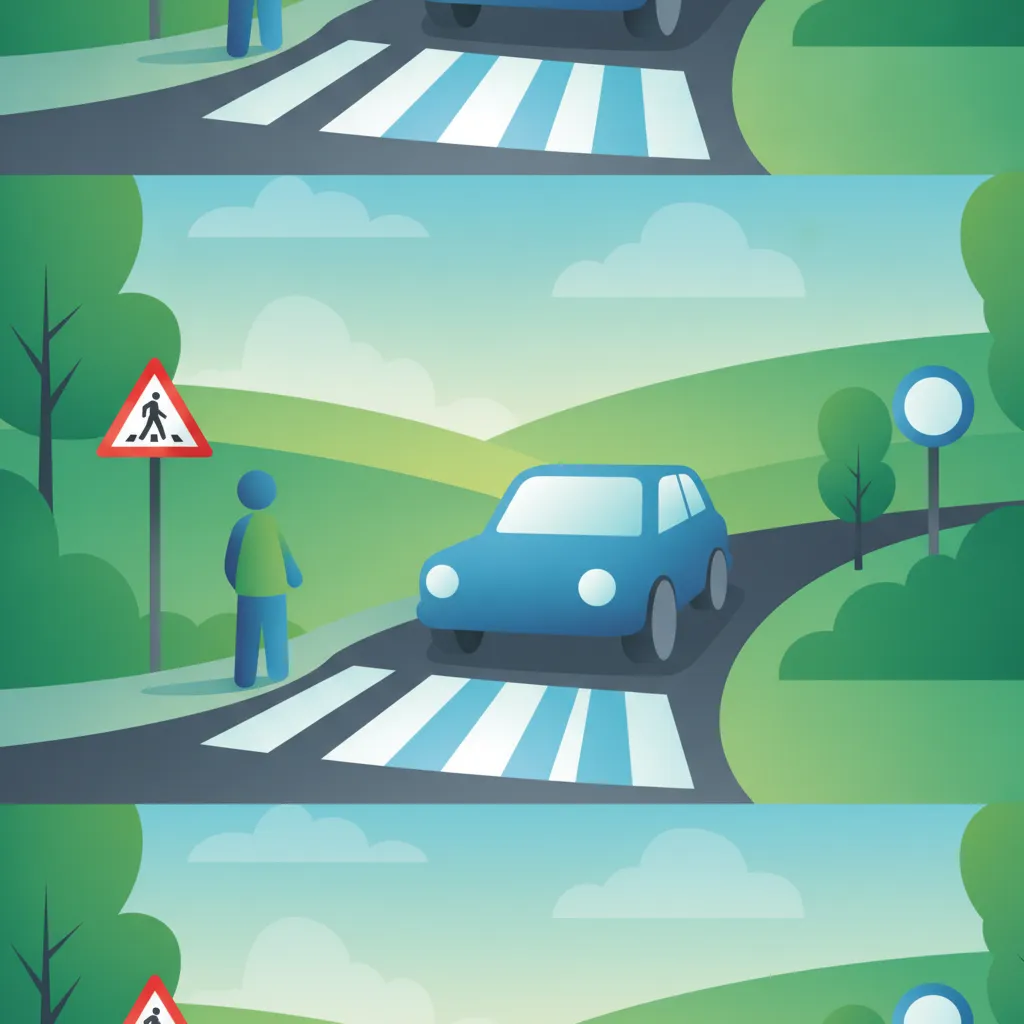
Theory topic content overview
Read the full theory topic guide for Pedestrian Priority with structured, easy-to-scan content built for learners in Austria. This detailed section explains the exact rule, meaning, traffic context, comparison points, and exam logic behind this Austrian driving theory topic so you can study faster, understand the concept more clearly, and avoid common interpretation mistakes on the theory test.
Pedestrian priority rules are fundamental to ensuring safety on Austrian roads, placing significant responsibility on drivers to protect vulnerable road users. In Austria, these rules are enshrined in the Straßenverkehrsordnung (StVO) and are a crucial part of the driving theory exam. Understanding when and how to yield to pedestrians is not just about avoiding fines, but about actively preventing accidents and fostering a safe traffic environment.
Pedestrian priority refers to specific situations where pedestrians have the legal right to cross the road ahead of oncoming vehicles, and drivers are legally obliged to stop or slow down to allow them to do so safely. This concept is vital in Austrian driving theory because pedestrians, lacking physical protection, are the most vulnerable participants in road traffic. Drivers must be prepared to anticipate pedestrian movements and adjust their driving accordingly, ensuring a safe passage for those on foot.
Understanding pedestrian priority is critical for several reasons:
StVO) clearly defines driver obligations. Failing to yield to pedestrians where they have priority can result in significant penalties and points on your license.Vertrauensgrundsatz correctly.In Austria, pedestrian priority mainly applies in these key situations:
Schutzweg or Zebrastreifen)The most recognized area where pedestrians have priority is at a Schutzweg, often called a Zebrastreifen due to its white stripes on the road.
Schutzweg, drivers must slow down considerably, observe the crossing and its surroundings carefully, and be prepared to stop.Schutzweg or clearly intending to step onto it. This means stopping your vehicle completely, even if they are only just approaching the edge.Schutzweg to allow pedestrians to cross, as this could dangerously obstruct your view or cause an accident.Even at intersections without a marked Schutzweg, drivers often have to yield to pedestrians:
Schutzweg is regulated by traffic lights, both drivers and pedestrians must obey their respective signals. Pedestrians only have priority when they have a green light.Begegnungszonen (Shared Zones): In designated Begegnungszonen, vehicles are permitted, but pedestrians are allowed to use the entire road space. Drivers must exercise extreme caution, adapt their speed (often limited to 20 km/h or 30 km/h), and never endanger pedestrians. Pedestrians technically have priority over vehicles, but both must exercise mutual consideration.Haltestellenbereich): When approaching a bus or tram stop, especially if public transport is arriving or departing, drivers must be extra vigilant for pedestrians crossing to or from the stop. While not always formal priority, extreme caution is mandatory.Vertrauensgrundsatz and its LimitsIn Austrian traffic law, the Vertrauensgrundsatz (Principle of Trust) states that road users can generally trust that other road users will obey traffic rules. However, this principle has crucial exceptions, particularly regarding vulnerable road users:
Vertrauensgrundsatz when dealing with children. Children's behaviour is unpredictable, and drivers must always anticipate sudden movements or misunderstandings of traffic rules.Vertrauensgrundsatz when encountering visually impaired individuals, identifiable by a white cane or yellow armband. They may not perceive traffic dangers in the same way.Learners in Austria often make these mistakes regarding pedestrian priority:
Schutzweg yet. Always assume the pedestrian will cross if they are looking towards the crossing or show any signs of movement.Schutzwege with reduced speed and readiness to stop. This can endanger the pedestrian and other traffic.Schutzwege: Never overtake another vehicle that has stopped at a Schutzweg. This is extremely dangerous and strictly forbidden.Schutzweg, pedestrians don't have priority.Vertrauensgrundsatz: Assuming children or visually impaired persons will follow rules. This is a critical error in Austrian theory and practice.Pedestrian priority in Austria is not just a rule; it's a core principle of safety and mutual consideration. Always approach areas where pedestrians might be present (especially Schutzwege and intersections) with extreme caution, reduced speed, and a readiness to stop. Remember your heightened responsibility towards children, visually impaired, and other vulnerable road users, overriding the Vertrauensgrundsatz in these cases. Proactive observation and anticipation are your most important tools for ensuring pedestrian safety and passing your Austrian driving theory exam successfully.
Pedestrian priority in Austria is governed by the StVO and places significant responsibility on drivers to protect vulnerable road users. At marked Schutzwege, pedestrians have absolute priority and drivers must stop completely for anyone on or intending to cross, never overtaking stopped vehicles at crossings. When turning at intersections, drivers must yield to pedestrians crossing the road they enter regardless of markings. The Vertrauensgrundsatz (Principle of Trust) does not apply to children, visually impaired persons, or other vulnerable individuals, requiring drivers to actively anticipate unpredictable behavior. Begegnungszonen and public transport stops require heightened caution with pedestrians permitted to use full road space.
A short set of high-value points that capture the most important ideas from this theory explanation.
Pedestrians have absolute priority at marked Schutzweg (Zebrastreifen) crossings and drivers must stop completely for anyone on or clearly intending to enter.
When turning at any intersection, drivers must yield to pedestrians crossing the road they are turning into, regardless of whether markings exist.
The Vertrauensgrundsatz (Principle of Trust) does not apply to children, visually impaired persons, or visibly impaired individuals—drivers must always anticipate unpredictable behavior from these groups.
In Begegnungszonen (shared zones), pedestrians may use the full roadway and have priority, requiring drivers to proceed with extreme caution at very low speeds.
Never overtake another vehicle that has stopped at a Schutzweg, as this blocks your view and endangers crossing pedestrians.
At a Schutzweg: slow down, observe, and stop completely for pedestrians already on or clearly approaching the crossing.
When turning: pedestrians crossing your intended lane of travel always have priority, even without markings.
Vertrauensgrundsatz exceptions: children, visually impaired (white cane/yellow armband), and elderly or impaired persons require proactive driver anticipation.
At traffic lights controlling a Schutzweg: pedestrians only have priority when their signal shows green.
In Begegnungszonen: maximum caution applies with pedestrians permitted to use the entire road space.
Failing to recognize when a pedestrian intends to cross (looking toward the crossing or showing movement) and proceeding without stopping.
Approaching Schutzwege at full speed and braking abruptly instead of reducing speed early with readiness to stop.
Assuming no Schutzweg means no pedestrian priority when turning at intersections, neglecting the turning yield rule.
Misapplying the Vertrauensgrundsatz by trusting that children or visually impaired persons will follow traffic rules correctly.
Moving forward before a pedestrian has fully cleared all lanes the vehicle would cross, making pedestrians feel rushed.
Start with a short, direct summary of Pedestrian Priority before reading the full explanation below.
Pedestrian priority in Austria means drivers must yield to pedestrians in designated areas like marked pedestrian crossings (Zebrastreifen/Schutzweg) and often when turning at intersections. Drivers must approach these areas cautiously, be prepared to stop, and ensure pedestrians can cross safely before proceeding. This is a fundamental principle of road safety to protect vulnerable road users.
Review the most important terms, rule signals, and traffic concepts linked to Pedestrian Priority.
Explore related theory topic pages connected to Pedestrian Priority and continue with the next useful rule explanation.
See the common search queries learners use when trying to understand Pedestrian Priority in Austria.

Ready to delve deeper into specific theory topics? Continue exploring detailed explanations of Austrian road signs, traffic rules, and critical driving situations. Solidify your knowledge, clarify any doubts, and ensure you're fully prepared for every aspect of your official driving licence theory exam.
Austrian Driving Theory TopicsTheory topic content overview
A short set of high-value points that capture the most important ideas from this theory explanation.
Pedestrians have absolute priority at marked Schutzweg (Zebrastreifen) crossings and drivers must stop completely for anyone on or clearly intending to enter.
When turning at any intersection, drivers must yield to pedestrians crossing the road they are turning into, regardless of whether markings exist.
The Vertrauensgrundsatz (Principle of Trust) does not apply to children, visually impaired persons, or visibly impaired individuals—drivers must always anticipate unpredictable behavior from these groups.
In Begegnungszonen (shared zones), pedestrians may use the full roadway and have priority, requiring drivers to proceed with extreme caution at very low speeds.
Never overtake another vehicle that has stopped at a Schutzweg, as this blocks your view and endangers crossing pedestrians.
At a Schutzweg: slow down, observe, and stop completely for pedestrians already on or clearly approaching the crossing.
When turning: pedestrians crossing your intended lane of travel always have priority, even without markings.
Vertrauensgrundsatz exceptions: children, visually impaired (white cane/yellow armband), and elderly or impaired persons require proactive driver anticipation.
At traffic lights controlling a Schutzweg: pedestrians only have priority when their signal shows green.
In Begegnungszonen: maximum caution applies with pedestrians permitted to use the entire road space.
Failing to recognize when a pedestrian intends to cross (looking toward the crossing or showing movement) and proceeding without stopping.
Approaching Schutzwege at full speed and braking abruptly instead of reducing speed early with readiness to stop.
Assuming no Schutzweg means no pedestrian priority when turning at intersections, neglecting the turning yield rule.
Misapplying the Vertrauensgrundsatz by trusting that children or visually impaired persons will follow traffic rules correctly.
Moving forward before a pedestrian has fully cleared all lanes the vehicle would cross, making pedestrians feel rushed.
Start with a short, direct summary of Pedestrian Priority before reading the full explanation below.
Pedestrian priority in Austria means drivers must yield to pedestrians in designated areas like marked pedestrian crossings (Zebrastreifen/Schutzweg) and often when turning at intersections. Drivers must approach these areas cautiously, be prepared to stop, and ensure pedestrians can cross safely before proceeding. This is a fundamental principle of road safety to protect vulnerable road users.
Review the most important terms, rule signals, and traffic concepts linked to Pedestrian Priority.
Explore related theory topic pages connected to Pedestrian Priority and continue with the next useful rule explanation.
See the common search queries learners use when trying to understand Pedestrian Priority in Austria.
Ready to delve deeper into specific theory topics? Continue exploring detailed explanations of Austrian road signs, traffic rules, and critical driving situations. Solidify your knowledge, clarify any doubts, and ensure you're fully prepared for every aspect of your official driving licence theory exam.
Austrian Driving Theory TopicsUse this exam-focused revision tip to understand how Pedestrian Priority is likely to appear in theory questions for learners in Austria. This section helps you identify the most testable part of the rule, avoid common traps, and remember the concept more effectively during Austrian driving theory exam preparation.
In the Austrian theory exam, pedestrian priority questions often test your ability to anticipate pedestrian behavior, especially involving children or at unmarked crossings when turning. Always prioritize safety: if there's any doubt about a pedestrian's intent, assume they will cross and be prepared to stop. Failing to yield is a common and serious mistake.
Read direct answers to the most common learner questions about Pedestrian Priority in Austria. This FAQ focuses on rule confusion, practical meaning, comparison with similar concepts, and the exact uncertainties that appear most often in Austrian driving theory revision and exam preparation.
In Austria, pedestrians generally have priority at marked pedestrian crossings (known as 'Schutzweg' or 'Zebrastreifen'), when already crossing the road a vehicle is turning into, and sometimes in special zones like 'Begegnungszonen' (shared zones).
A 'Schutzweg' or 'Zebrastreifen' is a marked pedestrian crossing (zebra stripes) where drivers must stop and allow pedestrians to cross safely. Drivers must approach these cautiously and be ready to stop if pedestrians are on or intending to step onto the crossing.
When turning at an intersection in Austria, drivers must yield to pedestrians who are already crossing or clearly intending to cross the road you are turning into, even if there isn't a marked 'Schutzweg'.
The 'Vertrauensgrundsatz' (principle of trust) in Austrian traffic law means drivers generally trust other road users to follow rules. However, this principle is limited for vulnerable users like children, visually impaired persons (with white cane/yellow armband), or clearly impaired individuals, meaning drivers must exercise extra caution for them.
You must exercise extreme caution. Even if a child does not formally have priority or clearly indicate intent to cross, you must slow down, be prepared to stop, and ensure their safety. Children's behavior in traffic can be unpredictable.
Yes, at designated public transport stops, drivers must be especially cautious. If passengers are entering or exiting a bus or tram, drivers must stop and allow them to cross the road safely if necessary, particularly if there's no dedicated island.
Refine your study plan by searching for specific Austrian driving theory practice sets. Pinpoint questions related to particular road rules, signs, or challenge levels, and begin practicing immediately to reinforce your knowledge and excel in your official exam with confidence. Get started with focused revision today.