
In Austrian urban environments, interacting safely with trams (Straßenbahnen) and other public transport like buses requires specific knowledge of priority rules. Unlike other vehicles, trams are bound to their tracks and have significantly longer stopping distances. This section clarifies when you must yield to these vehicles, helping you navigate complex traffic situations correctly and confidently.
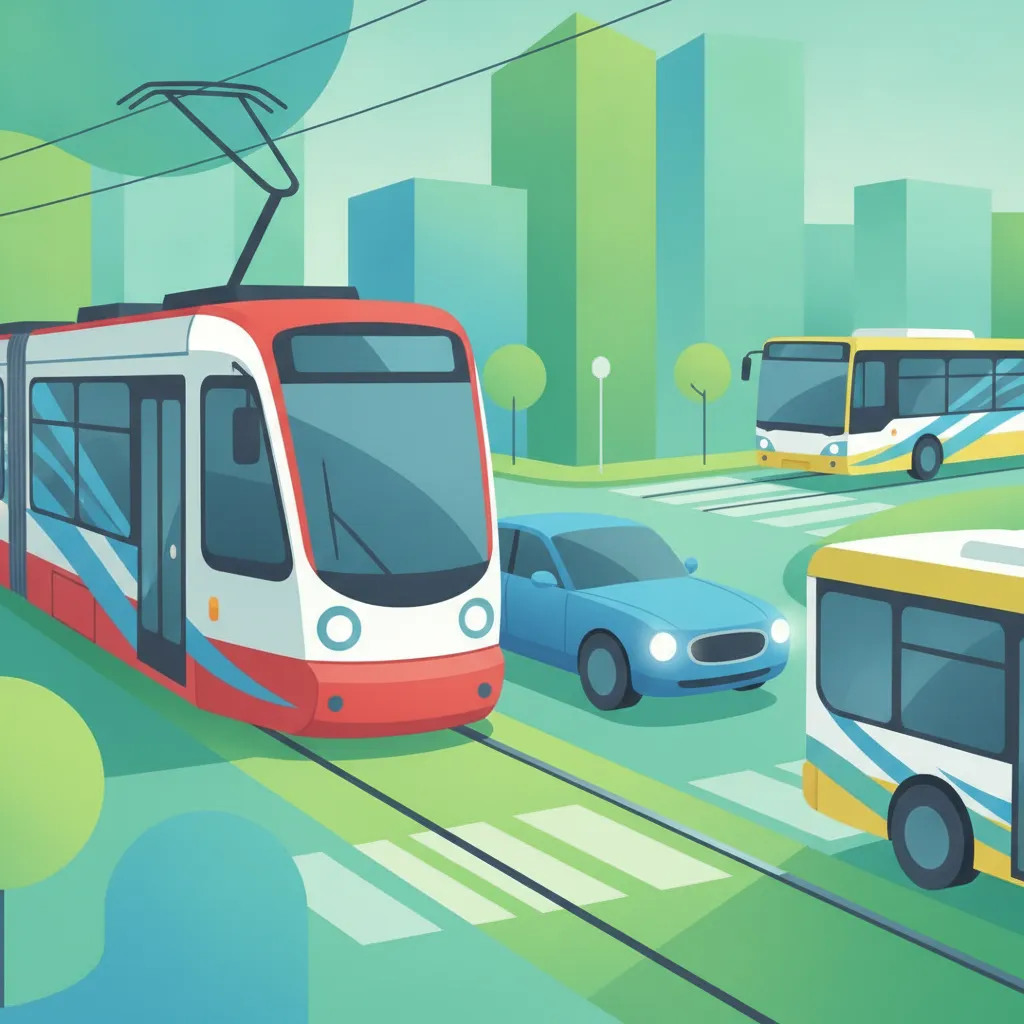
Theory topic content overview
Read the full theory topic guide for Tram & Public Transport Priority with structured, easy-to-scan content built for learners in Austria. This detailed section explains the exact rule, meaning, traffic context, comparison points, and exam logic behind this Austrian driving theory topic so you can study faster, understand the concept more clearly, and avoid common interpretation mistakes on the theory test.
In Austria, understanding the special priority rules for trams (Straßenbahnen) and certain other public transport vehicles is paramount for safe and legal driving. Unlike private vehicles, trams operate on fixed tracks and have limited maneuverability and significantly longer stopping distances due to their weight. This inherent rigidity necessitates specific priority rules to ensure smooth operation, passenger safety, and efficient urban traffic flow.
The core principle in Austrian traffic, as laid out in the Straßenverkehrsordnung (StVO), is that trams generally have priority. This fundamental rule often overrides other common priority conventions, such as "Rechts vor Links" (right-before-left), making it a crucial concept for all drivers, especially in bustling city environments like Vienna, Graz, or Linz.
The unique status of trams and public transport vehicles is not arbitrary. It's rooted in practical realities and safety imperatives:
Understanding the general principle is one thing; applying it in specific Austrian traffic situations is another. Here's a breakdown:
The golden rule for tram and public transport priority in Austria is simple: Trams run on rails, you don't. You adapt. Always assume trams have priority unless a traffic light or specific sign unequivocally states otherwise. For buses, especially at designated stops, be courteous and yield to support the efficient flow of public transport. Your proactive attention and willingness to yield ensure safety for all road users and smooth traffic operations in Austrian urban environments.
Austrian traffic law grants trams special priority because they run on fixed rails and cannot swerve, making them the primary exception to the 'Rechts vor Links' rule at unmarked intersections. Drivers must yield to trams at all intersections without conflicting signals and must slow down or stop when trams are stationary at Haltestellen to ensure passenger safety. Traffic lights and specific priority signs can override general tram priority. For Linienbusse, drivers should yield when buses signal to re-enter traffic from designated stops. These rules are frequently tested in the Austrian theory exam and are essential for safe urban driving in cities like Vienna, Graz, and Linz.
A short set of high-value points that capture the most important ideas from this theory explanation.
Trams (Straßenbahnen) generally have priority in Austrian traffic due to their fixed tracks and inability to swerve, overriding the standard 'Rechts vor Links' rule at unmarked intersections
When a tram is stopped at a Haltestelle, you must slow down or stop to allow passengers to board and alight safely, proceeding only when the roadway is clear
Traffic lights and explicit priority signs take precedence over general tram priority rules
Linienbusse pulling out from designated stops have priority to re-enter traffic flow, and other drivers should yield
You must never block tram tracks or enter an intersection where you might become stationary on the tracks
Trams override Rechts vor Links – always yield to a tram at an unmarked intersection unless signals or signs state otherwise
Reduce speed and be prepared to stop when passing a stationary tram at a Haltestelle
Overtaking a tram on the left is generally forbidden in Austria unless on a one-way street or unavoidable
Trams require significantly longer stopping distances than cars – never assume a tram can stop quickly
Bus pull-out priority applies to Linienbusse signaling to leave a designated stop in urban areas
Applying 'Rechts vor Links' to situations involving trams, forgetting they have exceptional priority
Failing to slow down when passing a tram stopped at a Haltestelle with passengers boarding or alighting
Entering an intersection or road section where you may become stationary on tram tracks
Underestimating how far a tram needs to stop and pulling out in front of one
Ignoring Linienbus turn signals when the bus is pulling out from a designated stop
Start with a short, direct summary of Tram & Public Transport Priority before reading the full explanation below.
Trams and designated public transport vehicles in Austria typically have priority due to their limited maneuverability and longer stopping distances. Drivers must yield to trams, especially at intersections and near stops, even if other priority rules might suggest otherwise for private vehicles. Always be prepared to stop and ensure clear passage for these essential urban transport systems.
Review the most important terms, rule signals, and traffic concepts linked to Tram & Public Transport Priority.
Explore related theory topic pages connected to Tram & Public Transport Priority and continue with the next useful rule explanation.
See the common search queries learners use when trying to understand Tram & Public Transport Priority in Austria.

Ready to delve deeper into specific theory topics? Continue exploring detailed explanations of Austrian road signs, traffic rules, and critical driving situations. Solidify your knowledge, clarify any doubts, and ensure you're fully prepared for every aspect of your official driving licence theory exam.
Austrian Driving Theory TopicsTheory topic content overview
A short set of high-value points that capture the most important ideas from this theory explanation.
Trams (Straßenbahnen) generally have priority in Austrian traffic due to their fixed tracks and inability to swerve, overriding the standard 'Rechts vor Links' rule at unmarked intersections
When a tram is stopped at a Haltestelle, you must slow down or stop to allow passengers to board and alight safely, proceeding only when the roadway is clear
Traffic lights and explicit priority signs take precedence over general tram priority rules
Linienbusse pulling out from designated stops have priority to re-enter traffic flow, and other drivers should yield
You must never block tram tracks or enter an intersection where you might become stationary on the tracks
Trams override Rechts vor Links – always yield to a tram at an unmarked intersection unless signals or signs state otherwise
Reduce speed and be prepared to stop when passing a stationary tram at a Haltestelle
Overtaking a tram on the left is generally forbidden in Austria unless on a one-way street or unavoidable
Trams require significantly longer stopping distances than cars – never assume a tram can stop quickly
Bus pull-out priority applies to Linienbusse signaling to leave a designated stop in urban areas
Applying 'Rechts vor Links' to situations involving trams, forgetting they have exceptional priority
Failing to slow down when passing a tram stopped at a Haltestelle with passengers boarding or alighting
Entering an intersection or road section where you may become stationary on tram tracks
Underestimating how far a tram needs to stop and pulling out in front of one
Ignoring Linienbus turn signals when the bus is pulling out from a designated stop
Start with a short, direct summary of Tram & Public Transport Priority before reading the full explanation below.
Trams and designated public transport vehicles in Austria typically have priority due to their limited maneuverability and longer stopping distances. Drivers must yield to trams, especially at intersections and near stops, even if other priority rules might suggest otherwise for private vehicles. Always be prepared to stop and ensure clear passage for these essential urban transport systems.
Review the most important terms, rule signals, and traffic concepts linked to Tram & Public Transport Priority.
Explore related theory topic pages connected to Tram & Public Transport Priority and continue with the next useful rule explanation.
See the common search queries learners use when trying to understand Tram & Public Transport Priority in Austria.
Ready to delve deeper into specific theory topics? Continue exploring detailed explanations of Austrian road signs, traffic rules, and critical driving situations. Solidify your knowledge, clarify any doubts, and ensure you're fully prepared for every aspect of your official driving licence theory exam.
Austrian Driving Theory TopicsUse this exam-focused revision tip to understand how Tram & Public Transport Priority is likely to appear in theory questions for learners in Austria. This section helps you identify the most testable part of the rule, avoid common traps, and remember the concept more effectively during Austrian driving theory exam preparation.
The Austrian theory exam often tests your understanding of tram priority in urban scenarios. Remember that a tram's inability to swerve means you are almost always responsible for yielding, even if a 'right-before-left' rule might seem to apply. Pay close attention to tram tracks and stops in test questions, as these are common traps.
Read direct answers to the most common learner questions about Tram & Public Transport Priority in Austria. This FAQ focuses on rule confusion, practical meaning, comparison with similar concepts, and the exact uncertainties that appear most often in Austrian driving theory revision and exam preparation.
Trams operate on fixed tracks and have limited maneuverability and longer braking distances. Granting them priority ensures safety and smooth flow for a high-capacity public transport system, as stipulated by Austrian traffic law (StVO).
You must yield to trams at most intersections, especially when they are approaching or turning, and often when entering a road with tram tracks. Always give way to passengers boarding or alighting at designated tram stops.
Generally, no. Trams often have priority over the 'right before left' rule due to their operational constraints as 'Schienenfahrzeuge'. Always assume a tram has priority unless explicitly indicated otherwise by traffic signs or lights.
While buses don't have fixed tracks, certain situations in Austria grant them priority, such as when departing from designated bus stops, especially if they signal their intention to re-enter traffic. Drivers must facilitate this movement safely.
Yes. When a tram is stopped to allow passengers to board or alight, you must stop behind it and ensure passengers can cross the road safely and unimpeded. Only proceed when there is no danger to passengers, maintaining a safe distance.
StVO §28(2) in Austrian traffic law specifically outlines provisions concerning 'Schienenfahrzeuge' (rail vehicles), establishing their special status and priority in various traffic situations. This legal basis often means trams override general priority rules for other road users.
Refine your study plan by searching for specific Austrian driving theory practice sets. Pinpoint questions related to particular road rules, signs, or challenge levels, and begin practicing immediately to reinforce your knowledge and excel in your official exam with confidence. Get started with focused revision today.