
Navigating rural roads requires a disciplined approach, especially when dealing with slow-moving agricultural equipment or heavy goods vehicles that restrict your view of the road ahead. This guide breaks down the essential rules for safe overtaking, helping you develop the patience and defensive driving techniques required to pass your DVSA theory test and become a safer driver on the road.
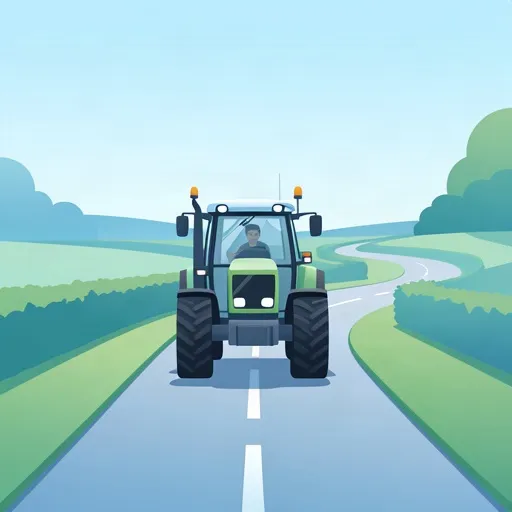
Article content overview
Driving on rural roads in Great Britain presents unique challenges that every learner must master to pass their DVSA theory test and become a safe, considerate motorist. Encountering slow-moving agricultural vehicles or heavy goods vehicles (HGVs) is common, and knowing how to handle these situations is a core component of the Highway Code. Impatience is a leading cause of accidents on country roads, often stemming from a failure to assess visibility and the time required to complete a manoeuvre.
When you are following a large vehicle, your vision of the road ahead is significantly restricted. This is precisely why Highway Code Rule 164 advises that you should "drop back" when following large or agricultural vehicles. By increasing the distance between your vehicle and the one ahead, you gain a better field of vision, allowing you to see further down the road, identify potential hazards, and observe oncoming traffic that might otherwise be hidden.
Furthermore, keeping a safe following distance allows the driver of the large vehicle to see you in their mirrors. If you sit too close, you remain in their blind spot, which is a major safety hazard. If a problem develops on the road, the driver ahead may need to brake suddenly or change position; having that extra space gives you the reaction time necessary to avoid a collision.
Never assume you can follow a vehicle ahead that is currently overtaking a large vehicle. There may only be enough room for one vehicle, and if the driver ahead is forced to abort their manoeuvre, you could be left with nowhere to go. Always make your own independent assessment of whether it is safe to proceed.
Overtaking is one of the most complex manoeuvres you will perform. Before you decide to pull out, you must ensure that you have enough room to complete the overtake comfortably without forcing other road users to take evasive action. It takes significantly longer to pass a long vehicle than a car, and you must never use the size of your own vehicle to intimidate others.
In the hazard perception part of your theory test, you may be presented with scenarios involving slow-moving tractors or HGVs. The DVSA expects you to demonstrate "defensive driving" habits. This means you should prioritize safety over reaching your destination a few seconds faster. If you are ever in doubt about whether it is safe to overtake, the correct decision is always to remain behind the vehicle.
If a faster-moving vehicle approaches from behind you while you are waiting to overtake, do not pull out. If you pull out to overtake at the wrong time, you risk forcing the faster vehicle behind you to brake sharply, which is a major fault. Professional road conduct involves showing consideration to all road users and maintaining a calm, predictable driving style.
While the general rule is to overtake on the right, there are specific, limited circumstances where you may overtake on the left. According to Rule 161, you may only overtake on the left if the vehicle in front is signalling to turn right and there is sufficient room to pass them safely. Understanding these nuances is essential for success in your theory exam, as examiners look for your ability to apply these rules in specific, real-world contexts.
This article covers the essential procedures for safely overtaking large vehicles and tractors on rural roads, which are common on DVSA theory test hazard perception scenarios. The core principle is the drop-back technique from Highway Code Rule 164, which gives you better visibility and keeps you out of blind spots. A five-step pre-overtake checklist covers mirror checks, blind spot assessments, road clearance, signalling, and decisive execution. The article emphasizes defensive driving habits, including making independent assessments rather than following other vehicles and always choosing patience over risk when unsure.
A short set of high-value points that capture the most important ideas from this article.
The drop-back technique (Highway Code Rule 164) increases your following distance behind large vehicles to improve your view of the road ahead and avoid blind spots
Overtaking a long vehicle takes significantly longer than overtaking a car, so you need much more clear road ahead
You must make your own independent assessment of whether it is safe to overtake, never rely on following another vehicle that is already overtaking
When in doubt about whether to overtake, the safest decision is always to remain behind the vehicle
Large vehicles have substantial blind spots where you cannot be seen in their mirrors, making proper following distance critical
Highway Code Rule 164 advises dropping back when following large or agricultural vehicles to improve visibility
Rule 161 specifies that overtaking on the left is only permitted when the vehicle ahead is signalling right and there is sufficient room
Maintaining extra following distance gives you reaction time if the vehicle ahead brakes suddenly or needs to change position
A faster vehicle approaching from behind while you wait to overtake means you should not pull out to overtake
The DVSA expects learners to demonstrate defensive driving habits in hazard perception scenarios
Sitting too close behind a large vehicle and remaining in the driver's blind spot
Assuming it is safe to overtake just because the vehicle ahead has already started overtaking, as there may only be room for one vehicle
Rushing an overtake to avoid waiting, which can lead to misjudging distance and speed
Forgetting to check mirrors and blind spots before initiating an overtake manoeuvre
Pulling out to overtake when a faster vehicle is approaching from behind, forcing them to brake sharply
Article content overview
A short set of high-value points that capture the most important ideas from this article.
The drop-back technique (Highway Code Rule 164) increases your following distance behind large vehicles to improve your view of the road ahead and avoid blind spots
Overtaking a long vehicle takes significantly longer than overtaking a car, so you need much more clear road ahead
You must make your own independent assessment of whether it is safe to overtake, never rely on following another vehicle that is already overtaking
When in doubt about whether to overtake, the safest decision is always to remain behind the vehicle
Large vehicles have substantial blind spots where you cannot be seen in their mirrors, making proper following distance critical
Highway Code Rule 164 advises dropping back when following large or agricultural vehicles to improve visibility
Rule 161 specifies that overtaking on the left is only permitted when the vehicle ahead is signalling right and there is sufficient room
Maintaining extra following distance gives you reaction time if the vehicle ahead brakes suddenly or needs to change position
A faster vehicle approaching from behind while you wait to overtake means you should not pull out to overtake
The DVSA expects learners to demonstrate defensive driving habits in hazard perception scenarios
Sitting too close behind a large vehicle and remaining in the driver's blind spot
Assuming it is safe to overtake just because the vehicle ahead has already started overtaking, as there may only be room for one vehicle
Rushing an overtake to avoid waiting, which can lead to misjudging distance and speed
Forgetting to check mirrors and blind spots before initiating an overtake manoeuvre
Pulling out to overtake when a faster vehicle is approaching from behind, forcing them to brake sharply
Explore related topics, search based questions, and concepts that learners often look up when studying Overtaking Large Vehicles and Tractors. These themes reflect real search intent and help you understand how this topic connects to wider driving theory knowledge in Great Britain.
Find clear and practical answers to common questions learners often have about Overtaking Large Vehicles and Tractors. This section helps explain difficult points, remove confusion, and reinforce the key driving theory concepts that matter for learners in Great Britain.
Dropping back increases your field of vision, allowing you to see the road ahead more clearly, and ensures the driver of the large vehicle can see you in their mirrors.
No. You should not assume it is safe to follow another vehicle during an overtake, as there may only be enough road space for one vehicle to complete the maneuver safely.
These vehicles are often wider than they appear and may have trailers or equipment attached; the maneuver takes longer than passing a standard car, so ensure you have sufficient clear road space before committing.
Absolutely not. Professional driving requires consideration for all road users; you should never use your vehicle's size to pressure or intimidate others.
Explore our extensive library of Great Britain driving theory articles to clarify any topic, review specific road rules, or gain deeper insights into vehicle safety and the Highway Code. Use the search to find exactly what you need for comprehensive DVSA theory test preparation.