
This lesson explains the legal consequences of traffic offences for motorcycle riders in Great Britain. You will learn how the penalty points system functions, the implications of fines, and the specific rules regarding licence revocation for new riders.
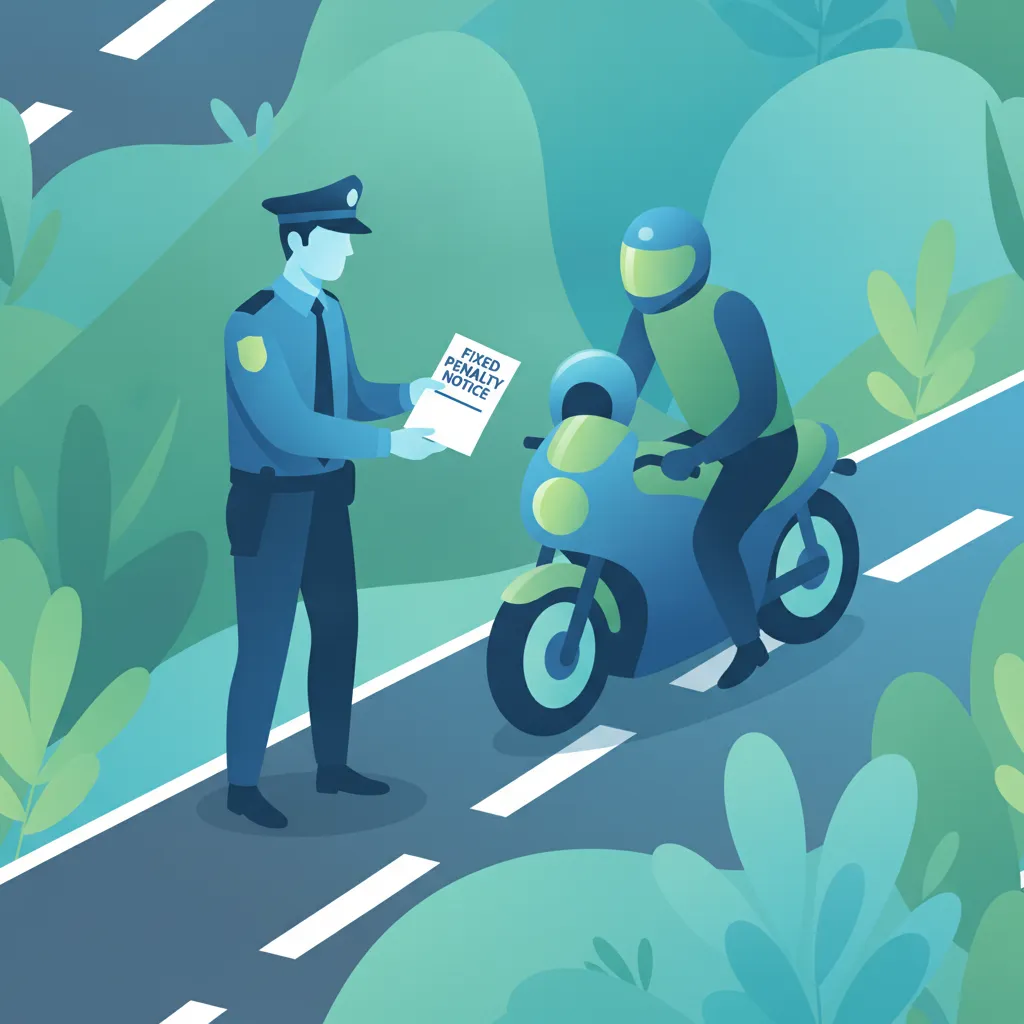
Lesson content overview
Operating a motorcycle on public roads in Great Britain comes with significant responsibilities. Beyond mastering the practical skills of riding, it is crucial for every rider to have a thorough understanding of the legal framework that governs traffic offences, including the consequences of breaking the law. This lesson provides a detailed exposition of the penalty points system, the structure of fines, and the procedures that can lead to licence disqualification or revocation for motorcyclists.
Understanding these legal ramifications is not merely about avoiding punishment; it is an essential part of becoming a safe, responsible, and compliant road user. Knowledge of the penalty system directly influences rider behaviour, risk assessment, and decision-making on the road, encouraging a proactive approach to safety and legal adherence.
The core of Great Britain's system for dealing with traffic offences is the penalty points system, also known as endorsements. When a motorcyclist commits a traffic offence, a certain number of points are recorded on their driving licence. These points serve as a measurable record of unsafe or illegal behaviour and accumulate over time.
Each offence is assigned a specific number of points, typically ranging from 1 to 9, depending on its severity. For instance, minor infractions like certain failures to obey signage might incur fewer points, while serious offences such as using a mobile phone while riding will result in a higher penalty. Critically, these points do not simply disappear after a short period; they remain on a rider's licence for a prescribed duration, typically four years from the date of the offence, though some severe offences may lead to points remaining for up to 11 years.
It is a common misunderstanding that points "reset" after a year or that paying a fine automatically clears them. Neither is true. Points are actively counted for disqualification purposes within a specific rolling three-year window, but their presence on the licence for insurance and other administrative checks lasts longer.
Penalty Points (Endorsements) are numeric units recorded on a rider’s licence for traffic offences, remaining for a statutory period. A standard rider faces disqualification at 12 points, while new riders face it at 6 points.
The number of penalty points assigned reflects the potential danger or illegality of the offence. This tiered approach aims to provide a proportionate response to different types of traffic violations.
Each point added to your licence contributes to your cumulative total for the purpose of the 'totting-up' procedure, which determines if a disqualification should be enforced. Understanding these point values is crucial for all motorcyclists to grasp the potential consequences of their actions.
The 'totting-up' procedure is the legal mechanism designed to ensure that repeated or severe infractions lead to escalating consequences, ultimately protecting all road users. It involves aggregating all penalty points a rider has accrued within a specific three-year period.
When a motorcyclist commits an offence that incurs points, their current points record is checked. If the total number of live points (those within the three-year rolling window) meets or exceeds a defined threshold, an automatic disqualification from riding follows. This procedure applies to all riders, but with different thresholds based on experience.
The three-year window for 'totting-up' is rolling. This means points are continuously counted from the date of each offence. There is no automatic "reset" after a fixed period like a calendar year.
The system employs different thresholds to acknowledge the varying risk levels associated with rider experience:
Upon crossing the applicable threshold, the rider is automatically disqualified for a statutory minimum period. For a first disqualification under the totting-up procedure, the minimum period is six months. This period can increase to one year for a second disqualification within three years, and two years for a third disqualification within three years, depending on the severity and frequency of offences. Courts also have the discretion to impose longer disqualification periods for particularly dangerous or egregious behaviours.
Licence revocation is a more severe outcome than temporary disqualification. It involves the administrative removal of a rider’s legal entitlement to ride. Revocation can occur for several reasons, including:
When a licence is revoked, the rider must immediately cease riding. Riding a motorcycle without a valid licence is a criminal offence, carrying further severe penalties. Reinstatement of a revoked licence is a complex process and may require retaking parts of the theory test, undertaking a mandatory remedial riding course, or waiting out a significantly longer cooling-off period before being eligible to apply for a new provisional licence and start the testing process again.
The legal removal of riding privileges, often following a disqualification or failure to satisfy financial penalties. It may require the rider to retake driving tests to regain their licence.
New riders, specifically those who have held their full motorcycle licence for less than two years, are subject to distinct and stricter rules within the penalty points system. This "new rider" status is critical because it significantly lowers the disqualification threshold, offering additional protection to less experienced motorcyclists and encouraging the early adoption of safe riding habits.
The primary implication is the 6-point disqualification threshold. If a new rider accumulates 6 or more penalty points within their initial two-year probationary period, their licence will be revoked. This is a crucial difference from the 12-point threshold for standard, more experienced riders.
The rationale behind this lower threshold is to acknowledge the elevated risk associated with inexperience. New riders are statistically more likely to be involved in accidents due to a lack of developed hazard perception, judgment, and machine control skills. By imposing stricter penalties, the system aims to deter dangerous behaviour before it becomes ingrained, pushing new riders towards compliance and continuous improvement in safety.
For a new rider, receiving a Fixed Penalty Notice for even a relatively minor offence, such as using a handheld mobile device (6 points) or specific speeding infractions (3-6 points), could immediately lead to revocation or put them precariously close to the limit. Should a new rider's licence be revoked, they would typically have to reapply for a provisional licence and retake both the theory and practical tests to regain their full motorcycle entitlement.
If you are a new rider, be extra vigilant about your riding behaviour. Even minor infractions can quickly accumulate points that will lead to the revocation of your licence, meaning you will have to start the licensing process from scratch.
In addition to penalty points, traffic offences often result in monetary sanctions known as fines. These financial penalties serve as an immediate deterrent, proportionate to the offence's severity, and are a distinct consequence from points.
Fines for motorcyclists in Great Britain generally fall into two categories:
It is vital to understand that paying a fine does not typically remove any associated penalty points. The fine addresses the financial aspect of the penalty, while points address the rider's record and potential disqualification risk. Failure to pay a fine can lead to additional points, a court summons, and potentially more severe consequences, including licence revocation or even imprisonment in extreme cases. Payment deadlines for FPNs are typically 28 days.
A monetary penalty issued for minor traffic offences, offering an opportunity to avoid court proceedings by paying a set fine. It is often accompanied by penalty points.
Motorcyclists, like all road users, are subject to a wide range of traffic laws. Certain offences are particularly relevant or common among riders. Understanding these, along with their associated penalties, is crucial for maintaining a clean licence and ensuring safety.
Exceeding the speed limit is one of the most common offences and a significant contributor to road accidents. The severity of the penalty depends on how much the rider exceeds the limit and the road type.
Dangerous riding encompasses behaviours that fall significantly below the standard of a competent and careful driver and which might cause danger to other road users or oneself. This includes actions like weaving excessively through traffic, high-speed filtering with insufficient clearance, or reckless overtaking manoeuvres.
Wearing an approved safety helmet (ECE Regulation 22 standard) is mandatory for all motorcyclists and passengers on public roads in Great Britain. This rule is in place to significantly reduce the risk of head injury in the event of an accident.
Riding a motorcycle under the influence of alcohol or drugs is extremely dangerous and carries some of the most severe penalties. Alcohol and drugs severely impair judgment, reaction time, and coordination, drastically increasing the risk of a crash.
Having valid third-party insurance is a legal requirement for all motor vehicles on public roads. It ensures that victims of accidents can be compensated. Similarly, motorcycles over three years old require an annual Ministry of Transport (MOT) test to ensure they meet minimum safety and environmental standards.
Using a handheld mobile phone or similar device while riding a motorcycle is illegal and highly distracting. This includes making calls, texting, checking notifications, or using apps.
The exact penalty for an offence is not always static; it can be influenced by various contextual factors. Courts and even police officers have some discretion in applying penalties based on the specific circumstances surrounding an incident. These conditional variations often relate to factors that amplify the risk or severity of the offence.
These variations highlight that the legal system considers the overall context of an offence, aiming to mitigate risk and promote safer riding habits in all conditions.
The penalties and points system in Great Britain is underpinned by a robust legal framework, primarily derived from Acts of Parliament and statutory instruments. Familiarity with these foundational laws helps motorcyclists understand the legal basis of their obligations.
This is the primary piece of legislation governing road traffic in the UK. It outlines a wide range of driving offences, including dangerous driving, careless driving, drink and drug driving, and speeding. Most penalty points and fines are issued under provisions of this Act. For example, Section 2 covers driving offences broadly, while Section 3 relates to careless driving.
While not a direct legal statute, the Highway Code contains mandatory rules established by the Road Traffic Acts. Breaching these rules can be used in court as evidence to establish liability for an offence. Rule 10, for instance, explicitly mentions the penalty points system and the 12-point disqualification threshold.
These regulations specify the legal requirements for vehicle equipment, condition, and maintenance. This includes mandatory safety equipment such as helmets, lighting, brakes, and tyres. Non-compliance (e.g., riding with defective lights or an illegal exhaust modification) can lead to penalty points and fines.
This Act introduced significant amendments to road traffic law, including strengthening powers to deal with dangerous drivers and introducing new rules related to drug driving and speeding. Section 39, for example, reinforces the mechanisms for disqualification based on accumulated penalty points.
This amendment made riding a motorcycle without valid third-party insurance a serious offence, with mandatory penalties including a fine and endorsement of points.
Understanding the penalties for traffic offences is a strong deterrent, but true safety and legal compliance stem from proactive riding and a commitment to responsible behaviour. By integrating the knowledge of penalties into daily riding practices, motorcyclists can significantly reduce their risk of incurring points or fines.
By focusing on these proactive measures, motorcyclists can foster a culture of safety, ensuring a long and uninterrupted riding career free from the significant financial, legal, and personal costs associated with traffic penalties.
The Great Britain Motorcycle Theory Course emphasises not just the skills of riding, but also the legal responsibilities that accompany them. The penalty points system, coupled with fines and the possibility of disqualification or licence revocation, is designed to deter unsafe behaviour and ensure compliance with road traffic laws.
Understanding these rules is fundamental to a responsible riding career. It fosters a proactive approach to safety, reduces the likelihood of legal sanctions, and contributes to safer roads for everyone. This knowledge integrates directly with other units of your Great Britain Motorcycle Theory Course, building a foundation for defensive riding strategies and responsible conduct.
This lesson explains the penalty points system for motorcyclists in Great Britain, where points are recorded on your licence for traffic offences and accumulate within a rolling three-year window for disqualification purposes. Standard riders face disqualification at 12 points, while new riders (holding a full licence under two years) face the stricter 6-point threshold that triggers immediate licence revocation. Common offences include speeding (3-6 points), mobile phone use (6 points), dangerous riding (6-9 points), and drink driving (automatic 12-month minimum disqualification). Financial penalties range from £100 Fixed Penalty Notices to unlimited court fines, but paying a fine never removes associated penalty points from your record.
A short set of high-value points that capture the most important learning from this lesson.
Penalty points (endorsements) are recorded on your licence for traffic offences and remain for up to 11 years depending on severity
Standard riders face disqualification at 12 points accumulated within a rolling three-year window
New riders (licence held less than two years) face immediate licence revocation at just 6 points
Fixed Penalty Notices (FPNs) are issued for minor offences with set fines, while serious offences go to court with potentially unlimited fines
Paying a fine does not remove penalty points from your licence
Explore all units and lessons included in this driving theory course.
Points are counted within a rolling three-year window for totting-up disqualification, not a calendar year reset
New riders have half the disqualification threshold of standard riders due to inexperience
Using a handheld mobile phone while riding incurs 6 points, which alone can revoke a new rider's licence
Very serious offences like dangerous riding can result in immediate disqualification even without reaching 12 points
Licence revocation requires retaking both theory and practical tests to regain riding privileges
Believing points automatically reset after a year or that paying a fine clears points from your licence
New riders underestimating the 6-point threshold and thinking minor offences carry low risk
Assuming FPNs always avoid court and points when some serious offences require court appearances regardless
Confusing temporary disqualification periods with permanent licence revocation consequences
Overlooking how contextual factors (weather, night riding, vulnerable road users) can increase penalty severity
Lesson content overview
A short set of high-value points that capture the most important learning from this lesson.
Penalty points (endorsements) are recorded on your licence for traffic offences and remain for up to 11 years depending on severity
Standard riders face disqualification at 12 points accumulated within a rolling three-year window
New riders (licence held less than two years) face immediate licence revocation at just 6 points
Fixed Penalty Notices (FPNs) are issued for minor offences with set fines, while serious offences go to court with potentially unlimited fines
Paying a fine does not remove penalty points from your licence
Explore all units and lessons included in this driving theory course.
Points are counted within a rolling three-year window for totting-up disqualification, not a calendar year reset
New riders have half the disqualification threshold of standard riders due to inexperience
Using a handheld mobile phone while riding incurs 6 points, which alone can revoke a new rider's licence
Very serious offences like dangerous riding can result in immediate disqualification even without reaching 12 points
Licence revocation requires retaking both theory and practical tests to regain riding privileges
Believing points automatically reset after a year or that paying a fine clears points from your licence
New riders underestimating the 6-point threshold and thinking minor offences carry low risk
Assuming FPNs always avoid court and points when some serious offences require court appearances regardless
Confusing temporary disqualification periods with permanent licence revocation consequences
Overlooking how contextual factors (weather, night riding, vulnerable road users) can increase penalty severity
Explore search topics learners often look for when studying Penalties, Fines, and Licence Points for Motorcyclists. These topics reflect common questions about road rules, driving situations, safety guidance, and lesson level theory preparation for learners in Great Britain.
Browse additional driving theory lessons that cover connected traffic rules, road signs, and common driving situations related to this topic. Improve your understanding of how different rules interact across everyday traffic scenarios.
Learn how to improve your hazard perception and decision-making on the road. This guide covers proactive riding techniques that help you anticipate the actions of other road users and avoid dangerous traffic situations in Great Britain.

Defensive riding is the practice of actively anticipating potential hazards rather than just reacting to them. This lesson teaches you how to scan for clues, predict the actions of other road users, and position yourself to avoid trouble. By developing strong anticipation skills, you can significantly reduce your risk of being taken by surprise on the road.
This lesson focuses on developing advanced hazard perception skills and using them to manage your speed proactively. You will learn to constantly scan the road for potential dangers, anticipate the actions of other road users, and adjust your speed to give yourself more time to react. This defensive approach to speed management is fundamental to staying safe and avoiding emergency situations while riding in complex traffic environments.

This lesson teaches strategic road positioning techniques to maximize your visibility and safety in traffic. You will learn how to choose the correct lane position to avoid the blind spots of larger vehicles and how to communicate your intentions through predictable riding. Key skills covered include effective use of shoulder checks, making eye contact with drivers, and maintaining a safe following distance, all of which are crucial for defensive riding on British roads.

This lesson identifies behaviours that significantly increase a rider's risk of being involved in a collision. It explains the dangers of excessive speed, following too closely, and aggressive riding. You will learn how a rider's attitude and choices directly contribute to their safety and the legal penalties associated with these offences.

This lesson teaches you to interpret warning signs, which are typically triangular and designed to alert you to potential hazards ahead. You will learn the meanings of common signs indicating sharp curves, slippery surfaces, roadworks, or areas with frequent pedestrian or animal crossings. Understanding these signs is crucial for anticipating dangers and adjusting your speed and position defensively, which is especially important for vulnerable riders of AM vehicles.

This lesson prepares you for the specific challenges of driving in the countryside. It explains the correct procedure for overtaking horse riders: slow down and pass wide, ensuring you do not spook the animal. You will also learn how to anticipate and safely manage encounters with slow-moving tractors and other farm machinery.

This lesson introduces the skill of hazard perception, a critical component of the official theory test and safe driving. It teaches you to actively scan your environment for potential dangers, such as a pedestrian about to cross or a car waiting to emerge from a junction. By identifying these situations early, you can take action to avoid them turning into actual dangers.

This lesson teaches riders how to be constantly aware of blind spots to prevent collisions. You will learn the importance of the 'lifesaver' shoulder check before changing position, turning, or moving off. The content emphasizes active visual scanning of the road ahead and around you, along with developing the judgment needed to accurately assess traffic speed and create safe gaps for maneuvering in various traffic situations.
This lesson teaches drivers how to identify various types of vulnerable road users and anticipate their potential actions to prevent conflicts. It covers the specific risks associated with pedestrians, cyclists, motorcyclists, children, and elderly or disabled individuals. Emphasis is placed on heightened awareness and defensive driving techniques required to share the road safely. Understanding their perspectives and typical behaviours is key to protecting them and maintaining safety for everyone.

This lesson highlights why motorcyclists are considered vulnerable road users. It covers the increased risk of serious injury in a collision due to lack of physical protection compared to car occupants. You will learn about common visibility challenges and how to adopt proactive, defensive strategies to mitigate risks and anticipate potential hazards on the road.
Understand the full range of rider duties as set out in the Highway Code. This lesson explains mandatory vehicle checks, documentation requirements, and the legal obligations every motorcyclist must meet to remain compliant on British roads.

This lesson details the documentation a motorcyclist is legally required to produce when stopped by the police or a DVSA officer. It covers the driving licence, valid certificate of insurance, current MOT certificate, and the vehicle registration document (V5C). You will also learn about the legal consequences of failing to provide these documents, such as fines and penalty points.

This lesson details the crucial documentation required for legal driving in the UK. It explains the purpose of the V5C registration document, the MOT test certificate, and proof of insurance and road tax (Vehicle Excise Duty). You will learn where to keep these documents and when you might be required to present them to authorities.

This lesson focuses on the specific obligations a motorcyclist has according to the Highway Code. It emphasizes the legal duty of care towards other road users, pedestrians, and the environment. You will learn how to apply key rules on speed, lane positioning, and signalling from a rider's perspective to ensure safety and legal compliance.
This lesson details all the necessary documentation required at each stage of the AM licensing process, from applying for a provisional licence to attending your theory and practical tests. You will learn about the required forms of identification, proof of insurance, and vehicle registration documents. The lesson also provides a clear overview of the DVSA test procedures, explaining the format of the multiple-choice theory test, the hazard perception section, and the criteria for the practical assessment.

Knowing what to do at an accident scene can save lives. This lesson outlines the critical steps: ensuring your own safety, making the scene safe for others, assessing casualties, and calling the emergency services. It also covers your legal obligations to stop, report the collision, and exchange details with other parties involved.
This lesson guides you through the compulsory insurance and tax obligations for Category AM vehicles in Great Britain. It differentiates between third-party and comprehensive insurance policies and explains the legal necessity of each. Furthermore, it details the process for vehicle tax and registration, highlighting the severe consequences of non-compliance, which can include fines, penalty points, and even vehicle seizure, ensuring you understand how to keep your vehicle road-legal.

This lesson outlines the fundamental responsibilities of an AM driver on British roads, focusing on adherence to the Highway Code and cultivating a safety-first mindset. You will learn the principles of defensive riding, the importance of being visible to others, and the need to protect vulnerable road users like pedestrians and cyclists. The content also covers legal duties such as vehicle maintenance and conducting risk assessments before every journey to promote responsible road behaviour.

This lesson details the importance of wearing a legally compliant and correctly fitted motorcycle helmet. It explains UK and European safety standards (like ECE 22.06), the different types of helmets available, and how to check for a secure fit. You will also learn about helmet maintenance, visor regulations, and when a helmet should be replaced to ensure it remains effective.
Find clear answers to common questions learners have about Penalties, Fines, and Licence Points for Motorcyclists. Learn how the lesson is structured, which driving theory objectives it supports, and how it fits into the overall learning path of units and curriculum progression in Great Britain. These explanations help you understand key concepts, lesson flow, and exam focused study goals.
Under the Road Traffic (New Drivers) Act, if you receive 6 or more penalty points within two years of passing your first test, your licence is automatically revoked. You would then need to reapply for a provisional licence and pass both theory and practical tests again.
Most penalty points remain on your driving record for four years from the date of the offence. However, for more serious offences, they can remain for up to 11 years.
Yes, all riders face the risk of disqualification under the totting-up procedure if they accumulate 12 or more penalty points within a three-year period. This leads to a court appearance where a period of disqualification is usually determined.
Fines are generally based on the offence committed, such as speeding or failing to stop, rather than the type of vehicle. However, motorcycle-specific offences like failing to wear an approved helmet can carry their own set of penalties.
Dive into our comprehensive question bank to find exactly what you need for your Great Britain theory test. Use our advanced filters to pinpoint specific subjects or test your knowledge on challenging areas, ensuring you're fully prepared for success.