
Understanding the precise legal differences between cycling path types is a fundamental requirement for every driver in Germany. This guide clarifies the StVO-based restrictions for driving, stopping, and parking near bike infrastructure, while highlighting the legal obligations regarding the safety of vulnerable road users to help you pass the theory test with confidence.
Article content overview
Cycling infrastructure in Germany is diverse, and understanding the precise legal distinctions between different types of bike lanes is a fundamental requirement for every driver. For the German driving theory exam, you must distinguish between mandatory cycle paths, cycle lanes on the road, and advisory lanes. Failing to identify these correctly can lead to critical errors, particularly when it comes to right-of-way, stopping, and parking restrictions.
In Germany, the Straßenverkehrs-Ordnung (StVO) clearly defines how vehicles and cyclists interact based on the type of infrastructure. Knowing the difference between these is not just about avoiding a fine; it is about protecting vulnerable road users and passing your theoretical test.
A dedicated path for cyclists, often separated from the road by curbs or green strips. When marked with sign 237, use is mandatory for cyclists.
Unlike a standard cycle path, a Radfahrstreifen is a part of the roadway reserved for bicycles, separated by a continuous white line (sign 295). Drivers are strictly prohibited from driving on, stopping on, or parking on these lanes. On the other hand, a Schutzstreifen (advisory lane) is marked by a broken line. While it is intended for cyclists, drivers may cross the broken line if necessary—for instance, to avoid oncoming traffic—provided that no cyclist is endangered or hindered.
The safety of cyclists is a primary focus of the German theory test. Since the 2020 StVO reform, the rules regarding lateral clearance have been strictly enforced to reduce the risk of accidents. When overtaking a cyclist, you must maintain a minimum lateral distance of at least 1.5 meters within built-up areas and 2.0 meters outside of built-up areas.
Always judge your distance based on the slowest part of the cyclist’s movement, including any potential swerving. If you cannot maintain the required distance, you must not overtake, even if there is a broken center line.
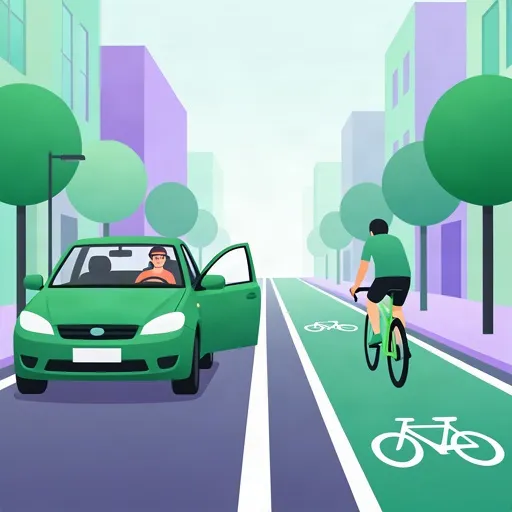
"Dooring"—opening your car door into the path of an approaching cyclist—is a common cause of severe accidents in German cities. The theory exam frequently tests your awareness of this hazard. Before opening a car door, you are legally obligated to check your surroundings using your mirrors and by looking over your shoulder.
The following table provides a quick reference to help you distinguish between the rules for different lane markings and signs encountered in German traffic law.
| Infrastructure Type | Marking Type | Driving Allowed? | Stopping/Parking |
|---|---|---|---|
| Radweg | Separate path | No | Prohibited |
| Radfahrstreifen | Continuous line | No | Prohibited |
| Schutzstreifen | Broken line | Only if necessary | Prohibited |
German cycling infrastructure distinguishes three types: Radwege are mandatory separated paths (sign 237), Radfahrstreifen are on-road lanes with continuous white lines, and Schutzstreifen are advisory lanes marked with broken lines. Motor vehicles are prohibited from entering, stopping, or parking on Radwege and Radfahrstreifen, while crossing a Schutzstreifen is only permitted when necessary and without endangering cyclists. Since the 2020 StVO reform, drivers must maintain at least 1.5m lateral clearance in towns and 2.0m outside them when overtaking cyclists, and must not overtake at all if this distance cannot be ensured. Dooring accidents are a tested hazard requiring drivers to check mirrors and perform shoulder checks before opening any door.
A short set of high-value points that capture the most important ideas from this article.
Radweg (sign 237) is a mandatory separated path; Radfahrstreifen uses a continuous white line; Schutzstreifen uses a broken line—each has different legal rules
Drivers must never drive, stop, or park on a Radweg or Radfahrstreifen; crossing a Schutzstreifen is only permitted when necessary and safe
Minimum lateral overtaking distance is 1.5 meters in built-up areas and 2.0 meters outside built-up areas
If the required overtaking distance cannot be maintained, you must not overtake regardless of road markings
Dooring accidents are a serious hazard—always check mirrors and perform shoulder checks before opening any vehicle door
Solid line = Radfahrstreifen (prohibited for vehicles); broken line = Schutzstreifen (advisory, may be crossed if necessary)
Radweg and Radfahrstreifen have the same prohibition rules—motor vehicles cannot enter, stop, or park
The 2020 StVO reform introduced stricter lateral clearance requirements for overtaking cyclists
Dooring prevention requires three checks: interior mirror, side mirror, then shoulder check
Cyclists on these lanes are classified as vulnerable road users requiring extra caution under StVO
Confusing Radfahrstreifen with Schutzstreifen and assuming vehicles can use either lane freely
Attempting to overtake a cyclist without being able to maintain the mandatory lateral distance
Skipping the shoulder check and only relying on mirrors before opening a car door
Forgetting that even advisory lanes (Schutzstreifen) prohibit stopping and parking
Believing 'necessary' means any reason to cross a Schutzstreifen rather than genuine safety reasons only
Article content overview
A short set of high-value points that capture the most important ideas from this article.
Radweg (sign 237) is a mandatory separated path; Radfahrstreifen uses a continuous white line; Schutzstreifen uses a broken line—each has different legal rules
Drivers must never drive, stop, or park on a Radweg or Radfahrstreifen; crossing a Schutzstreifen is only permitted when necessary and safe
Minimum lateral overtaking distance is 1.5 meters in built-up areas and 2.0 meters outside built-up areas
If the required overtaking distance cannot be maintained, you must not overtake regardless of road markings
Dooring accidents are a serious hazard—always check mirrors and perform shoulder checks before opening any vehicle door
Solid line = Radfahrstreifen (prohibited for vehicles); broken line = Schutzstreifen (advisory, may be crossed if necessary)
Radweg and Radfahrstreifen have the same prohibition rules—motor vehicles cannot enter, stop, or park
The 2020 StVO reform introduced stricter lateral clearance requirements for overtaking cyclists
Dooring prevention requires three checks: interior mirror, side mirror, then shoulder check
Cyclists on these lanes are classified as vulnerable road users requiring extra caution under StVO
Confusing Radfahrstreifen with Schutzstreifen and assuming vehicles can use either lane freely
Attempting to overtake a cyclist without being able to maintain the mandatory lateral distance
Skipping the shoulder check and only relying on mirrors before opening a car door
Forgetting that even advisory lanes (Schutzstreifen) prohibit stopping and parking
Believing 'necessary' means any reason to cross a Schutzstreifen rather than genuine safety reasons only
Explore related topics, search based questions, and concepts that learners often look up when studying German Cycling Infrastructure Rules. These themes reflect real search intent and help you understand how this topic connects to wider driving theory knowledge in Germany.
Find clear and practical answers to common questions learners often have about German Cycling Infrastructure Rules. This section helps explain difficult points, remove confusion, and reinforce the key driving theory concepts that matter for learners in Germany.
A Radfahrstreifen is a dedicated lane marked with a solid line (Zeichen 237), which motor vehicles must not enter, stop, or park on. A Schutzstreifen is marked by a broken line and may be driven over only when necessary, provided that cyclists are not endangered.
Drivers must maintain a lateral distance of at least 1.5 meters when overtaking cyclists within built-up areas and at least 2.0 meters outside of built-up areas.
No. Driving, stopping, and parking on a Radweg (cycle path) is strictly prohibited at all times, as these areas are reserved exclusively for bicycle traffic.
Dooring refers to the danger of opening a car door into the path of an approaching cyclist. Drivers must check their mirrors and perform a shoulder check before opening any vehicle door to ensure it is safe.
Didn't find what you were looking for? Continue your German driving theory preparation by exploring related articles, specific road sign categories, or in-depth guides on complex traffic situations. Deepen your understanding before the official test.