
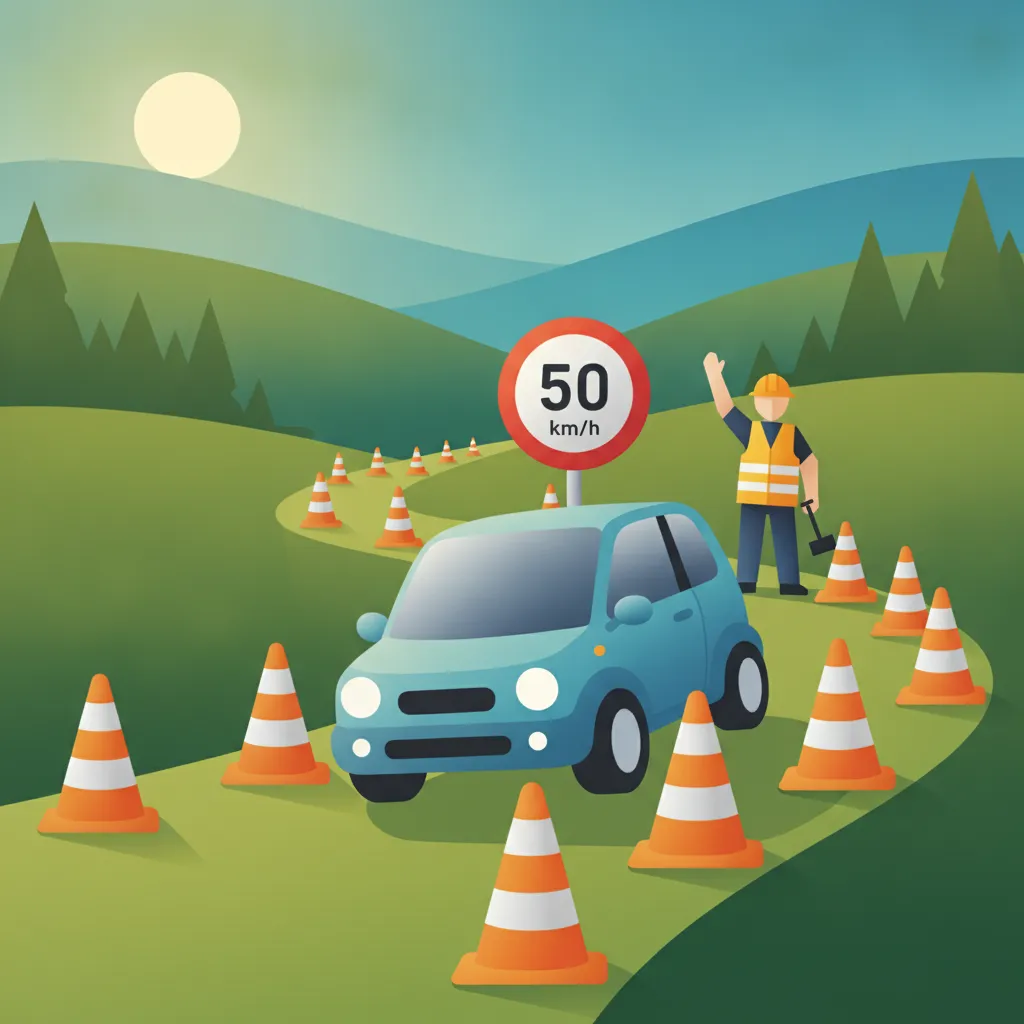
In Germany, road work zones, or 'Baustellen', are temporary areas where construction, maintenance, or repair work is ongoing. These zones introduce dynamic changes to traffic flow, often involving temporary signs, reduced speed limits, narrower lanes, and the presence of workers. Mastering how to navigate these areas safely is crucial for every driver, both for the German theory exam and real-world driving.
Theory topic content overview
Read the full theory topic guide for Road Work Zones Germany with structured, easy-to-scan content built for learners in Germany. This detailed section explains the exact rule, meaning, traffic context, comparison points, and exam logic behind this German driving theory topic so you can study faster, understand the concept more clearly, and avoid common interpretation mistakes on the theory test.
Road work zones, universally known as Baustellen in Germany, are temporary, dynamic areas on roads where construction, maintenance, or repair work is taking place. These zones fundamentally alter the normal flow of traffic, introduce new hazards, and demand a significantly heightened level of driver attention and adaptation. Understanding how to safely navigate a Baustelle is critical for every driver in Germany, not only for passing the German driving theory test but, more importantly, for ensuring the safety of all road users and the vulnerable workers present.
A Baustelle is a designated section of road where work is being carried out, requiring temporary traffic management measures. These measures can include:
Leitkegel), and barriers are used to guide drivers.The defining characteristic of a Baustelle is its temporary and often rapidly changing nature, which is why standard driving rules must be adapted.
Driving through German Baustellen presents unique and significant challenges that contribute to a higher risk of accidents.
Runter vom Gas campaign in Germany frequently highlights the dangers faced by workers in Baustellen.Reißverschlussverfahren), and appropriate speed adaptation in Baustellen are common and crucial parts of the German driving theory exam.Safe passage through a Baustelle requires a systematic approach, anticipating hazards and actively adjusting your driving behavior:
Early Hazard Recognition:
Fahrbare Absperrtafel mit Blinkpfeil (Mobile Barrier Board with Flashing Arrow, Sign 616) or other warning trailers, often displaying amber flashing lights, which indicate an approaching lane closure or hazard.Observe and Understand Temporary Traffic Controls:
Reißverschlussverfahren (zip merging technique) to ensure smooth and fair traffic flow.Entering the Baustelle:
Driving Through the Work Zone:
Exiting the Baustelle:
Several elements are critical to successfully navigating a Baustelle in Germany:
Temporäre Verkehrszeichen): These signs are legally binding and take precedence over permanent signs. Examples include:
Zeichen 123 (Road works warning sign)Zeichen 274 (Speed limit, often with a yellow border when temporary)Zeichen 616 (Fahrbare Absperrtafel mit Blinkpfeil) – a crucial mobile warning device for lane closures.Gelbe Markierungen): These temporary markings are always superior to white markings. If you see both, follow the yellow lines.Reißverschlussverfahren (Zip Merging): This technique is mandatory when two lanes merge into one due to a Baustelle or other obstruction. Drivers must use both lanes until the point of merge, then take turns (like teeth in a zipper) to merge smoothly into the single lane. Failing to use this method correctly can be a common learner mistake and leads to congestion.StVO (Straßenverkehrs-Ordnung): While temporary rules apply, the general principles of the StVO regarding care, attention, and mutual consideration remain in force.To clarify common points of confusion in German Baustellen:
Fahrbare Absperrtafel warns of a closure, but the implied instruction to pass on the open side is mandatory.Approaching an Autobahn Baustelle: You're driving on the Autobahn at 130 km/h and see a Fahrbare Absperrtafel mit Blinkpfeil several hundred meters ahead, accompanied by warning signs for Arbeitsstelle and a reduced speed limit of 80 km/h, then 60 km/h.
Reißverschlussverfahren if lanes are merging.Lane Narrowing on a Rural Road: You encounter a Baustelle on a Landstraße where one lane is closed, and traffic is being channeled into a single lane, regulated by traffic lights or a flagger.
Merging on a Multi-lane Road: Two lanes become one due to a construction area, indicated by a merge sign.
Reißverschlussverfahren (zip merging), allowing one car from the closed lane to merge in front of your car, then you proceed, and so on. This ensures smooth flow and prevents queues forming unnecessarily early.Learners and experienced drivers often make these critical errors:
Reißverschlussverfahren Correctly: Either merging too early, blocking traffic, or trying to block others from merging, leading to frustration and congestion.The concept of the Baustelle is deeply embedded in German driving culture and law. The Straßenverkehrs-Ordnung (StVO) mandates specific behaviors for these zones. Key aspects include:
Reißverschlussverfahren: This is a distinctly German rule for merging traffic, designed for efficiency and fairness, and its correct application is vital.Fahrbare Absperrtafel: This mobile sign is a very common and important sight in Germany, explicitly mentioned in the StVO (Zeichen 616) as a traffic control device.When encountering a Baustelle in Germany, adopt the mindset of Observe, Adapt, Protect.
By consistently applying these principles, you will navigate Baustellen safely and competently, fulfilling the requirements of the German driving licence theory test and practical driving on German roads.
German Baustellen (road work zones) fundamentally alter traffic flow through temporary signs, reduced speed limits, narrowed lanes, and yellow markings that override permanent rules. Drivers must observe all temporary traffic controls, begin slowing down well before the work zone, and use the mandatory Reißverschlussverfahren when lanes merge. Worker safety is paramount, requiring increased following distance and full focus on the road. Temporary speed limits and sign configurations are legally binding and take absolute precedence over conflicting permanent signs, making correct identification and application of these rules essential for both the theory test and real-world driving.
A short set of high-value points that capture the most important ideas from this theory explanation.
Temporary signs, yellow lane markings, and speed limits in a Baustelle always override permanent road rules and markings
Reißverschlussverfahren (zip merging) is the mandatory technique: use both lanes until the merge point, then alternate merging
Begin reducing speed well before entering a work zone; abrupt braking increases collision risk in narrowed lanes
Yellow lane markings take absolute precedence over white permanent markings within the Baustelle
Road workers are extremely vulnerable; maintaining safe distance and full concentration protects their lives
Zeichen 123 warns of Baustelle ahead, Zeichen 274 (yellow border) sets temporary speed limits, Zeichen 616 is the mobile barrier board with flashing arrow indicating lane closure
The posted temporary speed limit is a legal maximum; adjust to an even lower safe speed when conditions warrant (rain, poor visibility, narrow lanes)
End of Baustelle signs or a repeated normal speed limit sign indicate when temporary rules cease and standard limits resume
Increase following distance significantly in Baustellen to allow reaction time for sudden braking or lane changes
Watch for Leitkegel (traffic cones), uneven surfaces, and be alert for workers who may step onto the roadway unexpectedly
Waiting until the last possible moment to reduce speed, causing abrupt braking in the narrow lane section
Following white lane markings instead of yellow temporary markings when both are visible
Merging too early or blocking other drivers from using Reißverschlussverfahren correctly
Underestimating the width of their vehicle when lanes are narrowed to just over 2 meters on Autobahn Baustellen
Being distracted by phones or infotainment and missing critical temporary signs or worker movements
Start with a short, direct summary of Road Work Zones Germany before reading the full explanation below.
When approaching and driving through road work zones (Baustellen) in Germany, drivers must significantly reduce speed, pay close attention to all temporary traffic signs and lane markings, and be prepared for sudden changes in road conditions or traffic flow. Protecting workers by maintaining a safe distance and adhering strictly to all temporary regulations is paramount, as these environments pose heightened risks for everyone.
Review the most important terms, rule signals, and traffic concepts linked to Road Work Zones Germany.
Explore related theory topic pages connected to Road Work Zones Germany and continue with the next useful rule explanation.
See the common search queries learners use when trying to understand Road Work Zones Germany in Germany.

Solidify your understanding of German road rules. Explore specific theory topics in detail, from priority rules to complex Autobahn situations. Review key concepts and prepare thoroughly for every aspect of your official driving license theory examination.
German Driving Theory TopicsTheory topic content overview
A short set of high-value points that capture the most important ideas from this theory explanation.
Temporary signs, yellow lane markings, and speed limits in a Baustelle always override permanent road rules and markings
Reißverschlussverfahren (zip merging) is the mandatory technique: use both lanes until the merge point, then alternate merging
Begin reducing speed well before entering a work zone; abrupt braking increases collision risk in narrowed lanes
Yellow lane markings take absolute precedence over white permanent markings within the Baustelle
Road workers are extremely vulnerable; maintaining safe distance and full concentration protects their lives
Zeichen 123 warns of Baustelle ahead, Zeichen 274 (yellow border) sets temporary speed limits, Zeichen 616 is the mobile barrier board with flashing arrow indicating lane closure
The posted temporary speed limit is a legal maximum; adjust to an even lower safe speed when conditions warrant (rain, poor visibility, narrow lanes)
End of Baustelle signs or a repeated normal speed limit sign indicate when temporary rules cease and standard limits resume
Increase following distance significantly in Baustellen to allow reaction time for sudden braking or lane changes
Watch for Leitkegel (traffic cones), uneven surfaces, and be alert for workers who may step onto the roadway unexpectedly
Waiting until the last possible moment to reduce speed, causing abrupt braking in the narrow lane section
Following white lane markings instead of yellow temporary markings when both are visible
Merging too early or blocking other drivers from using Reißverschlussverfahren correctly
Underestimating the width of their vehicle when lanes are narrowed to just over 2 meters on Autobahn Baustellen
Being distracted by phones or infotainment and missing critical temporary signs or worker movements
Start with a short, direct summary of Road Work Zones Germany before reading the full explanation below.
When approaching and driving through road work zones (Baustellen) in Germany, drivers must significantly reduce speed, pay close attention to all temporary traffic signs and lane markings, and be prepared for sudden changes in road conditions or traffic flow. Protecting workers by maintaining a safe distance and adhering strictly to all temporary regulations is paramount, as these environments pose heightened risks for everyone.
Review the most important terms, rule signals, and traffic concepts linked to Road Work Zones Germany.
Explore related theory topic pages connected to Road Work Zones Germany and continue with the next useful rule explanation.
See the common search queries learners use when trying to understand Road Work Zones Germany in Germany.
Solidify your understanding of German road rules. Explore specific theory topics in detail, from priority rules to complex Autobahn situations. Review key concepts and prepare thoroughly for every aspect of your official driving license theory examination.
German Driving Theory TopicsUse this exam-focused revision tip to understand how Road Work Zones Germany is likely to appear in theory questions for learners in Germany. This section helps you identify the most testable part of the rule, avoid common traps, and remember the concept more effectively during German driving theory exam preparation.
In the German theory exam, questions about road work zones often focus on identifying temporary signs, understanding priority in merging lanes, and correct speed adaptation. Pay close attention to distinguishing temporary rules from permanent ones, as temporary rules always override. Remember that the safety of road workers is a key consideration.
Read direct answers to the most common learner questions about Road Work Zones Germany in Germany. This FAQ focuses on rule confusion, practical meaning, comparison with similar concepts, and the exact uncertainties that appear most often in German driving theory revision and exam preparation.
Primary dangers include reduced lane width, uneven road surfaces, sudden lane changes, reduced visibility, the presence of workers and equipment close to traffic, and reduced speed limits that require immediate adaptation.
Temporary traffic signs in German road work zones often have orange backgrounds or use dynamic LED displays. They always take precedence over permanent signs or markings, dictating new speed limits, lane configurations, or warnings for specific hazards.
Always adhere strictly to the posted temporary speed limits, which are often significantly reduced. Even if no specific limit is shown, drivers must adapt their speed to the conditions, driving slowly and carefully to ensure safety.
Plan lane changes well in advance, signal clearly, and merge smoothly. Be aware of the zipper merging principle ('Reißverschlussverfahren') where applicable, and always yield to workers or equipment. Lane widths can be very narrow, requiring extra precision.
A 'Fahrbare Absperrtafel' is a mobile barrier board with lights, often featuring a flashing arrow (Blinkpfeil), used in Germany to mark road closures or guide traffic past obstacles. Yellow flashing lights or arrows direct traffic, while red lights usually indicate a full lane closure.
Road workers are highly vulnerable as they operate close to live traffic. Drivers have a legal and moral responsibility to protect them by reducing speed, avoiding distractions, and giving them ample space, helping prevent serious accidents.
Begin your targeted revision now. Use our practice search to quickly find specific German driving theory questions. Filter by StVO rules, road signs, or hazard perception to create your focused study plan. Master challenging areas and prepare confidently for your theoretical driving test.