
When roads are wet due to rain, the friction between your tires and the road surface is significantly reduced, leading to longer braking distances and decreased vehicle stability. This condition can also lead to aquaplaning, where a layer of water completely separates the tires from the road. Mastering how to safely navigate these conditions is vital for any driver in Germany.
Theory topic content overview
Read the full theory topic guide for Wet Road Braking & Aquaplaning with structured, easy-to-scan content built for learners in Germany. This detailed section explains the exact rule, meaning, traffic context, comparison points, and exam logic behind this German driving theory topic so you can study faster, understand the concept more clearly, and avoid common interpretation mistakes on the theory test.
Driving on wet roads, particularly in Germany, fundamentally alters how your vehicle handles and performs. The primary concern is a significant reduction in friction (grip) between your tires and the road surface. This reduction in grip leads to several critical dangers:
Understanding these effects is crucial for safe driving in Germany and is a frequent topic in the German driving theory test.
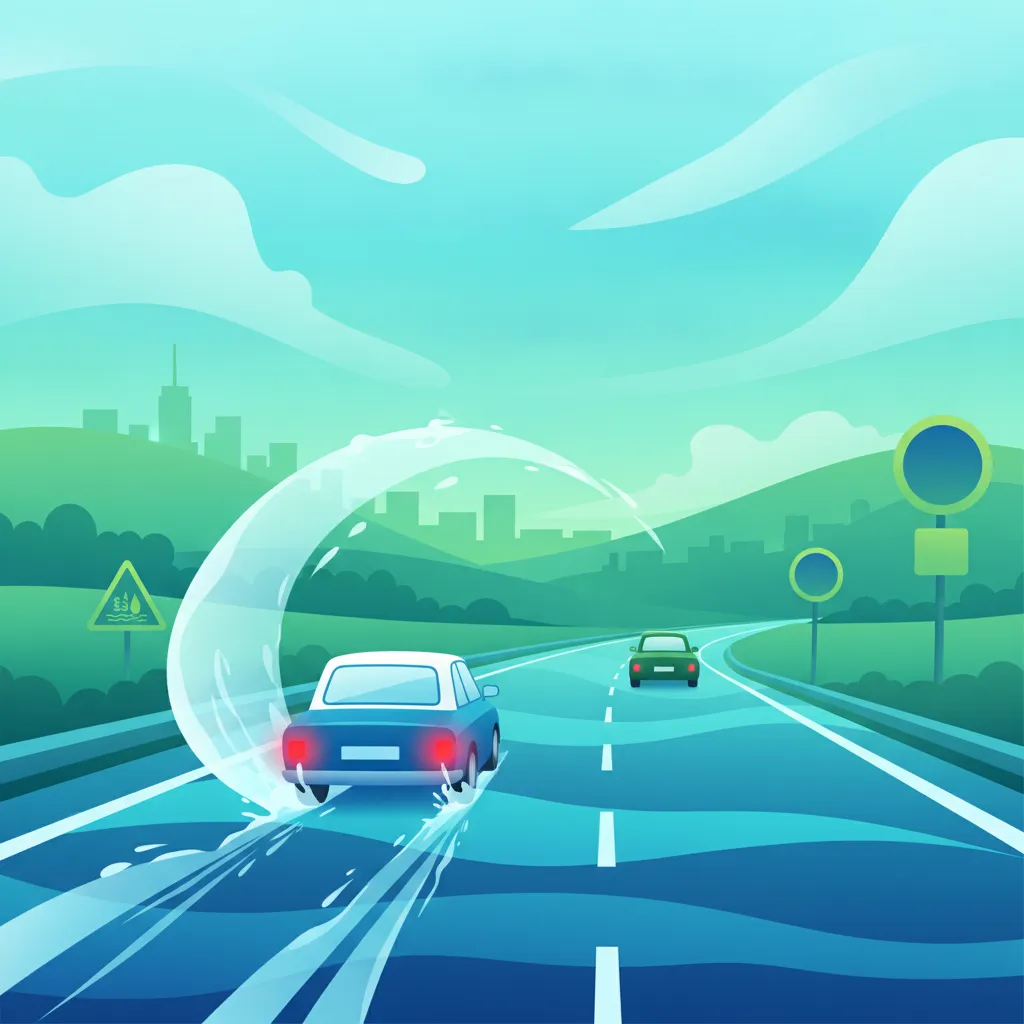
A particularly dangerous phenomenon on wet roads is aquaplaning, also known in German as Wasserglätte (literally "water slipperiness"). Aquaplaning occurs when a layer of water builds up between your tires and the road surface faster than the tire tread can disperse it. When this happens, your tires completely lose contact with the road, essentially "floating" on the water film.
During aquaplaning, your vehicle becomes uncontrollable:
This complete loss of contact is a critical hazard, especially given the higher speeds often encountered on German rural roads and the Autobahn.
The danger of wet roads stems from the presence of water acting as a lubricant between the tire rubber and the road asphalt.
On a dry road, tire tread grips the microscopic irregularities of the road surface, creating strong friction. When water is present, this direct contact is reduced. The tires must first push the water aside to find grip. This process consumes energy and time, directly translating into longer braking distances. A vehicle travelling at 100 km/h on a wet road might require double the braking distance compared to dry conditions. This compounding effect of speed on braking distance is a key focus in German hazard perception training.
Reduced grip also increases the risk of skidding. Any sudden input – harsh braking, sharp steering, or aggressive acceleration – can easily overcome the available friction. If the tires lose traction laterally (sideways), the vehicle can spin. If they lose traction longitudinally (forward/backward), the wheels can lock up during braking (even with ABS, which prevents complete lock-up but cannot create grip where none exists) or spin pointlessly during acceleration.
Several factors determine the severity of wet road hazards:
Zusatzschild "bei Nässe"):
"bei Nässe" (meaning "in wet conditions"). This explicitly indicates that the speed limit applies only when the road is wet. If the road is dry, the higher general speed limit (or no limit on the Autobahn) may apply. This sign is a direct warning to adapt your speed.StVO (Straßenverkehrs-Ordnung) mandates that drivers must always adapt their speed to prevailing road, weather, and visibility conditions, making reduced speed in rain a legal requirement, not just a recommendation.The best defense against wet road hazards in Germany is a proactive and adaptive driving style:
Abblendlicht) to improve your visibility to others, even during daylight hours. Fog lights (rear) should only be used in very heavy rain where visibility is below 50 metres.Despite precautions, aquaplaning can happen. If your vehicle starts to aquaplane (you'll feel the steering lighten, the engine revs might rise without speed increase, or you might hear a distinct "swooshing" sound):
Learners and even experienced drivers often make mistakes in wet conditions:
Zusatzschild "bei Nässe" and failing to reduce speed accordingly.The German driving theory test (Theorieprüfung) places significant emphasis on understanding how adverse weather affects driving. For wet roads and aquaplaning, expect questions that cover:
Wasserglätte).Zusatzschild "bei Nässe".In Germany, where speeds can be higher and weather conditions can change rapidly, the principle of "Fahren auf Sicht" (driving within your visible range) and "Fahren nach Bedingungen" (driving according to conditions) is paramount. On wet roads, this means drastically reducing your speed, greatly increasing your following distance, and making all vehicle inputs smoothly and cautiously. Your safety, and the safety of others, depends on it.
Wet roads fundamentally reduce tire grip through water lubrication, extending braking distances significantly and increasing both skidding and aquaplaning risks. Aquaplaning (Wasserglätte) completely severs tire-to-road contact, eliminating all vehicle control until speed naturally decreases. Key safety measures include drastically reducing speed, doubling following distance to at least four seconds, maintaining smooth inputs, and ensuring tires have adequate tread depth and correct pressure. German roads present specific hazards like Spurrillen (rutted wheel tracks) that collect water, while traffic signs with 'bei Nässe' indicate wet-condition speed limits that must be observed under StVO requirements.
A short set of high-value points that capture the most important ideas from this theory explanation.
Wet roads reduce tire grip significantly, causing braking distances to double or more compared to dry conditions
Aquaplaning (Wasserglätte) occurs when water separates tires from the road, making steering, braking, and acceleration completely ineffective
Reducing speed is the single most effective safety measure on wet roads and helps tires displace water more efficiently
Tire tread depth below 1.6 mm (legal minimum in Germany) dramatically increases aquaplaning risk; 3-4 mm is recommended for wet conditions
The Zusatzschild 'bei Nässe' sign means the posted speed limit applies only when roads are wet, and StVO requires adapting speed to conditions
The two-second following distance rule should become four seconds or more in wet conditions to account for longer braking distances
Deep ruts (Spurrillen) on German roads collect water and create extreme aquaplaning hazards; drive slightly offset when possible
During aquaplaning, ease off the accelerator and hold the steering wheel straight; do not brake or steer sharply
Poor tire maintenance (worn tread or incorrect pressure) is a critical factor in wet weather accidents and is actively checked in Germany
Even with ABS, braking effectiveness is severely reduced on wet roads because the system cannot create grip where water prevents contact
Assuming the posted speed limit is always safe in wet weather; the legal maximum is not necessarily the safe speed
Maintaining normal dry-weather following distances in rain, which leaves insufficient safety margin for extended braking distances
Sudden braking, sharp steering, or rapid acceleration on wet surfaces, which easily overwhelms available tire grip
Ignoring the Zusatzschild 'bei Nässe' supplementary sign and failing to reduce speed when wet conditions exist
Driving with worn tires or incorrect tire pressure, believing that the legal minimum tread depth is adequate for wet conditions
Start with a short, direct summary of Wet Road Braking & Aquaplaning before reading the full explanation below.
Wet roads dramatically reduce tire grip, causing braking distances to increase significantly compared to dry conditions. This reduced friction also heightens the risk of skidding and aquaplaning (Wasserglätte), where your tires lose contact with the road due to a water film. To maintain control and safety in Germany, drivers must reduce their speed, increase following distances, and make smoother steering and braking inputs.
Review the most important terms, rule signals, and traffic concepts linked to Wet Road Braking & Aquaplaning.
Explore related theory topic pages connected to Wet Road Braking & Aquaplaning and continue with the next useful rule explanation.
See the common search queries learners use when trying to understand Wet Road Braking & Aquaplaning in Germany.

Solidify your understanding of German road rules. Explore specific theory topics in detail, from priority rules to complex Autobahn situations. Review key concepts and prepare thoroughly for every aspect of your official driving license theory examination.
German Driving Theory TopicsTheory topic content overview
A short set of high-value points that capture the most important ideas from this theory explanation.
Wet roads reduce tire grip significantly, causing braking distances to double or more compared to dry conditions
Aquaplaning (Wasserglätte) occurs when water separates tires from the road, making steering, braking, and acceleration completely ineffective
Reducing speed is the single most effective safety measure on wet roads and helps tires displace water more efficiently
Tire tread depth below 1.6 mm (legal minimum in Germany) dramatically increases aquaplaning risk; 3-4 mm is recommended for wet conditions
The Zusatzschild 'bei Nässe' sign means the posted speed limit applies only when roads are wet, and StVO requires adapting speed to conditions
The two-second following distance rule should become four seconds or more in wet conditions to account for longer braking distances
Deep ruts (Spurrillen) on German roads collect water and create extreme aquaplaning hazards; drive slightly offset when possible
During aquaplaning, ease off the accelerator and hold the steering wheel straight; do not brake or steer sharply
Poor tire maintenance (worn tread or incorrect pressure) is a critical factor in wet weather accidents and is actively checked in Germany
Even with ABS, braking effectiveness is severely reduced on wet roads because the system cannot create grip where water prevents contact
Assuming the posted speed limit is always safe in wet weather; the legal maximum is not necessarily the safe speed
Maintaining normal dry-weather following distances in rain, which leaves insufficient safety margin for extended braking distances
Sudden braking, sharp steering, or rapid acceleration on wet surfaces, which easily overwhelms available tire grip
Ignoring the Zusatzschild 'bei Nässe' supplementary sign and failing to reduce speed when wet conditions exist
Driving with worn tires or incorrect tire pressure, believing that the legal minimum tread depth is adequate for wet conditions
Start with a short, direct summary of Wet Road Braking & Aquaplaning before reading the full explanation below.
Wet roads dramatically reduce tire grip, causing braking distances to increase significantly compared to dry conditions. This reduced friction also heightens the risk of skidding and aquaplaning (Wasserglätte), where your tires lose contact with the road due to a water film. To maintain control and safety in Germany, drivers must reduce their speed, increase following distances, and make smoother steering and braking inputs.
Review the most important terms, rule signals, and traffic concepts linked to Wet Road Braking & Aquaplaning.
Explore related theory topic pages connected to Wet Road Braking & Aquaplaning and continue with the next useful rule explanation.
See the common search queries learners use when trying to understand Wet Road Braking & Aquaplaning in Germany.
Solidify your understanding of German road rules. Explore specific theory topics in detail, from priority rules to complex Autobahn situations. Review key concepts and prepare thoroughly for every aspect of your official driving license theory examination.
German Driving Theory TopicsUse this exam-focused revision tip to understand how Wet Road Braking & Aquaplaning is likely to appear in theory questions for learners in Germany. This section helps you identify the most testable part of the rule, avoid common traps, and remember the concept more effectively during German driving theory exam preparation.
In German theory tests, questions about wet road braking often focus on the extended braking distance and the risks of aquaplaning. Remember to always reduce speed and increase your following distance in rain. Pay attention to how tire condition (e.g., tread depth) also plays a crucial role in preventing hazards like Wasserglätte.
Read direct answers to the most common learner questions about Wet Road Braking & Aquaplaning in Germany. This FAQ focuses on rule confusion, practical meaning, comparison with similar concepts, and the exact uncertainties that appear most often in German driving theory revision and exam preparation.
Braking distance on wet roads can be significantly longer due to reduced tire grip. As a general rule for German driving, you should anticipate at least double the distance required on dry roads, and potentially much more if there is standing water or poor tire tread.
Aquaplaning, known as Wasserglätte in German, occurs when a layer of water builds up between your tires and the road surface. This causes your tires to lose complete contact with the road, making steering, braking, and accelerating ineffective until grip is restored.
If your vehicle aquaplanes, remain calm. Do not brake or steer sharply. Gently ease off the accelerator, keep the steering wheel straight, and let the vehicle slow down until your tires regain contact with the road. Avoid sudden movements that could cause a loss of control once grip returns.
To prevent aquaplaning in Germany, reduce your speed, especially in heavy rain or when approaching areas prone to standing water like depressions or wheel ruts. Ensure your tires have adequate tread depth (mindestens 1.6mm, though 3mm is recommended for wet conditions) and are correctly inflated according to vehicle manufacturer specifications.
While ABS (Anti-lock Braking System) helps prevent your wheels from locking up during braking and allows for some steering control, it does not shorten braking distances on wet roads. More importantly, ABS cannot prevent aquaplaning if the tires completely lose contact with the road surface.
In wet conditions, you should at least double your normal following distance to account for increased braking distances. This means maintaining a gap of at least a four-second interval to the vehicle in front, or even more depending on visibility and road conditions.
Yes, in Germany, you may see a supplementary sign that reads "bei Nässe" (when wet) placed below a speed limit sign. This indicates that the reduced speed limit applies only when the road surface is wet.
Begin your targeted revision now. Use our practice search to quickly find specific German driving theory questions. Filter by StVO rules, road signs, or hazard perception to create your focused study plan. Master challenging areas and prepare confidently for your theoretical driving test.