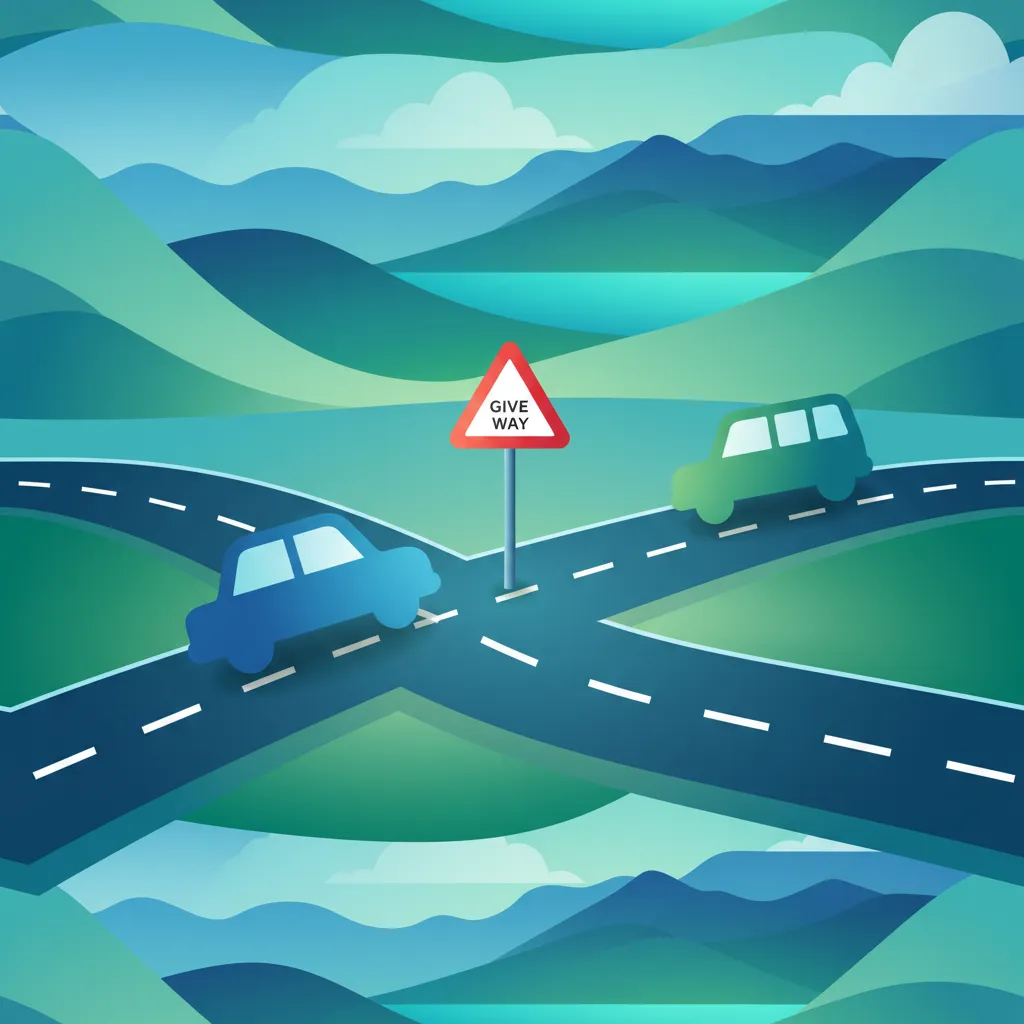
The Give Way sign is an inverted red-bordered triangle that dictates a specific priority rule at intersections and junctions in Iceland. It indicates that you must yield to traffic on the intersecting road before proceeding. This page explains your obligations, how to correctly interpret traffic situations, and the key differences between a Give Way and a Stop sign, all within the context of Icelandic road laws.
Theory topic content overview
Read the full theory topic guide for Give Way Sign Rules with structured, easy-to-scan content built for learners in Iceland. This detailed section explains the exact rule, meaning, traffic context, comparison points, and exam logic behind this Icelandic driving theory topic so you can study faster, understand the concept more clearly, and avoid common interpretation mistakes on the theory test.
The Give Way sign, universally recognised as an inverted red-bordered triangle, is a fundamental traffic sign in Iceland that dictates priority at intersections and junctions. Its primary instruction is clear: you must yield priority to other traffic before proceeding. This means that drivers encountering this sign have a mandatory obligation to allow vehicles on the intersecting road to pass without obstruction. Mastering the correct interpretation and action at a Give Way sign is not just crucial for road safety but also essential for success in your Icelandic driving theory exam.
Understanding and correctly applying Icelandic Give Way rules is vital for several reasons:
Approaching a Give Way sign (sometimes referred to as a yield sign), your actions should follow a systematic process of observation and decision-making:
Remember, the goal is to enter the flow of priority traffic safely and smoothly, without causing inconvenience or danger to other road users in Iceland.
Several factors specific to Icelandic driving conditions can impact your actions at a Give Way sign:
A common point of confusion for learners in Iceland is the difference between a Give Way sign (Víkjandi Vegur sign) and a Stop sign (Stoppskylda sign). While both require you to yield priority, their primary instructions differ fundamentally:
In Iceland, failing to come to a complete stop at a Stop sign is a serious offence and an automatic failure in a driving test. Not stopping when traffic demands it at a Give Way sign is equally serious.
Consider these practical situations on Icelandic roads:
Learners often struggle with Give Way sign rules during their driving lessons and theory exams in Iceland:
examTip specifically warns against this.The Give Way sign is a cornerstone of the priority rules established by Icelandic traffic legislation. These rules are uniformly applied across the country, from the bustling streets of Reykjavík to the remote highlands. Understanding how these signs interact with other priority rules, such as the basic "right-hand rule" at unmarked junctions, is critical for obtaining your Icelandic driving licence. The Icelandic Transport Authority (Samgöngustofa) places significant emphasis on correct interpretation of traffic signs, and demonstrating this knowledge is paramount for passing both the theory and practical driving tests.
When encountering a Give Way sign in Iceland, adopt a proactive and defensive mindset. Always be prepared to yield, but also be confident in proceeding when the path is truly clear. Your priority is safety and maintaining smooth traffic flow. By slowing down, observing thoroughly, and making an informed decision, you can navigate Give Way situations confidently and correctly, contributing to safer roads for everyone in Iceland.
The Give Way sign in Iceland requires drivers to slow down significantly, thoroughly observe all approaching traffic from the intersecting road, and proceed only when it is safe to do so without forcing other vehicles to slow or change direction. Unlike a Stop sign, a complete stop is not required if the path is clear, though maintaining reduced speed is always necessary. Icelandic conditions such as winter weather, gravel roads, and high-speed rural routes like the Ring Road demand extra caution and earlier braking. The key distinction from a Stop sign is that Stop always mandates a complete halt regardless of traffic, making precise understanding essential for both road safety and passing the Icelandic driving theory exam.
A short set of high-value points that capture the most important ideas from this theory explanation.
The Give Way sign (inverted red triangle) requires slowing down and yielding priority, but a complete stop is only mandatory when traffic would be forced to slow or change direction.
Your core obligation is to enter the priority road without causing other vehicles to take evasive action or adjust their speed.
Adopt a systematic approach: observe early, slow significantly, assess speed and distance of approaching traffic, then decide to stop only if necessary or proceed when clear.
In Iceland, always factor in reduced visibility from fog, heavy rain, or snow, and longer stopping distances on ice, gravel, or wet surfaces.
The difference from a Stop sign is fundamental: Stop always requires a complete stop, while Give Way only requires stopping when traffic is present.
Give Way sign = inverted red triangle (Víkjandi Vegur), Stop sign = octagon (Stoppskylda).
Stop at a Give Way only when approaching traffic would need to brake or swerve if you proceeded.
In Iceland, slow down extra early on gravel roads, icy conditions, or when visibility is reduced by weather.
Always scan the entire intersection for pedestrians, cyclists, and motorcycles before making your decision.
On the Ring Road (Route 1), even distant traffic may be travelling at high speed, requiring a larger gap to merge safely.
Stopping unnecessarily when the road is clear, causing delays and confusing other drivers who expect you to proceed.
Misjudging the speed of priority traffic, especially on high-speed rural Icelandic roads, and pulling out too early.
Only checking one direction of traffic and failing to scan the entire intersection for all approaching vehicles.
Forgetting to stop behind the Give Way line when a full stop is required to gain a clear view.
Not adjusting driving for Iceland-specific conditions such as ice, snow, or gravel that increase stopping distance.
Start with a short, direct summary of Give Way Sign Rules before reading the full explanation below.
In Iceland, a Give Way sign instructs you to yield priority to other traffic, meaning you must slow down significantly, observe approaching vehicles, and only proceed when it is safe to do so without forcing others to slow down or change direction. Unlike a Stop sign, a complete stop is not always required if the path is clearly free.
Review the most important terms, rule signals, and traffic concepts linked to Give Way Sign Rules.
Explore related theory topic pages connected to Give Way Sign Rules and continue with the next useful rule explanation.
See the common search queries learners use when trying to understand Give Way Sign Rules in Iceland.

Ready to master Icelandic driving theory? Explore our comprehensive sections. Review road rules, traffic signs, and critical concepts. Build essential knowledge for confident and safe driving in Iceland. Start studying today.
Explore Icelandic Driving TheoryTheory topic content overview
A short set of high-value points that capture the most important ideas from this theory explanation.
The Give Way sign (inverted red triangle) requires slowing down and yielding priority, but a complete stop is only mandatory when traffic would be forced to slow or change direction.
Your core obligation is to enter the priority road without causing other vehicles to take evasive action or adjust their speed.
Adopt a systematic approach: observe early, slow significantly, assess speed and distance of approaching traffic, then decide to stop only if necessary or proceed when clear.
In Iceland, always factor in reduced visibility from fog, heavy rain, or snow, and longer stopping distances on ice, gravel, or wet surfaces.
The difference from a Stop sign is fundamental: Stop always requires a complete stop, while Give Way only requires stopping when traffic is present.
Give Way sign = inverted red triangle (Víkjandi Vegur), Stop sign = octagon (Stoppskylda).
Stop at a Give Way only when approaching traffic would need to brake or swerve if you proceeded.
In Iceland, slow down extra early on gravel roads, icy conditions, or when visibility is reduced by weather.
Always scan the entire intersection for pedestrians, cyclists, and motorcycles before making your decision.
On the Ring Road (Route 1), even distant traffic may be travelling at high speed, requiring a larger gap to merge safely.
Stopping unnecessarily when the road is clear, causing delays and confusing other drivers who expect you to proceed.
Misjudging the speed of priority traffic, especially on high-speed rural Icelandic roads, and pulling out too early.
Only checking one direction of traffic and failing to scan the entire intersection for all approaching vehicles.
Forgetting to stop behind the Give Way line when a full stop is required to gain a clear view.
Not adjusting driving for Iceland-specific conditions such as ice, snow, or gravel that increase stopping distance.
Start with a short, direct summary of Give Way Sign Rules before reading the full explanation below.
In Iceland, a Give Way sign instructs you to yield priority to other traffic, meaning you must slow down significantly, observe approaching vehicles, and only proceed when it is safe to do so without forcing others to slow down or change direction. Unlike a Stop sign, a complete stop is not always required if the path is clearly free.
Review the most important terms, rule signals, and traffic concepts linked to Give Way Sign Rules.
Explore related theory topic pages connected to Give Way Sign Rules and continue with the next useful rule explanation.
See the common search queries learners use when trying to understand Give Way Sign Rules in Iceland.
Ready to master Icelandic driving theory? Explore our comprehensive sections. Review road rules, traffic signs, and critical concepts. Build essential knowledge for confident and safe driving in Iceland. Start studying today.
Explore Icelandic Driving TheoryUse this exam-focused revision tip to understand how Give Way Sign Rules is likely to appear in theory questions for learners in Iceland. This section helps you identify the most testable part of the rule, avoid common traps, and remember the concept more effectively during Icelandic driving theory exam preparation.
Many learners incorrectly assume a Give Way sign always means a full stop, similar to a Stop sign. Remember, you must only stop if there is traffic to yield to. Failing to proceed when clear can also be a mistake, causing hesitation and potential traffic flow issues in your Icelandic driving test.
Read direct answers to the most common learner questions about Give Way Sign Rules in Iceland. This FAQ focuses on rule confusion, practical meaning, comparison with similar concepts, and the exact uncertainties that appear most often in Icelandic driving theory revision and exam preparation.
The main instruction is to yield priority to all traffic on the intersecting road or path, ensuring you do not interfere with their flow or force them to take evasive action.
No, you do not always have to come to a complete stop. You must slow down, observe carefully, and be prepared to stop. You only stop if there is traffic to which you must yield priority.
A Stop sign (Stoppskylda) requires you to come to a complete halt before the stop line, regardless of traffic. A Give Way sign (Víkja fyrir umferð) only requires you to stop if necessary to yield to other traffic.
Yielding priority means allowing other road users who have the right of way to proceed first. You must ensure that your action of entering or crossing the road does not cause them to brake, swerve, or adjust their speed.
You can proceed when the intersecting road is clear, or when approaching traffic is far enough away that your entry will not cause them to alter their speed or direction.
Give Way signs are common across all types of roads in Iceland, particularly where minor roads meet major roads, at slip roads, or at intersections where the right-hand rule does not apply.
If your view is obstructed, you must proceed cautiously until you have a clear view of the intersecting traffic. Be prepared to stop before entering the main flow of traffic to ensure it is safe to proceed.
Utilize our advanced practice set search to pinpoint the exact Icelandic driving theory topics you need to review. Filter by subject, difficulty, or question type to create a highly effective study plan and ensure you are fully prepared for your official driving licence test in Iceland.