
Roundabouts are designed to improve traffic flow and safety at intersections. In Iceland, specific rules dictate how drivers must approach, enter, and exit these circular junctions. Understanding these priority rules, especially the unique considerations for multi-lane roundabouts, is fundamental for preventing collisions and ensuring smooth traffic movement.
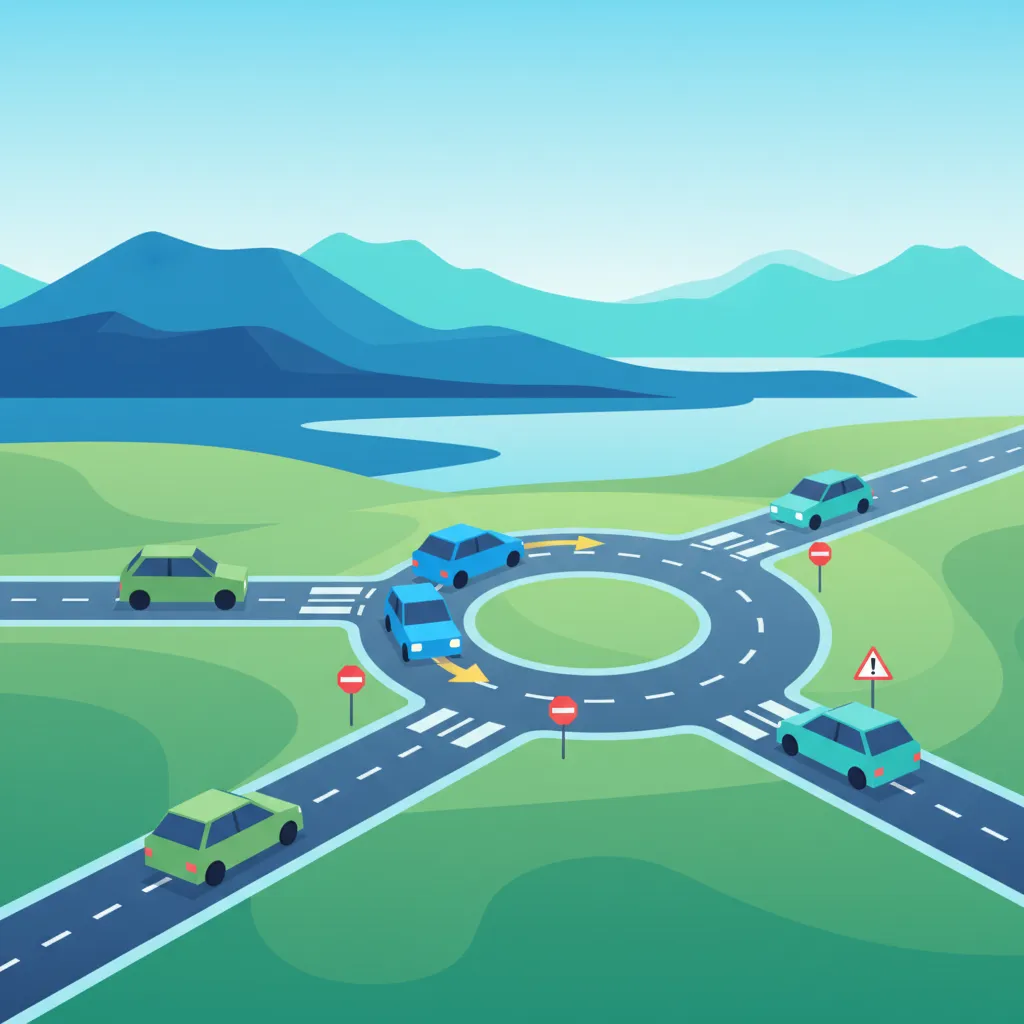
Theory topic content overview
Read the full theory topic guide for Roundabout Priority with structured, easy-to-scan content built for learners in Iceland. This detailed section explains the exact rule, meaning, traffic context, comparison points, and exam logic behind this Icelandic driving theory topic so you can study faster, understand the concept more clearly, and avoid common interpretation mistakes on the theory test.
Navigating roundabouts efficiently and safely is a crucial skill for any driver in Iceland, and understanding the priority rules (umferðarhringur forgangur) is fundamental for passing your theory exam and preventing collisions. While the basic principles of roundabouts are global, Iceland has a specific rule that drivers must master to ensure correct and safe conduct.
Roundabout priority refers to the rules that dictate which vehicle has the right to proceed first when approaching, entering, circulating within, and exiting a roundabout. These rules are designed to maintain a continuous flow of traffic and reduce the potential for head-on or T-bone collisions often associated with traditional intersections.
In Iceland, the overarching principle is that vehicles already inside the roundabout always have priority over those wishing to enter. This is a common international standard. However, a distinctive Icelandic rule applies to multi-lane roundabouts: the inner lane has priority when exiting. This means drivers in the outer lane must yield to traffic in the inner lane that is signaling to exit.
Mastering roundabout priority is critical for several reasons unique to the Icelandic driving context:
Understanding the sequence of actions and priority is key to safe roundabout navigation.
Several factors can influence roundabout navigation and priority:
It's vital to differentiate the Icelandic rules from common assumptions or rules in other countries:
You are approaching a two-lane roundabout in Reykjavík, planning to take the third exit (turning left).
You are driving towards a single-lane roundabout on a rural Icelandic road. You see a cyclist already in the roundabout, approaching your entry point.
Drivers, especially learners, frequently make these errors regarding Icelandic roundabout priority:
To master roundabout priority in Iceland, always remember these key points:
By internalizing these rules and distinctions, you'll be well-prepared for the Icelandic theory exam and safer on the roads.
Roundabout priority in Iceland follows the universal rule that circulating traffic has priority over entering traffic, but includes a distinctive Icelandic requirement where inner lane traffic has priority when exiting multi-lane roundabouts. Drivers must always yield to traffic already in the roundabout, select appropriate lanes before entry, signal correctly based on their intended exit, and remain vigilant for vulnerable road users such as cyclists and pedestrians. These rules are frequently tested in the Icelandic theory exam and are essential for safe driving on Icelandic roads, particularly in challenging weather conditions.
A short set of high-value points that capture the most important ideas from this theory explanation.
Vehicles already inside a roundabout always have priority over those trying to enter - yield to traffic from your left
In multi-lane roundabouts, the inner lane has priority when exiting, meaning outer lane traffic must yield to inner lane vehicles exiting past them
Signal right before entering only when taking the first exit; for all other exits, signal right after passing the exit immediately before yours
Always give special consideration to cyclists and pedestrians around roundabouts as vulnerable road users
Icelandic weather conditions require slower speeds and greater yielding distances at roundabouts
Yield to circulating traffic from your left when entering
Inner lane priority on exit - outer lane must yield to inner lane exiting
Signal timing: right signal only before entry for first exit; signal right after passing the exit before yours for other exits
Check mirrors and blind spots before exiting, especially for cyclists alongside your vehicle
In rural Iceland, also watch for horse riders and give vulnerable road users ample space
Entering the roundabout without yielding to circulating traffic, forcing vehicles already inside to brake
Failing to yield to inner lane traffic signaling to exit - this is the most commonly tested mistake in Iceland
Incorrect signaling: either not signaling at all, signaling too early, or signaling at the wrong time
Not checking for cyclists in the roundabout or pedestrians at crossing points before exiting
Changing lanes unnecessarily while circulating inside the roundabout
Start with a short, direct summary of Roundabout Priority before reading the full explanation below.
In Iceland, vehicles already inside a roundabout always have priority over those entering. Drivers must yield to circulating traffic, slowing down and waiting for a safe gap before entering. A key distinction in multi-lane Icelandic roundabouts is that the inner lane has priority when exiting, meaning outer lane traffic must yield to inner lane traffic exiting past them. Proper signaling is also essential for safe maneuvering.
Review the most important terms, rule signals, and traffic concepts linked to Roundabout Priority.
Explore related theory topic pages connected to Roundabout Priority and continue with the next useful rule explanation.
See the common search queries learners use when trying to understand Roundabout Priority in Iceland.

Ready to master Icelandic driving theory? Explore our comprehensive sections. Review road rules, traffic signs, and critical concepts. Build essential knowledge for confident and safe driving in Iceland. Start studying today.
Explore Icelandic Driving TheoryTheory topic content overview
A short set of high-value points that capture the most important ideas from this theory explanation.
Vehicles already inside a roundabout always have priority over those trying to enter - yield to traffic from your left
In multi-lane roundabouts, the inner lane has priority when exiting, meaning outer lane traffic must yield to inner lane vehicles exiting past them
Signal right before entering only when taking the first exit; for all other exits, signal right after passing the exit immediately before yours
Always give special consideration to cyclists and pedestrians around roundabouts as vulnerable road users
Icelandic weather conditions require slower speeds and greater yielding distances at roundabouts
Yield to circulating traffic from your left when entering
Inner lane priority on exit - outer lane must yield to inner lane exiting
Signal timing: right signal only before entry for first exit; signal right after passing the exit before yours for other exits
Check mirrors and blind spots before exiting, especially for cyclists alongside your vehicle
In rural Iceland, also watch for horse riders and give vulnerable road users ample space
Entering the roundabout without yielding to circulating traffic, forcing vehicles already inside to brake
Failing to yield to inner lane traffic signaling to exit - this is the most commonly tested mistake in Iceland
Incorrect signaling: either not signaling at all, signaling too early, or signaling at the wrong time
Not checking for cyclists in the roundabout or pedestrians at crossing points before exiting
Changing lanes unnecessarily while circulating inside the roundabout
Start with a short, direct summary of Roundabout Priority before reading the full explanation below.
In Iceland, vehicles already inside a roundabout always have priority over those entering. Drivers must yield to circulating traffic, slowing down and waiting for a safe gap before entering. A key distinction in multi-lane Icelandic roundabouts is that the inner lane has priority when exiting, meaning outer lane traffic must yield to inner lane traffic exiting past them. Proper signaling is also essential for safe maneuvering.
Review the most important terms, rule signals, and traffic concepts linked to Roundabout Priority.
Explore related theory topic pages connected to Roundabout Priority and continue with the next useful rule explanation.
See the common search queries learners use when trying to understand Roundabout Priority in Iceland.
Ready to master Icelandic driving theory? Explore our comprehensive sections. Review road rules, traffic signs, and critical concepts. Build essential knowledge for confident and safe driving in Iceland. Start studying today.
Explore Icelandic Driving TheoryUse this exam-focused revision tip to understand how Roundabout Priority is likely to appear in theory questions for learners in Iceland. This section helps you identify the most testable part of the rule, avoid common traps, and remember the concept more effectively during Icelandic driving theory exam preparation.
The Icelandic theory exam often tests your understanding of yielding to traffic already in the roundabout and correct signaling. Pay close attention to multi-lane scenarios, especially the unique rule that the inner lane has priority when exiting. Remember to always signal when exiting to inform other drivers of your intentions.
Read direct answers to the most common learner questions about Roundabout Priority in Iceland. This FAQ focuses on rule confusion, practical meaning, comparison with similar concepts, and the exact uncertainties that appear most often in Icelandic driving theory revision and exam preparation.
In Iceland, vehicles already inside the roundabout always have priority. You must yield to traffic already circulating before entering, unless signs or markings clearly indicate otherwise.
A significant rule in Icelandic multi-lane roundabouts is that the inner lane has priority when exiting. This means drivers in the outer lane must be prepared to yield to vehicles exiting from an inner lane that cross their path.
No, you only need to stop if there is circulating traffic to which you must yield. Otherwise, if the path is clear, you can enter safely without stopping, ensuring clear observation.
Signal right when you are exiting the roundabout. If you are taking the first exit, you can signal right upon approach. For other exits, signal right only after passing the exit immediately before yours.
Common mistakes include failing to yield to circulating traffic upon entry, not signaling correctly, or misunderstanding the unique inner lane priority rule when exiting multi-lane roundabouts, potentially cutting off exiting vehicles.
Drivers must exercise special consideration for cyclists. If a cyclist is in an inner lane, they maintain priority over a vehicle in an outer lane that is also attempting to exit. Always ensure adequate space and reduce speed as needed for cyclists.
Yes, roundabouts are typically indicated by a blue circular sign with three white arrows forming a circle (Sign 410 Roundabout). Give way signs (202 Obligation to wait) and markings are also common at entry points.
Utilize our advanced practice set search to pinpoint the exact Icelandic driving theory topics you need to review. Filter by subject, difficulty, or question type to create a highly effective study plan and ensure you are fully prepared for your official driving licence test in Iceland.