
Entering a 'centro abitato' in Italy triggers immediate changes to your legal responsibilities as a driver, including a strict default speed limit and specific restrictions on vehicle stopping. This article breaks down these requirements to help you confidently identify the transition points at city entry and exit signs. You will learn how to apply these rules correctly during your theory test and in real-world driving situations.
Article content overview
Navigating an Italian centro abitato—or built-up area—is a fundamental skill for every driver. In the context of Italian road law, the centro abitato is not merely a town or city but a legally defined space where specific regulations automatically apply. Recognizing the entry and exit points of these areas is critical, as they dictate your legal responsibilities regarding speed, stopping, and communication with other road users. Failing to adjust your driving behavior the moment you pass a centro abitato sign is a frequent cause of both road accidents and errors in the Italian driving theory exam.
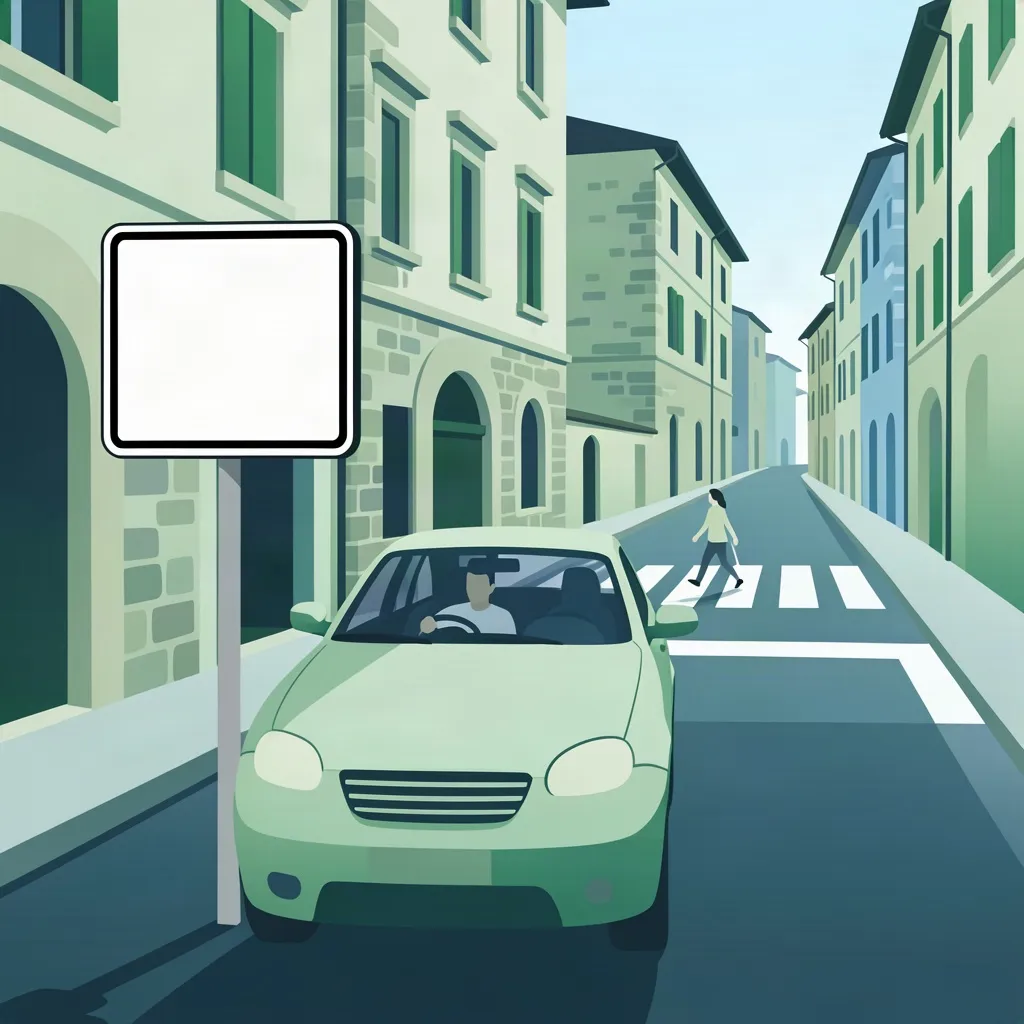
The legal transition into a built-up area is marked by a specific rectangular sign with a white background and black text, often bordered in blue. This sign indicates the official name of the locality. From the exact line where this sign is positioned, the national speed limit for that road type is superseded by the urban speed limit. Similarly, when leaving a built-up area, you will encounter the same sign crossed out by a red diagonal stripe. It is essential to understand that the rules of the road change instantly at these markers; you are expected to decelerate or accelerate smoothly but immediately to comply with the new regulatory zone.
Within an Italian centro abitato, the default maximum speed limit is 50 km/h. While some urban roads, particularly large boulevards or well-constructed thoroughfares, may be signed to allow for a limit of up to 70 km/h, the general rule remains 50 km/h unless an explicit traffic sign states otherwise. In the theory exam, you must be prepared for questions that test your ability to recognize that urban infrastructure quality alone does not permit higher speeds; only official administrative ordinances signaled by road signs can override the 50 km/h limit. Remember that this limit is designed to protect vulnerable road users, such as pedestrians and cyclists, who are naturally more concentrated in these zones.
One of the most nuanced areas of the Codice della Strada involves the distinction between fermata (a temporary stop) and sosta (parking). In urban areas, you may perform a fermata to allow passengers to alight or board, provided the vehicle does not obstruct traffic and the stop is brief. If you remain stopped for more than two minutes, the action is legally considered sosta (parking), which is subject to much stricter regulations, such as parking bay availability, ZTL access, and payment requirements. Crucially, if you are stopped and remain in the driver's seat, you are generally not required to use hazard lights, but you must be ready to move immediately if instructed by authorities or traffic conditions.
In many countries, drivers use their horns frequently to signal frustration or announce their presence. In Italian centri abitati, the use of the horn is strictly regulated and discouraged. According to the Codice della Strada, the horn should only be used in cases of immediate danger or to prevent an accident. Using the horn to signal one's arrival, to warn a pedestrian on the sidewalk, or simply because of a traffic delay is a violation of the law. Developing the habit of silent, proactive driving is not only a legal requirement but a hallmark of the safe, defensive driving style expected in your final practical test.
The exam authority (MIT) frequently includes questions regarding the transition between road types. You might be presented with a scenario where a driver is on an extraurbana secondaria (90 km/h) and approaches a sign for a town. The question will often test whether you know that the reduction to 50 km/h must begin exactly at the sign. Another common trap involves asking about the usage of high-beam headlights; remember that in illuminated built-up areas, using high beams is generally prohibited as it can dazzle other road users and is unnecessary given urban street lighting.
Driving in an Italian centro abitato means entering a zone where the Codice della Strada automatically enforces a default 50 km/h speed limit that only official signs can override, regardless of how urban the road appears. The critical distinction between fermata (a brief stop under two minutes with the driver ready to move) and sosta (parking) governs where and how you may stop, with separate rules for hazard lights and ZTL access. Horn use is strictly limited to preventing immediate danger, not for communication or expression. The MIT theory exam frequently tests your knowledge of these transitions and distinctions, so recognizing the exact signage and remembering the two-minute threshold are essential for both the test and safe real-world driving.
A short set of high-value points that capture the most important ideas from this article.
The centro abitato is a legally defined zone where specific regulations automatically take effect at the sign, not at the visible town boundary.
The default urban speed limit is 50 km/h regardless of road width or traffic volume; only an official traffic sign can change it.
A fermata is a brief stop limited to the time needed for passengers to board or alight; exceeding two minutes legally becomes sosta.
In illuminated built-up areas, high-beam headlights are prohibited because urban street lighting makes them unnecessary and they can dazzle other road users.
The horn in a centro abitato may only be used to prevent immediate danger, never to signal arrival or express frustration.
Speed limit changes take effect at the exact position of the entry or exit sign, not before or after.
Fermata means the driver must remain at the wheel and ready to move immediately; sosta (parking) has stricter regulations including bay requirements and payment.
ZTL (Zona a Traffico Limitato) restrictions apply separately and are not cancelled upon entering a centro abitato.
The 50 km/h limit protects vulnerable road users who are more concentrated in built-up areas.
Only the Codice della Strada and official signs define the rules; road appearance does not determine the speed limit.
Assuming that wider or better-maintained urban roads automatically allow speeds above 50 km/h without a visible sign.
Believing that a stop longer than two minutes is still legally a fermata rather than sosta with different rules.
Using the horn to warn pedestrians on the sidewalk or to signal arrival at a destination, which violates Codice della Strada Article 155.
Failing to adjust speed exactly at the sign when transitioning between extraurbana and centro abitato on the theory exam.
Confusing the rectangular white entry sign with other regulatory signs; the diagonal red stripe on exit is the definitive transition marker.
Article content overview
A short set of high-value points that capture the most important ideas from this article.
The centro abitato is a legally defined zone where specific regulations automatically take effect at the sign, not at the visible town boundary.
The default urban speed limit is 50 km/h regardless of road width or traffic volume; only an official traffic sign can change it.
A fermata is a brief stop limited to the time needed for passengers to board or alight; exceeding two minutes legally becomes sosta.
In illuminated built-up areas, high-beam headlights are prohibited because urban street lighting makes them unnecessary and they can dazzle other road users.
The horn in a centro abitato may only be used to prevent immediate danger, never to signal arrival or express frustration.
Speed limit changes take effect at the exact position of the entry or exit sign, not before or after.
Fermata means the driver must remain at the wheel and ready to move immediately; sosta (parking) has stricter regulations including bay requirements and payment.
ZTL (Zona a Traffico Limitato) restrictions apply separately and are not cancelled upon entering a centro abitato.
The 50 km/h limit protects vulnerable road users who are more concentrated in built-up areas.
Only the Codice della Strada and official signs define the rules; road appearance does not determine the speed limit.
Assuming that wider or better-maintained urban roads automatically allow speeds above 50 km/h without a visible sign.
Believing that a stop longer than two minutes is still legally a fermata rather than sosta with different rules.
Using the horn to warn pedestrians on the sidewalk or to signal arrival at a destination, which violates Codice della Strada Article 155.
Failing to adjust speed exactly at the sign when transitioning between extraurbana and centro abitato on the theory exam.
Confusing the rectangular white entry sign with other regulatory signs; the diagonal red stripe on exit is the definitive transition marker.
Explore related topics, search based questions, and concepts that learners often look up when studying Driving in Italian Built-Up Areas. These themes reflect real search intent and help you understand how this topic connects to wider driving theory knowledge in Italy.
Find clear and practical answers to common questions learners often have about Driving in Italian Built-Up Areas. This section helps explain difficult points, remove confusion, and reinforce the key driving theory concepts that matter for learners in Italy.
The default speed limit in an Italian built-up area (centro abitato) is 50 km/h, unless otherwise indicated by local signs.
You exit a built-up area when you pass the town name sign crossed out by a red diagonal line, at which point the general extraurban speed limits apply.
Stopping (fermata) is permitted for up to 2 minutes without using hazard lights, provided you remain with the vehicle to allow passengers to board or alight.
Yes, the use of the horn is strictly limited to immediate safety hazards; it is prohibited in non-emergency situations within built-up areas.
Refine your search or explore related Italian driving theory articles to build a stronger foundation for your exam. Dive deeper into specific traffic regulations, road signs, and practical driving scenarios that are essential for passing your official licence test.