
While an Italian Class B license provides certain privileges for lighter vehicles, it is critical to understand the exact technical limitations enforced by the Codice della Strada. This guide breaks down the eligibility for A1 category motorcycles, the restricted nature of these permissions to Italian territory, and the legal consequences of exceeding your licensed category. Mastering these rules is essential for both your theoretical knowledge and your safety on the road.
Article content overview
Many drivers in Italy assume that their standard Class B license grants them universal privileges for two-wheeled vehicles. While it is true that holding a Class B license provides specific entitlements, these rights are constrained by strict technical and geographical boundaries defined by the Italian Codice della Strada. Understanding these rules is not just a matter of legal compliance; it is a critical requirement for anyone preparing for the Italian theory exam or driving on public roads.
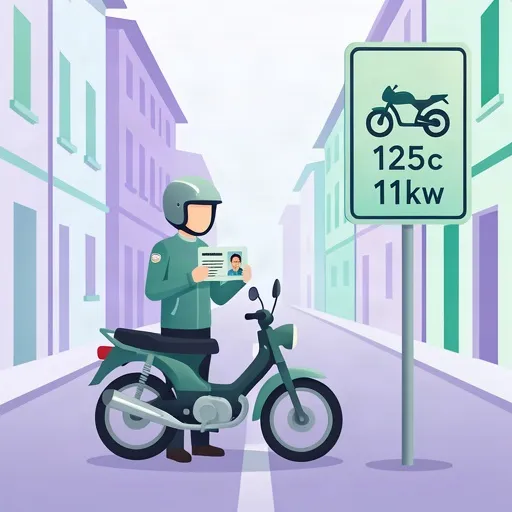
In Italy, the Class B license permits the holder to operate certain motorcycles categorized as A1. Specifically, you may ride a motorcycle with a maximum engine displacement of 125 cm³, a maximum power output of 11 kW, and a power-to-weight ratio not exceeding 0.1 kW/kg. It is important to emphasize that this specific authorization is valid strictly within Italian territory. Unlike the full Class B driving rights, which are recognized throughout the European Union, the "extra" entitlement to ride 125cc motorcycles with a car license is a national provision and does not grant you the right to ride these vehicles in other countries or even in neighboring states like France or Switzerland.
Attempting to operate a 125cc motorcycle outside of Italy with only a Class B license can lead to severe legal consequences, as international authorities do not recognize this specific Italian national exemption. Always check the local regulations of the country you are visiting.
A common point of confusion among long-term drivers in Italy involves the so-called "grandfather" rule. If you obtained your Class B license before January 1, 1986, you are authorized to drive all types of motorcycles without any displacement or power restrictions. This historical exception remains valid, but it is unique to individuals who held their license prior to that specific legislative cut-off. If you obtained your license after this date, you are strictly bound by the 125cc and 11 kW limitations unless you upgrade your license by passing the required practical examinations for category A2 or A.
The question of whether a student driver can practice on a 125cc motorcycle using the foglio rosa (learner's permit) associated with a Class B license has been clarified by the Ministry of Infrastructure and Transport. Because the Class B license entitles the holder to ride A1 category vehicles, the Ministry has confirmed that a learner may indeed use their foglio rosa to practice on 125cc motorcycles. However, these practice sessions must take place in areas with low traffic density to ensure safety, as there is no passenger seat for an instructor to provide real-time guidance as there would be in a car.
Operating a motorcycle that exceeds the 125cc or 11 kW limit without the proper license category is considered a serious infraction of the Codice della Strada. If caught, you may face significant administrative fines, ranging from approximately 1,000€ to 4,000€. Furthermore, the authorities may enforce the administrative impoundment of the vehicle for a period of up to three months. Beyond the financial impact, such a violation results in the deduction of license points and creates a permanent record of the offense, which can complicate future administrative procedures regarding your driving privileges.
Italian Class B license holders may ride A1 category motorcycles up to 125cc and 11kW with a power-to-weight ratio not exceeding 0.1 kW/kg, but this is a national provision valid only within Italy. Drivers who obtained their license before January 1, 1986 enjoy unlimited motorcycle riding rights under the grandfather clause. Learner drivers can practice on compliant 125cc motorcycles using their foglio rosa, but only in low-traffic areas. Violations result in substantial fines, vehicle impoundment, and point deductions, making it essential to know your exact permitted category before riding.
A short set of high-value points that capture the most important ideas from this article.
A Class B license in Italy allows riding A1 category motorcycles up to 125cc, 11kW, with a power-to-weight ratio not exceeding 0.1 kW/kg.
This motorcycle privilege is valid ONLY in Italy and is NOT recognized in other EU countries or neighboring states like France or Switzerland.
If you obtained your Class B license before January 1, 1986, you may ride any motorcycle without displacement or power restrictions.
Learner drivers with a foglio rosa may practice on compliant 125cc motorcycles but only in areas with low traffic density.
Exceeding your licensed motorcycle category can result in fines of €1,000 to €4,000, vehicle impoundment up to three months, and license point deductions.
The three A1 motorcycle limits: 125cc maximum displacement, 11kW maximum power, and 0.1 kW/kg maximum power-to-weight ratio.
The 125cc/11kW privilege is a national Italian provision only — it does not extend across the European Union.
The pre-1986 grandfather clause grants unlimited motorcycle access ONLY to those who held a Class B license before January 1, 1986.
Practice on 125cc motorcycles with a foglio rosa requires low-traffic areas and carrying official learner documentation.
Vehicle impoundment for up to three months is a possible consequence of riding an unauthorized motorcycle.
Assuming the 125cc riding privilege with a Class B license is valid throughout the EU — it is not.
Confusing the A1 motorcycle category limits with other categories; A1 specifically requires 125cc, 11kW, and 0.1 kW/kg.
Believing any Class B license holder can ride any motorcycle, ignoring the strict technical thresholds.
Attempting to practice on a 125cc motorcycle without ensuring the vehicle meets all three criteria (displacement, power, and power-to-weight ratio).
Overlooking that the grandfather exception applies only to licenses obtained before January 1, 1986.
Article content overview
A short set of high-value points that capture the most important ideas from this article.
A Class B license in Italy allows riding A1 category motorcycles up to 125cc, 11kW, with a power-to-weight ratio not exceeding 0.1 kW/kg.
This motorcycle privilege is valid ONLY in Italy and is NOT recognized in other EU countries or neighboring states like France or Switzerland.
If you obtained your Class B license before January 1, 1986, you may ride any motorcycle without displacement or power restrictions.
Learner drivers with a foglio rosa may practice on compliant 125cc motorcycles but only in areas with low traffic density.
Exceeding your licensed motorcycle category can result in fines of €1,000 to €4,000, vehicle impoundment up to three months, and license point deductions.
The three A1 motorcycle limits: 125cc maximum displacement, 11kW maximum power, and 0.1 kW/kg maximum power-to-weight ratio.
The 125cc/11kW privilege is a national Italian provision only — it does not extend across the European Union.
The pre-1986 grandfather clause grants unlimited motorcycle access ONLY to those who held a Class B license before January 1, 1986.
Practice on 125cc motorcycles with a foglio rosa requires low-traffic areas and carrying official learner documentation.
Vehicle impoundment for up to three months is a possible consequence of riding an unauthorized motorcycle.
Assuming the 125cc riding privilege with a Class B license is valid throughout the EU — it is not.
Confusing the A1 motorcycle category limits with other categories; A1 specifically requires 125cc, 11kW, and 0.1 kW/kg.
Believing any Class B license holder can ride any motorcycle, ignoring the strict technical thresholds.
Attempting to practice on a 125cc motorcycle without ensuring the vehicle meets all three criteria (displacement, power, and power-to-weight ratio).
Overlooking that the grandfather exception applies only to licenses obtained before January 1, 1986.
Explore related topics, search based questions, and concepts that learners often look up when studying Class B License Motorcycle Rules. These themes reflect real search intent and help you understand how this topic connects to wider driving theory knowledge in Italy.
Find clear and practical answers to common questions learners often have about Class B License Motorcycle Rules. This section helps explain difficult points, remove confusion, and reinforce the key driving theory concepts that matter for learners in Italy.
No, a Class B license only allows you to ride motorcycles classified under category A1, which means a maximum cylinder capacity of 125cc and a maximum power output of 11kW, with a power-to-weight ratio not exceeding 0.1 kW/kg.
No, the authorization to ride motorcycles with a Class B license is specific to Italian territory and does not apply in other countries, including those within the European Union.
Yes, individuals who held a Class B license issued before January 1, 1986, are subject to different regulations and may be permitted to ride larger motorcycles, but it is highly recommended to verify current status with the motor vehicle office.
Operating a vehicle outside of your licensed category is a serious violation of the Codice della Strada, which can result in heavy administrative fines, deduction of license points, and the administrative impoundment of the vehicle.
Yes, following official ministerial guidance, holders of a Class B learner's permit (foglio rosa) are permitted to practice on A1 category motorcycles, provided they do so in locations with little traffic.
Refine your search or explore related Italian driving theory articles to build a stronger foundation for your exam. Dive deeper into specific traffic regulations, road signs, and practical driving scenarios that are essential for passing your official licence test.