
Understanding how to safely share the road with trams is a fundamental aspect of Italian driving theory. This guide covers essential regulations, including why trams generally hold absolute priority, the strict limitations on overtaking, and the importance of maintaining proper clearance. You will also learn about specific risks, such as losing traction on wet rails, helping you prepare effectively for both your theory exam and real-world urban driving.
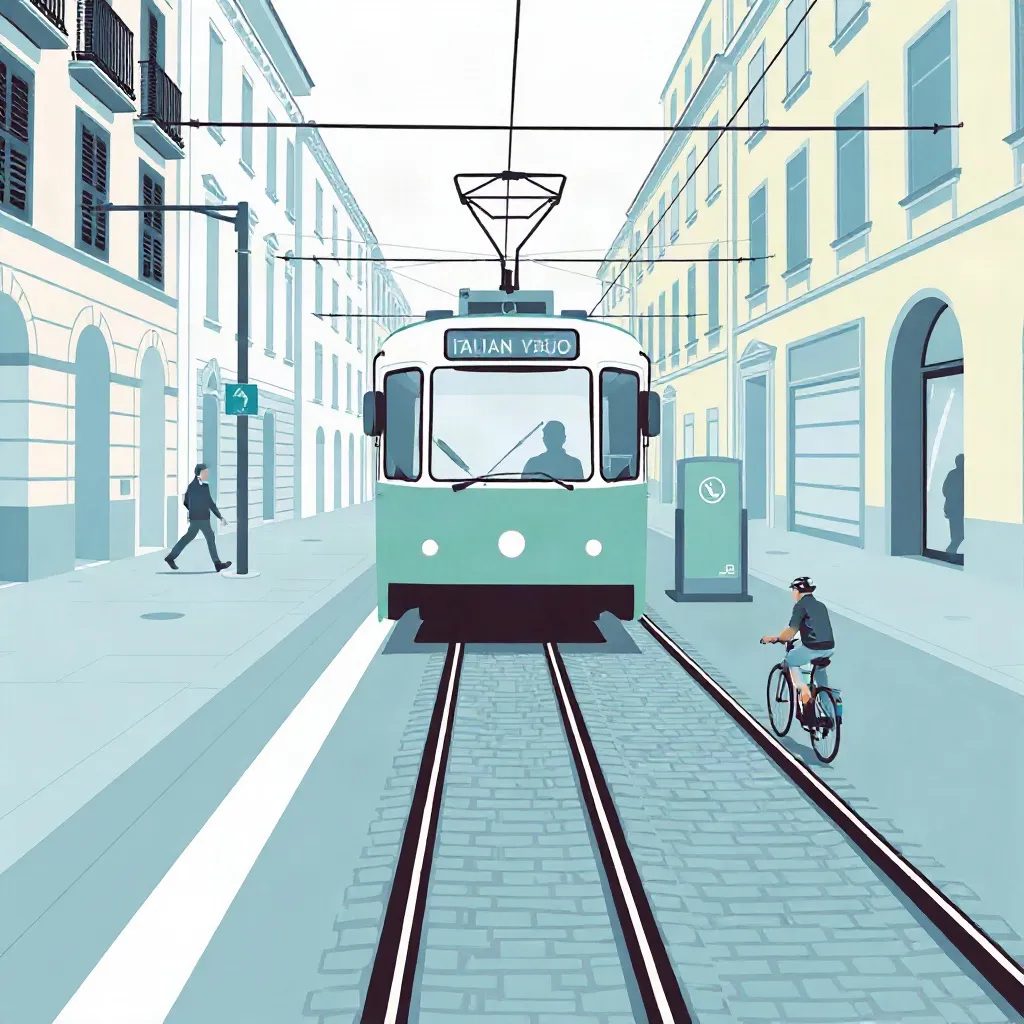
Article content overview
Navigating Italian urban environments, especially in cities like Milan, Turin, Florence, Rome, and Naples, requires a sophisticated understanding of how to share the road with tram networks. Trams are a fixed-path public transport system that operates under strict traffic regulations defined by the Italian Codice della Strada. For learners preparing for the theory exam, it is essential to distinguish between the general priority rules applied to private vehicles and the specific, often absolute, priority granted to tramway traffic.
In the context of the Italian theory exam, the most fundamental concept to grasp is that trams almost always possess the right of way over private vehicles. While standard intersections typically follow the "right-hand rule" (giving way to vehicles coming from the right), these rules are frequently superseded by the physical and legal presence of a tram line. Unless a specific traffic signal or sign indicates otherwise, you must expect the tram to take precedence, as it cannot maneuver to avoid collisions.
The principle that, on public roads, tramways generally hold the right of way over other vehicular traffic due to their inability to deviate from their fixed path and their significant mass.
When approaching an intersection where a tram is present, you must verify the tram's trajectory. If the tram is moving or preparing to enter the intersection, you are legally and ethically obligated to wait. Attempting to "beat" a tram to an intersection is a common cause of accidents and is frequently flagged as a critical error in theory exam scenarios.
Driving on roads that feature tram tracks requires constant vigilance. According to the Codice della Strada, you are permitted to travel on roads with tram lines, but you must be mindful of your lane positioning. If the tracks are embedded in the carriageway, you must avoid creating obstacles for the tram. Furthermore, overtaking a tram requires specific maneuvers depending on the road layout.
In standard scenarios, overtaking a tram should be performed on the right side. However, if there is insufficient space on the right, or if the road layout dictates otherwise, you may pass on the left, provided that this does not interfere with the tram's progress or violate other traffic laws. A crucial exception exists regarding the salvagente (safety island). If there is a raised safety island at a tram stop, you must pass it according to the signaled direction, typically keeping to the right of the island.
Always remember that you must never overtake a tram that is stopped for the boarding or alighting of passengers if there is no raised safety island. In such cases, you must stop and wait until all pedestrians have cleared the area and the tram is ready to resume movement.
The grooved nature of tram rails presents a unique and severe danger to motorcyclists and cyclists. When a tire drops into the groove of the track, the rider often loses steering control immediately, which can result in a dangerous fall or collision. This risk is exponentially higher during adverse weather conditions, such as rain, when the metal tracks become incredibly slippery.
When you must cross tracks—whether as a car driver or on a two-wheeled vehicle—it is essential to do so at an angle as close to 90 degrees as possible. Crossing at a shallow angle increases the likelihood of the wheel becoming trapped in the rail slot. Additionally, avoid braking or accelerating sharply while your tires are in contact with the metal rails, as the sudden change in friction will almost certainly lead to a loss of traction.
The Codice della Strada imposes strict limitations on stopping and parking near tram infrastructure to ensure the network remains efficient and safe. Generally, parking is prohibited within 5 meters of a tramway line if it would obstruct the tram’s movement or block the path of passengers accessing the tram.
Effective hazard perception in the theory exam relies on recognizing these spatial constraints. Many exam questions test your knowledge of how these distances and physical barriers influence your ability to stop safely. Always scan for salvagente platforms, which indicate a formal tram stop, and adjust your speed accordingly to manage your braking distance, as trams are much heavier and require a significantly longer distance to come to a complete halt compared to a standard passenger car.
This article covers the essential Italian traffic regulations for sharing roads with tram networks, emphasizing that trams possess absolute priority over private vehicles due to their fixed path and inability to maneuver. Key rules include overtaking procedures (normally right-side, left only when necessary), strict prohibitions on passing stopped trams without a safety island, and specific parking restrictions within 5 meters of tram lines. The content highlights critical hazards for two-wheeled vehicles, particularly the danger of rail grooves causing loss of control in wet conditions, and recommends crossing tracks at angles close to 90 degrees. Learners should memorize the Italian terminology including Codice della Strada, salvagente, and precedenza to succeed in the theory exam.
A short set of high-value points that capture the most important ideas from this article.
Trams hold absolute priority over private vehicles on Italian roads because they cannot deviate from their fixed rail path
Overtaking trams should normally be done on the right side; passing on the left is only permitted when the right side is insufficient or dictated by road layout
Never overtake a tram that is stopped for passenger boarding unless a raised safety island (salvagente) is present
Two-wheeled vehicles face severe hazard from tram rail grooves, especially in wet conditions; cross tracks at angles close to 90 degrees
Parking is prohibited within 5 meters of tramway lines if it would obstruct tram movement or passenger access
Tram priority supersedes the standard 'right-hand rule' at intersections unless specific signals indicate otherwise
A raised safety island (salvagente) at a tram stop allows traffic to continue when the tram is stopped; without it, you must stop and wait
Grooved tram rails can trap motorcycle and bicycle tires, causing immediate loss of steering control
When crossing tram tracks, use a 90-degree angle and avoid braking or accelerating while tires contact the metal rails
Trams require significantly longer braking distances than cars due to their mass
Assuming standard intersection priority rules apply when a tram is present, instead of recognizing tram absolute priority
Attempting to overtake a stopped tram near a platform without a safety island, which forces passengers to walk into traffic
Crossing tram tracks at a shallow angle, increasing the risk of tires becoming trapped in the rail groove
Parking too close to tram lines without respecting the 5-meter minimum clearance requirement
Braking or accelerating while tires are in contact with wet tram rails, causing sudden loss of traction
Article content overview
A short set of high-value points that capture the most important ideas from this article.
Trams hold absolute priority over private vehicles on Italian roads because they cannot deviate from their fixed rail path
Overtaking trams should normally be done on the right side; passing on the left is only permitted when the right side is insufficient or dictated by road layout
Never overtake a tram that is stopped for passenger boarding unless a raised safety island (salvagente) is present
Two-wheeled vehicles face severe hazard from tram rail grooves, especially in wet conditions; cross tracks at angles close to 90 degrees
Parking is prohibited within 5 meters of tramway lines if it would obstruct tram movement or passenger access
Tram priority supersedes the standard 'right-hand rule' at intersections unless specific signals indicate otherwise
A raised safety island (salvagente) at a tram stop allows traffic to continue when the tram is stopped; without it, you must stop and wait
Grooved tram rails can trap motorcycle and bicycle tires, causing immediate loss of steering control
When crossing tram tracks, use a 90-degree angle and avoid braking or accelerating while tires contact the metal rails
Trams require significantly longer braking distances than cars due to their mass
Assuming standard intersection priority rules apply when a tram is present, instead of recognizing tram absolute priority
Attempting to overtake a stopped tram near a platform without a safety island, which forces passengers to walk into traffic
Crossing tram tracks at a shallow angle, increasing the risk of tires becoming trapped in the rail groove
Parking too close to tram lines without respecting the 5-meter minimum clearance requirement
Braking or accelerating while tires are in contact with wet tram rails, causing sudden loss of traction
Explore related topics, search based questions, and concepts that learners often look up when studying Driving Near Italian Tram Tracks. These themes reflect real search intent and help you understand how this topic connects to wider driving theory knowledge in Italy.
Find clear and practical answers to common questions learners often have about Driving Near Italian Tram Tracks. This section helps explain difficult points, remove confusion, and reinforce the key driving theory concepts that matter for learners in Italy.
Yes, as a general rule in the Italian Codice della Strada, trams have absolute priority over other vehicles, even if standard intersection priority rules might otherwise apply, unless specific traffic lights or signals indicate otherwise.
No, you must generally overtake a tram on the right. Overtaking on the left is prohibited unless there are specific road markings or signage that explicitly allow it.
You are strictly prohibited from parking or stopping within 5 meters of a tram line, as this can block the path of the tram and cause serious traffic disruptions.
The metal grooves of the rails create a significant risk of losing control. If a wheel drops into the groove, especially in wet conditions, it can lead to immediate skidding or a fall, making it essential to cross tracks at as close to a right angle as possible.
If a tram stops for passengers to board or alight and there is no raised safety platform, you must stop behind the tram and wait for it to move, ensuring passengers can do so safely without risk from your vehicle.
Refine your search or explore related Italian driving theory articles to build a stronger foundation for your exam. Dive deeper into specific traffic regulations, road signs, and practical driving scenarios that are essential for passing your official licence test.