
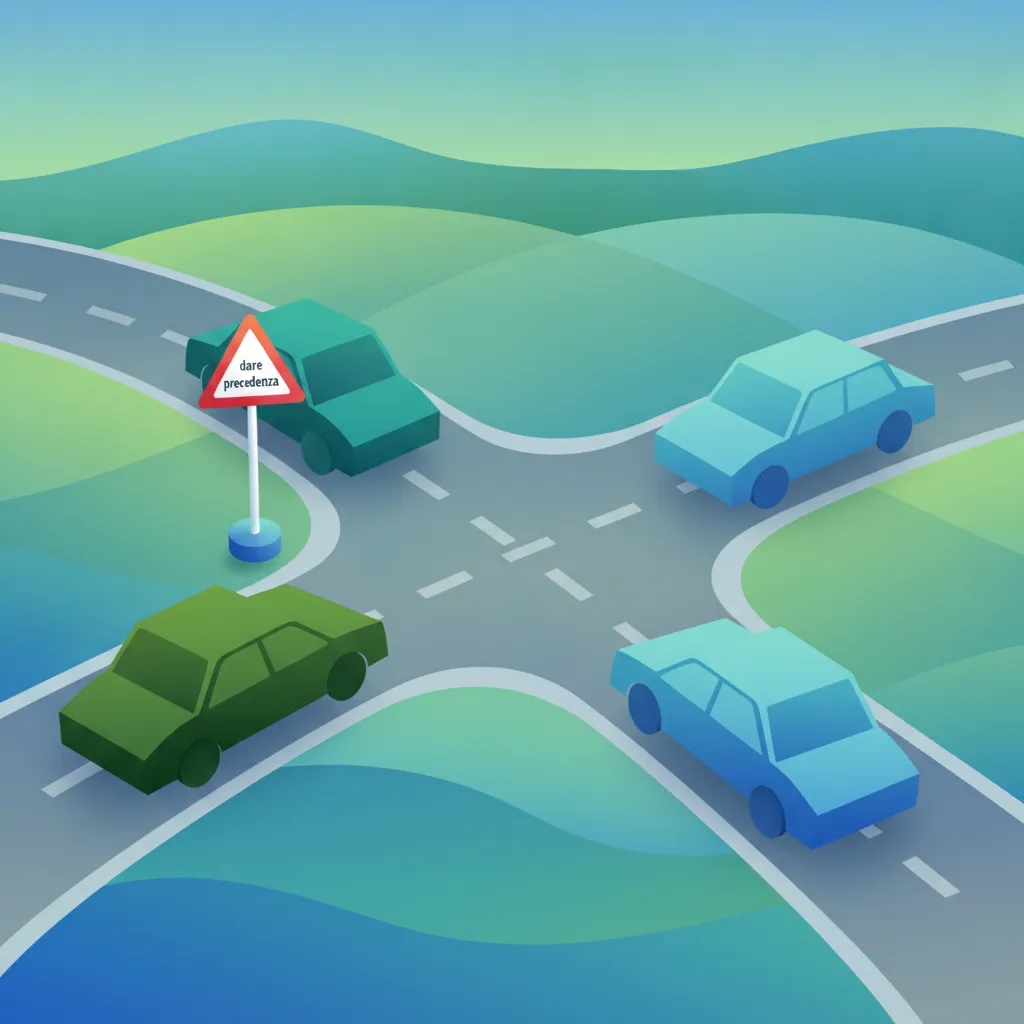
In Italy, determining right of way, known as "precedenza," is a fundamental aspect of safe and orderly traffic flow. This concept clarifies which road user has the legal right to proceed first at conflict points, such as intersections, roundabouts, and pedestrian crossings. Understanding these rules, whether indicated by signs, markings, or general principles, is essential for every driver and frequently tested in the Italian driving license theory exam.
Theory topic content overview
Read the full theory topic guide for Italian Right of Way with structured, easy-to-scan content built for learners in Italy. This detailed section explains the exact rule, meaning, traffic context, comparison points, and exam logic behind this Italian driving theory topic so you can study faster, understand the concept more clearly, and avoid common interpretation mistakes on the theory test.
Precedenza)In Italian traffic law, right of way is known as precedenza. It is a fundamental principle that dictates which road user has the legal right to proceed first at any point where paths might cross or conflict. Mastering precedenza is not just about avoiding collisions; it's also a cornerstone of the Italian driving theory exam, frequently featuring in complex intersection diagrams.
Understanding precedenza creates order out of potential chaos, ensuring smooth and safe traffic flow by clearly defining who must yield (dare la precedenza) and who may continue (avere la precedenza).
For anyone learning to drive in Italy, or even experienced drivers, a clear grasp of precedenza is paramount.
Codice della Strada (Italian Highway Code) strictly defines right of way. Violating these rules can lead to fines, penalty points, and dangerous situations.precedenza. You'll encounter numerous questions with detailed illustrations of intersections, requiring you to correctly identify the order of passage for various vehicles. Failure to understand these scenarios can significantly impact your exam results.precedenza rules, traffic moves more smoothly, reducing congestion and unnecessary stops. This is especially important in Italy's often bustling urban environments and historical centres.Determining precedenza in Italy follows a clear hierarchy. You must assess the situation in this order:
Agenti del traffico / Vigili Urbani): Instructions from traffic police always override all other signals, signs, and rules.Segnali luminosi): Functioning traffic lights (red, amber, green) take precedence over all road signs and general rules.Segnali verticali) and Road Markings (Segnali orizzontali): If no police or traffic lights are present, fixed road signs and markings dictate priority. These include STOP signs, Dare precedenza (Yield) signs, and Diritto di precedenza (Priority Road) signs, along with stop lines and yield lines on the road surface.Regole generali): In the absence of any of the above, general rules from the Codice della Strada apply. The most crucial of these is dare la precedenza a destra (give way to the right).STOP Sign: Requires a complete stop behind the stop line, even if no traffic is visible. You must then yield to all traffic on the intersecting road before proceeding safely.Dare precedenza (Yield/Give Way) Sign: Requires you to slow down and be prepared to stop. You must yield to all traffic on the intersecting road before entering. If the way is clear, you can proceed without stopping.Diritto di precedenza (Priority Road) Sign: This diamond-shaped yellow sign indicates you are on a priority road. Traffic joining or crossing from side roads will have Dare precedenza or STOP signs, meaning you generally have priority. However, always remain vigilant.Fine del diritto di precedenza (End of Priority Road) Sign: A similar sign with a black diagonal stripe, indicating the priority road ends and general rules or other signs will apply from that point.Striscia di arresto): A solid white line indicating where to stop at a STOP sign or traffic light.Striscia di dare precedenza): A series of white triangles pointing towards your vehicle, indicating where to yield at a Dare precedenza sign.Dare la Precedenza a Destra (Give Way to the Right)This is perhaps the most critical general rule in Italian traffic law, especially for the theory exam. At uncontrolled intersections (those without traffic lights, signs, or police direction), you must yield to any vehicle approaching from your right.
Exceptions to Dare la Precedenza a Destra:
Even at an uncontrolled intersection, dare la precedenza a destra does not apply in these specific situations:
Veicoli su rotaia): Trams and trains always have priority.Mezzi di soccorso): Police, ambulance, and fire services with active sirens and flashing lights always have priority.Svolta a sinistra): A vehicle turning left must yield to all oncoming traffic that is proceeding straight or turning right. This is a common exam trick question.Rotatorie)Italian roundabouts can be a source of confusion as their priority rules vary:
Dare precedenza (Yield) signs at its entries, then vehicles already circulating inside the roundabout have priority. This is the modern and most common configuration in Italy.Dare precedenza signs at the entry, the general rule of dare la precedenza a destra applies. This means vehicles entering the roundabout have priority over those already inside it. Always confirm the signage!Strisce pedonali / Zebra Crossings): Pedestrians crossing on designated strisce pedonali always have priority once they step onto the crossing. Drivers must slow down, be prepared to stop, and allow them to cross safely.Ciclisti): Cyclists often share similar priority rules to vehicles, but drivers must exercise extreme caution due to their vulnerability.fermata dell'autobus) generally have priority if they signal their intention, especially in urban areas.STOP vs. Dare precedenza: A STOP sign demands a full stop behind the line, regardless of traffic. A Dare precedenza sign requires you to yield, meaning you only stop if necessary to allow other traffic to pass.Precedenza a destra vs. Priority Signs: The general precedenza a destra rule only applies when no signs or lights are present. Signs like Diritto di precedenza or Dare precedenza override this general rule.Dare precedenza signs upon entering a roundabout. This determines whether you yield to traffic already in the circle (signed) or traffic entering from your right (unsigned, less common).dare la precedenza to the van, even if you arrive first.rotatoria where a Dare precedenza sign is clearly visible at your entry point. You must slow down and yield to any vehicles already circulating within the roundabout before entering.via in Florence. Ahead, a pedestrian steps onto a strisce pedonali (zebra crossing). You must immediately slow down and stop to allow the pedestrian to cross safely, even if traffic behind you is impatient.svoltare a sinistra). An oncoming car is proceeding straight. Even with a green light, you must yield to the oncoming car that is going straight or turning right before completing your left turn.Precedenza a Destra: Many learners incorrectly apply precedenza a destra even when a STOP or Dare precedenza sign is clearly present, leading to dangerous situations and incorrect exam answers. Remember: signs override general rules.STOP: A common oversight is a "rolling stop" or only slowing down at a STOP sign. The Codice della Strada requires a full, momentary halt behind the stop line.Dare precedenza sign.precedenza to pedestrians on strisce pedonali is a serious safety lapse and a guaranteed exam failure.Precedenza in ItalyNavigating Italian roads safely and successfully passing your esame di teoria depends heavily on your ability to quickly and accurately determine precedenza. Always follow this mental framework:
STOP, Dare precedenza, Diritto di precedenza)? Are there road markings?dare la precedenza a destra.When in doubt, always dare la precedenza (yield). It's always safer to give way than to assume you have priority and risk a collision. This cautious approach is key to safe driving in Italy.
Italian right of way (precedenza) is determined by a clear hierarchy where traffic police override all, followed by traffic lights, road signs, and finally general rules. At uncontrolled intersections, the 'dare la precedenza a destra' rule requires yielding to vehicles from your right, but this rule has important exceptions including trams, emergency vehicles, vehicles exiting private property, and vehicles already in the intersection. Roundabouts require checking for Dare precedenza signs—modern signed roundabouts give priority to circulating traffic, while unsigned roundabouts follow the standard 'give way to the right' principle. Pedestrians on designated crossings and public transport re-entering traffic also hold specific priority rights that drivers must respect.
A short set of high-value points that capture the most important ideas from this theory explanation.
Right of way (precedenza) in Italy follows a strict hierarchy: traffic police > traffic lights > road signs/markings > general Codice della Strada rules.
The general rule of 'dare la precedenza a destra' (give way to the right) only applies at uncontrolled intersections with no signs, lights, or police.
STOP requires a complete halt behind the line; Dare precedenza only requires yielding if necessary without a mandatory stop.
At signed roundabouts, circulating traffic has priority; at unsigned roundabouts (older type), 'dare la precedenza a destra' applies.
Pedestrians on zebra crossings (strisce pedonali) and vehicles on rails (trams/trains) always have absolute priority regardless of other rules.
When turning left, always yield to oncoming traffic proceeding straight or turning right, even with a green light.
Priority signs (Diritto di precedenza) override the general 'precedenza a destra' rule until the End of Priority Road sign appears.
Emergency vehicles with active sirens and flashing lights have absolute priority over all other traffic and rules.
Vehicles exiting private property must always yield to all traffic on the public road.
If no signs, lights, or police are present at an intersection, 'dare la precedenza a destra' is your default guide.
Applying 'precedenza a destra' when STOP or Dare precedenza signs are clearly visible—signs always override general rules.
Performing a rolling stop at STOP signs instead of a complete, momentary halt behind the stop line.
Assuming all roundabouts work the same way; failing to check for Dare precedenza signs at entry points.
Not yielding to pedestrians the instant they step onto a zebra crossing (strisce pedonali).
Forgetting that trams and emergency vehicles have priority even when other traffic rules would normally apply.
Start with a short, direct summary of Italian Right of Way before reading the full explanation below.
Right of way (precedenza) in Italy dictates which vehicle or road user has the legal priority to proceed at an intersection or conflict point. This is primarily determined by traffic signs (e.g., 'Stop', 'Dare precedenza'), traffic lights, road markings, and specific regulations from the Codice della Strada. When no specific indications are present, the general rule of 'giving way to the right' (dare la precedenza a destra) often applies, but there are important exceptions to know.
Review the most important terms, rule signals, and traffic concepts linked to Italian Right of Way.
Explore related theory topic pages connected to Italian Right of Way and continue with the next useful rule explanation.
See the common search queries learners use when trying to understand Italian Right of Way in Italy.

Ready to deepen your knowledge? Explore specific Italian driving theory topics in detail, review challenging concepts, or test your understanding with practice questions. Build confidence for your official Italian driving licence exam by continuously learning and applying these essential road rules.
Explore Italian Driving TheoryTheory topic content overview
A short set of high-value points that capture the most important ideas from this theory explanation.
Right of way (precedenza) in Italy follows a strict hierarchy: traffic police > traffic lights > road signs/markings > general Codice della Strada rules.
The general rule of 'dare la precedenza a destra' (give way to the right) only applies at uncontrolled intersections with no signs, lights, or police.
STOP requires a complete halt behind the line; Dare precedenza only requires yielding if necessary without a mandatory stop.
At signed roundabouts, circulating traffic has priority; at unsigned roundabouts (older type), 'dare la precedenza a destra' applies.
Pedestrians on zebra crossings (strisce pedonali) and vehicles on rails (trams/trains) always have absolute priority regardless of other rules.
When turning left, always yield to oncoming traffic proceeding straight or turning right, even with a green light.
Priority signs (Diritto di precedenza) override the general 'precedenza a destra' rule until the End of Priority Road sign appears.
Emergency vehicles with active sirens and flashing lights have absolute priority over all other traffic and rules.
Vehicles exiting private property must always yield to all traffic on the public road.
If no signs, lights, or police are present at an intersection, 'dare la precedenza a destra' is your default guide.
Applying 'precedenza a destra' when STOP or Dare precedenza signs are clearly visible—signs always override general rules.
Performing a rolling stop at STOP signs instead of a complete, momentary halt behind the stop line.
Assuming all roundabouts work the same way; failing to check for Dare precedenza signs at entry points.
Not yielding to pedestrians the instant they step onto a zebra crossing (strisce pedonali).
Forgetting that trams and emergency vehicles have priority even when other traffic rules would normally apply.
Start with a short, direct summary of Italian Right of Way before reading the full explanation below.
Right of way (precedenza) in Italy dictates which vehicle or road user has the legal priority to proceed at an intersection or conflict point. This is primarily determined by traffic signs (e.g., 'Stop', 'Dare precedenza'), traffic lights, road markings, and specific regulations from the Codice della Strada. When no specific indications are present, the general rule of 'giving way to the right' (dare la precedenza a destra) often applies, but there are important exceptions to know.
Review the most important terms, rule signals, and traffic concepts linked to Italian Right of Way.
Explore related theory topic pages connected to Italian Right of Way and continue with the next useful rule explanation.
See the common search queries learners use when trying to understand Italian Right of Way in Italy.
Ready to deepen your knowledge? Explore specific Italian driving theory topics in detail, review challenging concepts, or test your understanding with practice questions. Build confidence for your official Italian driving licence exam by continuously learning and applying these essential road rules.
Explore Italian Driving TheoryUse this exam-focused revision tip to understand how Italian Right of Way is likely to appear in theory questions for learners in Italy. This section helps you identify the most testable part of the rule, avoid common traps, and remember the concept more effectively during Italian driving theory exam preparation.
Many Italian theory exam questions feature complex intersection diagrams testing your knowledge of 'precedenza'. Pay close attention to all road signs, markings, and the direction vehicles are taking, especially when no signs are present and the 'give way to the right' rule (dare la precedenza a destra) applies or is explicitly overridden.
Read direct answers to the most common learner questions about Italian Right of Way in Italy. This FAQ focuses on rule confusion, practical meaning, comparison with similar concepts, and the exact uncertainties that appear most often in Italian driving theory revision and exam preparation.
Precedenza is the Italian term for right of way, referring to the legal right of a vehicle or road user to proceed before others at a point where their paths might conflict, such as an intersection or merge point.
The rule of 'dare la precedenza a destra' (give way to the right) applies at uncontrolled intersections in Italy. This means if there are no signs, signals, or road markings, you must yield to vehicles coming from your right.
Pedestrians generally have right of way when crossing at designated pedestrian crossings (strisce pedonali) and drivers must yield. Drivers also need to be prepared to yield to pedestrians stepping onto the road, especially in urban areas.
Traffic lights in Italy override all other right of way rules and signs when they are functioning. A green light gives you the right to proceed, while a red light requires you to stop before the stop line.
Common right of way signs in Italy include 'STOP' (stop sign), 'DARE PRECEDENZA' (give way sign), and signs indicating a priority road (e.g., 'Diritto di precedenza' or 'Intersezione con diritto di precedenza').
At roundabouts in Italy, the right of way depends on the specific signage. If a 'Dare precedenza' sign is present before entering, vehicles already in the roundabout have priority. Without such signs, the general 'dare la precedenza a destra' rule would apply upon entry, making entry more complex.
Yes, when turning in Italy, you must generally yield to vehicles that are proceeding straight. If turning left, you must also yield to vehicles coming from the opposite direction that are proceeding straight or turning right.
Yes, emergency vehicles (ambulances, police, fire brigade) with activated sirens and flashing lights always have absolute right of way in Italy, and all other road users must safely facilitate their passage.
Start searching now to pinpoint exactly which Italian driving theory topics, road signs, or traffic rules you need to master. Use our advanced filters to build a custom practice session and ensure you're fully prepared for every aspect of your official driving licence exam.