
In Italy, roundabout priority is primarily determined by road signs, especially the 'Dare precedenza' (Give Way) sign. While most modern roundabouts require you to yield to vehicles already circulating, it's crucial to understand that without such signage, the general rule of giving way to the right applies, which means entering vehicles would have priority. This page explains both scenarios and how to drive safely and correctly.
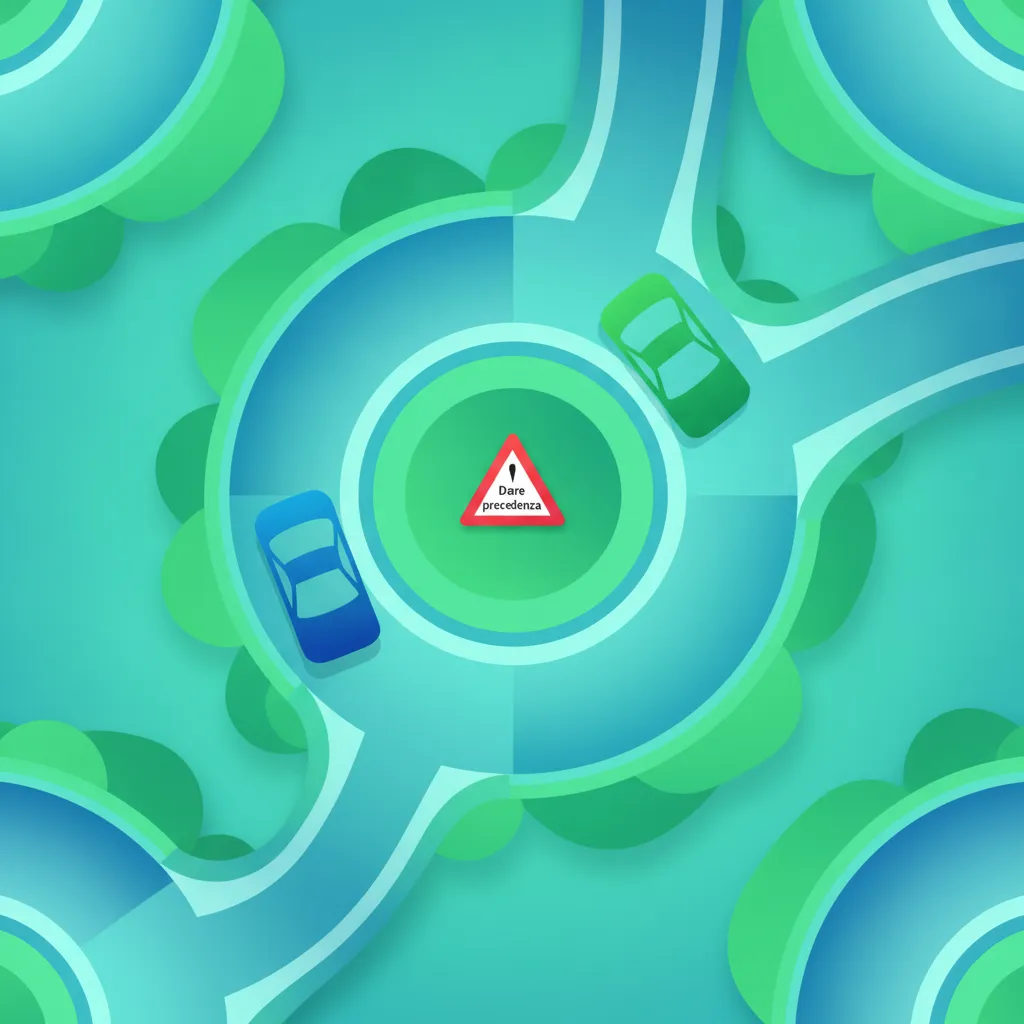
Theory topic content overview
Read the full theory topic guide for Roundabout Priority with structured, easy-to-scan content built for learners in Italy. This detailed section explains the exact rule, meaning, traffic context, comparison points, and exam logic behind this Italian driving theory topic so you can study faster, understand the concept more clearly, and avoid common interpretation mistakes on the theory test.
Navigating Italian roundabouts, known as rotatorie or intersezioni a circolazione rotatoria, requires a clear understanding of priority rules to ensure safety and comply with the Codice della Strada (Italian Highway Code). While many modern roundabouts follow a common international standard, Italy has a crucial distinction that is a frequent source of confusion and an important point in the Italian driving theory exam.
The core principle of roundabout priority in Italy hinges on the presence, or absence, of specific road signage. This determines whether you yield to traffic already circulating or if the general precedenza a destra (give way to the right) rule applies.
Understanding roundabout priority is critical for several reasons, particularly for drivers in Italy:
rotatorie.Italian traffic law distinguishes between two primary types of roundabouts concerning priority:
Most contemporary roundabouts in Italy are regulated by specific signs that indicate priority.
striscia trasversale di triangoli bianchi (transverse strip of white triangles) painted on the road surface. This marking indicates the precise point before which you must stop or yield.anello (ring) of the roundabout. This means you must slow down, prepare to stop, and only enter when there is a safe gap in the traffic already inside, without forcing them to brake or change course.This scenario aligns with the roundabout rules found in many other countries, making it intuitive for most drivers.
This is the most crucial distinction for Italian driving and a frequent source of error.
precedenza a destra (give way to the right) applies.Codice della Strada, which states that at intersections, the obligation to give way is to those coming from the right, unless otherwise signaled.Regardless of the priority rule, several practices are essential when navigating rotatorie in Italy:
The most vital distinction for Italian drivers is between:
Dare precedenza): You yield to traffic already inside.Dare precedenza): You apply precedenza a destra, meaning you may have priority over circulating traffic coming from your left, but circulating traffic must yield to those entering from their right. This often means entering vehicles have priority over those already circulating.This stands in stark contrast to roundabout rules in many other European countries where circulating traffic almost universally has priority, regardless of signage. Always check for the Dare precedenza sign specifically. If it's absent, assume precedenza a destra.
Dare precedenza sign: You see the inverted triangle sign and the white yield triangles on the road. You slow down, observe the silver Fiat 500 already circling, and wait for it to pass safely before entering.Dare precedenza sign. A red Vespa is already inside, coming from your left. According to precedenza a destra, the Vespa must yield to you as you are coming from its right. However, given the potential confusion, you still proceed with extreme caution, making eye contact and being ready to stop if the Vespa driver does not yield. This is where defensive driving is paramount.Italian driving theory candidates frequently make these errors regarding roundabout priority:
Dare precedenza sign.Precedenza a Destra: Not knowing when and how to apply the precedenza a destra rule at unsignaled roundabouts, often leading to dangerous assumptions that circulating traffic always has the right of way.The golden rule for roundabout priority in Italy is "Signs dictate priority."
Dare precedenza sign: If present, yield to vehicles already inside the roundabout. This is the norm for modern rotatorie.Dare precedenza sign: Apply the general rule of precedenza a destra. This means vehicles entering from the right have priority, including those entering as you circulate. This is the critical exception and exam trap.Italian roundabout priority hinges entirely on signage: modern roundabouts with a 'Dare precedenza' sign require yielding to circulating traffic, while unsignaled roundabouts apply the 'precedenza a destra' rule where entering vehicles have priority over traffic approaching from their left. This distinction, rooted in Article 145 of the Codice della Strada, is a frequent exam trap since it differs from roundabout conventions in other countries. Safe navigation requires moderate approach speed, careful observation for the inverted triangle sign, correct lane positioning in multi-lane roundabouts, and mandatory right-signal upon exiting. Defensive driving is especially critical at unsignaled roundabouts where other drivers may incorrectly assume circulating traffic has priority.
A short set of high-value points that capture the most important ideas from this theory explanation.
Modern Italian roundabouts display a 'Dare precedenza' (Give Way) sign requiring you to yield to vehicles already circulating inside the ring.
At unsignaled roundabouts without the 'Dare precedenza' sign, the 'precedenza a destra' rule applies, meaning vehicles entering from your right have priority over circulating traffic from your left.
The absence of the 'Dare precedenza' sign is the key indicator that the general give-way-to-the-right rule overrides the usual circulating-traffic priority.
You must always signal right when exiting a roundabout, activating after passing the exit immediately before your intended one.
In multi-lane roundabouts, use the right lane for the first or second exit and the left (inner) lane for later exits, exiting only from the rightmost lane.
If 'Dare precedenza' is present: yield to circulating traffic. If absent: precedenza a destra applies, giving priority to vehicles entering from the right.
Unsignaled roundabouts are the critical exam trap—entering vehicles may have priority over those already inside.
Left indicator upon entry is generally not required in Italy; signaling your exit is mandatory.
Always reduce speed when approaching any roundabout to assess signs, traffic, and potential hazards.
When in an inner lane, you must move to the rightmost lane before your exit without cutting off other vehicles.
Assuming vehicles already inside a roundabout always have priority—this is only true with a 'Dare precedenza' sign present.
Failing to recognize when 'precedenza a destra' applies at unsignaled roundabouts, leading to dangerous incorrect yielding.
Using the left indicator when entering a roundabout (unless changing lanes internally), which is not required and can confuse other drivers.
Entering a roundabout at excessive speed, preventing proper assessment of traffic priority and signs.
Neglecting to yield to pedestrians at marked crossings near the roundabout entrance or exit.
Start with a short, direct summary of Roundabout Priority before reading the full explanation below.
In Italian roundabouts, vehicles already circulating generally have priority over those entering, especially when indicated by 'Dare precedenza' signs at the entrance. However, if there are no signs, the general rule of 'precedenza a destra' (give way to the right) applies, meaning vehicles entering from the right have priority. Always approach with caution, observe signage, and be prepared to yield or proceed based on the specific situation.
Review the most important terms, rule signals, and traffic concepts linked to Roundabout Priority.
Explore related theory topic pages connected to Roundabout Priority and continue with the next useful rule explanation.
See the common search queries learners use when trying to understand Roundabout Priority in Italy.

Ready to deepen your knowledge? Explore specific Italian driving theory topics in detail, review challenging concepts, or test your understanding with practice questions. Build confidence for your official Italian driving licence exam by continuously learning and applying these essential road rules.
Explore Italian Driving TheoryTheory topic content overview
A short set of high-value points that capture the most important ideas from this theory explanation.
Modern Italian roundabouts display a 'Dare precedenza' (Give Way) sign requiring you to yield to vehicles already circulating inside the ring.
At unsignaled roundabouts without the 'Dare precedenza' sign, the 'precedenza a destra' rule applies, meaning vehicles entering from your right have priority over circulating traffic from your left.
The absence of the 'Dare precedenza' sign is the key indicator that the general give-way-to-the-right rule overrides the usual circulating-traffic priority.
You must always signal right when exiting a roundabout, activating after passing the exit immediately before your intended one.
In multi-lane roundabouts, use the right lane for the first or second exit and the left (inner) lane for later exits, exiting only from the rightmost lane.
If 'Dare precedenza' is present: yield to circulating traffic. If absent: precedenza a destra applies, giving priority to vehicles entering from the right.
Unsignaled roundabouts are the critical exam trap—entering vehicles may have priority over those already inside.
Left indicator upon entry is generally not required in Italy; signaling your exit is mandatory.
Always reduce speed when approaching any roundabout to assess signs, traffic, and potential hazards.
When in an inner lane, you must move to the rightmost lane before your exit without cutting off other vehicles.
Assuming vehicles already inside a roundabout always have priority—this is only true with a 'Dare precedenza' sign present.
Failing to recognize when 'precedenza a destra' applies at unsignaled roundabouts, leading to dangerous incorrect yielding.
Using the left indicator when entering a roundabout (unless changing lanes internally), which is not required and can confuse other drivers.
Entering a roundabout at excessive speed, preventing proper assessment of traffic priority and signs.
Neglecting to yield to pedestrians at marked crossings near the roundabout entrance or exit.
Start with a short, direct summary of Roundabout Priority before reading the full explanation below.
In Italian roundabouts, vehicles already circulating generally have priority over those entering, especially when indicated by 'Dare precedenza' signs at the entrance. However, if there are no signs, the general rule of 'precedenza a destra' (give way to the right) applies, meaning vehicles entering from the right have priority. Always approach with caution, observe signage, and be prepared to yield or proceed based on the specific situation.
Review the most important terms, rule signals, and traffic concepts linked to Roundabout Priority.
Explore related theory topic pages connected to Roundabout Priority and continue with the next useful rule explanation.
See the common search queries learners use when trying to understand Roundabout Priority in Italy.
Ready to deepen your knowledge? Explore specific Italian driving theory topics in detail, review challenging concepts, or test your understanding with practice questions. Build confidence for your official Italian driving licence exam by continuously learning and applying these essential road rules.
Explore Italian Driving TheoryUse this exam-focused revision tip to understand how Roundabout Priority is likely to appear in theory questions for learners in Italy. This section helps you identify the most testable part of the rule, avoid common traps, and remember the concept more effectively during Italian driving theory exam preparation.
A common trap in the Italian theory exam involves unsignaled roundabouts. Remember: if there is no 'Dare precedenza' sign, the general 'precedenza a destra' rule applies, meaning vehicles entering from your right (including those already inside) have priority. Don't assume circulating traffic always has the right of way unless explicitly signaled.
Read direct answers to the most common learner questions about Roundabout Priority in Italy. This FAQ focuses on rule confusion, practical meaning, comparison with similar concepts, and the exact uncertainties that appear most often in Italian driving theory revision and exam preparation.
The general rule in Italy is that if a roundabout has 'Dare precedenza' (Give Way) signs at its entries, vehicles already in the roundabout have priority. However, if there are no signs, the general right-hand priority rule ('precedenza a destra') applies.
'Dare precedenza' is the Italian term for 'Give Way'. When you see this sign at a roundabout entrance, it means you must yield to any vehicles already circulating within the roundabout before entering.
If an Italian roundabout has no specific signs ('Dare precedenza'), the general rule of 'precedenza a destra' (give way to the right) applies. This means vehicles entering the roundabout from your right have priority, including those already circulating, which is a key distinction from many other countries.
You should use your right indicator only when you are about to exit the roundabout. It's generally not necessary to signal when entering or circulating, unless you are changing lanes within a multi-lane roundabout.
In multi-lane roundabouts, the priority rules (whether 'Dare precedenza' applies or 'precedenza a destra') still govern entry. Once inside, you must position your vehicle in the correct lane for your intended exit and be mindful of lane changes, which require proper signaling and checking your blind spot.
Yes, you should always moderate your speed when approaching any roundabout in Italy. This allows you to observe traffic inside, check for signage, and safely decide whether to yield or proceed.
Start searching now to pinpoint exactly which Italian driving theory topics, road signs, or traffic rules you need to master. Use our advanced filters to build a custom practice session and ensure you're fully prepared for every aspect of your official driving licence exam.