
Learning how to react during a motorway breakdown is a critical component of the Portuguese driving theory test. This article explains the legal requirements for stopping on the hard shoulder, how to identify emergency assistance locations using guardrail markers, and why you must never attempt to cross the lanes. Understanding these rules is essential for both your exam success and your real-world safety on highways.
Article content overview
Experiencing a vehicle breakdown on a Portuguese motorway (autoestrada) is one of the most stressful situations a driver can encounter. Beyond the immediate inconvenience, high-speed traffic and limited visibility make the hard shoulder a dangerous environment. For the IMT theory exam, you are expected to demonstrate an expert-level understanding of the mandatory safety sequence designed to prevent secondary collisions and ensure the protection of all vehicle occupants.
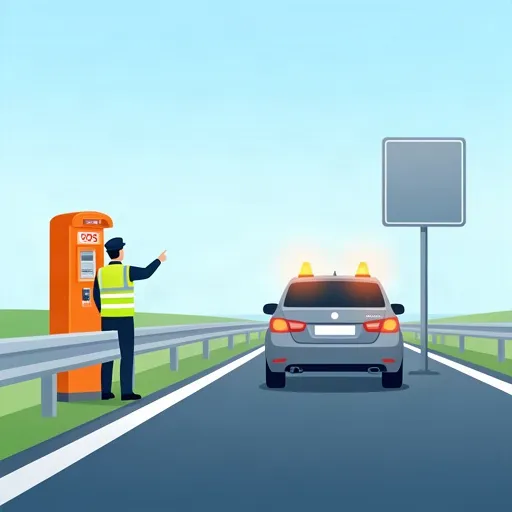
When your vehicle shows signs of a mechanical failure, your primary objective is to reach the hard shoulder (berma) without causing a hazard to other road users. You must immediately activate your hazard lights to warn following drivers of your reduced speed. If the vehicle remains drivable, maneuver it as far to the right as possible, ideally keeping it close to the safety barrier or guardrail.
Once the vehicle is brought to a full stop, never attempt to perform mechanical repairs while in the emergency lane. The high speed of motorway traffic, which can reach 120 km/h in Portugal, makes any presence on the road surface life-threatening. The IMT exam strictly tests your knowledge on this: the goal is to exit the vehicle and reach a position of safety immediately.
Never attempt to walk across the motorway lanes to reach the other side. Crossing a motorway is strictly prohibited and is a leading cause of fatal accidents in breakdown scenarios. Always remain on the side of the road where your vehicle is immobilized.
Safety protocols mandate that all passengers must exit the vehicle through the doors furthest from the traffic flow—typically the passenger-side doors. Every occupant must wear a high-visibility reflective vest before stepping out of the vehicle, as this is a legal requirement in Portugal to ensure you are visible to other drivers.
After exiting, you should move all passengers behind the safety barrier or guardrail. Position yourself at a safe distance from the hard shoulder, waiting for professional assistance. If you have a warning triangle, you must place it at least 100 meters behind your vehicle, ensuring it is clearly visible to oncoming traffic. However, your own physical safety takes precedence over placing the triangle; if it is too dangerous to walk along the side of the road, prioritize remaining behind the barrier.
On Portuguese motorways, finding help is streamlined through the use of SOS emergency phones located at intervals along the route. If you are unfamiliar with your exact location, you can identify the direction of the nearest SOS phone by checking the small marker plates attached to the guardrails every 100 meters. These plates are designed to indicate the precise distance and direction to the closest emergency call station.
Using an official SOS phone is preferred over a mobile phone because it automatically provides the motorway operator with your precise location, ensuring that emergency services or towing vehicles can reach you quickly.
Once your vehicle has been repaired or cleared by the breakdown service, re-entering the main traffic flow requires patience and precision. You must never drive directly from the hard shoulder into the main lane at a low speed. Instead, accelerate gradually within the emergency lane, signaling with your left-turn indicator. Only merge into the right-hand lane when you have confirmed through your mirrors and shoulder checks that the path is completely clear and that your speed is sufficient to match the flow of traffic without endangering other drivers.
The IMT emphasizes that re-entry must be performed gradually. Sudden, sharp steering movements from a standstill on the hard shoulder are highly dangerous and likely to be cited as an error in both real-world driving and the theory exam.
This article covers essential motorway breakdown safety procedures mandated by IMT regulations for Portuguese autoestradas. The critical sequence involves activating hazard lights, stopping safely on the hard shoulder, ensuring all occupants wear reflective vests, and moving everyone behind the safety barrier. Drivers should place warning triangles at least 100 meters behind the vehicle and use official SOS phones, which automatically provide location data to emergency services. Re-entering traffic requires gradual acceleration and confirming a clear path before merging, as sudden movements from the hard shoulder are extremely dangerous at motorway speeds.
A short set of high-value points that capture the most important ideas from this article.
When breakdown occurs on a motorway, immediately activate hazard lights and maneuver to the hard shoulder (berma) as far right as possible.
All occupants must wear reflective vests (coletes retrorefletores) before exiting the vehicle—a legal requirement in Portugal.
Passengers should exit through doors furthest from traffic and move behind the safety barrier while waiting for assistance.
Use official SOS phones rather than mobile phones as they automatically transmit your precise location to emergency services.
Re-entering traffic from the hard shoulder requires gradual acceleration with left indicator, matching traffic speed before merging.
Warning triangles must be placed at least 100 meters behind the vehicle if it is safe to do so.
SOS emergency phones can be located using 100-meter marker plates attached to guardrails.
Motorway speed limits in Portugal reach 120 km/h, making any presence on the road surface extremely dangerous.
Crossing motorway lanes on foot is strictly prohibited and a leading cause of fatal breakdown accidents.
Physical safety takes priority over placing the warning triangle—if it's too dangerous to approach the rear of the vehicle, stay behind the barrier.
Attempting to perform mechanical repairs while still in the emergency lane instead of exiting the vehicle.
Exiting the vehicle through the door closest to traffic instead of the passenger-side doors.
Forgetting to wear the reflective vest before stepping out, which is a legal requirement in Portugal.
Re-entering traffic too abruptly or at low speed from the hard shoulder, creating hazards for other drivers.
Using a mobile phone instead of the official SOS phone, which delays assistance due to unknown precise location.
Article content overview
A short set of high-value points that capture the most important ideas from this article.
When breakdown occurs on a motorway, immediately activate hazard lights and maneuver to the hard shoulder (berma) as far right as possible.
All occupants must wear reflective vests (coletes retrorefletores) before exiting the vehicle—a legal requirement in Portugal.
Passengers should exit through doors furthest from traffic and move behind the safety barrier while waiting for assistance.
Use official SOS phones rather than mobile phones as they automatically transmit your precise location to emergency services.
Re-entering traffic from the hard shoulder requires gradual acceleration with left indicator, matching traffic speed before merging.
Warning triangles must be placed at least 100 meters behind the vehicle if it is safe to do so.
SOS emergency phones can be located using 100-meter marker plates attached to guardrails.
Motorway speed limits in Portugal reach 120 km/h, making any presence on the road surface extremely dangerous.
Crossing motorway lanes on foot is strictly prohibited and a leading cause of fatal breakdown accidents.
Physical safety takes priority over placing the warning triangle—if it's too dangerous to approach the rear of the vehicle, stay behind the barrier.
Attempting to perform mechanical repairs while still in the emergency lane instead of exiting the vehicle.
Exiting the vehicle through the door closest to traffic instead of the passenger-side doors.
Forgetting to wear the reflective vest before stepping out, which is a legal requirement in Portugal.
Re-entering traffic too abruptly or at low speed from the hard shoulder, creating hazards for other drivers.
Using a mobile phone instead of the official SOS phone, which delays assistance due to unknown precise location.
Explore related topics, search based questions, and concepts that learners often look up when studying Motorway Breakdown Safety. These themes reflect real search intent and help you understand how this topic connects to wider driving theory knowledge in Portugal.
Find clear and practical answers to common questions learners often have about Motorway Breakdown Safety. This section helps explain difficult points, remove confusion, and reinforce the key driving theory concepts that matter for learners in Portugal.
Look for the small kilometer marker plates located on the safety guardrails. These are spaced every 100 meters and indicate the direction of the nearest emergency SOS phone.
No, never. Crossing the motorway lanes is extremely dangerous and strictly prohibited; it is a common cause of fatal accidents and will result in an immediate fail on the IMT theory exam.
Move as far to the right as possible in the emergency lane, activate your hazard lights, exit the vehicle on the passenger side wearing a reflective vest, and wait behind the safety barrier, never beside or in front of the vehicle.
You must re-enter the traffic flow gradually using your left turn signal, ensuring the road is clear. You must not drive directly from the standing position in the emergency lane, but accelerate sufficiently to avoid impeding vehicles traveling at higher speeds.
If you haven't found what you're looking for, use our powerful article search to explore related topics, refine your understanding of Portuguese road rules, or discover new insights for your IMT driving exam preparation. Continue building your knowledge effectively.