
Understanding how to position your wheels when parking on a slope is a vital skill for both daily driving safety and success in the Portuguese theory exam. This article details the legal and practical expectations for managing your vehicle on inclines, explaining the mechanics behind curb-side positioning and gear selection. You will learn the correct procedures to ensure your vehicle remains stationary, reflecting the standards required by the IMT.
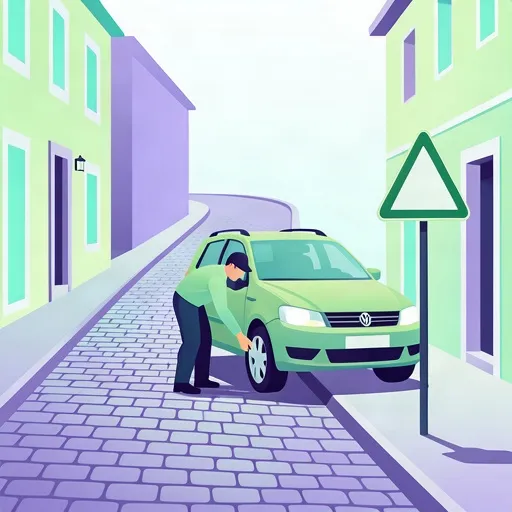
Article content overview
Parking on an incline is a fundamental skill that every driver in Portugal must master. Under the Código da Estrada, the legal responsibility lies with the driver to ensure that a parked vehicle remains stationary and does not pose a hazard to other road users. Failure to correctly position your wheels or secure your vehicle on a slope can lead to significant safety risks, including the vehicle rolling into traffic if the parking brake fails. For the IMT theory exam, understanding the specific mechanics of slope parking is crucial, as this topic frequently appears in situational questions.
In Portugal, when you park your vehicle, you are legally required to take all necessary measures to prevent it from moving spontaneously. While applying the handbrake (parking brake) is the primary action, the Código da Estrada implies that secondary measures—such as wheel positioning and gear selection—are essential to ensure the vehicle is safely immobilized.
When parking on a slope, gravity exerts a constant force on the chassis. If your parking brake is not fully engaged or suffers a mechanical failure, the vehicle will naturally roll. By turning your front wheels toward or away from the curb, you use the physical structure of the road edge as a barrier to stop the vehicle's movement.
The rule for wheel positioning depends entirely on whether there is a curb present and whether you are facing uphill or downhill. These scenarios are designed to ensure that if the vehicle moves, it rolls away from the center of the road or into a barrier that prevents a collision with other vehicles or pedestrians.
When driving a manual transmission vehicle, always leave the car in gear when parking on a slope. Use the first gear when facing uphill and reverse gear when facing downhill. For automatic vehicles, ensure the selector is firmly in the 'P' (Park) position.
The IMT theory exam often presents scenarios that test your ability to apply these rules to specific street layouts. A common trap for learners is to assume that the parking brake is sufficient on its own. In a real-world scenario—and on your exam—you must demonstrate an understanding that the road infrastructure (the curb) is a tool for safety. If you are parked on a steep street, the angle of your wheels determines whether your car will safely stop against the curb or roll uncontrollably into a busy lane.
One of the most frequent errors reported by students is forgetting to adjust the wheel position when parking on roads without a curb. Many learners mistakenly believe that the "turn towards the curb" rule only applies when a curb is present. However, on rural roads or streets without formal sidewalks, the instruction to turn your wheels toward the edge of the road remains vital. If your vehicle begins to roll, it must move toward the verge or the ditch, away from the flow of traffic, to minimize the potential for a serious accident.
This article covers the Código da Estrada requirements for safely parking on slopes in Portugal, focusing on wheel positioning as a secondary safety measure against rollaway. The core rule distinguishes between uphill and downhill parking with a curb, and between roads with and without curbs, with each scenario requiring specific wheel direction to ensure the vehicle either contacts a barrier or rolls off the carriageway. For manual vehicles, selecting first gear uphill and reverse gear downhill adds an additional mechanical stop, while automatic vehicles must be firmly placed in 'P'. Understanding these procedures is essential for both safe driving and success in IMT theory exam questions that present situational parking scenarios.
A short set of high-value points that capture the most important ideas from this article.
When parking downhill with a curb, turn your front wheels toward the curb (to the right) so the vehicle rolls into it as a barrier
When parking uphill with a curb, turn your front wheels away from the curb (to the left) so the back of the front tire rests against it
On roads without a curb, always turn wheels toward the road edge (to the right) so any rollaway moves off the carriageway
The handbrake is your primary immobilization method, while wheel positioning is a critical secondary safety measure
Use first gear when parking uphill and reverse gear when parking downhill in manual vehicles
The curb acts as a mechanical barrier—wheel positioning determines whether your vehicle uses it safely or rolls past it
Uphill with curb: wheels turn left (away from curb); downhill with curb: wheels turn right (toward curb)
No curb present: always turn wheels toward the road edge, regardless of slope direction
Automatic vehicles must be firmly secured in 'P' (Park) position as their equivalent of gear selection
Wheel positioning only works as a safety measure if the parking brake is also applied
Assuming the handbrake alone is sufficient and neglecting wheel positioning entirely
Forgetting to adjust wheel position on roads without a curb, believing the rule only applies when a sidewalk is present
Turning wheels the wrong direction when parking uphill with a curb, which would push the vehicle away from the barrier into traffic
Not using the correct gear for slope direction in manual vehicles, reducing the effectiveness of secondary immobilization
Leaving an automatic in a drive gear instead of 'P', which can allow the vehicle to roll if the parking pawl fails
Article content overview
A short set of high-value points that capture the most important ideas from this article.
When parking downhill with a curb, turn your front wheels toward the curb (to the right) so the vehicle rolls into it as a barrier
When parking uphill with a curb, turn your front wheels away from the curb (to the left) so the back of the front tire rests against it
On roads without a curb, always turn wheels toward the road edge (to the right) so any rollaway moves off the carriageway
The handbrake is your primary immobilization method, while wheel positioning is a critical secondary safety measure
Use first gear when parking uphill and reverse gear when parking downhill in manual vehicles
The curb acts as a mechanical barrier—wheel positioning determines whether your vehicle uses it safely or rolls past it
Uphill with curb: wheels turn left (away from curb); downhill with curb: wheels turn right (toward curb)
No curb present: always turn wheels toward the road edge, regardless of slope direction
Automatic vehicles must be firmly secured in 'P' (Park) position as their equivalent of gear selection
Wheel positioning only works as a safety measure if the parking brake is also applied
Assuming the handbrake alone is sufficient and neglecting wheel positioning entirely
Forgetting to adjust wheel position on roads without a curb, believing the rule only applies when a sidewalk is present
Turning wheels the wrong direction when parking uphill with a curb, which would push the vehicle away from the barrier into traffic
Not using the correct gear for slope direction in manual vehicles, reducing the effectiveness of secondary immobilization
Leaving an automatic in a drive gear instead of 'P', which can allow the vehicle to roll if the parking pawl fails
Explore related topics, search based questions, and concepts that learners often look up when studying Parking on Slopes in Portugal. These themes reflect real search intent and help you understand how this topic connects to wider driving theory knowledge in Portugal.
Find clear and practical answers to common questions learners often have about Parking on Slopes in Portugal. This section helps explain difficult points, remove confusion, and reinforce the key driving theory concepts that matter for learners in Portugal.
You should turn your wheels toward the curb. This ensures that if the vehicle begins to roll, the tire will make contact with the curb, stopping the movement.
You should turn your wheels away from the curb. This allows the rear of the front tire to rest against the curb if the car rolls backward.
Regardless of whether you are facing uphill or downhill, turn your wheels toward the edge of the road. This directs the vehicle away from the lane of traffic if it rolls.
For parking uphill, the vehicle should be left in first gear. For parking downhill, it should be left in reverse gear. Always ensure the parking brake is firmly applied.
Automatic vehicles should always be shifted into the Park position, ensuring the parking brake is also fully engaged to hold the vehicle securely.
If you haven't found what you're looking for, use our powerful article search to explore related topics, refine your understanding of Portuguese road rules, or discover new insights for your IMT driving exam preparation. Continue building your knowledge effectively.