
Learners often struggle with identifying when the default priority rule applies at unmarked intersections in Portugal. This guide clarifies the legal priority hierarchy, explains when you must yield to traffic from the right, and highlights critical exceptions like roundabouts and private road exits that are frequently tested in the official theory examination.
Article content overview
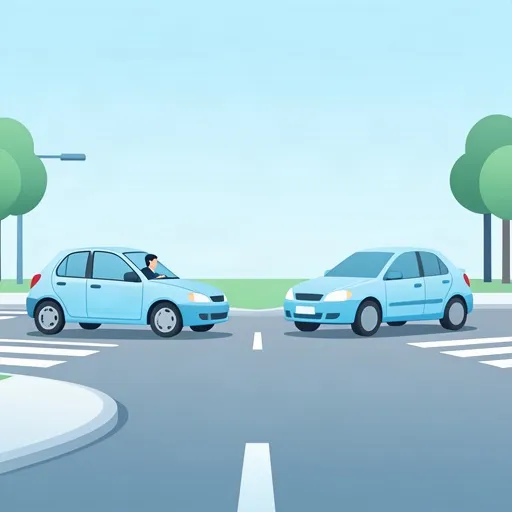
In the context of the Portuguese Código da Estrada, understanding the concept of "prioridade da direita" is not just a requirement for passing your IMT theory exam; it is a fundamental safety skill for navigating urban and residential environments. Many learners are surprised to discover that in the absence of specific road signs, traffic lights, or road markings, the default rule is that you must yield to vehicles approaching from your right at an intersection.
Mastering this rule requires moving beyond basic memorization and learning to perform a systematic scan of the road before entering any crossing. Relying on the right-hand rule is your safety net when official signage is absent, but it is equally vital to understand the hierarchy of rules that can override this default behavior.
Before assuming the "priority from the right" rule applies, you must understand the legal hierarchy of road signaling in Portugal. Traffic rules are applied in a strict order of precedence: commands from police officers on duty always come first, followed by temporary signage, traffic light signals, vertical road signs, road markings, and finally, the general rules of the road.
If you encounter a stop sign or a "give way" sign, these override the rule of priority from the right. Failing to recognize this hierarchy is a common cause of errors in the IMT theory exam. Always verify that there is no sign or marking dictating a different flow of traffic before concluding that you must apply the default right-hand rule.
While the "prioridade da direita" is the standard, several specific scenarios in Portugal dictate different priority behaviors. For instance, drivers exiting private driveways, parking lots, or unpaved roads do not have the right of way over traffic on the main road; in these cases, you must yield to all vehicles, regardless of whether they approach from your left or right.
Roundabouts also function under distinct rules. According to the Código da Estrada, vehicles already circulating within the roundabout have priority over those intending to enter. This is a critical distinction that ensures the fluidity of traffic in urban areas.
One of the most frequent mistakes students make is assuming that a "major road" always has priority simply because it is wider or more heavily trafficked. In reality, the legal priority is defined by signage. If you are on a main road but an intersection is unmarked, the vehicle coming from a smaller street on your right technically has the right of way.
Do not assume you have priority simply because you are on a wider street. If there are no signs or markings, the priority from the right rule remains the law, and you could be held liable in a collision if you fail to yield to a vehicle approaching from the right.
To succeed in your exam, you must be comfortable with the terminology used by the IMT. Understanding the difference between "cedência de passagem" (yielding) and "prioridade" (priority) is essential for interpreting situational questions correctly.
When practicing for your theory test, focus on scenarios involving multiple variables. The exam often presents images of intersections where you must identify the correct order of passing based on the combined presence of signs and general rules. Consistency in your study habits will help you react instinctively to these situations.
The priority from the right rule (prioridade da direita) is the default law at unmarked intersections in Portugal according to the Código da Estrada, but it only applies when no higher-ranking signals are present. Drivers must systematically check for police direction, temporary signals, traffic lights, vertical signs, and road markings before concluding that the general right-hand rule governs. Critical exceptions include roundabouts (where circulating traffic has priority) and private road exits (where you must yield to all main road traffic). The IMT theory exam frequently tests the priority hierarchy and these exceptions, so understanding the exact order of precedence and specific terminology is essential for both passing the exam and safe driving practice.
A short set of high-value points that capture the most important ideas from this article.
The priority from the right rule only applies after checking and finding no traffic signs, markings, or signals present
Traffic rules follow a strict hierarchy: police commands > temporary signals > traffic lights > vertical signs > road markings > general rules
Vehicles already circulating inside a roundabout have priority over those wanting to enter
Drivers exiting private driveways, parking lots, or unpaved roads must yield to all traffic on the main road
A wider or busier road does not automatically have priority - signage and markings define legal priority
Priority hierarchy order: police officers, temporary signals, traffic lights, vertical signs (B8/B9 series), road markings, then general rules
Portuguese terms: prioridade (priority), cedência de passagem (yielding), interseção (intersection), sinalização vertical (vertical signs), marcas rodoviárias (road markings)
Roundabouts follow specific rules where circulating vehicles take priority over entering vehicles
Stop lines and yield triangles painted on the road can override the default right-hand rule
IMT (Instituto da Mobilidade e dos Transportes) sets the standards for the Portuguese driving theory exam
Assuming a major or wider road always has priority over smaller streets when no signs are present
Forgetting to check for vertical signs (B8 or B9 series) before applying the default right-hand rule
Believing that the priority from the right rule applies at roundabouts (it does not - circulating vehicles have priority)
Failing to yield when exiting private driveways or parking lots, thinking the main road vehicle should yield
Confusing cedência de passagem (yielding) with prioridade (priority) when answering exam questions
Article content overview
A short set of high-value points that capture the most important ideas from this article.
The priority from the right rule only applies after checking and finding no traffic signs, markings, or signals present
Traffic rules follow a strict hierarchy: police commands > temporary signals > traffic lights > vertical signs > road markings > general rules
Vehicles already circulating inside a roundabout have priority over those wanting to enter
Drivers exiting private driveways, parking lots, or unpaved roads must yield to all traffic on the main road
A wider or busier road does not automatically have priority - signage and markings define legal priority
Priority hierarchy order: police officers, temporary signals, traffic lights, vertical signs (B8/B9 series), road markings, then general rules
Portuguese terms: prioridade (priority), cedência de passagem (yielding), interseção (intersection), sinalização vertical (vertical signs), marcas rodoviárias (road markings)
Roundabouts follow specific rules where circulating vehicles take priority over entering vehicles
Stop lines and yield triangles painted on the road can override the default right-hand rule
IMT (Instituto da Mobilidade e dos Transportes) sets the standards for the Portuguese driving theory exam
Assuming a major or wider road always has priority over smaller streets when no signs are present
Forgetting to check for vertical signs (B8 or B9 series) before applying the default right-hand rule
Believing that the priority from the right rule applies at roundabouts (it does not - circulating vehicles have priority)
Failing to yield when exiting private driveways or parking lots, thinking the main road vehicle should yield
Confusing cedência de passagem (yielding) with prioridade (priority) when answering exam questions
Explore related topics, search based questions, and concepts that learners often look up when studying Portugal Priority from the Right Rules. These themes reflect real search intent and help you understand how this topic connects to wider driving theory knowledge in Portugal.
Find clear and practical answers to common questions learners often have about Portugal Priority from the Right Rules. This section helps explain difficult points, remove confusion, and reinforce the key driving theory concepts that matter for learners in Portugal.
At unmarked intersections where there are no traffic signs or signals, you must give way to any vehicle approaching from your right.
No. It only applies at intersections without signs, markings, or traffic lights. It is overridden by signs like Stop, Give Way, or priority road signs, as well as traffic police instructions.
Vehicles exiting a private area, such as a driveway or parking lot, must always yield to all traffic on the main road, regardless of which side they are approaching from.
No. In Portugal, vehicles already circulating inside the roundabout have priority over those intending to enter it.
If you haven't found what you're looking for, use our powerful article search to explore related topics, refine your understanding of Portuguese road rules, or discover new insights for your IMT driving exam preparation. Continue building your knowledge effectively.