
Learning how to return to the main carriageway after an emergency stop is a core safety requirement on Portuguese motorways. This guide clarifies the legal obligations defined by the Código da Estrada, focusing on why pulling directly into traffic is prohibited and how to accelerate safely to match the speed of other vehicles.
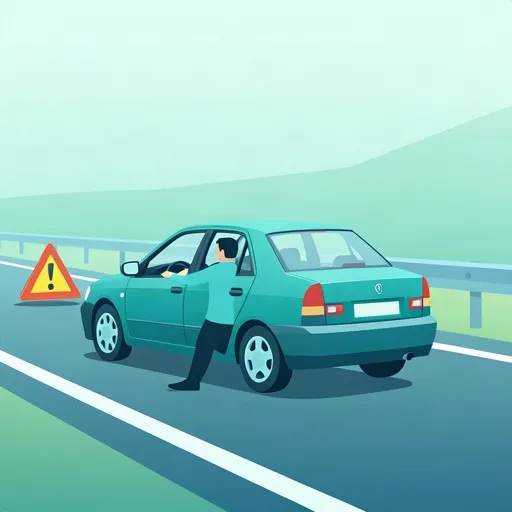
Article content overview
A vehicle breakdown on a Portuguese autoestrada is a high-stress, high-risk event. While knowing how to signal for help and wait safely behind a barrier is vital, understanding the legal and practical requirements for re-entering the main traffic flow is equally critical for your safety and your IMT theory exam success. Many learner drivers fail to realize that returning to the carriageway is not simply a matter of pulling out; it is a complex maneuver that requires patience, observation, and adherence to specific traffic laws.
According to the Código da Estrada, re-entering the main traffic lane from an emergency lane (berma) must be performed with the utmost caution. You are transitioning from a stationary position into a stream of traffic that may be moving at speeds up to 120 km/h. Because the motorway environment is unforgiving, the law mandates that your re-entry be gradual and executed only when the lane is completely clear for the distance required to match the flow of traffic.
Never attempt to move directly into the main carriageway from a stationary position. You must accelerate along the emergency lane or the acceleration lane (if applicable) until your vehicle speed is sufficient to merge safely without forcing other drivers to change speed or direction.
When the issue causing your breakdown has been resolved and you are ready to resume your journey, you must follow a disciplined process. Rushing this sequence is a common cause of secondary collisions, which are statistically more dangerous than the initial breakdown.
In the IMT theory exam, questions regarding motorway breakdowns often focus on the danger of sudden maneuvers. An exam question might present a scenario where a driver pulls directly into the fast lane from the emergency lane, or where a driver attempts to move off without adequate speed. Remember that in all cases, the driver who is already in the main lane has the right of way. You are entering a priority lane, and the burden of safety rests entirely on your ability to judge a gap that allows for safe integration.
Understanding the terminology used in the Código da Estrada is essential for interpreting exam questions correctly. Familiarizing yourself with these terms will help you distinguish between legal requirements and dangerous habits.
This article explains the mandatory procedure for returning to motorway traffic after a breakdown in Portugal, as defined by the Código da Estrada. The key legal principle is that re-entry must be gradual, with the driver accelerating along the emergency lane until their speed matches the flow of traffic before merging. The driver re-entering bears full responsibility for safety, as drivers already in the main lane retain priority and are under no obligation to change speed or direction. The IMT theory exam frequently tests these principles by presenting scenarios where drivers attempt sudden, unsafe maneuvers from the emergency lane.
A short set of high-value points that capture the most important ideas from this article.
Re-entering the motorway must be gradual; never pull directly into traffic from a stationary position
Accelerate along the emergency lane until your speed matches the flow of main traffic before merging
You bear the entire burden of safety when re-entering; drivers in the main lane have priority
Activate your left-turn signal early to warn other road users of your intention to merge
All passengers must be secured and seatbelts fastened before attempting to move off
The berma (emergency lane) is for emergency stops only; merging requires using acceleration lane procedures
Motorway speeds can reach 120 km/h; your vehicle must match this flow before merging
Final mirror and blind-spot checks are required before steering into the right-hand lane
In Portuguese law, the driver already in the main carriageway always has the right of way
The IMT exam tests your understanding that sudden maneuvers from the emergency lane are prohibited
Pulling directly into the fast lane without accelerating to match traffic speed
Failing to check mirrors and blind spots before initiating the merge
Moving off from the emergency lane without activating the left-turn signal
Attempting to re-enter when traffic is too close, expecting other drivers to slow down
Forgetting to ensure all passengers are secured with seatbelts before moving
Article content overview
A short set of high-value points that capture the most important ideas from this article.
Re-entering the motorway must be gradual; never pull directly into traffic from a stationary position
Accelerate along the emergency lane until your speed matches the flow of main traffic before merging
You bear the entire burden of safety when re-entering; drivers in the main lane have priority
Activate your left-turn signal early to warn other road users of your intention to merge
All passengers must be secured and seatbelts fastened before attempting to move off
The berma (emergency lane) is for emergency stops only; merging requires using acceleration lane procedures
Motorway speeds can reach 120 km/h; your vehicle must match this flow before merging
Final mirror and blind-spot checks are required before steering into the right-hand lane
In Portuguese law, the driver already in the main carriageway always has the right of way
The IMT exam tests your understanding that sudden maneuvers from the emergency lane are prohibited
Pulling directly into the fast lane without accelerating to match traffic speed
Failing to check mirrors and blind spots before initiating the merge
Moving off from the emergency lane without activating the left-turn signal
Attempting to re-enter when traffic is too close, expecting other drivers to slow down
Forgetting to ensure all passengers are secured with seatbelts before moving
Explore related topics, search based questions, and concepts that learners often look up when studying Motorway Re-entry After Breakdown. These themes reflect real search intent and help you understand how this topic connects to wider driving theory knowledge in Portugal.
Find clear and practical answers to common questions learners often have about Motorway Re-entry After Breakdown. This section helps explain difficult points, remove confusion, and reinforce the key driving theory concepts that matter for learners in Portugal.
No. You must never move off from a stationary position directly into the main lane. You must enter the lane gradually while signalling and only when it is completely safe to do so, ensuring you do not endanger other drivers.
You must use your left-turn signal to indicate your intention to move from the emergency lane into the main traffic flow, ensuring you have clear visibility and space before merging.
Motorway traffic travels at high speeds, often up to 120 km/h. Entering the flow at a low speed creates a major collision risk, so you must accelerate adequately to integrate safely with the existing traffic.
If you haven't found what you're looking for, use our powerful article search to explore related topics, refine your understanding of Portuguese road rules, or discover new insights for your IMT driving exam preparation. Continue building your knowledge effectively.