
Understanding speed limits is a fundamental requirement for the Portuguese driving theory exam and safe daily driving. This guide breaks down the distinction between the general 50 km/h limit in localidade areas and the specific implementation of 30 km/h zones. Learn how to interpret local traffic signals and apply correct speed management techniques to ensure safety for all road users.
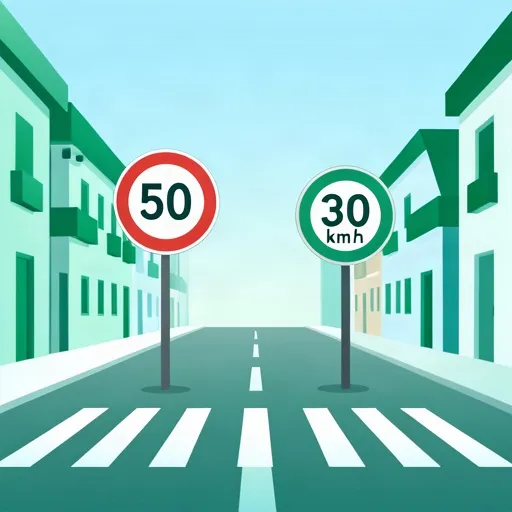
Article content overview
Navigating the roads of Portugal requires more than just mechanical skill; it demands a deep understanding of the Código da Estrada. One of the most common areas where learners struggle during their IMT theory exam is distinguishing between general speed limits and special zones. While the standard speed limit for urban areas (localidades) is well-defined, there are specific environments where traffic calming measures and lower legal limits take precedence.
According to Article 27 of the Portuguese Código da Estrada, the general maximum speed limit within a localidade is 50 km/h for light vehicles. A localidade is defined as a zone with buildings where the entrances and exits are typically identified by specific road signs. It is a common misconception that this limit is universal across all streets within a town; however, the law allows for specific zones where the physical design and signage override the general rule to improve safety.
A built-up area where urban traffic rules apply, typically marked by signs indicating the name of the locality, which establishes a general speed limit of 50 km/h unless otherwise signaled.
In recent years, the Autoridade Nacional de Segurança Rodoviária (ANSR) has placed a strong emphasis on "traffic calming" in residential areas. These are areas where the road environment is designed to be shared between motorists, pedestrians, and cyclists. When you see a "Zona 30" sign, the general 50 km/h limit no longer applies within that boundary. You must reduce your speed to 30 km/h and remain at or below this speed until you pass a sign indicating the end of the zone.
Do not assume that the speed limit is 50 km/h simply because you are driving through a neighborhood. Always scan for zone signs. Failing to notice a 30 km/h zone is a frequent cause of errors in both the theory exam and practical driving evaluations.
Beyond the posted legal limits, the Código da Estrada mandates that drivers must adapt their speed to the conditions of the road, weather, traffic density, and the presence of vulnerable road users. Even if a road has a higher speed limit, you are legally obligated to drive at a speed that allows you to stop safely if an obstacle appears suddenly. This is particularly critical in urban environments where pedestrians or cyclists may emerge from behind parked vehicles.
| Road Environment | Default Speed Limit |
|---|---|
| Inside Localidade (General) | 50 km/h |
| Designated 30 km/h Zone | 30 km/h |
| Residential Shared Zones | 20 km/h |
| Autoestradas (Light Vehicles) | 120 km/h |
The IMT theory exam often uses image-based questions to test your situational awareness. You might be presented with a photo of a street with specific signs or road markings and asked to identify the maximum permitted speed. Always look for the presence of zone signs, as these are "higher order" rules that override the default 50 km/h limit. If a question asks about the speed limit in a residential area without signs, remember the legal baseline, but always consider if a "zone" was implied by the context of the question.
In Portugal, the default urban speed limit within a locality is 50 km/h, but this is overridden by posted zone signs such as Zona 30 (30 km/h) or residential shared zones (20 km/h). Learners must scan for regulatory signs at every street entrance and adjust speed immediately upon passing them, not after entering the zone. The Código da Estrada also mandates that drivers always adapt speed to conditions, regardless of posted limits. For the IMT exam, remember that zone signs represent higher-order rules that take precedence over the general 50 km/h baseline, and questions often test your ability to identify which limit applies from visual scenarios.
A short set of high-value points that capture the most important ideas from this article.
The general urban speed limit of 50 km/h applies only within a locality (localidade), which is a built-up area marked by specific entry and exit road signs.
30 km/h zones (Zona 30) are higher-order rules that override the default 50 km/h limit when the G4a sign is posted.
Speed zone signs must be spotted immediately upon entering a street; the new limit applies as soon as you pass the sign, not after gradual deceleration.
Even when no signs are visible, drivers must always adapt speed to road conditions, weather, and the presence of vulnerable road users.
Residential shared zones operate at 20 km/h and are designed for pedestrians, cyclists, and vehicles to coexist.
A localidade is a built-up area defined by road signs showing the settlement name; it establishes the baseline 50 km/h limit unless otherwise posted.
The G4a sign marks a Zona 30 entry where the maximum permitted speed drops to 30 km/h.
Physical traffic calming features such as speed humps and road narrowing often accompany 30 km/h zones to reinforce the limit.
When asked in the IMT exam about a residential street without visible signs, the default 50 km/h applies, but always check for implied zone context.
The Código da Estrada requires drivers to slow down whenever conditions prevent a safe stop within the visible distance, regardless of posted limits.
Assuming the 50 km/h limit is universal throughout a town rather than checking for specific zone signs at each street entrance.
Failing to notice a Zona 30 sign because the learner is focused on other traffic rather than scanning for regulatory signs.
Continuing to drive at 50 km/h while gradually slowing down instead of adjusting speed immediately upon passing the zone entry sign.
Overlooking the end-of-zone sign and continuing to drive at the lower limit after the zone has ended.
Confusing residential shared zones (20 km/h) with standard residential streets that may have a 50 km/h limit.
Article content overview
A short set of high-value points that capture the most important ideas from this article.
The general urban speed limit of 50 km/h applies only within a locality (localidade), which is a built-up area marked by specific entry and exit road signs.
30 km/h zones (Zona 30) are higher-order rules that override the default 50 km/h limit when the G4a sign is posted.
Speed zone signs must be spotted immediately upon entering a street; the new limit applies as soon as you pass the sign, not after gradual deceleration.
Even when no signs are visible, drivers must always adapt speed to road conditions, weather, and the presence of vulnerable road users.
Residential shared zones operate at 20 km/h and are designed for pedestrians, cyclists, and vehicles to coexist.
A localidade is a built-up area defined by road signs showing the settlement name; it establishes the baseline 50 km/h limit unless otherwise posted.
The G4a sign marks a Zona 30 entry where the maximum permitted speed drops to 30 km/h.
Physical traffic calming features such as speed humps and road narrowing often accompany 30 km/h zones to reinforce the limit.
When asked in the IMT exam about a residential street without visible signs, the default 50 km/h applies, but always check for implied zone context.
The Código da Estrada requires drivers to slow down whenever conditions prevent a safe stop within the visible distance, regardless of posted limits.
Assuming the 50 km/h limit is universal throughout a town rather than checking for specific zone signs at each street entrance.
Failing to notice a Zona 30 sign because the learner is focused on other traffic rather than scanning for regulatory signs.
Continuing to drive at 50 km/h while gradually slowing down instead of adjusting speed immediately upon passing the zone entry sign.
Overlooking the end-of-zone sign and continuing to drive at the lower limit after the zone has ended.
Confusing residential shared zones (20 km/h) with standard residential streets that may have a 50 km/h limit.
Explore related topics, search based questions, and concepts that learners often look up when studying Portugal Urban Speed Limits. These themes reflect real search intent and help you understand how this topic connects to wider driving theory knowledge in Portugal.
Find clear and practical answers to common questions learners often have about Portugal Urban Speed Limits. This section helps explain difficult points, remove confusion, and reinforce the key driving theory concepts that matter for learners in Portugal.
The general speed limit for light vehicles within a 'localidade' (urban area) is 50 km/h, as defined by the Código da Estrada, unless otherwise indicated by road signs.
Yes. When you enter a zone marked with a specific 30 km/h speed limit sign, that limit overrides the general urban speed limit for that specific area.
These zones are implemented to improve road safety, particularly to protect vulnerable road users like pedestrians and cyclists, and to calm traffic in residential or sensitive areas.
While they both aim to calm traffic, they are distinct classifications. 30 km/h zones are areas where the maximum speed is strictly limited to 30 km/h, often using traffic calming engineering, whereas residential zones may have even lower speed restrictions, such as 20 km/h.
If you haven't found what you're looking for, use our powerful article search to explore related topics, refine your understanding of Portuguese road rules, or discover new insights for your IMT driving exam preparation. Continue building your knowledge effectively.