
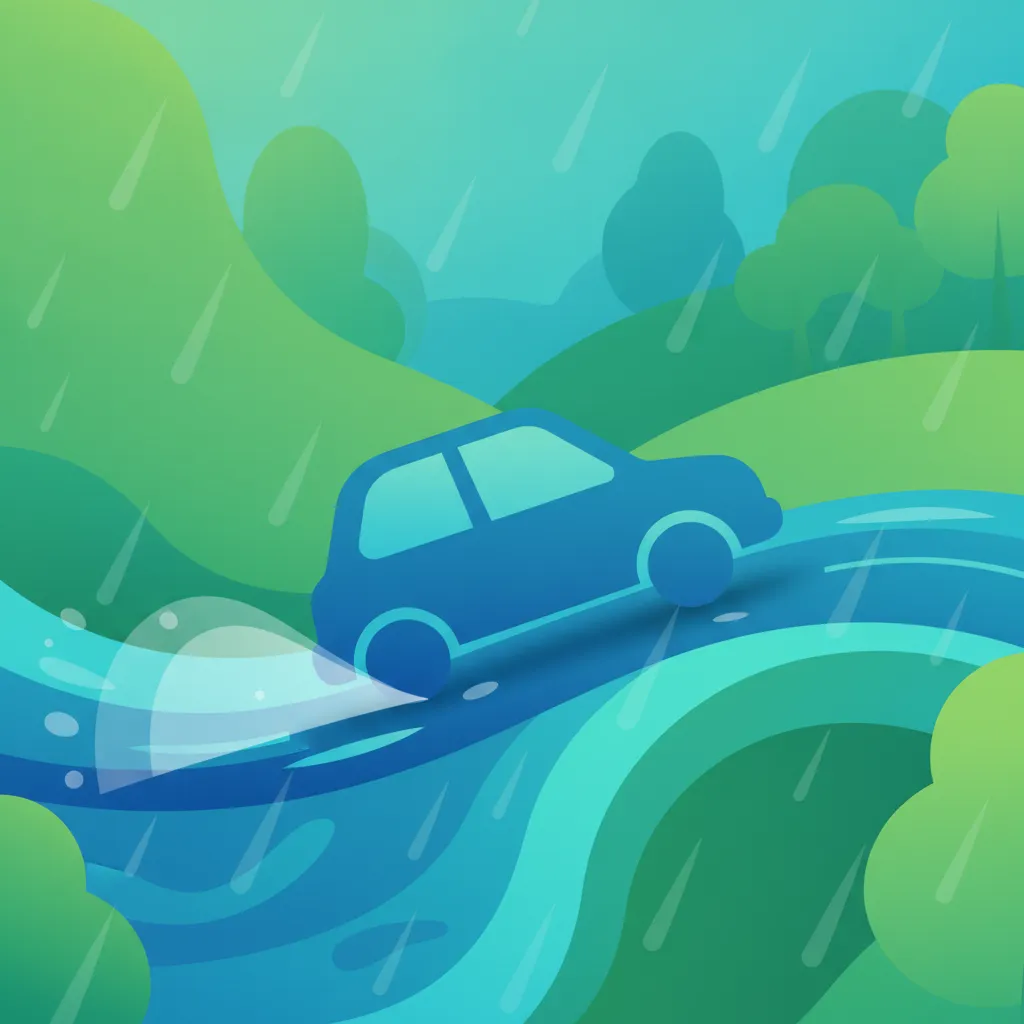
Rainfall introduces several hazards, fundamentally changing how your vehicle interacts with the road. It reduces tire grip, significantly extends braking distances, and impairs visibility. Understanding these effects and knowing how to adapt your driving is vital for safety on French roads and a key part of the Code de la route.
Theory topic content overview
Read the full theory topic guide for Rainy Weather Driving with structured, easy-to-scan content built for learners in France. This detailed section explains the exact rule, meaning, traffic context, comparison points, and exam logic behind this French driving theory topic so you can study faster, understand the concept more clearly, and avoid common interpretation mistakes on the theory test.
Driving in rainy conditions fundamentally alters how your vehicle interacts with the road, demanding significant adjustments from every driver in France. The Code de la route requires drivers to adapt their behavior to weather conditions, and misunderstanding these requirements is a common cause of accidents and theory test failures. This section explores the specific risks associated with rain and the essential safety measures drivers must adopt on French roads.
Rainfall, even light showers, introduces a range of hazards that affect road safety, vehicle control, and visibility. For learners preparing for the permis de conduire (driving license) theory exam (ETG), questions about driving in adverse weather, especially rain, are frequent. Beyond the exam, mastering safe driving in rain is crucial for navigating France's diverse road network, from urban rues to fast-paced autoroutes, where conditions can change rapidly.
Key reasons to adapt include:
Code de la route mandates drivers to adjust their speed and driving style according to road and weather conditions. Failure to do so can result in penalties and is considered a fault during the practical driving test.distances de sécurité), appropriate lighting, and preventing aquaplaning are standard in the French theory test.The presence of water on the road surface directly affects several critical aspects of driving:
Reduced Adherence (Grip):
A thin layer of water between your tires and the road significantly reduces friction, often referred to as adhérence in French driving theory. This makes it harder for tires to grip the tarmac, impacting your ability to accelerate, steer, and, most critically, brake effectively.
Extended Braking Distances (Distances de Freinage):
With less grip, your vehicle requires a much longer distance to come to a stop. On wet roads, your braking distance can easily double compared to dry conditions. This is a critical factor and a common point of emphasis in the French driving exam. Failing to account for this can lead to rear-end collisions.
Decreased Visibility: Rain itself, water spray from other vehicles, and condensation on your windshield severely limit your field of vision. This makes it harder to spot road signs, other road users (especially pedestrians and cyclists), and potential hazards ahead. Poor visibility directly increases reaction time.
Hydroplaning (Aquaplaning):
Aquaplaning occurs when your tires lose complete contact with the road surface, riding on a layer of water. This happens when the tires cannot displace enough water, typically at higher speeds or in deep standing water. When aquaplaning, you lose steering control and braking capability, turning your vehicle into an uncontrollable sled. This is an extremely dangerous phenomenon.
To counteract the risks of driving in rain, the Code de la route and general safety principles demand specific adaptations:
Distances de Sécurité): Because braking distances double on wet roads, you must double your following distance. Instead of the typical 2-second rule for dry conditions, aim for at least 4 seconds, or even more in heavy rain. This is a primary exam requirement.Feux de croisement (Dipped Headlights): These should be switched on as soon as rain starts, even during the day, to improve your visibility to others and help you see the road.Feux de brouillard arrière (Rear Fog Lights): Only use these in very heavy rain where visibility drops below 50 meters, as they can dazzle drivers behind you. Turn them off once visibility improves.Feux de brouillard avant (Front Fog Lights): These are optional and can be used in rain, fog, or snow to improve your own visibility of the road ahead.aquaplaning.profondeur des sculptures) to effectively channel water away. Worn tires are a major aquaplaning risk.aquaplaning risk. Each scenario requires focused adaptation.autoroute in a Downpour: As you merge, the increased speed and volume of water spray from trucks and other vehicles drastically reduce visibility. You must anticipate this, reduce your speed before merging, and ensure ample space (distance de sécurité) to adapt to fast-moving traffic.rond-point (Roundabout) in Rain: Roundabouts often have painted markings (marquages au sol) that become extremely slippery when wet. Brake gently and much earlier, reduce your speed significantly before entering, and anticipate that other drivers might also struggle with grip.route nationale with Standing Water: Be particularly vigilant for puddles or sections of standing water. If you cannot avoid them, reduce your speed to a crawl before entering, keep your steering wheel straight, and gently ease off the accelerator. Do not brake or steer sharply through standing water to minimize aquaplaning risk.Based on Code de la route theory test feedback and practical driving assessments, these are frequent errors:
distances de sécurité, leading to insufficient time to react and brake. This is a common exam "trap."feux de croisement or using feux de brouillard arrière unnecessarily when visibility is not severely impaired.When the skies open up over France, remember the three core principles for driving safely in rain: Anticipate, Reduce, and Increase.
distances de sécurité) to give yourself double the time and space to react.By consistently applying these principles and understanding the specific physics of driving in rain, you will not only be safer on the road but also well-prepared for any Code de la route question on this critical topic.
Start with a short, direct summary of Rainy Weather Driving before reading the full explanation below.
When driving in rain, you must immediately reduce your speed and significantly increase your following distance to compensate for reduced grip and longer braking distances. Ensure your vehicle's lights are on for better visibility, and avoid sudden steering or braking to prevent hydroplaning. Adjusting your behavior is critical for safety on wet French roads.
Review the most important terms, rule signals, and traffic concepts linked to Rainy Weather Driving.
Explore related theory topic pages connected to Rainy Weather Driving and continue with the next useful rule explanation.
See the common search queries learners use when trying to understand Rainy Weather Driving in France.

Continue your journey by exploring specific French driving theory topics, from road signs and priority rules to vehicle safety and administrative procedures. Deepen your understanding of the Code de la route and prepare effectively for your permis de conduire ETG exam to ensure success and safe driving practices.
French Driving Theory Topics & RulesTheory topic content overview
Start with a short, direct summary of Rainy Weather Driving before reading the full explanation below.
When driving in rain, you must immediately reduce your speed and significantly increase your following distance to compensate for reduced grip and longer braking distances. Ensure your vehicle's lights are on for better visibility, and avoid sudden steering or braking to prevent hydroplaning. Adjusting your behavior is critical for safety on wet French roads.
Review the most important terms, rule signals, and traffic concepts linked to Rainy Weather Driving.
Explore related theory topic pages connected to Rainy Weather Driving and continue with the next useful rule explanation.
See the common search queries learners use when trying to understand Rainy Weather Driving in France.
Continue your journey by exploring specific French driving theory topics, from road signs and priority rules to vehicle safety and administrative procedures. Deepen your understanding of the Code de la route and prepare effectively for your permis de conduire ETG exam to ensure success and safe driving practices.
French Driving Theory Topics & RulesUse this exam-focused revision tip to understand how Rainy Weather Driving is likely to appear in theory questions for learners in France. This section helps you identify the most testable part of the rule, avoid common traps, and remember the concept more effectively during French driving theory exam preparation.
A common exam trap relates to increased safety distances. Remember: in rain, your braking distance can double, so your total stopping distance increases significantly. Always choose the answer that involves reducing speed and increasing following distance to maintain safety margins.
Read direct answers to the most common learner questions about Rainy Weather Driving in France. This FAQ focuses on rule confusion, practical meaning, comparison with similar concepts, and the exact uncertainties that appear most often in French driving theory revision and exam preparation.
Rain creates a thin layer of water between your tires and the road surface, drastically reducing friction and making it harder for your vehicle to grip, steer, and brake effectively.
Hydroplaning, known as aquaplaning in French theory, occurs when a layer of water builds up between your tires and the road surface, causing your vehicle to lose contact with the road. This results in a loss of steering and braking control.
You must reduce your speed significantly below the dry road limit. For example, on a motorway (autoroute) in France, the speed limit drops from 130 km/h to 110 km/h in rain, and on national roads, it typically drops from 90 km/h to 80 km/h. Local limits may also be reduced.
You should at least double your normal dry-weather following distance. This provides more time and space to react and brake safely, as stopping distances are much longer on wet surfaces.
Always use your dipped headlights (feux de croisement) in rain, even during the day, to make your vehicle more visible to others. In heavy rain or fog, you may also use your front fog lights (feux de brouillard avant), but never your rear fog lights (feux de brouillard arrière) unless visibility is severely reduced (less than 50 meters).
To prevent hydroplaning, reduce your speed, ensure your tires are in good condition with sufficient tread, avoid large puddles, and do not make sudden steering or braking movements. Maintain a light touch on the steering wheel.
Yes, braking distances are significantly longer on wet roads compared to dry conditions. It can take up to twice the distance to stop on a wet road, a critical factor emphasized in the Code de la route.
In urban areas, rain combines with oil and debris on the road to create a very slippery surface, especially at the start of rainfall. Pedestrians and cyclists are also harder to spot, and standing water in gutters can increase hydroplaning risk.
Ready to focus your study? Use the practice search to find exactly the French driving theory questions you need for the Code de la route and permis de conduire ETG. Refine your knowledge on specific topics or challenging rules to boost your confidence and exam readiness.