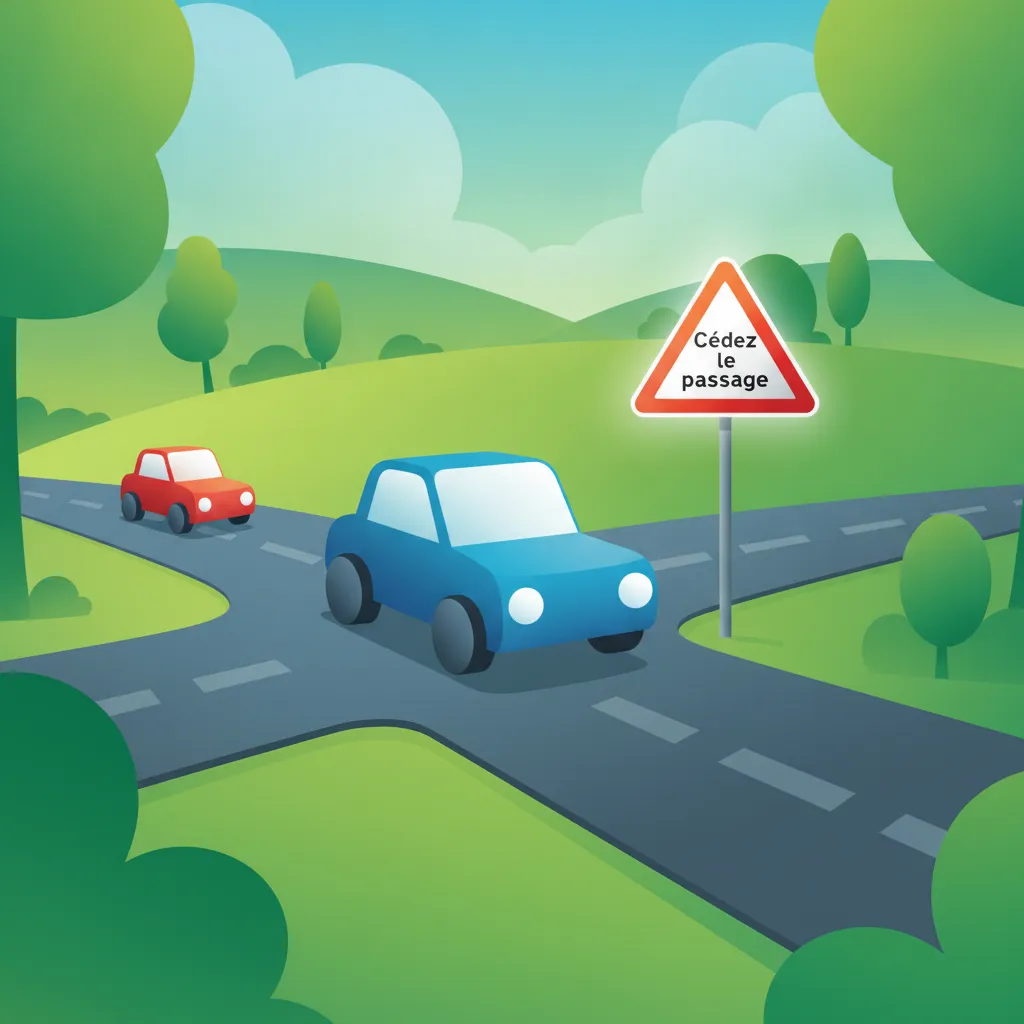
The Give Way sign, or 'Cédez le passage' in France, instructs you to yield to traffic on the road you are approaching or crossing. It doesn't always demand a full stop, but requires careful observation and readiness to stop if necessary to allow priority traffic to proceed undisturbed. Correctly interpreting this sign is vital for both your theory exam and real-world road safety.
Theory topic content overview
Read the full theory topic guide for Give Way Sign Rules with structured, easy-to-scan content built for learners in France. This detailed section explains the exact rule, meaning, traffic context, comparison points, and exam logic behind this French driving theory topic so you can study faster, understand the concept more clearly, and avoid common interpretation mistakes on the theory test.
Cédez le passage) in FranceThe Cédez le passage sign, known as the Give Way sign in English, is a fundamental regulatory sign in French driving theory and practice. It is a downward-pointing equilateral triangle with a red border and a white (or sometimes yellow) background, sometimes accompanied by a supplementary panel. This sign instructs drivers to yield priority to all traffic on the road they are approaching or crossing.
Crucially, Cédez le passage does not always demand a complete stop. Instead, it requires you to slow down, be prepared to stop, and only proceed when it is safe to do so without interfering with priority traffic. Mastering this distinction is vital for both your Code de la route exam and safe driving in France.
Understanding and correctly applying the Cédez le passage rule is critical for several reasons:
Code de la route): The Cédez le passage is a legally binding instruction under the Code de la route. Failure to comply can result in penalties and points on your permis de conduire.ETG): Questions on Cédez le passage scenarios, distinguishing it from a Stop sign, and assessing priority are very common in the French driving theory exam. It tests your hazard perception and decision-making skills at intersections.Cédez le passage Works in PracticeWhen you encounter a Cédez le passage sign, your actions must follow a precise sequence:
Contrôle): Look in all directions for approaching traffic on the priority road. This includes checking left and right, and in some cases, traffic from behind if you are merging. Pay particular attention to motorcycles and cyclists, which can be harder to spot.Cédez le passage line. Wait until the way is genuinely clear.Remember, the goal is to integrate into traffic without causing any disruption to those with priority.
Several factors impact how you should interpret and act on a Cédez le passage sign:
Cédez le passage with even greater caution and be prepared to stop earlier.Rond-points or Giratoires): In France, the Cédez le passage sign is almost universally present at roundabout entries, meaning you must yield to traffic already circulating within the roundabout. This is a crucial French specificity.usagers vulnérables (vulnerable road users) like pedestrians and cyclists, who may be harder to see and require more space.Cédez le passage vs. Stop Sign: A Crucial French DistinctionOne of the most common confusions for learners in France, and a frequent Code de la route exam trap, is differentiating between the Cédez le passage sign and the Stop sign.
| Feature | Cédez le passage (Give Way) | Stop Sign |
|---|---|---|
| Shape | Downward-pointing triangle | Octagonal |
| Primary Rule | Yield priority to traffic on the main road. | Always come to a complete halt before the stop line. |
| Stopping | Optional if the way is absolutely clear and safe. | Mandatory full stop, even if no traffic is visible. |
| Line Marking | Dashed white line (Ligne discontinue) | Solid white line (Ligne continue) |
| Action After Stop | Proceed when clear, without affecting priority traffic. | After stopping, proceed only when clear, without affecting priority traffic. |
Key takeaway for French driving theory: At a Cédez le passage, if you can proceed without making anyone on the priority road change their speed or direction, you may do so. At a Stop sign, the stop is non-negotiable, irrespective of traffic.
Cédez le passageRond-point): You are approaching a rond-point in France, indicated by a Cédez le passage sign. You see a car already circulating within the roundabout to your left. You must slow down and stop if necessary to allow that car to pass before entering the roundabout. Even if a car is far away, if it would have to brake for you, you must wait.Cédez le passage sign to join a busier main road. You look left and right. If the main road is empty, or traffic is very distant, you can carefully accelerate and join without stopping. However, if a vehicle is approaching from either direction that would be inconvenienced, you must stop behind the dashed line and wait for a clear gap.Cédez le passage where a building or a high hedge obstructs your view of the priority road. Even if no traffic is immediately visible, the poor visibility demands extreme caution. You should slow down to a crawl or even stop briefly (without necessarily coming to a full halt if you can clearly see it's safe) to improve your view before proceeding.Cédez le passage in FranceLearners and even experienced drivers often make specific mistakes related to the Cédez le passage sign:
Priorité à droite: In France, Cédez le passage signs override the general priorité à droite rule. Always obey the sign.Cédez le passage line.The Cédez le passage sign in France is about responsible integration. It demands active observation, clear judgment, and prioritizing the safety and flow of traffic already on the main road. Think of it as a proactive request to ensure your entry does not create an obstacle for others. Slow down, look carefully, and only proceed when you are absolutely certain you will not force any priority traffic to alter its course or speed. This mindset will serve you well in your Code de la route exam and throughout your driving career in France.
Start with a short, direct summary of Give Way Sign Rules before reading the full explanation below.
The Give Way sign (Cédez le passage) in France means you must yield priority to all traffic on the road you are joining or crossing. You must slow down and be prepared to stop. If the road is clear and you can proceed without forcing other traffic to brake or change direction, you may do so without coming to a complete stop. Always prioritize vehicles already on the main road.
Review the most important terms, rule signals, and traffic concepts linked to Give Way Sign Rules.
Explore related theory topic pages connected to Give Way Sign Rules and continue with the next useful rule explanation.
See the common search queries learners use when trying to understand Give Way Sign Rules in France.

Continue your journey by exploring specific French driving theory topics, from road signs and priority rules to vehicle safety and administrative procedures. Deepen your understanding of the Code de la route and prepare effectively for your permis de conduire ETG exam to ensure success and safe driving practices.
French Driving Theory Topics & RulesTheory topic content overview
Start with a short, direct summary of Give Way Sign Rules before reading the full explanation below.
The Give Way sign (Cédez le passage) in France means you must yield priority to all traffic on the road you are joining or crossing. You must slow down and be prepared to stop. If the road is clear and you can proceed without forcing other traffic to brake or change direction, you may do so without coming to a complete stop. Always prioritize vehicles already on the main road.
Review the most important terms, rule signals, and traffic concepts linked to Give Way Sign Rules.
Explore related theory topic pages connected to Give Way Sign Rules and continue with the next useful rule explanation.
See the common search queries learners use when trying to understand Give Way Sign Rules in France.
Continue your journey by exploring specific French driving theory topics, from road signs and priority rules to vehicle safety and administrative procedures. Deepen your understanding of the Code de la route and prepare effectively for your permis de conduire ETG exam to ensure success and safe driving practices.
French Driving Theory Topics & RulesUse this exam-focused revision tip to understand how Give Way Sign Rules is likely to appear in theory questions for learners in France. This section helps you identify the most testable part of the rule, avoid common traps, and remember the concept more effectively during French driving theory exam preparation.
Many learners confuse 'Cédez le passage' with a Stop sign. Remember, at a Give Way, you *may* proceed without stopping if the way is absolutely clear and you don't affect priority traffic. At a Stop sign, a full halt is always compulsory, even if no traffic is visible. This distinction is a common trap in the Code de la route exam.
Read direct answers to the most common learner questions about Give Way Sign Rules in France. This FAQ focuses on rule confusion, practical meaning, comparison with similar concepts, and the exact uncertainties that appear most often in French driving theory revision and exam preparation.
The Give Way sign (Cédez le passage) indicates that you must give priority to traffic on the road you are entering or crossing. You must slow down and only proceed when it is safe to do so without interfering with priority traffic.
No, unlike a Stop sign, a full stop is not always mandatory. You only need to stop if there is priority traffic approaching that you would obstruct or force to react. If the road is clear, you can proceed without stopping, but you must always be prepared to stop.
The main difference is the requirement to stop. A Stop sign (Stop) mandates a complete halt before the stop line, regardless of traffic. A Give Way sign (Cédez le passage) requires you to yield, meaning you only stop if necessary to let priority traffic pass.
All traffic on the road you are entering or crossing has priority. You must yield to vehicles approaching from both left and right if they are on the priority road.
If your view is obstructed, you must creep forward slowly and cautiously until you have a clear view of the priority road. Be prepared to stop immediately if you spot approaching traffic you need to yield to.
Yes, failing to yield at a Give Way sign when required is a serious offence in France and can result in fines, penalty points on your license, and even suspension of your driving permit.
Ready to focus your study? Use the practice search to find exactly the French driving theory questions you need for the Code de la route and permis de conduire ETG. Refine your knowledge on specific topics or challenging rules to boost your confidence and exam readiness.