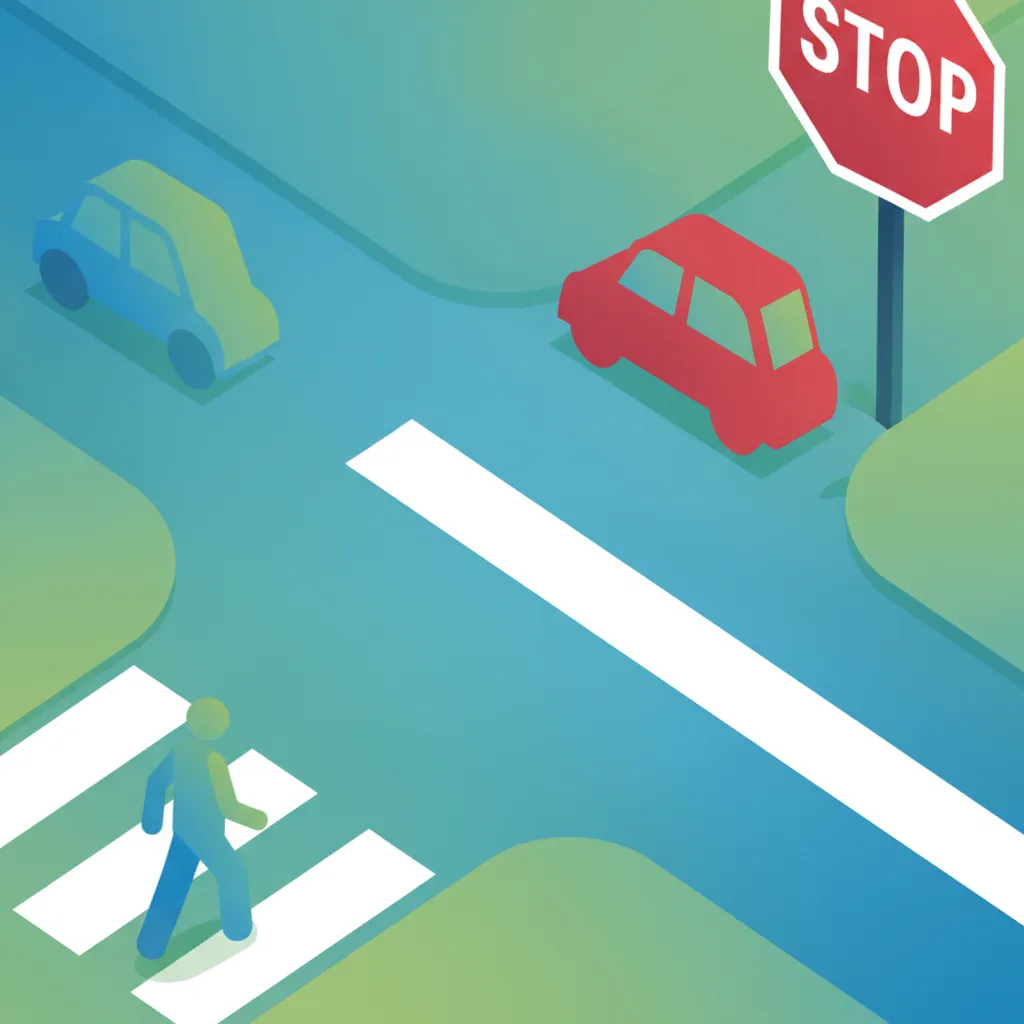
A stop sign (panneau stop) is a crucial regulatory sign in French traffic law, demanding a complete halt before you proceed. This page clarifies the absolute requirement to stop, regardless of traffic, and how to safely assess the intersection before moving. Pay close attention to the difference between stopping and merely slowing down, a key point for both safety and your permis de conduire exam.
Theory topic content overview
Read the full theory topic guide for Stop Sign: Complete Stop with structured, easy-to-scan content built for learners in France. This detailed section explains the exact rule, meaning, traffic context, comparison points, and exam logic behind this French driving theory topic so you can study faster, understand the concept more clearly, and avoid common interpretation mistakes on the theory test.
Panneau Stop)?A stop sign, known as a panneau stop in France, is a regulatory traffic sign that commands drivers to bring their vehicle to a complete and absolute halt before proceeding. This is not merely a suggestion to slow down or check for traffic; it is an unequivocal requirement under the French Code de la route to stop your vehicle fully.
The primary purpose of a stop sign is to enhance safety at intersections, railway crossings, or points of restricted visibility where immediate priority is not clear or where approaching traffic may be fast-moving. By forcing a complete stop, the sign ensures drivers have adequate time to:
Permis de ConduireUnderstanding and correctly executing the stop sign rule is paramount for both road safety and success in your Examen Théorique Général (ETG), the French driving theory exam.
panneau stop is a significant cause of collisions in France. It bypasses the crucial safety pause designed to prevent right-of-way conflicts and crashes, especially at blind intersections or junctions with heavy traffic.arrêt obligatoire – a mandatory stop. Ignoring this sign is a serious traffic violation, carrying penalties that can impact your permis de conduire and driving record.ETG frequently includes questions that test your knowledge of stop signs, often contrasting them with yield signs (cédez le passage). Examiners look for a clear understanding of the absolute stop requirement.A proper complete stop at a panneau stop involves more than just a momentary pause. It's a sequence of actions:
Ligne d'Arrêt):
ligne d'arrêt), you must stop before this line. Your front wheels should not cross it.ligne d'arrêt, you must stop where you have the best visibility of the intersecting road, without obstructing pedestrians or entering the flow of traffic. This usually means stopping just before the edge of the intersection.arrêt glissé (where the vehicle slows significantly but never fully stops) is not acceptable and is considered a violation.Contrôler (check) comprehensively.The requirement to stop at a panneau stop is universal, but certain factors highlight its importance:
Panneau Stop vs. Cédez le Passage (Yield Sign)This is a critical distinction for the French driving theory exam and real-world driving.
| Feature | Stop Sign (Panneau Stop / Arrêt obligatoire) | Yield Sign (Cédez le passage) |
|---|---|---|
| Stopping | Mandatory complete stop (vehicle must be stationary) | Not mandatory to stop, only if necessary to give way |
| Priority | You must give way to all other road users. | You must give way to traffic on the main road. |
| Proceeding | After stopping, proceed only when safe. | May proceed without stopping if the road is clear. |
| Legal Force | Absolute command to stop. | Command to give way; stopping is a means to do so if needed. |
The key takeaway for your permis de conduire is that a panneau stop always demands a full halt, whereas a cédez le passage sign requires you to give priority but allows you to continue moving if you can do so safely without impeding others.
Panneau StopUnderstanding how to apply the stop sign rule in various French traffic contexts is vital:
Panneau Stop at a T-junction in a Residential Area: You are driving through a quiet French village (en agglomération) and see a panneau stop at a T-junction. Even if the street ahead seems deserted, you must come to a full stop at the ligne d'arrêt. Then, lean forward slightly to gain better visibility around parked cars, check for cyclists on the pavement or road, and only then proceed when the main road is clear.Panneau Stop with Limited Visibility on a Rural Road: On a winding route départementale (hors agglomération), you encounter a stop sign just before a dense hedge that limits your view. You stop completely at the line. Because your view is still obstructed, you may then slowly creep forward after stopping, carefully peeking around the obstruction until you can clearly see approaching traffic from both directions before merging.Panneau Stop at a Junction with a Tram Line: In a city like Bordeaux or Nice, you might find a panneau stop at an intersection where a tram line crosses. After making your full stop, your observation must specifically include checking for trams, which have absolute priority and often move silently. You must only proceed when both road traffic and trams are clear.Many learners lose points or fail the permis de conduire exam due to incorrect stop sign execution:
Arrêt Glissé): This is the most common error, where the vehicle merely slows down significantly without ever reaching a complete standstill. This will result in immediate failure on the practical exam and is a major safety hazard.ligne d'arrêt or intersection, you may not have a clear view and might have to perform a second "stop" to see, which can be confusing and unsafe.ligne d'arrêt before stopping is a violation, as it places your vehicle in the path of intersecting traffic too soon.contrôler thoroughly, taking time to identify all potential hazards.Code de la Route and Your Practical ExamIn France, the panneau stop (B5) is unequivocally a regulatory sign demanding arrêt obligatoire. This means the obligation to stop is absolute. The strictness of this rule is deeply embedded in French driving culture and law.
Your ETG and practical driving exam will emphasize:
panneau stop and its accompanying ligne d'arrêt.contrôle visuel).Understanding this distinction from a yield sign is one of the most fundamental aspects of Code de la route theory for any aspiring French driver.
For every panneau stop you encounter in France:
ligne d'arrêt or at the intersection edge.Mastering the panneau stop is a cornerstone of safe and compliant driving in France. Always remember: a stop sign means arrêt obligatoire – no exceptions.
Start with a short, direct summary of Stop Sign: Complete Stop before reading the full explanation below.
A stop sign (panneau stop) requires drivers in France to bring their vehicle to a complete and full stop behind the stop line or before the intersection. This is mandatory even if the road appears clear. After stopping, you must look carefully for all other road users and only proceed when it is safe and you have priority, without obstructing traffic.
Review the most important terms, rule signals, and traffic concepts linked to Stop Sign: Complete Stop.
Explore related theory topic pages connected to Stop Sign: Complete Stop and continue with the next useful rule explanation.
See the common search queries learners use when trying to understand Stop Sign: Complete Stop in France.

Continue your journey by exploring specific French driving theory topics, from road signs and priority rules to vehicle safety and administrative procedures. Deepen your understanding of the Code de la route and prepare effectively for your permis de conduire ETG exam to ensure success and safe driving practices.
French Driving Theory Topics & RulesTheory topic content overview
Start with a short, direct summary of Stop Sign: Complete Stop before reading the full explanation below.
A stop sign (panneau stop) requires drivers in France to bring their vehicle to a complete and full stop behind the stop line or before the intersection. This is mandatory even if the road appears clear. After stopping, you must look carefully for all other road users and only proceed when it is safe and you have priority, without obstructing traffic.
Review the most important terms, rule signals, and traffic concepts linked to Stop Sign: Complete Stop.
Explore related theory topic pages connected to Stop Sign: Complete Stop and continue with the next useful rule explanation.
See the common search queries learners use when trying to understand Stop Sign: Complete Stop in France.
Continue your journey by exploring specific French driving theory topics, from road signs and priority rules to vehicle safety and administrative procedures. Deepen your understanding of the Code de la route and prepare effectively for your permis de conduire ETG exam to ensure success and safe driving practices.
French Driving Theory Topics & RulesUse this exam-focused revision tip to understand how Stop Sign: Complete Stop is likely to appear in theory questions for learners in France. This section helps you identify the most testable part of the rule, avoid common traps, and remember the concept more effectively during French driving theory exam preparation.
In the French driving theory exam, pay close attention to scenarios involving stop signs versus yield signs. The key difference is the absolute requirement to come to a complete stop at a stop sign, even if no other traffic is visible. Always stop fully, check both ways, and only then proceed when safe.
Read direct answers to the most common learner questions about Stop Sign: Complete Stop in France. This FAQ focuses on rule confusion, practical meaning, comparison with similar concepts, and the exact uncertainties that appear most often in French driving theory revision and exam preparation.
A stop sign (panneau stop) means you must bring your vehicle to a complete halt behind the stop line or before the intersection, and give way to all other traffic before proceeding.
Yes, in France, a complete stop is mandatory at every stop sign, even if you see no other traffic approaching. You must stop fully, then check carefully before proceeding.
A stop sign requires a full stop, whereas a yield sign only requires you to slow down and be prepared to stop if necessary to give way. You can continue moving with a yield sign if the road is clear.
After coming to a complete stop, you must check for all road users from all directions. Only proceed when it is safe to do so, and your movement will not force other traffic to slow down or change course.
No, you must stop completely behind the stop line. If visibility is poor, you may carefully creep forward after your initial stop to get a better view, but the initial stop must always be behind the line.
Failing to stop at a stop sign in France is a serious infraction of the Code de la route, leading to a fine, penalty points on your permis de conduire, and potential suspension of your license.
Ready to focus your study? Use the practice search to find exactly the French driving theory questions you need for the Code de la route and permis de conduire ETG. Refine your knowledge on specific topics or challenging rules to boost your confidence and exam readiness.