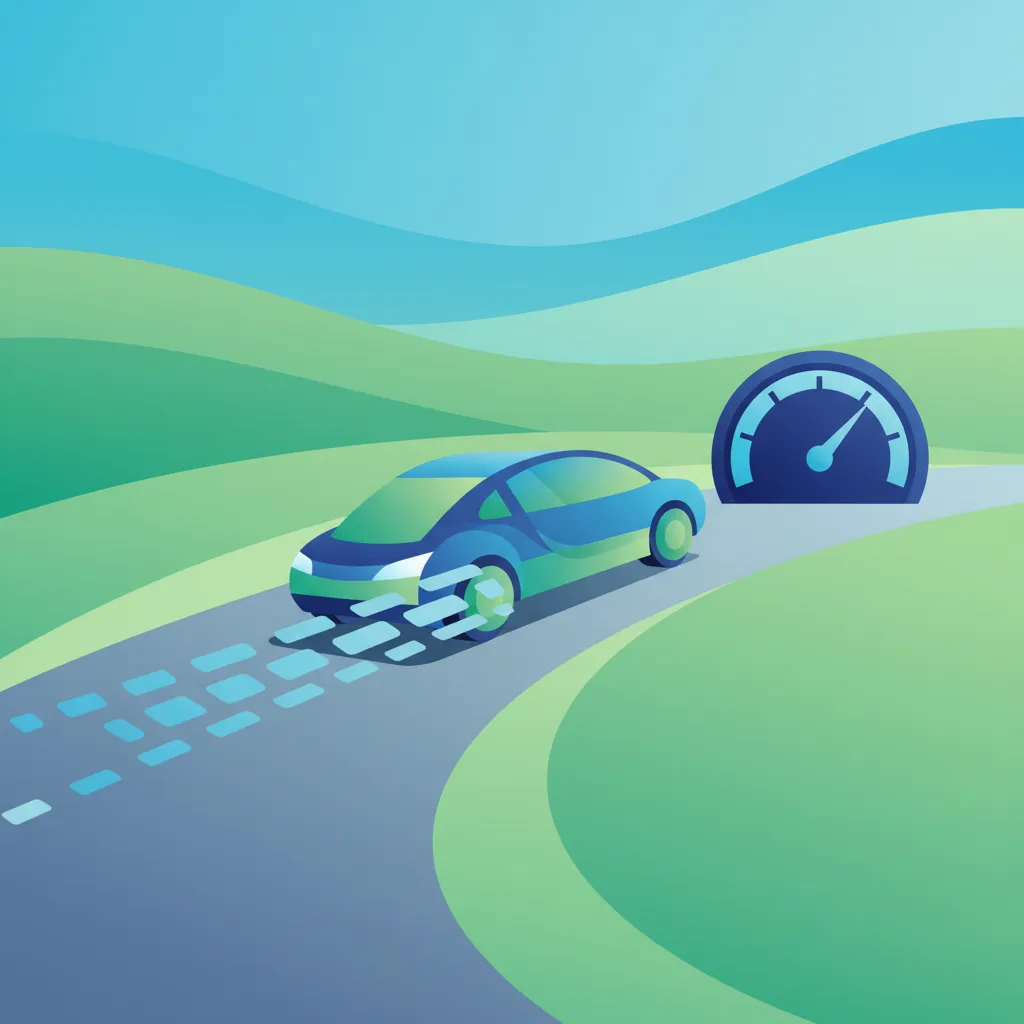
Reaction distance is the crucial stretch your vehicle covers from the moment you spot a hazard until you physically start braking. This page clarifies the elements that define your reaction time and how various factors, especially speed, dramatically increase this distance in real Swedish traffic conditions.
Theory topic content overview
Read the full theory topic guide for Reaction Distance with structured, easy-to-scan content built for learners in Sweden. This detailed section explains the exact rule, meaning, traffic context, comparison points, and exam logic behind this Swedish driving theory topic so you can study faster, understand the concept more clearly, and avoid common interpretation mistakes on the theory test.
Reaction distance, known as reaktionssträcka in Swedish driving theory, is the distance your vehicle travels from the moment you first perceive a hazard until you actually begin to take a corrective action, such as braking or steering. It is the crucial initial segment of your total stoppsträcka (stopping distance).
This seemingly brief period involves several steps:
During your reaction time (the duration of these three steps), your vehicle continues to travel at its current speed, covering the reaction distance.
Understanding reaktionssträcka is fundamental for safe driving in Sweden and a core component of the Swedish driving theory exam. Misjudging this distance is a common cause of collisions, especially rear-end accidents or failing to stop in time for unexpected hazards.
reaktionssträcka allows drivers to maintain a safe following distance (tvåsekundersregeln – the two-second rule) and adjust speed according to prevailing conditions, from busy urban streets to winding landsvägar (rural roads) or motorvägar (motorways).Transportstyrelsen) places significant emphasis on a driver's ability to assess and react to hazards. Theory exam questions frequently test your knowledge of how reaktionssträcka changes with speed and other factors, sometimes requiring simple calculations.överfarter), negotiating roundabouts (rondeller), or driving in adverse weather conditions common in Sweden, such as rain, snow, or ice.The length of your reaktionssträcka is primarily determined by two factors: your vehicle's speed and your individual reaction time.
The relationship between speed and reaction distance is direct and proportional (linear). This is a vital principle to remember:
reaktionssträcka will also double.reaktionssträcka will be three times longer.This linear increase highlights why even a small increase in speed can significantly impact your ability to react and avoid a hazard, especially on Sweden's high-speed motorways or when wildlife (vilt) might appear suddenly on rural roads.
While speed is objective, reaction time is highly variable, usually ranging from 0.5 to 2 seconds for an alert driver. This individual time is influenced by several factors.
Several elements can extend your reaction time, thereby lengthening your reaktionssträcka:
trötthet): Drowsiness dramatically slows down perception and decision-making, similar to the effects of alcohol. Long drives, especially during Sweden's dark winters, increase fatigue risk.distraktion): Anything that takes your attention away from the road – a mobile phone (mobiltelefon), in-car systems, passengers, or even adjusting the radio – prolongs your reaction time.alkohol, droger och mediciner): Impair judgment, coordination, and reaction speed. Driving under the influence is a serious offense in Sweden and severely compromises safety.dimma), heavy rain (kraftigt regn), snow (snö), or glare from the sun (solbländning) obscure hazards, requiring more time to perceive them.Conversely, reaktionssträckan can be shortened by:
förutseende och handlingsberedskap): Actively looking for potential hazards and being ready to act.A common point of confusion for learners is distinguishing between reaktionssträcka and bromssträcka (braking distance).
Reaktionssträcka (Reaction Distance): The distance covered before you start braking. It's about your internal response to a hazard.Bromssträcka (Braking Distance): The distance covered from the moment you apply the brakes until the vehicle comes to a complete stop. It's about the vehicle's physical stopping capability.Together, these two components make up the stoppsträcka (total stopping distance):
Stoppsträcka = Reaktionssträcka + Bromssträcka
While reaktionssträcka increases linearly with speed, bromssträcka increases quadratically (four times longer if speed doubles). Understanding this difference is crucial for accurately assessing total stopping distances.
For the Swedish driving theory exam, you may need to estimate reaktionssträcka. A simple rule of thumb for an average reaction time of 1 second is often taught:
To estimate reaction distance (in meters) for a 1-second reaction time:
Example Calculations (assuming 1-second reaction time):
If your reaction time is longer (e.g., 2 seconds due to fatigue), simply double the calculated reaktionssträcka. For instance, at 50 km/h with a 2-second reaction time, the distance would be 15 * 2 = 30 meters.
övergångsställe) in Stockholm, a pedestrian steps out unexpectedly. Even if you react in 1 second, your car travels 15 meters before you even touch the brake. This emphasizes why förutseende (anticipation) is key in city traffic.landsväg) at 90 km/h: Driving on a winding road in Småland, an elk (älg) suddenly appears on the road. At 90 km/h, your reaktionssträcka alone is 27 meters (with a 1-second reaction time). This highlights the critical importance of speed reduction and scanning for wildlife in rural Sweden.motorväg) in Rain: Traveling at 110 km/h on the E4 south of Jönköping during heavy rain. The reduced visibility and potentially longer reaction time (due to harder perception) mean your reaktionssträcka could easily be over 33 meters before bromssträckan even begins, making adequate following distance paramount.Learners frequently make these mistakes when considering reaktionssträcka:
reaktionssträcka.reaktionssträcka from bromssträcka, leading to an incomplete understanding of stoppsträcka.To ensure safety and pass your Swedish driving theory exam, always remember:
Your reaktionssträcka is the hidden distance your vehicle covers before you even begin to act. It's a direct reflection of your mental state and attention. By maintaining full focus, avoiding distractions, staying rested, and adapting your speed to all conditions, you actively minimize your reaktionssträcka and maximize your ability to react safely to any unexpected situation on Swedish roads. Always drive with förutseende – anticipation – to give yourself the most crucial commodity: time to react.
Reaction distance (reaktionssträcka) measures how far your vehicle travels during the time it takes you to perceive a hazard, decide on an action, and physically begin braking — typically 0.5 to 2 seconds. This distance increases directly in proportion to your speed, meaning double the speed means double the reaction distance. Key factors that lengthen reaction time include fatigue, distraction, alcohol, poor visibility, and complex decision-making. The concept is distinct from braking distance (bromssträcka), which is governed by vehicle physics and increases quadratically with speed. For the Swedish theory exam, be prepared to calculate reaction distances and clearly distinguish between reaktionssträcka, bromssträcka, and the total stoppsträcka.
A short set of high-value points that capture the most important ideas from this theory explanation.
Reaction distance (reaktionssträcka) is the distance your vehicle travels from noticing a hazard to initiating braking, forming the first part of total stopping distance (stoppsträcka)
Reaction distance increases linearly with speed: doubling your speed doubles your reaction distance
Personal reaction time typically ranges from 0.5 to 2 seconds, and is influenced by fatigue, distraction, alcohol, stress, and visibility conditions
Reaktionssträcka is fundamentally different from bromssträcka (braking distance) — reaction distance is about your mental response, while braking distance is about vehicle physics
Anticipation and scanning ahead actively shortens reaction distance by starting the perception step earlier
To estimate reaction distance: take speed in km/h, divide by 10, multiply by 3 (for a 1-second reaction time)
At 50 km/h with 1-second reaction time, reaction distance is 15 metres; at 70 km/h it is 21 metres
While reaktionssträcka increases linearly with speed, bromssträcka increases quadratically (four times longer if speed doubles)
Drivers aged 45-54 tend to have optimal reaction times, combining sharp senses with experience
The three steps in reaction time are: Perception, Decision, and Action — all happening before you touch the brake
Confusing reaktionssträcka (reaction distance) with bromssträcka (braking distance), leading to incomplete understanding of stoppsträcka
Assuming an ideal 0.5-second reaction time rather than accounting for real conditions like fatigue or minor distractions
Underestimating how even small speed increases proportionally lengthen reaction distance
Not adjusting speed or following distance for poor visibility, adverse weather, or slippery roads
Driving passively without actively scanning for hazards, which delays the perception step and lengthens reaction time
Start with a short, direct summary of Reaction Distance before reading the full explanation below.
Reaction distance is the distance your vehicle travels during your reaction time, which is the period from perceiving a hazard to initiating a braking or evasive action. It is a critical component of total stopping distance, increasing directly with speed. Factors like fatigue, distraction, or alcohol significantly lengthen this distance, making it harder to avoid accidents on Swedish roads.
Review the most important terms, rule signals, and traffic concepts linked to Reaction Distance.
Explore related theory topic pages connected to Reaction Distance and continue with the next useful rule explanation.
See the common search queries learners use when trying to understand Reaction Distance in Sweden.

Dive deeper into specific theory topics, review detailed explanations of road rules, and reinforce your understanding of Swedish traffic regulations. Continue your preparation for the driving licence exam by exploring each core concept in detail.
Explore Driving Theory TopicsTheory topic content overview
A short set of high-value points that capture the most important ideas from this theory explanation.
Reaction distance (reaktionssträcka) is the distance your vehicle travels from noticing a hazard to initiating braking, forming the first part of total stopping distance (stoppsträcka)
Reaction distance increases linearly with speed: doubling your speed doubles your reaction distance
Personal reaction time typically ranges from 0.5 to 2 seconds, and is influenced by fatigue, distraction, alcohol, stress, and visibility conditions
Reaktionssträcka is fundamentally different from bromssträcka (braking distance) — reaction distance is about your mental response, while braking distance is about vehicle physics
Anticipation and scanning ahead actively shortens reaction distance by starting the perception step earlier
To estimate reaction distance: take speed in km/h, divide by 10, multiply by 3 (for a 1-second reaction time)
At 50 km/h with 1-second reaction time, reaction distance is 15 metres; at 70 km/h it is 21 metres
While reaktionssträcka increases linearly with speed, bromssträcka increases quadratically (four times longer if speed doubles)
Drivers aged 45-54 tend to have optimal reaction times, combining sharp senses with experience
The three steps in reaction time are: Perception, Decision, and Action — all happening before you touch the brake
Confusing reaktionssträcka (reaction distance) with bromssträcka (braking distance), leading to incomplete understanding of stoppsträcka
Assuming an ideal 0.5-second reaction time rather than accounting for real conditions like fatigue or minor distractions
Underestimating how even small speed increases proportionally lengthen reaction distance
Not adjusting speed or following distance for poor visibility, adverse weather, or slippery roads
Driving passively without actively scanning for hazards, which delays the perception step and lengthens reaction time
Start with a short, direct summary of Reaction Distance before reading the full explanation below.
Reaction distance is the distance your vehicle travels during your reaction time, which is the period from perceiving a hazard to initiating a braking or evasive action. It is a critical component of total stopping distance, increasing directly with speed. Factors like fatigue, distraction, or alcohol significantly lengthen this distance, making it harder to avoid accidents on Swedish roads.
Review the most important terms, rule signals, and traffic concepts linked to Reaction Distance.
Explore related theory topic pages connected to Reaction Distance and continue with the next useful rule explanation.
See the common search queries learners use when trying to understand Reaction Distance in Sweden.
Dive deeper into specific theory topics, review detailed explanations of road rules, and reinforce your understanding of Swedish traffic regulations. Continue your preparation for the driving licence exam by exploring each core concept in detail.
Explore Driving Theory TopicsUse this exam-focused revision tip to understand how Reaction Distance is likely to appear in theory questions for learners in Sweden. This section helps you identify the most testable part of the rule, avoid common traps, and remember the concept more effectively during Swedish driving theory exam preparation.
Remember that reaction distance increases linearly with speed – double your speed, double your reaction distance. Pay close attention to questions in the Swedish theory exam that involve calculating this distance or identifying factors that prolong reaction time, such as mental workload or poor visibility. Always factor in your personal reaction time, typically between 0.5 to 2 seconds.
Read direct answers to the most common learner questions about Reaction Distance in Sweden. This FAQ focuses on rule confusion, practical meaning, comparison with similar concepts, and the exact uncertainties that appear most often in Swedish driving theory revision and exam preparation.
Reaction distance is the distance a vehicle travels from the moment a driver perceives a hazard until they actually begin to apply the brakes or take evasive action.
Reaction distance is the distance covered before braking starts, while braking distance is the distance covered while the vehicle is actively braking. Together, they make up the total stopping distance.
Yes, reaction distance increases directly and proportionally with speed. If you double your speed, your reaction distance also doubles, even if your reaction time stays the same.
Common factors include fatigue, distraction (e.g., mobile phone use), alcohol or drugs, certain medications, stress, and poor visibility. These all lengthen your reaction time and thus the reaction distance.
A typical reaction time for an attentive driver is usually estimated to be between 0.5 and 2 seconds, though this can vary greatly depending on the individual and external factors.
The Swedish driving theory exam (förarprovet) often includes questions on reaction distance to assess your understanding of safe driving principles, how speed affects stopping, and the impact of driver condition on road safety.
A common quick method for estimating reaction distance in meters is to take the first digit of your speed in km/h, multiply it by your reaction time in seconds, and then multiply by 3. For example, at 50 km/h with 1 second reaction time: (5 * 1 * 3) = 15 meters.
Refine your study plan by exploring practice sets on specific Swedish traffic rules, road signs, or driving situations. Use the search to quickly access relevant questions and focus your preparation for the official driving licence theory exam.