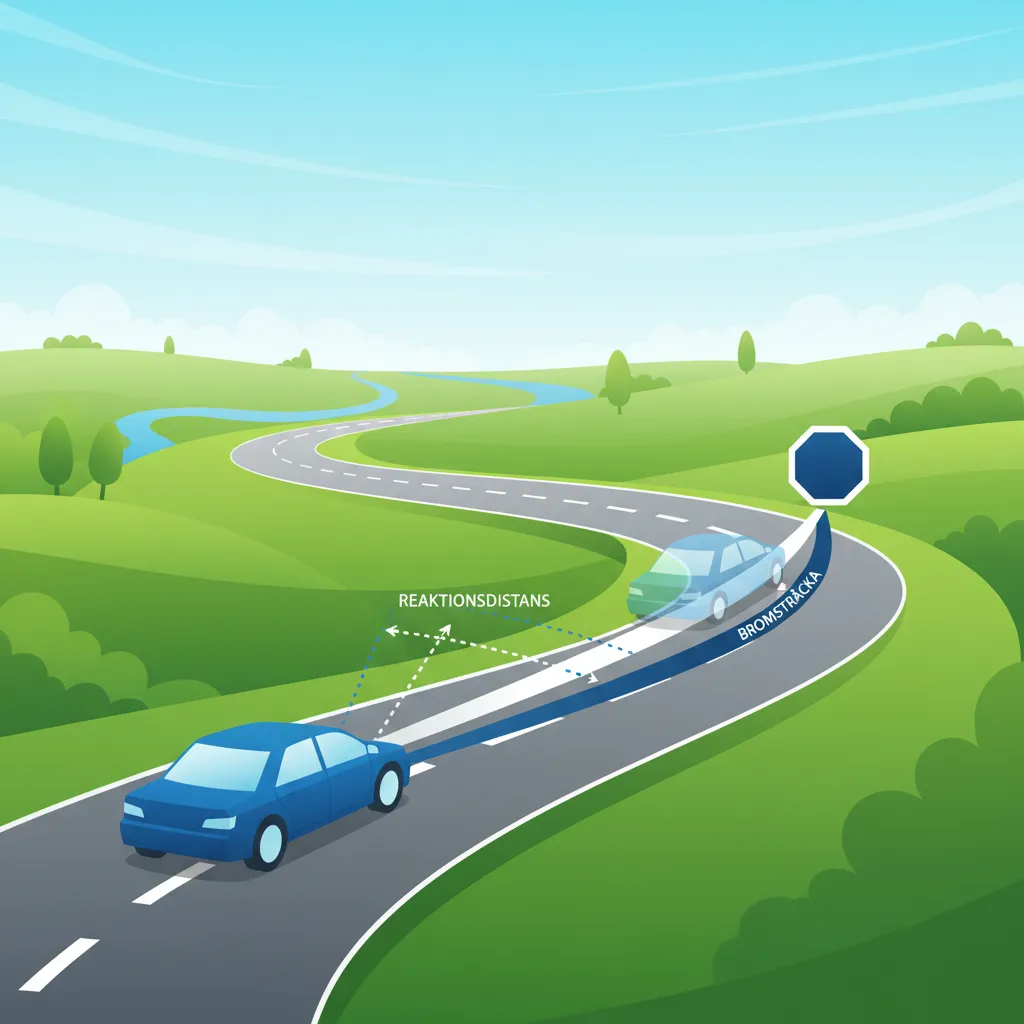
Stopping distance is one of the most fundamental concepts in driving theory, directly impacting road safety. In Sweden, as elsewhere, it refers to the total ground covered from the moment a driver identifies a hazard to when their vehicle comes to a complete halt. It's crucial to understand its two main components and how various factors dramatically increase the required stopping space.
Theory topic content overview
Read the full theory topic guide for Stopping Distance with structured, easy-to-scan content built for learners in Sweden. This detailed section explains the exact rule, meaning, traffic context, comparison points, and exam logic behind this Swedish driving theory topic so you can study faster, understand the concept more clearly, and avoid common interpretation mistakes on the theory test.
Understanding your stopping distance (known as stoppsträcka in Swedish) is one of the most fundamental principles in driving theory and vital for road safety, especially on varied Swedish roads. It represents the total ground your vehicle covers from the moment you first perceive a hazard until your vehicle comes to a complete, stationary stop.
This critical distance is not a single, fixed measurement but rather the sum of two distinct components: reaction distance (reaktionssträcka) and braking distance (bromssträcka). Misjudging your total stopping distance is a leading cause of collisions and a common pitfall for new drivers.
To truly grasp stopping distance, you must understand its two sequential phases:
This is the distance your vehicle travels during your reaction time – the period from when you first perceive a hazard (e.g., a child running into the road, traffic ahead braking suddenly) until your foot actually starts to press the brake pedal.
This is the distance your vehicle travels from the moment you begin to apply the brakes until the vehicle comes to a full stop.
Understanding stoppsträcka is not just theoretical; it's a practical necessity for safe driving in Sweden and a core component of the Swedish driving license theory exam (körkortsteori).
This is arguably the most crucial aspect of stopping distance for drivers to grasp. While reaction distance increases linearly with speed, braking distance increases approximately with the square of your speed.
What does this mean in practice?
Several factors can dramatically increase both your reaction and braking distances:
It's crucial to differentiate these terms:
Common Learner Confusion: Many learners incorrectly assume "stopping distance" only refers to the distance covered while braking. They overlook the crucial "thinking and moving" phase that precedes actual brake application. The Swedish theory exam often aims to test this specific distinction.
Consider these common situations on Swedish roads where understanding stopping distance is vital:
For safe driving in Sweden and to confidently pass your körkortsteori, always remember:
By internalizing these principles, you'll be a safer driver and well-prepared for any stopping distance questions on the Swedish driving theory exam.
Stopping distance (stoppsträcka) consists of two sequential phases: reaction distance (reaktionssträcka), the distance traveled during perception and physical response before braking begins, and braking distance (bromssträcka), the distance traveled while actively braking. A critical principle is that while reaction distance increases linearly with speed, braking distance increases with the square of speed, making small speed increases disproportionately dangerous. Multiple factors including driver condition (fatigue, distraction), vehicle condition (tires, brakes), and environmental factors (wet/icy roads, slopes) can significantly extend both components. Understanding this concept is essential for maintaining safe following distances and adapting speed to conditions in Swedish traffic.
A short set of high-value points that capture the most important ideas from this theory explanation.
Stopping distance is the sum of reaction distance (before braking) and braking distance (while braking), not just braking distance alone.
Braking distance increases approximately with the square of your speed, meaning doubling speed roughly quadruples braking distance.
Reaction distance is affected by driver factors including fatigue, distraction, alcohol, and inexperience.
Environmental conditions such as wet roads, ice, snow, and gravel dramatically increase braking distance beyond normal conditions.
Maintaining a safe following distance and anticipating hazards early are essential because stopping distance is context-dependent.
Reaction distance = distance traveled before brake application; braking distance = distance traveled while brakes are applied.
Speed is the single biggest factor causing exponential increases in total stopping distance.
Swedish winter conditions (halkigt väglag) can multiply braking distance many times over compared to dry conditions.
The 3-second following distance rule should be extended to 6 seconds or more on wet or slippery roads.
A quicker reaction depends on early hazard perception, which reduces effective reaction distance.
Assuming 'stopping distance' refers only to the braking phase and ignoring the distance traveled during reaction time.
Thinking that doubling speed simply doubles total stopping distance, rather than understanding the exponential impact on braking distance.
Not adjusting speed for road conditions, assuming the speed limit is safe regardless of weather or surface.
Underestimating how much winter conditions (ice, snow, slush) extend braking distance in Sweden.
Failing to recognize that distraction or fatigue increases reaction distance before brakes are even applied.
Start with a short, direct summary of Stopping Distance before reading the full explanation below.
Stopping distance is the total distance a vehicle covers from when the driver first detects a hazard to the point where the vehicle is completely stationary. It is made up of two parts: reaction distance (the distance traveled before braking begins) and braking distance (the distance traveled while braking). This total distance increases significantly with speed and is influenced by driver condition, vehicle maintenance, and road surface conditions, making it a key element of safe driving in Sweden.
Review the most important terms, rule signals, and traffic concepts linked to Stopping Distance.
Explore related theory topic pages connected to Stopping Distance and continue with the next useful rule explanation.
See the common search queries learners use when trying to understand Stopping Distance in Sweden.

Dive deeper into specific theory topics, review detailed explanations of road rules, and reinforce your understanding of Swedish traffic regulations. Continue your preparation for the driving licence exam by exploring each core concept in detail.
Explore Driving Theory TopicsTheory topic content overview
A short set of high-value points that capture the most important ideas from this theory explanation.
Stopping distance is the sum of reaction distance (before braking) and braking distance (while braking), not just braking distance alone.
Braking distance increases approximately with the square of your speed, meaning doubling speed roughly quadruples braking distance.
Reaction distance is affected by driver factors including fatigue, distraction, alcohol, and inexperience.
Environmental conditions such as wet roads, ice, snow, and gravel dramatically increase braking distance beyond normal conditions.
Maintaining a safe following distance and anticipating hazards early are essential because stopping distance is context-dependent.
Reaction distance = distance traveled before brake application; braking distance = distance traveled while brakes are applied.
Speed is the single biggest factor causing exponential increases in total stopping distance.
Swedish winter conditions (halkigt väglag) can multiply braking distance many times over compared to dry conditions.
The 3-second following distance rule should be extended to 6 seconds or more on wet or slippery roads.
A quicker reaction depends on early hazard perception, which reduces effective reaction distance.
Assuming 'stopping distance' refers only to the braking phase and ignoring the distance traveled during reaction time.
Thinking that doubling speed simply doubles total stopping distance, rather than understanding the exponential impact on braking distance.
Not adjusting speed for road conditions, assuming the speed limit is safe regardless of weather or surface.
Underestimating how much winter conditions (ice, snow, slush) extend braking distance in Sweden.
Failing to recognize that distraction or fatigue increases reaction distance before brakes are even applied.
Start with a short, direct summary of Stopping Distance before reading the full explanation below.
Stopping distance is the total distance a vehicle covers from when the driver first detects a hazard to the point where the vehicle is completely stationary. It is made up of two parts: reaction distance (the distance traveled before braking begins) and braking distance (the distance traveled while braking). This total distance increases significantly with speed and is influenced by driver condition, vehicle maintenance, and road surface conditions, making it a key element of safe driving in Sweden.
Review the most important terms, rule signals, and traffic concepts linked to Stopping Distance.
Explore related theory topic pages connected to Stopping Distance and continue with the next useful rule explanation.
See the common search queries learners use when trying to understand Stopping Distance in Sweden.
Dive deeper into specific theory topics, review detailed explanations of road rules, and reinforce your understanding of Swedish traffic regulations. Continue your preparation for the driving licence exam by exploring each core concept in detail.
Explore Driving Theory TopicsUse this exam-focused revision tip to understand how Stopping Distance is likely to appear in theory questions for learners in Sweden. This section helps you identify the most testable part of the rule, avoid common traps, and remember the concept more effectively during Swedish driving theory exam preparation.
Remember that stopping distance is more than just braking! The Swedish theory exam often tests your ability to distinguish between reaction distance and braking distance. Pay close attention to how speed exponentially increases total stopping distance, as this is a common point of confusion and a frequent question topic.
Read direct answers to the most common learner questions about Stopping Distance in Sweden. This FAQ focuses on rule confusion, practical meaning, comparison with similar concepts, and the exact uncertainties that appear most often in Swedish driving theory revision and exam preparation.
Stopping distance is the total distance your vehicle travels from the moment you detect a hazard on the road until your vehicle comes to a complete stop. It's a combination of your reaction distance and braking distance.
Reaction distance is the distance your vehicle travels during the time it takes you to react to a hazard and start braking. Braking distance is the distance your vehicle travels from the moment you apply the brakes until it completely stops.
Speed has a critical, non-linear effect on stopping distance. Reaction distance increases proportionally with speed, but braking distance increases roughly with the square of the speed due to kinetic energy. This means doubling your speed can quadruple your braking distance.
Beyond speed, stopping distance in Sweden is affected by driver factors (fatigue, distraction, alcohol), vehicle condition (tires, brakes), and road conditions (wet, icy, gravel). These factors primarily impact your reaction time and the vehicle's braking capability.
The Swedish theory test frequently assesses your understanding of stopping distance, especially the relationship between speed, reaction time, and braking. It's crucial for questions on safe following distances, hazard perception, and adapting to different road conditions.
While reaction times vary, a common estimate used in driving theory is around one second. However, this can be longer if you are distracted, tired, or under the influence, significantly increasing your overall stopping distance.
Refine your study plan by exploring practice sets on specific Swedish traffic rules, road signs, or driving situations. Use the search to quickly access relevant questions and focus your preparation for the official driving licence theory exam.