
This lesson guides you through the complexities of driving large goods vehicles on rural roads. You will learn to adapt your speed and positioning to account for limited visibility, narrow lanes, and common rural hazards such as agricultural machinery and livestock.
Lesson content overview
Driving a Heavy Goods Vehicle (HGV) on rural roads presents a distinctive set of challenges that demand exceptional skill, vigilance, and adherence to specific safety protocols. Unlike motorways or urban streets, rural routes often feature unpredictable geometry, variable surface conditions, and a diverse mix of road users, including slow-moving agricultural vehicles and wildlife. For professional Category C goods vehicle drivers in Great Britain, understanding these unique hazards and adapting driving behaviour, particularly speed, is paramount for safety, legal compliance, and the security of cargo.
This lesson delves into the complexities of navigating rural environments, focusing on how physical road characteristics, environmental factors, and traffic composition necessitate a dynamic approach to speed management. It connects directly with previous learning on vehicle dynamics, braking distances, and load security, demonstrating why general speed limits may often be too high for safe HGV operation on specific rural sections. By mastering these concepts, you will enhance your ability to anticipate risks, control your vehicle effectively, and contribute to safer roads for all users.
Rural roads in Great Britain are fundamentally different from their urban or motorway counterparts. They are often less engineered, designed for lower traffic volumes, and subject to environmental influences that are less prevalent elsewhere. For an HGV, these characteristics translate into a heightened risk profile.
Rural road geometry frequently poses significant challenges for large goods vehicles. These roads often feature single carriageways that can be surprisingly narrow, sometimes less than 3.5 metres wide, making it difficult for two HGVs or an HGV and a larger vehicle to pass safely. The presence of tight bends with small radii, often less than 200 metres, demands considerable speed reduction to maintain control and prevent the vehicle from straying into oncoming lanes or off the road.
Steep gradients, both ascents and descents exceeding 6%, are also common. These gradients significantly affect an HGV’s braking efficiency and engine braking capabilities. Ascending a steep hill requires careful gear selection to maintain momentum without overstraining the engine, while descending demands even greater caution. A fully loaded HGV on a steep downgrade needs to be in a low gear to utilise engine braking effectively, preventing brake overheating and potential loss of control. Failing to adjust speed before entering a curve or gradient, especially a blind one, is a common cause of incidents for heavy vehicles.
One of the defining features of rural roads is the presence of agricultural traffic. This includes slow-moving farm vehicles such as tractors, combine harvesters, and trailers, which often travel at speeds as low as 8–24 km/h (5–15 mph). These vehicles can be wide, obstructing much of the lane, and may require significant time and distance to safely overtake. HGV drivers must anticipate their presence, especially during planting and harvesting seasons, and be prepared for sudden deceleration or stops.
Animal convoys, such as herds of cattle or flocks of sheep, moving across or along the road, are also a regular occurrence. These animals are unpredictable and can suddenly change direction or stop. Drivers must exercise extreme patience, reduce speed significantly, and be prepared to stop completely to allow them to pass safely. The Highway Code mandates that drivers give way to animals on the road where it is safe to do so.
The surfaces of rural roads are often less consistent than those of major highways. Factors like weather, drainage, and agricultural activity can lead to highly variable conditions.
Drivers must constantly assess the road surface ahead and adjust their speed and driving style accordingly. Modulating throttle and brake pressure, and maintaining a lower speed, are critical to managing these hazards effectively.
Wildlife is a constant, unpredictable element on rural roads, particularly during dawn and dusk. Animals such as deer, badgers, hares, and sometimes stray livestock can suddenly appear on the road.
Heightened vigilance is essential, especially when driving during twilight hours. Drivers should scan the verges and fields for signs of movement and be prepared to brake in a controlled manner if an animal appears. Swerving abruptly, especially in an HGV, is often more dangerous than a controlled collision.
While general speed limits provide a legal baseline, they rarely dictate a safe operating speed for an HGV on all rural roads. Professional drivers must constantly assess conditions and adapt their speed, often travelling significantly below the posted limit.
The National Speed Limit (NSL) applies on roads where no other specific speed limit is displayed. For Heavy Goods Vehicles over 7.5 tonnes maximum laden weight in Great Britain, the NSL on rural roads is:
It is crucial to remember that these are maximum legal limits, not recommended driving speeds. Professional drivers must always evaluate whether the NSL is appropriate for the specific rural setting, considering factors like road geometry, visibility, load, and other road users.
The Safe Operating Speed (SOS) is the speed at which a driver can maintain full control of their vehicle, stop safely, and respond effectively to any foreseeable hazard, given the current conditions. On rural roads, the SOS for an HGV will often be significantly lower than the NSL.
The speed that ensures the driver can maintain control, stop safely, and respond to hazards, given vehicle characteristics, road geometry, load, and environmental conditions.
The underlying logic for reducing speed is rooted in physics. Kinetic energy (KE = ½mv²) increases quadratically with speed, meaning doubling your speed quadruples your kinetic energy and, consequently, your braking distance. A heavy vehicle carrying a significant load requires considerably longer distances to stop than a car. By reducing speed, drivers mitigate the kinetic energy, shorten braking distances, and gain precious extra reaction time for sudden, unexpected obstacles. Driver judgment is critical in determining the SOS.
Drivers must meticulously observe and interpret all speed limit signage. While the NSL applies by default, many rural sections will have explicit limits.
When multiple signs are present or conditions dictate, the lowest applicable speed limit must always be adhered to. Ignoring specific signage can lead to legal penalties and significantly increased accident risk.
Beyond general speed limits, several factors specific to HGVs and the rural environment critically influence safe driving practices.
The characteristics of the cargo being carried have a profound impact on an HGV's handling, braking, and stability.
Proper load securing, as per Regulation 95, is crucial to prevent cargo movement that could shift the CoG and compromise stability, especially on winding rural roads. Regulation 109 also mandates compliance with maximum mass limits and proper load distribution.
Visibility is often limited on rural roads, particularly at night, dawn, or dusk, or during adverse weather. Effective use of vehicle lighting is vital.
On unlit rural roads, using high beams significantly increases your detection distance, giving you more time to react to unexpected hazards like wildlife or pedestrians. Always dip them promptly for other road users.
Proper lighting increases the ability to detect hazards such as animals, pedestrians, or road surface irregularities, enhancing overall safety.
The human element of driving, particularly reaction time, plays a crucial role in preventing incidents on rural roads. Reaction time is the interval between perceiving a hazard and initiating a response, typically ranging from 0.7 to 1.5 seconds for professional drivers, but it can be longer due to fatigue, distraction, or individual differences.
The interval between a driver perceiving a hazard and initiating a response, typically 0.7–1.5 seconds for professional drivers.
The total stopping distance is the sum of the distance covered during this reaction time (perception-reaction distance) plus the actual braking distance. On rural roads, where hazards can appear suddenly and sight lines may be limited, a longer reaction time necessitates a lower operating speed to ensure there is enough space to stop safely. Fatigue significantly impairs reaction time and judgment, making adequate rest and breaks essential for HGV drivers navigating demanding rural routes.
Operating an HGV on rural roads requires strict adherence to specific Highway Code rules and statutory regulations in Great Britain.
Failure to comply with these rules and regulations can lead to significant fines, penalty points, legal prosecution, and a serious impact on your professional driving licence and career.
To ensure safe and efficient operation on rural roads, professional HGV drivers should adopt a proactive and defensive driving strategy.
One of the most common violations and causes of accidents for HGVs on rural roads is maintaining the National Speed Limit (NSL) on hazardous sections like sharp bends or where road conditions are poor. Always prioritise a safe operating speed over the posted limit.
Navigating rural roads in a Heavy Goods Vehicle demands a proactive, informed, and highly adaptable approach. The distinct blend of narrow, winding lanes, varied surfaces, unpredictable agricultural traffic, and wildlife creates a challenging driving environment that mandates vigilance and cautious speed management.
As a professional Category C driver, your ability to assess conditions, understand the physics of heavy vehicle dynamics, and apply the appropriate Highway Code rules and regulations will be critical. Always prioritise a Safe Operating Speed (SOS) over the National Speed Limit (NSL) when circumstances dictate. By mastering hazard anticipation, prudent speed adjustment, and effective vehicle control, you will not only ensure your own safety and the security of your cargo but also contribute significantly to road safety across Great Britain's rural network.
Explore all units and lessons included in this driving theory course.
Lesson content overview
Explore all units and lessons included in this driving theory course.
Explore search topics learners often look for when studying Rural Road Challenges and Speed Limits. These topics reflect common questions about road rules, driving situations, safety guidance, and lesson level theory preparation for learners in Great Britain.
Browse additional driving theory lessons that cover connected traffic rules, road signs, and common driving situations related to this topic. Improve your understanding of how different rules interact across everyday traffic scenarios.
Understand the nuances of speed management and vehicle control for HGVs on rural routes. Learn about safe operating speeds, the application of national and temporary speed limits, and managing gradients for your Great Britain driving theory test.
This lesson focuses on the principles of effective speed management for heavy goods vehicles, which extends beyond simply obeying the statutory speed limits. It covers how to adapt speed based on vehicle weight, load stability, road gradients, and prevailing traffic and weather conditions. You will also learn about the function of mandatory speed limiters and how intelligent use of speed and cruise control can significantly improve fuel efficiency and safety.

This lesson addresses the unique challenges of driving a large vehicle on rural roads. It provides techniques for positioning the vehicle through sharp bends and on narrow lanes, and for safely navigating unmarked or uncontrolled junctions. Learners will be taught to anticipate hidden hazards common in the countryside, such as slow-moving farm vehicles, animals on the road, and concealed entrances. The correct use of passing places and strategies for meeting oncoming traffic are also covered.
This lesson details speed management techniques applicable to urban, rural, and motorway environments, focusing on compliance with legal speed limits and developing appropriate speed perception. It covers strategies for monitoring speed and adjusting for road conditions, traffic density, and overall passenger safety. The lesson also reviews enforcement mechanisms and emphasizes the importance of speed compliance for accident avoidance and regulatory adherence, a critical skill for all professional drivers.

This lesson focuses on the specific rules and best practices for driving HGVs on motorways in Great Britain. It covers mandatory speed limits for goods vehicles, lane discipline including restrictions on using the outside lane, and procedures for safely joining and leaving the motorway. The lesson also includes up-to-date information on driving on smart motorways, including understanding the signs and using emergency refuge areas correctly.

This lesson teaches essential techniques for safely navigating steep inclines and descents in a heavy vehicle. It focuses on the correct use of auxiliary braking systems, such as engine brakes and retarders, to control speed without overheating the service brakes. Proper gear selection for both ascending and descending gradients is explained in detail to ensure the driver maintains full control of the vehicle's momentum at all times, preventing dangerous situations.

This lesson focuses on the regulations and best practices for driving a bus or coach on motorways. It details the specific speed limits applicable to PCVs and reinforces strict lane discipline. The content covers the correct procedures for safely joining from a slip road, overtaking other vehicles, and exiting the motorway. It also explains the features of smart motorways and the correct safety procedures to follow in the event of a breakdown, including the use of the hard shoulder.
This lesson prepares you for the challenges of countryside driving. It emphasizes that the national speed limit on these roads is often too fast for the conditions. You will learn how to approach sharp bends, use passing places on single-track roads, and anticipate hazards like slow-moving tractors, horse riders, or mud on the road surface.
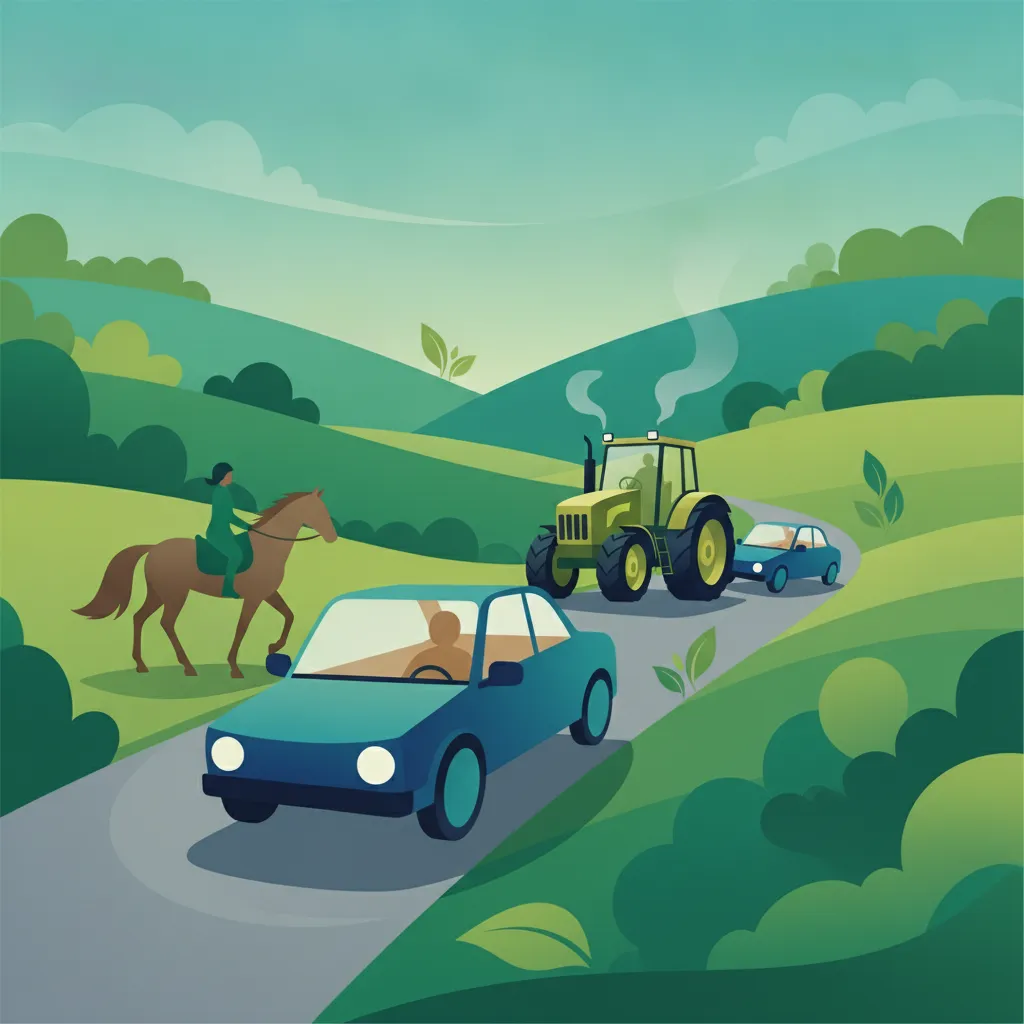
This lesson prepares you for the specific challenges of driving in the countryside. It explains the correct procedure for overtaking horse riders: slow down and pass wide, ensuring you do not spook the animal. You will also learn how to anticipate and safely manage encounters with slow-moving tractors and other farm machinery.
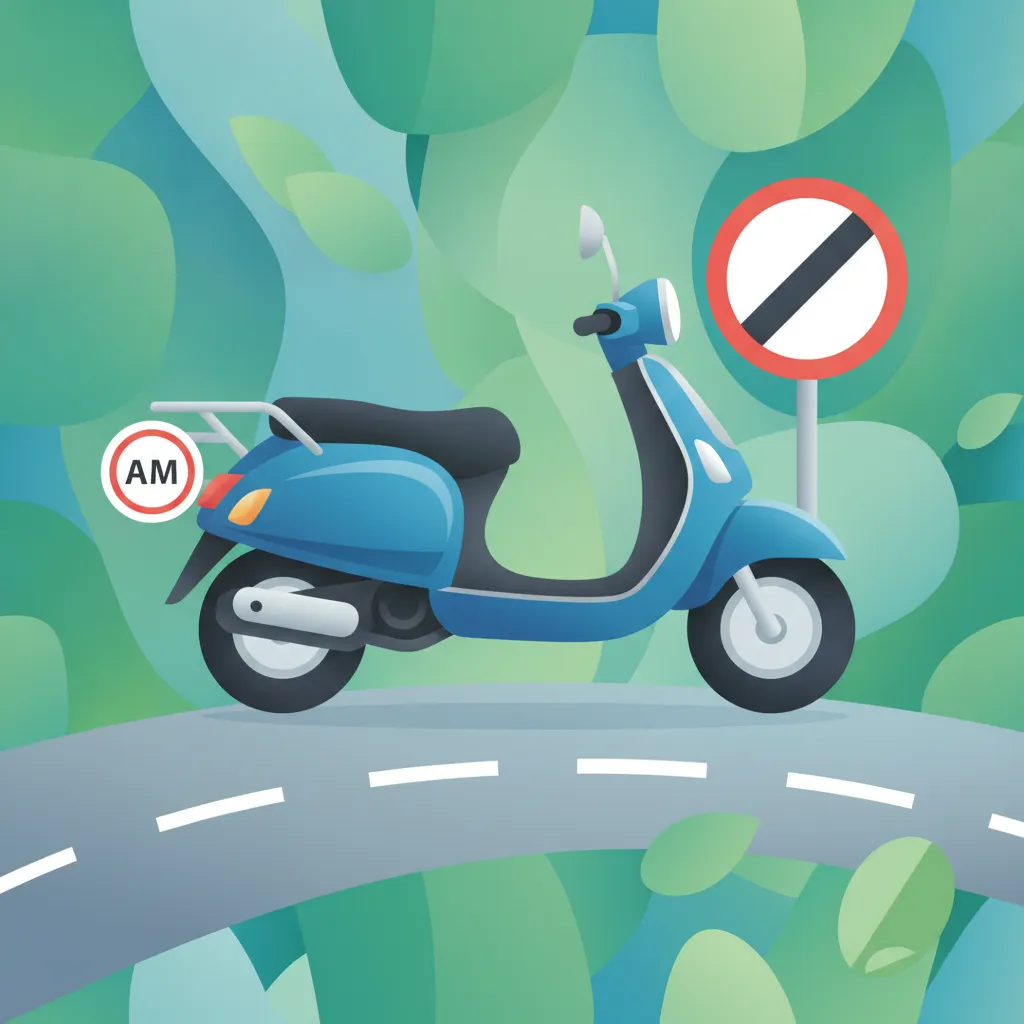
This lesson clarifies the specific speed limits that apply to Category AM vehicles on various British roads, from 30 mph zones in built-up areas to national speed limits on single and dual carriageways. It emphasizes that the posted limit is a maximum, not a target, and teaches you how to choose an appropriate speed based on factors like weather, traffic, and road layout. Understanding these rules is vital for both legal compliance and personal safety.
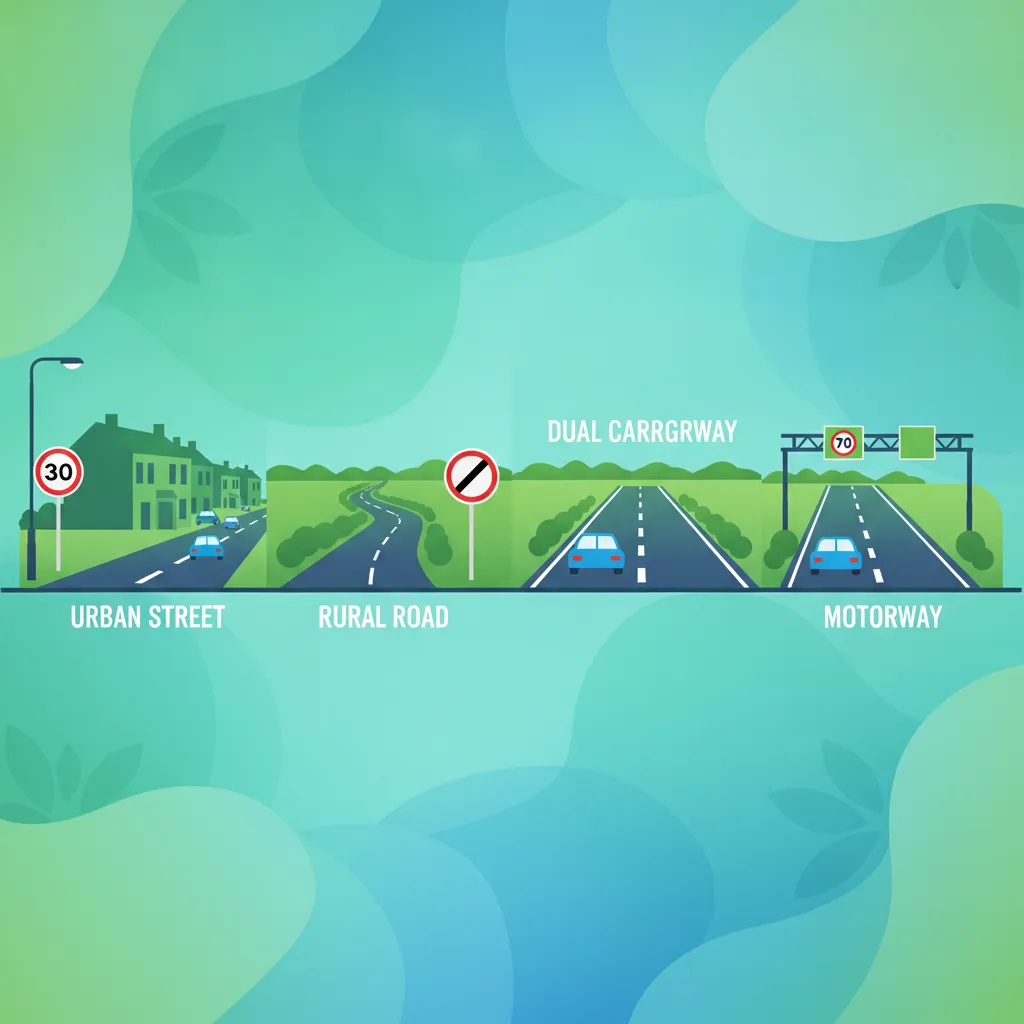
This lesson details the default speed limits for cars in Great Britain. You will learn the 30 mph limit for built-up areas, 60 mph on single carriageways, and 70 mph on dual carriageways and motorways. It also covers how to identify these roads and the importance of looking for signs indicating a different limit is in force.
Explore detailed strategies for anticipating and managing specific rural road hazards for Category C drivers. Learn how to safely navigate challenging conditions, including agricultural traffic, wildlife, and narrow lanes, to enhance your driving theory knowledge for UK roads.
This lesson prepares you for the specific challenges of driving in the countryside. It explains the correct procedure for overtaking horse riders: slow down and pass wide, ensuring you do not spook the animal. You will also learn how to anticipate and safely manage encounters with slow-moving tractors and other farm machinery.
This lesson addresses the unique challenges of driving a large vehicle on rural roads. It provides techniques for positioning the vehicle through sharp bends and on narrow lanes, and for safely navigating unmarked or uncontrolled junctions. Learners will be taught to anticipate hidden hazards common in the countryside, such as slow-moving farm vehicles, animals on the road, and concealed entrances. The correct use of passing places and strategies for meeting oncoming traffic are also covered.
This lesson prepares you for the challenges of countryside driving. It emphasizes that the national speed limit on these roads is often too fast for the conditions. You will learn how to approach sharp bends, use passing places on single-track roads, and anticipate hazards like slow-moving tractors, horse riders, or mud on the road surface.

This lesson contrasts the challenges of different road types. It covers how to handle the hidden bends, poor surfaces, and unexpected hazards of rural roads. It then details the specific procedures for using dual carriageways and motorways, including using slip roads, adhering to strict lane discipline, and safely overtaking at high speeds.

This lesson addresses the unique challenges of operating a large goods vehicle in congested urban and city environments. It focuses on techniques for navigating narrow streets, making tight turns, and safely accessing delivery points while being highly aware of vulnerable road users like pedestrians and cyclists. The importance of exceptional observation, low-speed control, and clear communication with other road users is heavily emphasized to minimize risk in these complex settings.
This lesson focuses on the specific rules and best practices for driving HGVs on motorways in Great Britain. It covers mandatory speed limits for goods vehicles, lane discipline including restrictions on using the outside lane, and procedures for safely joining and leaving the motorway. The lesson also includes up-to-date information on driving on smart motorways, including understanding the signs and using emergency refuge areas correctly.

This lesson equips drivers with strategies for maintaining control of a heavy vehicle during adverse weather conditions like heavy rain, ice, snow, and strong crosswinds. It covers the physics of traction loss, aquaplaning, and skidding, and explains how to use smooth inputs for steering, acceleration, and braking. The function of electronic stability control systems and other driver aids is also discussed as part of a proactive approach to safety in challenging environments.

This lesson explains how to adapt your driving around different vehicles. You will learn to look out for motorcyclists, who are often hard to see, especially at junctions. It also covers the challenges of sharing the road with large vehicles, such as their extended blind spots, wider turning circles, and the wind turbulence they can create.
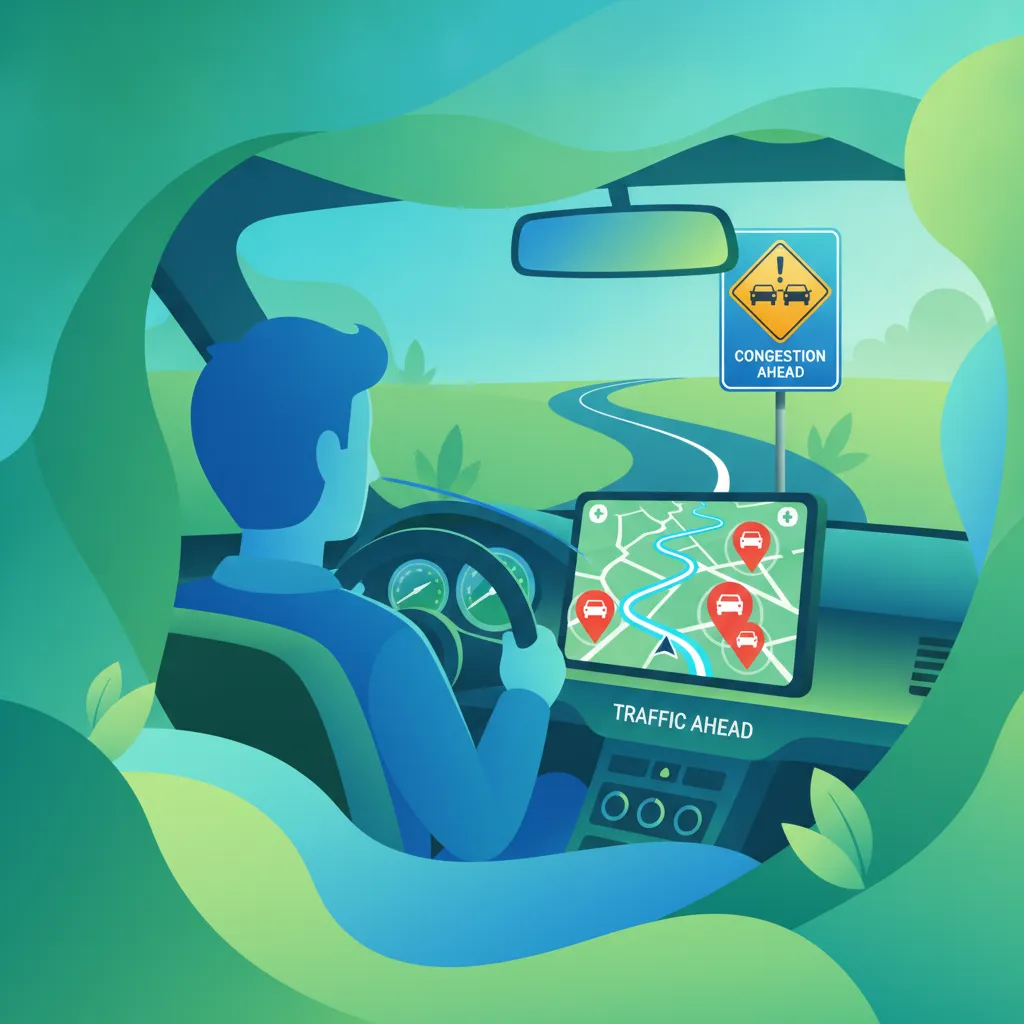
This lesson explores the effective use of modern digital navigation tools, including GPS systems and mobile apps tailored for HGVs. It explains how to leverage real-time traffic data, congestion alerts, and dynamic re-routing to adapt to changing road conditions. Importantly, it also emphasizes the need to use this technology safely, cross-referencing information with road signs and maintaining situational awareness to avoid distractions while driving.

This lesson provides guidance on how to safely and compliantly navigate through roadworks, which are a common feature of the road network. It covers the interpretation of temporary signs, strict adherence to reduced speed limits, and how to maneuver through narrow lanes and contraflow systems. The paramount importance of protecting road workers by driving with extra care and attention is a central theme of this lesson.
Find clear answers to common questions learners have about Rural Road Challenges and Speed Limits. Learn how the lesson is structured, which driving theory objectives it supports, and how it fits into the overall learning path of units and curriculum progression in Great Britain. These explanations help you understand key concepts, lesson flow, and exam focused study goals.
Category C vehicles have significant mass and momentum, which dramatically increase stopping distances. Lower speed limits are set to allow drivers sufficient time to react to hazards, such as narrow bends or blind summits, that are common on rural routes.
Slow down early and assess the road width before attempting to pass. If the lane is too narrow, wait for a passing place or a straight section with clear visibility, and always ensure you have enough space to clear the agricultural machinery safely without clipping verges.
Yes, look for mud or debris on the road from farm entrances, livestock on or near the road, narrow bridges, overhanging trees, and sharp, hidden bends. Always adjust your positioning for oncoming traffic that may also be taking a wide line.
Look for road signs indicating weight or width restrictions at the entrance to the road. If in doubt, use your digital navigation aids specifically configured for your vehicle's height and weight, and be prepared to take an alternative route if the signage indicates limited access.
Dive into our comprehensive question bank to find exactly what you need for your Great Britain theory test. Use our advanced filters to pinpoint specific subjects or test your knowledge on challenging areas, ensuring you're fully prepared for success.