
As a motorcyclist, you are significantly more vulnerable to road surface defects than car drivers. This lesson explores how to identify hazards like potholes, gravel patches, and slippery diesel spills to keep your ride stable and safe. It builds on your foundational knowledge of vehicle control, preparing you for both the hazard perception and multiple-choice sections of your motorcycle theory test.
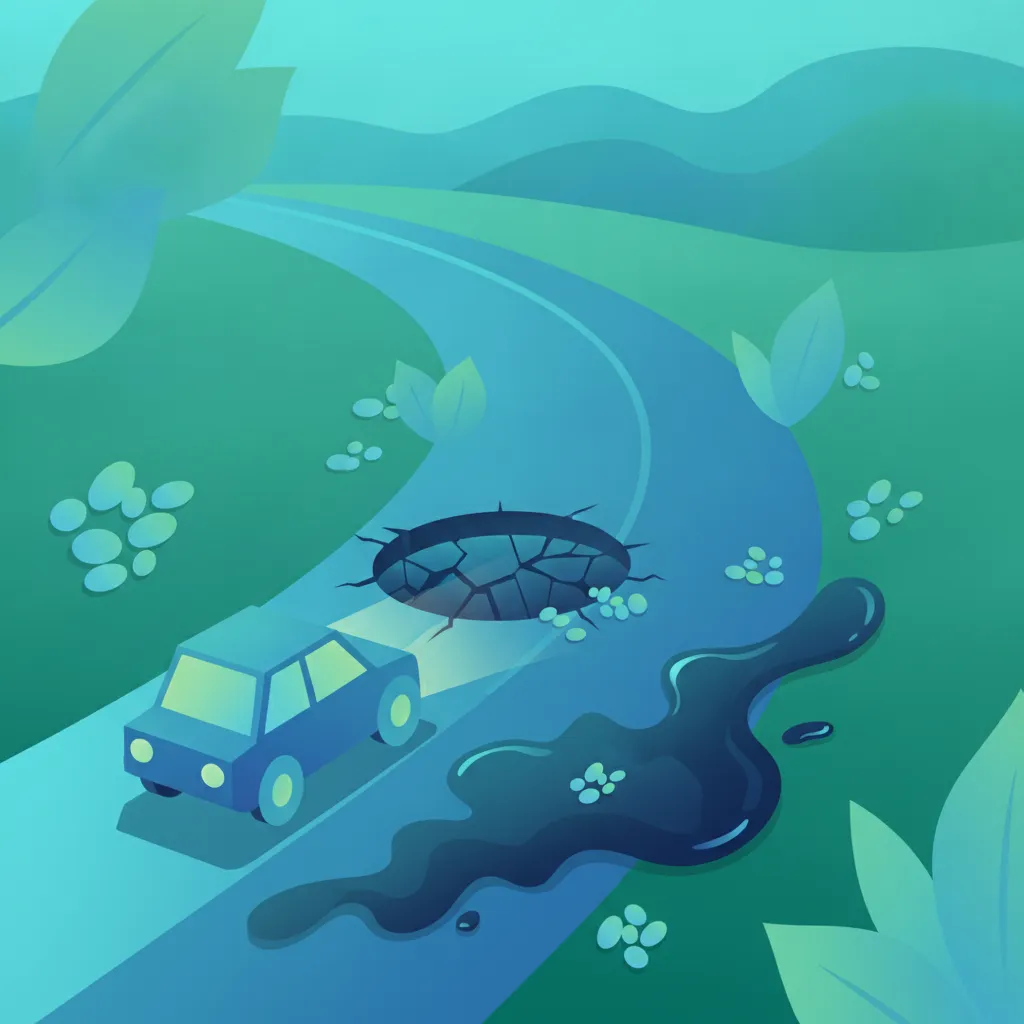
Lesson content overview
Motorcyclists experience a unique vulnerability to imperfections and inconsistencies in the road surface. Unlike four-wheeled vehicles, motorcycles rely heavily on a smaller contact patch between tyres and the road, making them highly susceptible to changes in friction or abrupt deflections. This lesson, part of the Great Britain Motorcycle Theory Course (A, A1, A2), will equip you with the essential knowledge and techniques to identify, assess, and safely navigate common road surface hazards: potholes, loose gravel, and slippery oil or diesel spills.
Understanding these hazards and how to react to them is not only crucial for your safety but also a key requirement for satisfying DVSA expectations in the motorcycle theory test. By mastering effective scanning, speed adjustment, and precise motorcycle control, you can significantly reduce the risks associated with these challenges.
Road surface hazards are unexpected variations in the road's texture or composition that directly impact the interaction between your tyres and the road. These variations can drastically reduce tyre grip or cause sudden movements, leading to a loss of control. For motorcyclists, the consequences of such events can range from a minor wobble to a severe accident, highlighting the importance of proactive hazard perception and mitigation.
The underlying physics reveals why these hazards are so dangerous. Potholes cause an abrupt change in the tyre's contact patch and steering geometry, potentially leading to a loss of steering control or even tyre damage. Loose gravel significantly reduces the coefficient of friction, making it easier for tyres to slide. Oil, and especially diesel, creates a lubricating film that dramatically lowers friction, turning even a slight steering input or braking attempt into a high-risk manoeuvre.
Unlike static obstacles like signs or parked cars, surface hazards are often subtle, varying in visibility based on light, weather, and angle. This requires a distinct scanning technique focused on texture, colour changes, and reflections rather than just objects. The DVSA mandates that riders must demonstrate an ability to continuously investigate the road surface ahead and take appropriate mitigating action to maintain control and adapt to changing conditions.
This understanding builds upon previous lessons regarding tyre grip, braking, cornering, and motorcycle dynamics. It also connects directly to principles of lane positioning, blind spot management, and space management, as selecting the safest path often involves strategic lane positioning. Ultimately, mastering surface hazard management forms a practical and critical component of your overall hazard perception skills, essential for both your theory test and real-world riding safety.
Remember that your motorcycle's small contact patch makes it inherently less stable than a car on compromised surfaces. Always assume less grip than you expect.
Effective management of road surface hazards hinges on a set of core principles that guide your behaviour and decision-making. These principles work in conjunction to provide a systematic approach to anticipating and reacting to unexpected road conditions.
Definition: Advance scanning involves systematically inspecting the road surface several seconds ahead of your current position. This technique requires continuous visual movement, focusing on subtle changes in texture, colour, water sheen, and reflections that might indicate a hazard.
Purpose: Early detection is paramount. It provides you with sufficient time to process the hazard, assess the risks, and plan a smooth, controlled corrective action before your tyres reach the danger zone. Without early detection, your reactions will be sudden and potentially unsafe.
Implications: Riders must train their eyes to constantly move, utilizing both central and peripheral vision to monitor the entire lane width and beyond. Be particularly alert to areas where hazards frequently occur, such as junctions, drainage grates, and areas prone to heavy vehicle traffic.
Definition: This principle mandates modifying your riding speed in direct response to the available tyre grip and the visibility of potential hazards.
Purpose: Reducing speed lowers your kinetic energy, which in turn reduces the distance required to stop or change direction. This provides a crucial margin for error and more time to react safely to unforeseen surface changes.
Implications: On wet, icy, gravelly, or oily surfaces, your speed must be reduced proportionally to the anticipated decrease in friction. This might mean riding significantly slower than the posted speed limit to maintain full control.
Definition: Choosing a lane position that maximises your distance from potential hazards while remaining compliant with traffic laws and road markings.
Purpose: Many surface hazards accumulate near kerbs, lane edges, or centre lines. By strategically positioning your motorcycle, you can minimise your exposure to these higher-risk areas, giving yourself more space and time to react.
Implications: Where safe and permissible, riding centrally in your lane often provides the best buffer from hazards that frequently collect at the sides. This also offers more space for emergency manoeuvres if needed.
Definition: Applying brakes in a progressive, modulated manner to avoid wheel lock-up or an uncontrolled rear-wheel slide, especially on surfaces with reduced grip.
Purpose: Prevents loss of traction during deceleration. Abrupt braking on a low-friction surface can easily cause a wheel to lock, leading to a skid and loss of control, which is significantly harder to recover from on a motorcycle.
Implications: On surfaces like oil or gravel, prefer initiating braking with the front brake, applying progressive pressure, and modulating the rear brake gently to prevent locking. Avoid sharp, sudden braking inputs.
Definition: A systematic evaluation process to determine whether it is safer to steer around a surface hazard or to pass directly through it with appropriate technique, considering factors like available space, speed, and surrounding traffic.
Purpose: Provides a logical method for making rapid, safety-critical decisions under pressure. Sometimes, avoiding a hazard might put you at greater risk of colliding with other road users, making a controlled crossing the safer option.
Implications: If there's sufficient clear space to safely steer around a hazard without endangering yourself or others, avoidance is generally preferred. However, if space is limited or traffic is dense, riding straight through with controlled inputs may be the safer alternative.
Each type of road surface hazard presents its own unique challenges and requires specific handling techniques. Understanding the characteristics of potholes, loose gravel, and oil spills is fundamental to managing them effectively.
Definition: Potholes are depressions or cavities in the road surface. They are typically caused by factors such as fatigue cracking of the asphalt, water infiltrating cracks and freezing (then thawing), or inadequate repairs over time. They are characterised by distinct, often sharp edges and abrupt changes in depth.
Types of Potholes:
Practical Meaning: Potholes often appear as darker, uneven patches on the road. They are frequently found in areas of heavy traffic, near junctions, around drainage grates, or on roads that experience significant temperature fluctuations. During wet weather, water can conceal their true depth, making them even more dangerous.
A common mistake is assuming your motorcycle's suspension will "absorb" a pothole at high speed. This can lead to serious damage or loss of control.
Safe Handling Techniques for Potholes:
Example Scenario: You are riding on a dual carriageway at 80 km/h and spot a large, dark depression in your lane about 20 metres ahead. You quickly assess that changing lanes safely is not possible due to surrounding traffic. The correct response is to smoothly reduce your speed to around 60 km/h before reaching the pothole, maintain a firm grip on the handlebars, keep your motorcycle upright and in a straight line, and roll straight over it.
Definition: Loose gravel refers to small, unbonded stones or aggregates present on the road surface. These can range from fine dust-like particles to larger pebbles. When a tyre contacts gravel, it can easily displace the stones, significantly reducing the coefficient of friction and causing a loss of grip.
Types of Loose Gravel:
Practical Meaning: Loose gravel often appears as a lighter, sometimes glittery or sparkling surface, especially in sunlight. It is common near construction zones (often indicated by "Roadworks" signage), on rural lanes after heavy rain has washed debris onto the road, or on unpaved sections leading to paved roads. It's particularly treacherous in corners.
Safe Handling Techniques for Loose Gravel:
Example Scenario: You are exiting a long bend on a rural road and notice a patch of fine gravel covering your lane from a recent roadworks project. You have enough time to react. The correct action is to gently close the throttle and reduce speed before reaching the gravel. Once on the gravel, maintain a steady, modest speed, keep the motorcycle upright, and steer gently in a straight line until you are clear of the hazard.
Definition: Oil or diesel spills are thin films of lubricating oil, diesel fuel, or other petroleum products on the road surface. These form an extremely slick layer that dramatically reduces the tyre-road friction, making them one of the most hazardous surface conditions for motorcyclists.
Types of Oil/Diesel Spills:
Practical Meaning: Oil and diesel spills are best recognised by a distinctive rainbow-like sheen on the road surface, especially under sunlight or streetlights. At night, they can appear as dark, glossy patches that reflect light differently. They are often found on the centreline (from dripping sumps), near kerbs (where spills accumulate), or in the path of heavy vehicle movements.
Associated Risks: The primary risk is a sudden and complete loss of tyre traction. Even a slight lean or braking input on an oil patch can cause the motorcycle to slide out from underneath the rider.
Safe Handling Techniques for Oil/Diesel Spills:
Example Scenario: You are riding through a city centre on a sunny afternoon and notice a prominent rainbow-like patch on the road just beyond a set of traffic lights, clearly indicating an oil spill. You have limited space to manoeuvre. The correct response is to gently reduce your speed before reaching the spill. As you cross it, keep your motorcycle in a straight line, avoid braking, and maintain a relaxed, upright posture until your tyres are on clear pavement again.
In wet conditions, oil and diesel become even more insidious, often spreading and being harder to distinguish from regular wet road surfaces. Always exercise extreme caution on wet roads where spills are likely.
Effective scanning is your first line of defence against road surface hazards. It's an active, continuous process that involves more than just looking at the vehicle in front of you.
Avoid fixating on a single point (tunnel vision). Your eyes should constantly be moving, scanning from side to side, checking mirrors, and alternating between long-range and short-range views. Use your peripheral vision to monitor the entire width of your lane and adjacent areas for hazards that might be subtle or partially obscured.
When you detect a road surface hazard, you have a critical decision to make: can you safely avoid it, or must you cross it? This decision-making process should be quick and logical.
If you can safely steer around a hazard without endangering yourself or other road users, this is generally the preferred option.
Step-by-Step Avoidance:
If safely avoiding the hazard is not feasible due to limited space, traffic, or the nature of the hazard, then a controlled crossing is the next safest option.
Step-by-Step Crossing:
Always remember: the risk of a collision with another road user when swerving might be greater than the risk of traversing the hazard with proper technique. Prioritise overall safety.
The DVSA (Driver and Vehicle Standards Agency) guidelines and the Highway Code emphasise that riders must adapt their riding to current road conditions, including surface integrity. While specific laws might not detail "how to cross a pothole," the overarching legal framework mandates safe and responsible riding.
Statement: Riders must reduce their speed when the road surface condition reduces tyre grip. This applies to hazards like potholes, gravel, oil spills, and also wet or icy roads.
Legal Status: This is mandatory practice under DVSA guidance and a core component of "driving/riding with due care and attention," which has legal backing. Failure to comply could lead to charges of careless or dangerous riding.
Rationale: Reducing speed minimises the forces involved in braking and steering, increasing reaction time and reducing the severity of any loss of control.
Statement: Riders are obligated to continuously scan the road surface ahead to identify potential hazards.
Legal Status: Considered part of "reasonable care" and "due diligence" expected of all road users. A failure to scan adequately, leading to an incident, could be seen as negligence.
Rationale: Early detection is fundamental to preventing incidents. Without effective scanning, reaction times are diminished, making safe navigation impossible.
Statement: When braking is required on low-friction surfaces (e.g., oil, gravel, wet patches), riders should apply brakes smoothly and progressively. Priority should be given to the front brake, with careful modulation of the rear brake to prevent wheel lock. Sudden or harsh rear-wheel braking is prohibited.
Legal Status: Mandatory practice under DVSA guidance for safe motorcycle control.
Rationale: The front brake provides the majority of a motorcycle's stopping power. Using it correctly on slippery surfaces is safer than relying solely on the rear brake, which is more prone to locking and causing a skid.
Statement: Riders should position their motorcycle centrally within the lane when safe and permissible. This maximises distance from kerbside hazards and provides a buffer zone.
Legal Status: A recommended best practice for safe riding. While not always legally binding to stay central, unsafe positioning that contributes to an incident can be criticised.
Rationale: Many surface hazards, such as drainage grates, debris, or accumulating oil/gravel, are found closer to the edges of the road. A central position helps avoid these and provides more space for emergency manoeuvres.
Statement: If a road surface hazard can be safely avoided without endangering other road users or violating traffic laws, the rider must take the avoidance manoeuvre.
Legal Status: Mandatory. Failure to take reasonable steps to avoid a clearly avoidable hazard, leading to an incident, can be considered reckless or dangerous riding.
Rationale: Prevention is always better than mitigation. If a hazard can be bypassed with minimal risk, it should be.
Understanding common errors can help you actively avoid them and develop safer riding habits.
| Violation | Why Wrong | Correct Behaviour | Consequence |
|---|---|---|---|
| Abrupt braking while crossing a pothole | Causes wheel lock or severe tyre deflection due to reduced contact patch and dynamic load changes. | Reduce speed gently before the pothole. Maintain steady, light braking if absolutely necessary and only before entering the hazard. | Potential crash, severe tyre/rim damage, loss of control, penalty points. |
| Accelerating through loose gravel | Decreases stability and traction, making the rear wheel more likely to spin and slide out. | Maintain a steady, moderate speed. Keep steering inputs smooth and minimal. Avoid sudden throttle changes until clear. | Sliding, potential high-side crash, injury. |
| Swerve sharply around an oil spill | Can cause loss of control due to excessive lean angle or lead to a collision with other traffic, as other road users may not anticipate such a sudden manoeuvre. | Reduce speed significantly. If unavoidable, cross the spill in a straight line with minimal lean, applying the front brake gently before entry if needed. | Rear-end collision, side impact, high-speed slide, serious injury. |
| Ignoring oil spill glare at night | Headlight reflections on oil can blind the rider or mask the true extent of the hazard, leading to an unexpected loss of grip. | Actively scan for unusual reflections. Adjust headlight beam (often to dipped) when approaching potential oil hazards. Reduce speed significantly. | Unexpected slide, crash in low visibility. |
| Riding too close to the kerb where potholes accumulate | Reduces reaction time to hazards that frequently appear at road edges. Increases exposure to debris, drain covers, and poor drainage that exacerbates potholes. | Maintain a central lane position when possible. Scan frequently ahead for edge hazards. Increase following distance to provide more space. | Tyre puncture, damaged suspension, upset steering, forced into traffic. |
| Braking with rear brake alone on gravel | The rear wheel locks easily on gravel, causing a skid and loss of stability. | Apply the front brake first with progressive pressure. Use the rear brake very lightly and with careful modulation, or avoid it entirely on loose surfaces. | Rear-wheel skid, loss of control, potential crash. |
| Crossing an oil spill while overtaking another vehicle | Severely limits visibility for the overtaking rider and exposes them to high slip risk at potentially higher speeds, with limited escape routes. | Wait until the lane is clear of both the hazard and other vehicles. Adjust speed appropriately and cross when absolutely safe. | High-speed slide, multiple-vehicle collision, severe injury. |
| Failing to scan when approaching a construction site | New roadworks frequently leave loose gravel, sand, or uneven surfaces. Neglecting to scan means missing these fresh hazards. | Increase scanning frequency and range when approaching construction zones. Anticipate surface changes and reduce speed proactively. | Unexpected loss of grip, accident. |
| Staying in the same lane when a clear lane is available to avoid a hazard | Neglects the primary principle of hazard avoidance, increasing risk unnecessarily. | Change lane if safe, legal, and clearly beneficial. Use appropriate signalling, mirror checks, and blind spot checks. | Forced to cross a high-risk hazard, potential collision if misjudged. |
| Using high-beamed headlights directly facing an oil spill at night | The intense reflection can create excessive glare, blinding the rider and making the oil spill even harder to gauge or see clearly. | Dim to dipped beam when approaching suspected oil hazards at night to reduce glare and improve contrast. | Reduced ability to spot the hazard, temporary blindness, accident. |
Your approach to road surface hazards must adapt to various environmental and vehicle conditions.
When making a decision to avoid a surface hazard, always ensure your manoeuvre does not endanger nearby cyclists, pedestrians, or other vulnerable road users. Your chosen trajectory should provide maximum safety for everyone. Sometimes, carefully crossing a hazard is safer than a risky swerve that could lead to a collision with another person.
A deeper understanding of the principles behind safe riding on varied surfaces can enhance your decision-making and awareness.
Successfully navigating road surface hazards on a motorcycle requires a combination of proactive scanning, measured control inputs, and informed decision-making.
Road surface hazards—potholes, loose gravel, and oil or diesel spills—pose significant risks to motorcyclists because of their reduced contact patch compared to four-wheeled vehicles. Safe navigation requires proactive scanning for visual cues like colour changes, texture variations, and reflections, combined with speed reduction before reaching hazards and maintaining a stable trajectory through them. Each hazard type demands specific techniques: potholes require pre-impact braking and straight-line crossing, gravel demands upright posture and steady throttle, and oil spills demand minimal inputs and no braking within the spill. The DVSA mandates that riders continuously scan ahead, adjust speed to conditions, and make rational avoid-or-cross decisions based on available space and traffic safety.
A short set of high-value points that capture the most important learning from this lesson.
Motorcycles are uniquely vulnerable to surface hazards because their small tyre contact patch makes grip highly sensitive to road texture changes.
Early detection through continuous scanning for colour changes, texture variations, and reflections is essential for identifying hazards in time.
Speed must always be reduced before reaching a surface hazard—hitting hazards at speed dramatically increases impact forces and loss of control risk.
The avoid-or-cross decision depends on available space, surrounding traffic, and overall safety—risky swerving may be more dangerous than controlled crossing.
Explore all units and lessons included in this driving theory course.
Potholes require speed reduction before impact, a straight line approach, and no braking while actually in the pothole to avoid wheel lock or violent deflection.
Loose gravel demands maintaining an upright motorcycle posture, steady moderate speed, and avoiding hard braking or acceleration to prevent rear-wheel slide.
Oil and diesel spills require significant speed reduction beforehand, traversing in a straight line, and avoiding any braking or steering inputs once within the spill.
Central lane positioning helps avoid hazards that accumulate at kerbs and edges, giving more reaction space for emergency manoeuvres.
Scanning must be both long-range (10-15 seconds ahead) and short-range (2-4 seconds ahead) to detect subtle surface changes early.
Braking while already in a pothole causes wheel lock or severe tyre deflection due to reduced contact patch under dynamic load changes.
Accelerating through loose gravel decreases rear-wheel traction and makes the motorcycle more likely to slide out sideways.
Making sharp steering corrections on oil spills causes immediate loss of traction and high-side crashes, especially at lean angles.
Riding too close to the kerb where potholes and debris accumulate reduces reaction time and exposure to road edge hazards.
Using only the rear brake on gravel easily locks the rear wheel, causing a skid and loss of stability.
Lesson content overview
A short set of high-value points that capture the most important learning from this lesson.
Motorcycles are uniquely vulnerable to surface hazards because their small tyre contact patch makes grip highly sensitive to road texture changes.
Early detection through continuous scanning for colour changes, texture variations, and reflections is essential for identifying hazards in time.
Speed must always be reduced before reaching a surface hazard—hitting hazards at speed dramatically increases impact forces and loss of control risk.
The avoid-or-cross decision depends on available space, surrounding traffic, and overall safety—risky swerving may be more dangerous than controlled crossing.
Explore all units and lessons included in this driving theory course.
Potholes require speed reduction before impact, a straight line approach, and no braking while actually in the pothole to avoid wheel lock or violent deflection.
Loose gravel demands maintaining an upright motorcycle posture, steady moderate speed, and avoiding hard braking or acceleration to prevent rear-wheel slide.
Oil and diesel spills require significant speed reduction beforehand, traversing in a straight line, and avoiding any braking or steering inputs once within the spill.
Central lane positioning helps avoid hazards that accumulate at kerbs and edges, giving more reaction space for emergency manoeuvres.
Scanning must be both long-range (10-15 seconds ahead) and short-range (2-4 seconds ahead) to detect subtle surface changes early.
Braking while already in a pothole causes wheel lock or severe tyre deflection due to reduced contact patch under dynamic load changes.
Accelerating through loose gravel decreases rear-wheel traction and makes the motorcycle more likely to slide out sideways.
Making sharp steering corrections on oil spills causes immediate loss of traction and high-side crashes, especially at lean angles.
Riding too close to the kerb where potholes and debris accumulate reduces reaction time and exposure to road edge hazards.
Using only the rear brake on gravel easily locks the rear wheel, causing a skid and loss of stability.
Explore search topics learners often look for when studying Road Surface Hazards: Potholes, Gravel, and Oil Spills. These topics reflect common questions about road rules, driving situations, safety guidance, and lesson level theory preparation for learners in Great Britain.
Browse additional driving theory lessons that cover connected traffic rules, road signs, and common driving situations related to this topic. Improve your understanding of how different rules interact across everyday traffic scenarios.
Deepen your understanding of distinct road surface hazards like potholes, gravel patches, and oil spills. Learn the specific physics and techniques required to safely navigate each type, critical for Great Britain motorcycle theory.
This lesson explains the function of warning signs, which are mostly triangular and alert road users to potential dangers ahead. You will learn to identify signs for bends, junctions, slippery surfaces, and other hazards particularly relevant to motorcyclists. Acting on these warnings allows a rider to adjust speed and position proactively, enhancing safety.

This lesson highlights why motorcyclists are considered vulnerable road users. It covers the increased risk of serious injury in a collision due to lack of physical protection compared to car occupants. You will learn about common visibility challenges and how to adopt proactive, defensive strategies to mitigate risks and anticipate potential hazards on the road.
This lesson focuses on the unique risks faced by motorcyclists and scooter riders when sharing the road with HGVs. It explains how their small size and rapid acceleration can make them difficult to see, especially when they are filtering through traffic. Drivers will learn the importance of making extra mirror checks—'look twice'—before any maneuver and giving motorcyclists extra space, as they can be more affected by wind buffeting and road surface imperfections.

Your safety depends on the small contact patch where your tyres meet the road. This lesson explains how grip (or traction) is affected by the type and condition of the road surface, as well as your tyre's condition and pressure. You will learn to recognise high-risk surfaces and adjust your riding to avoid losing traction.

This lesson focuses on the dynamic and often unpredictable nature of urban traffic. It covers how to safely negotiate various pedestrian crossings, anticipate the movement of cyclists and pedestrians, and be aware of hazards like bus stops and car doors opening. You will also learn about the considerations for safe and legal filtering in slow-moving traffic.

This lesson explores the crucial concept of tyre grip and how it is affected by various road surfaces and conditions. You will learn to identify potential hazards that reduce traction, such as wet leaves, manhole covers, oil spills, and loose gravel. The content provides strategies for adjusting your riding style, including speed and lean angle, to safely navigate these surfaces and prevent a loss of control.

This lesson decodes the language of road markings painted on the road surface. You will learn the rules associated with solid and broken white lines, double white lines that restrict overtaking, and yellow lines controlling parking. Proper understanding of these markings is crucial for maintaining correct lane discipline and riding legally.

Riding in the rain requires significant adjustments to your technique. This lesson covers how to ride smoothly to maintain traction, the importance of increasing your following distance, and how to deal with reduced visibility from spray and fogged visors. You will also learn what aquaplaning is and how to avoid or manage it.
This lesson explains the regulations for special road zones common in urban areas. You will learn about speed restrictions near schools, how to read signs indicating if and when motorcycles can use bus lanes, and how to safely interact with cyclist infrastructure such as advanced stop lines. Compliance with these specific rules is crucial for legal and safe urban riding.

This lesson teaches strategic road positioning techniques to maximize your visibility and safety in traffic. You will learn how to choose the correct lane position to avoid the blind spots of larger vehicles and how to communicate your intentions through predictable riding. Key skills covered include effective use of shoulder checks, making eye contact with drivers, and maintaining a safe following distance, all of which are crucial for defensive riding on British roads.
Explore essential strategies for managing road surface hazards. This lesson covers advanced scanning, speed adjustment, controlled braking, and decision-making for when to avoid or cross hazards, crucial for UK motorcycle theory.
This lesson explains the function of warning signs, which are mostly triangular and alert road users to potential dangers ahead. You will learn to identify signs for bends, junctions, slippery surfaces, and other hazards particularly relevant to motorcyclists. Acting on these warnings allows a rider to adjust speed and position proactively, enhancing safety.

Defensive riding is the practice of actively anticipating potential hazards rather than just reacting to them. This lesson teaches you how to scan for clues, predict the actions of other road users, and position yourself to avoid trouble. By developing strong anticipation skills, you can significantly reduce your risk of being taken by surprise on the road.
Your safety depends on the small contact patch where your tyres meet the road. This lesson explains how grip (or traction) is affected by the type and condition of the road surface, as well as your tyre's condition and pressure. You will learn to recognise high-risk surfaces and adjust your riding to avoid losing traction.
This lesson teaches strategic road positioning techniques to maximize your visibility and safety in traffic. You will learn how to choose the correct lane position to avoid the blind spots of larger vehicles and how to communicate your intentions through predictable riding. Key skills covered include effective use of shoulder checks, making eye contact with drivers, and maintaining a safe following distance, all of which are crucial for defensive riding on British roads.
This lesson highlights why motorcyclists are considered vulnerable road users. It covers the increased risk of serious injury in a collision due to lack of physical protection compared to car occupants. You will learn about common visibility challenges and how to adopt proactive, defensive strategies to mitigate risks and anticipate potential hazards on the road.

A key aspect of motorcycle safety is being seen by others. This lesson teaches techniques to increase your conspicuity on the road. Topics include the strategic use of high-visibility and reflective clothing, correct use of headlights and daytime running lights, and adopting lane positions that place you in the direct line of sight of other drivers.
This lesson focuses on the dynamic and often unpredictable nature of urban traffic. It covers how to safely negotiate various pedestrian crossings, anticipate the movement of cyclists and pedestrians, and be aware of hazards like bus stops and car doors opening. You will also learn about the considerations for safe and legal filtering in slow-moving traffic.
This lesson explores the crucial concept of tyre grip and how it is affected by various road surfaces and conditions. You will learn to identify potential hazards that reduce traction, such as wet leaves, manhole covers, oil spills, and loose gravel. The content provides strategies for adjusting your riding style, including speed and lean angle, to safely navigate these surfaces and prevent a loss of control.

This lesson identifies behaviours that significantly increase a rider's risk of being involved in a collision. It explains the dangers of excessive speed, following too closely, and aggressive riding. You will learn how a rider's attitude and choices directly contribute to their safety and the legal penalties associated with these offences.
This lesson focuses on developing advanced hazard perception skills and using them to manage your speed proactively. You will learn to constantly scan the road for potential dangers, anticipate the actions of other road users, and adjust your speed to give yourself more time to react. This defensive approach to speed management is fundamental to staying safe and avoiding emergency situations while riding in complex traffic environments.
Find clear answers to common questions learners have about Road Surface Hazards: Potholes, Gravel, and Oil Spills. Learn how the lesson is structured, which driving theory objectives it supports, and how it fits into the overall learning path of units and curriculum progression in Great Britain. These explanations help you understand key concepts, lesson flow, and exam focused study goals.
Diesel and oil reduce the tyre's grip significantly, often making the road surface as slippery as ice. Because motorcycles rely on two wheels for balance, even a small amount of liquid on a corner or at a junction can lead to an instant loss of traction and a fall.
If you cannot avoid it, stay upright, keep a steady throttle, and avoid sudden braking or steering inputs. Crossing at a 90-degree angle if possible helps, but maintaining a constant speed is the priority to keep the bike stable until you reach firmer ground.
You will likely see questions asking how to react to road surface warning signs or how to adjust your speed and lane position when approaching hazardous conditions. It is also a key element of the hazard perception test, where you must identify developing hazards early.
ABS helps prevent wheel lock-up during braking, but it does not make a motorcycle immune to the instability caused by hitting a pothole. Avoiding the pothole entirely remains the safest action; hitting one while braking or turning can cause the bike to lose composure.
Dive into our comprehensive question bank to find exactly what you need for your Great Britain theory test. Use our advanced filters to pinpoint specific subjects or test your knowledge on challenging areas, ensuring you're fully prepared for success.