
This lesson explores how the significant physical presence of a Category C vehicle influences traffic movement on our road network. You will learn to mitigate the impact of your vehicle's size, ensuring you contribute to safer and more fluid traffic conditions for all road users.

Lesson content overview
Operating a Category C goods vehicle in Great Britain requires a comprehensive understanding of how your vehicle interacts with the wider road network. The sheer size and weight of Large Goods Vehicles (LGVs) significantly influence traffic dynamics, particularly in busy urban environments, on narrow roads, and at complex junctions. This lesson delves into these impacts, providing essential knowledge for professional drivers to maintain safety and efficiency on the roads.
As a professional goods vehicle driver, your actions directly affect overall traffic flow and the safety of other road users. Mastering the principles discussed here is crucial for preventing congestion, reducing accident risks, and ensuring you operate within the legal framework of the Highway Code and other relevant regulations for the Professional Goods Vehicle Theory for Great Britain - Category C Licence.
The physical dimensions of an LGV dictate how much road space it occupies, a fundamental factor in traffic flow. Road space occupancy refers to the total longitudinal length and lateral width a vehicle requires to travel safely, including any attached trailers and necessary safety margins. For large vehicles, this occupancy can be significantly greater than for cars or smaller vans.
Understanding standard versus extended occupancy is vital. While a typical lane width in the UK is around 3.65 metres, an LGV, especially one approaching 2.9 metres in width or with a long trailer exceeding 12 metres, often requires additional clearance. This means it may not be able to comfortably share a lane with other vehicles or may need to occupy an entire lane to maintain safe separation. For example, a long articulated lorry on a single carriageway with a 3.3-metre lane width effectively uses the full lane, requiring oncoming traffic to adjust.
The Highway Code addresses this under Rule 131, which advises drivers of vehicles over 2.3 metres wide to keep as far to the right as practicable within their lane and to be prepared to occupy the whole lane if insufficient space exists to share with opposing traffic. Failing to account for full road space occupancy can lead to dangerous encroachments, forcing other road users to take evasive action, or even causing traffic to stop completely.
Maneuvering clearance is the additional space an LGV driver must have to safely execute movements such as turning, changing lanes, or overtaking, taking into account the vehicle's size, turning radius, and trailer articulation. This clearance can be categorised into static clearance, needed when the vehicle is stationary (e.g., waiting at a junction), and dynamic clearance, required while the vehicle is in motion (e.g., during an overtaking manoeuvre).
Due to their substantial length and often complex articulation points, LGVs have a significantly larger turning radius than smaller vehicles. When performing a left turn at a narrow junction, the rear of an articulated trailer will swing outwards, requiring considerable space that might encroach on an adjacent lane or even the opposite carriageway. Ignoring this trailer swing radius is a common mistake that can lead to collisions or severe traffic obstruction.
The Highway Code's general guidance to "Expect the unexpected" (Rule 105) is particularly relevant here. LGV drivers must constantly assess available space and predict how their vehicle's entire clearance envelope will behave. Proper assessment prevents the vehicle from cutting corners too tightly, mounting pavements, or swinging into the path of other road users.
Safe speed management is a critical aspect of LGV operation, directly impacting traffic flow and safety. Due to their greater mass, LGVs have significantly longer stopping distances compared to cars, especially when fully loaded or in adverse conditions such as wet or icy roads. Rule 126 of the Highway Code explicitly mandates that drivers comply with speed limits and adapt their speed to road conditions, vehicle size, and load.
Maintaining a safe following distance is paramount. Sudden braking by an LGV can lead to rear-end collisions if following vehicles do not have adequate time to react. In congested traffic, maintaining a steady, appropriate speed and allowing ample space prevents abrupt deceleration, which can create accordion effects and bottlenecks. Conversely, driving at speeds too high for the conditions or load reduces reaction time and increases the risk of accidents.
Adjusting Speed for Conditions: Always reduce your speed significantly in wet, icy, or foggy conditions. A fully loaded LGV requires much more distance to stop safely, making early anticipation and gentle braking essential.
Drivers must continuously evaluate road surface conditions, visibility, and traffic density. On a steep downgrade with a heavy load, maintaining the posted speed limit might still be unsafe if it compromises the ability to stop within the visible clear distance. Proactive speed management ensures predictable movements, allowing other road users to anticipate the LGV's behaviour and maintaining smoother overall traffic flow.
The size of LGVs inherently limits their opportunities for safe overtaking. On single carriageways, particularly those with narrow lanes, an LGV may be unable or legally prohibited from overtaking slower traffic. The vast road space occupancy and maneuvering clearance required mean that safely passing another vehicle often demands an extended period in the opposing lane, which can be hazardous or impossible if oncoming traffic is present.
Rule 219 of the Highway Code outlines general overtaking rules, emphasising that it must always be undertaken safely. For LGV drivers, this often means recognising that a "partial overtake" (moving temporarily into an adjacent lane without fully passing) is rarely feasible or safe. It's crucial to assess oncoming traffic distance, visibility, and the length of time needed to complete the manoeuvre. Attempting to overtake a parked vehicle on a narrow road without sufficient clearance for both the LGV and opposing traffic can lead to dangerous lane encroachment and potential collisions.
Patience is key. If safe overtaking is not possible, it is safer and more responsible to remain behind the slower vehicle, even if it impacts journey time. Forcing an overtake not only endangers others but can also attract penalties and lead to serious accidents.
Traffic bottlenecks are points in the road network where traffic flow is restricted, often disproportionately due to a high volume or proportion of large vehicles relative to the road's capacity. LGVs can exacerbate or even create these bottlenecks because they occupy more road width and length, limit overtaking opportunities, and have slower acceleration.
Bottlenecks can be physical, such as insufficient lane width or overall road width, or operational, arising from driver behaviour like unnecessary lane changes or abrupt braking. A common scenario is a group of LGVs travelling close together at a lower speed limit (e.g., 30 mph on an urban street), forming a "platoon" that creates a long queue of smaller vehicles behind them. This effect is compounded at junctions where LGVs need more space to turn, further restricting flow for other traffic.
Be Mindful of Bottleneck Creation: Your driving choices, particularly lane selection and speed management, directly influence traffic flow. Proactive measures can prevent you from inadvertently creating congestion.
Adhering to correct lane discipline and maintaining steady speeds are essential mitigation strategies. For instance, on multi-lane roads, LGVs should generally remain in the left-hand lane unless overtaking, keeping the other lanes clear for faster traffic. This helps to distribute traffic load and prevents the formation of long queues behind large vehicles. Understanding where bottlenecks commonly form (e.g., specific junctions, narrow bridges, or uphill sections) allows for pre-emptive driving strategies.
Lane discipline for LGVs involves selecting and maintaining the most appropriate lane to provide sufficient clearance, align with road design, and comply with Highway Code guidance. It is crucial for promoting steady traffic flow and minimising turbulence caused by unnecessary lane changes or obstructions.
Rule 131 of the Highway Code for Multi-Purpose Vehicles specifies that drivers of vehicles over 2.3 metres wide must keep as far to the right as practicable within their lane and may need to occupy the whole lane if insufficient space exists to safely share it with opposing traffic. This principle is not about hugging the centre line but about positioning the vehicle optimally to manage its width and ensure safety.
On dual carriageways and motorways, LGVs must typically use the left-hand lane unless overtaking. This is vital because occupying the middle or right-hand lanes unnecessarily can block faster-moving traffic, leading to frustration and risky overtaking manoeuvres by other drivers. Proper lane discipline reduces the need for other road users to make sudden adjustments, contributing to a safer and more predictable environment for everyone.
Negotiating junctions safely is one of the most challenging aspects of LGV driving due to the vehicle's size and turning radius. Junction clearance refers to the required space for an LGV to complete a turn without encroaching on adjacent lanes, opposing traffic, or road infrastructure.
Left turns generally demand more space due to the trailer's tendency to cut the corner (known as trailer cut-in or off-tracking). The rear wheels of an articulated vehicle track a tighter path than the front wheels. This means that if you steer too early on a left turn, the trailer's rear can swing significantly wide, potentially hitting street furniture, pedestrians, or encroaching onto the opposite carriageway.
For right turns, while the turning radius is generally smaller, careful positioning is still required to ensure the entire vehicle clears the intersection without infringing on turning circles or obstructing crossing traffic. Rule 148 of the Highway Code (Right-hand turn, turning on a priority road) reinforces the need to give way to traffic on the intersecting road and ensure no obstruction is caused.
Mastering Left Turns: When making a left turn in an LGV, you often need to approach slightly wider than you would in a car to allow the trailer sufficient room to follow without cutting the corner. Always check your mirrors thoroughly to monitor the trailer's path.
At signalised intersections, particular vigilance is needed. Do not initiate a turn, especially a left turn, if the path of your trailer swing will be blocked by waiting traffic or if you cannot complete the turn without encroaching on opposing lanes. Patience and waiting for a clear path are paramount.
Operating LGVs in dense urban environments presents a unique set of challenges that significantly impact traffic flow. Narrow streets, increased pedestrian and cyclist presence, frequent junctions, and specific local restrictions all combine to create a complex driving environment. Urban delivery operations, especially during peak hours, can exacerbate congestion.
Many urban areas have restricted access zones, such as Low Emission Zones (LEZ), Ultra Low Emission Zones (ULEZ), or specific streets with width, length, or weight limits. These restrictions are often indicated by specific signage, and ignoring them can lead to significant fines and traffic disruption. For instance, entering a residential street with a "No LGVs > 2.3 m width" sign with a 2.8 m wide lorry will likely cause a blockage and legal action.
Bus lanes are another crucial consideration. Rule 131 states that vehicles over 2.3 metres wide may not use bus lanes during their operational hours unless specifically permitted. Doing so disrupts public transport flow and can lead to penalties.
Successful urban delivery requires meticulous route planning, possibly adjusting delivery windows to avoid peak traffic, and heightened awareness of vulnerable road users. LGV drivers must prioritise safety and minimise disruption in these sensitive areas.
Adherence to the Highway Code is paramount for safe and lawful LGV operation. Several rules are particularly relevant to mitigating the impact of vehicle size on traffic flow:
| Rule | Statement | Applicability | Rationale | Correct Example |
|---|---|---|---|---|
| Rule 131 – Multi‑Purpose Vehicles | Drivers of vehicles over 2.3 m wide must keep as far right as practicable and may need to occupy the whole lane if clearance is insufficient. | All road types; mandatory for LGVs wider than 2.3 m. | Prevents obstruction of opposing traffic and promotes safe lateral clearance. | An articulated lorry keeping right on a dual carriageway where lanes are 3.75 m wide, allowing other vehicles to pass on the left if necessary. |
| Rule 105 – Expect the unexpected | Drivers must be alert for abnormal behaviours, especially when large vehicles are present. | General traffic situations. | Reduces reaction times for sudden movements or changes in traffic conditions. | Reducing speed and increasing following distance when approaching an LGV that may be slowing unexpectedly or preparing to manoeuvre. |
| Rule 126 – Speed limits and other signals | Drivers must comply with speed limits and adapt speed for road conditions, vehicle size, and load. | All road types; especially relevant for LGVs due to longer stopping distances. | Ensures adequate stopping distance and reaction time, preventing sudden stops and collisions. | Reducing speed in wet conditions to significantly increase the safe braking distance required for a fully loaded LGV. |
| Rule 148 – Right‑hand turn, turning on a priority road | Must give way to traffic on the intersecting road when turning right, ensuring no obstruction. | Turns at all junction types. | Prevents blockage of intersecting traffic and ensures junctions remain clear. | Checking that oncoming traffic at a signalised junction has cleared before initiating a right turn, even if the signal is green. |
| Rule 219 – Overtaking | Drivers must not overtake on the right unless traffic is moving slowly, and overtaking must be undertaken safely. | Overtaking manoeuvres for all vehicles, special caution for large vehicles. | Ensures overtaking is performed with sufficient space, visibility, and without endangering other road users. | An LGV only attempting to overtake on a multi-lane road from the left if the adjacent lane is completely clear for the entire manoeuvre. |
These rules form the foundation of responsible LGV driving, enabling drivers to minimise their vehicle's impact on traffic flow and enhance overall road safety.
Even experienced LGV drivers can make mistakes that lead to congestion or dangerous situations. Being aware of these common pitfalls can help you drive more safely and efficiently:
These actions not only carry legal penalties but also undermine road safety and the efficiency of the entire road network.
The impact of LGV size on traffic flow is not static; it varies significantly with contextual factors. Professional drivers must constantly adapt their strategies based on current conditions:
Wet, icy, or foggy conditions drastically increase braking distances for LGVs. Drivers must reduce speed further than for smaller vehicles, maintain even greater following intervals, and be prepared to stop earlier. Poor visibility also heightens the risk associated with overtaking and junction manoeuvres. Appropriate lighting, including side marker lights, is crucial to make the LGV visible to other road users in reduced visibility.
The type of road dictates permissible speeds, lane availability, and the complexity of manoeuvres:
A fully loaded LGV has several characteristics that require adjusted driving:
Drivers must always adjust their speed, following distance, and maneuvering tactics to the specific state of their vehicle and its load.
The presence of pedestrians, cyclists, and motorcyclists demands heightened awareness from LGV drivers, particularly in urban areas and at junctions. LGVs have larger blind spots, and vulnerable road users can be difficult to see. Always give way where feasible, maintain safe lateral clearance, and assume they may not see you.
Roadworks, lane closures, temporary width reductions, and altered traffic patterns (e.g., contraflows) significantly impact an LGV's ability to manoeuvre. Drivers must follow all temporary signs and adapt their route planning and driving style to the changed environment. Lane availability may be reduced, and the normal rules of the road may be temporarily altered, requiring extra vigilance.
The effective management of LGV size in traffic flow hinges on several key principles. By consistently applying these, Category C drivers contribute to safer roads and more efficient transport:
By embedding these principles into daily practice, professional goods vehicle drivers contribute significantly to reducing traffic bottlenecks, improving road safety, and ensuring the smooth operation of Great Britain's road network for everyone.
This lesson examines how the physical dimensions and weight of Category C vehicles significantly impact traffic dynamics, particularly in urban environments and at complex junctions. Learners study how road space occupancy, maneuvering clearance requirements, and longer stopping distances create challenges that drivers must anticipate through careful lane selection, steady speed management, and realistic overtaking assessments. Key Highway Code rules (131, 105, 126, 148, 219) provide the legal and safety framework for mitigating these impacts through disciplined lane usage, proper junction technique, and awareness of trailer swing during turns. Mastering these principles enables professional drivers to reduce congestion, prevent accidents, and contribute to smoother traffic flow for all road users in Great Britain.
A short set of high-value points that capture the most important learning from this lesson.
Large goods vehicles occupy significantly more road space than cars, often requiring full lane width and additional safety margins to operate safely.
LGV turning radii and trailer articulation mean the rear of an articulated vehicle swings outward during turns, requiring extra clearance space that smaller vehicles do not need.
Heavier loads dramatically increase stopping distances, making proactive speed management and adequate following gaps essential for safety.
Overtaking for LGVs requires substantially more time and space than for cars due to vehicle length and acceleration characteristics, making patience crucial.
Proper lane discipline (left-lane preference on multi-lane roads) distributes traffic load and prevents unnecessary congestion caused by large vehicles.
Explore all units and lessons included in this driving theory course.
Rule 131: Vehicles over 2.3 m wide must keep as far right as practicable and may need to occupy the whole lane when clearance is insufficient.
Rule 126: LGV drivers must adjust speed for vehicle size, load, and road conditions, accounting for significantly longer stopping distances.
Left turns require approaching wider than in a car to prevent trailer cut-in from swinging into adjacent lanes or the opposite carriageway.
Restricted access zones, bus lanes, and width limits are strictly enforced; ignoring signage causes blockages and penalties.
Vulnerable road users (pedestrians, cyclists, motorcyclists) require heightened awareness due to LGV blind spots and limited visibility.
Occupying a lane without sufficient clearance, stradling lane lines or encroaching on opposing traffic in violation of Rule 131.
Attempting left-hand overtaking on narrow single carriageways underestimating the space and time required for safe completion.
Failing to reduce speed appropriately in adverse conditions, leading to dangerously long stopping distances and sudden braking.
Initiating left turns at junctions without verifying trailer clearance, causing the trailer to swing into opposing lanes or crossing traffic.
Weaving between lanes or unnecessarily occupying middle/right lanes on motorways, creating turbulence and reducing overall traffic flow.
Lesson content overview
A short set of high-value points that capture the most important learning from this lesson.
Large goods vehicles occupy significantly more road space than cars, often requiring full lane width and additional safety margins to operate safely.
LGV turning radii and trailer articulation mean the rear of an articulated vehicle swings outward during turns, requiring extra clearance space that smaller vehicles do not need.
Heavier loads dramatically increase stopping distances, making proactive speed management and adequate following gaps essential for safety.
Overtaking for LGVs requires substantially more time and space than for cars due to vehicle length and acceleration characteristics, making patience crucial.
Proper lane discipline (left-lane preference on multi-lane roads) distributes traffic load and prevents unnecessary congestion caused by large vehicles.
Explore all units and lessons included in this driving theory course.
Rule 131: Vehicles over 2.3 m wide must keep as far right as practicable and may need to occupy the whole lane when clearance is insufficient.
Rule 126: LGV drivers must adjust speed for vehicle size, load, and road conditions, accounting for significantly longer stopping distances.
Left turns require approaching wider than in a car to prevent trailer cut-in from swinging into adjacent lanes or the opposite carriageway.
Restricted access zones, bus lanes, and width limits are strictly enforced; ignoring signage causes blockages and penalties.
Vulnerable road users (pedestrians, cyclists, motorcyclists) require heightened awareness due to LGV blind spots and limited visibility.
Occupying a lane without sufficient clearance, stradling lane lines or encroaching on opposing traffic in violation of Rule 131.
Attempting left-hand overtaking on narrow single carriageways underestimating the space and time required for safe completion.
Failing to reduce speed appropriately in adverse conditions, leading to dangerously long stopping distances and sudden braking.
Initiating left turns at junctions without verifying trailer clearance, causing the trailer to swing into opposing lanes or crossing traffic.
Weaving between lanes or unnecessarily occupying middle/right lanes on motorways, creating turbulence and reducing overall traffic flow.
Explore search topics learners often look for when studying Impact of Vehicle Size on Traffic Flow. These topics reflect common questions about road rules, driving situations, safety guidance, and lesson level theory preparation for learners in Great Britain.
Browse additional driving theory lessons that cover connected traffic rules, road signs, and common driving situations related to this topic. Improve your understanding of how different rules interact across everyday traffic scenarios.
Understand the critical concepts of maneuvering clearance and turning radius for large goods vehicles. Learn how to safely navigate junctions and urban environments in Great Britain, focusing on trailer swing dynamics for Category C drivers.

This lesson explains the dynamics of turning a long vehicle, focusing on the concepts of off-tracking, where the rear wheels follow a tighter path than the front wheels, and tail swing. You will learn the correct road positioning on approach to junctions and roundabouts to safely clear obstacles and avoid mounting kerbs or striking street furniture. Managing speed and using mirrors effectively throughout the turn are emphasized as crucial safety techniques.

This lesson examines the physical space a goods vehicle occupies on the road and its impact on maneuvering at junctions, roundabouts, and in tight spaces. Learners will understand the concepts of tail swing and off-tracking, and how to calculate the necessary clearance for safe turns. The content emphasizes maintaining safe distances from other road users and infrastructure, which is a key component of professional spatial awareness and accident prevention.

This lesson provides detailed instruction on turning techniques tailored for long vehicles. It explains the concepts of off-tracking (where rear wheels follow a tighter path than front wheels) and rear swing, and how to compensate for them. Learners will understand how to position the vehicle correctly when approaching and navigating left and right turns at junctions, roundabouts, and tight corners, using mirrors and signals effectively to ensure clearance and safety.

This lesson addresses the unique challenges of operating a large goods vehicle in congested urban and city environments. It focuses on techniques for navigating narrow streets, making tight turns, and safely accessing delivery points while being highly aware of vulnerable road users like pedestrians and cyclists. The importance of exceptional observation, low-speed control, and clear communication with other road users is heavily emphasized to minimize risk in these complex settings.

This lesson focuses on the importance of excellent lane discipline for drivers of large vehicles. It details the rules and best practices for lane selection on motorways and dual carriageways, emphasizing the need to stay in the appropriate lane and signal intentions early. Correct positioning within a lane to maximize safety margins and visibility, especially around vulnerable road users, is a key focus for maintaining professional driving standards.

This lesson addresses the unique challenges of driving a large vehicle on rural roads. It provides techniques for positioning the vehicle through sharp bends and on narrow lanes, and for safely navigating unmarked or uncontrolled junctions. Learners will be taught to anticipate hidden hazards common in the countryside, such as slow-moving farm vehicles, animals on the road, and concealed entrances. The correct use of passing places and strategies for meeting oncoming traffic are also covered.
Reversing is one ofthe highest-risk maneuvers for an HGV driver. This lesson provides a structured guide to reversing safely, covering the 'get out and look' principle, effective use of all mirrors, and the use of reversing cameras and alarms. It stresses the importance of using a trained banksman (signaller) whenever possible, using agreed signals, and maintaining a slow, controlled speed throughout the maneuver to prevent accidents.
This lesson provides a detailed focus on the specific road signs that directly affect drivers of large goods vehicles. You will learn to accurately interpret mandatory signs for weight, height, and width restrictions, as well as signs indicating lane usage and prohibited routes. Understanding these signs is not optional; it is a legal requirement for avoiding fines, preventing accidents, and ensuring the safe passage of your vehicle through the road network.

This lesson provides guidance on how to safely and compliantly navigate through roadworks, which are a common feature of the road network. It covers the interpretation of temporary signs, strict adherence to reduced speed limits, and how to maneuver through narrow lanes and contraflow systems. The paramount importance of protecting road workers by driving with extra care and attention is a central theme of this lesson.

This lesson provides a detailed map of the significant blind spots located to the front, sides, and rear of a typical heavy goods vehicle. It explains the purpose of the different classes of mirrors and how to adjust them correctly for maximum visibility. Learners will be taught effective scanning techniques—'mirror-signal-manoeuvre'—to actively check these zones before changing position, ensuring they are aware of any hidden hazards or other road users.
Learn essential strategies for LGV drivers to prevent traffic bottlenecks and ensure smooth traffic flow. This lesson covers effective lane discipline, speed management, and urban delivery considerations for Category C licence holders in Great Britain.
This lesson focuses on the importance of excellent lane discipline for drivers of large vehicles. It details the rules and best practices for lane selection on motorways and dual carriageways, emphasizing the need to stay in the appropriate lane and signal intentions early. Correct positioning within a lane to maximize safety margins and visibility, especially around vulnerable road users, is a key focus for maintaining professional driving standards.

This lesson focuses on the specific rules and best practices for driving HGVs on motorways in Great Britain. It covers mandatory speed limits for goods vehicles, lane discipline including restrictions on using the outside lane, and procedures for safely joining and leaving the motorway. The lesson also includes up-to-date information on driving on smart motorways, including understanding the signs and using emergency refuge areas correctly.
This lesson covers the importance of maintaining correct lane discipline when driving a large passenger vehicle. It details how to position your vehicle safely within a lane on various road types, including multi-lane carriageways and motorways. You will learn the specific rules governing bus lanes, including how to interpret markings, adhere to operating times, and understand the exemptions and penalties associated with their use to ensure legal and efficient driving.
This lesson provides guidance on how to safely and compliantly navigate through roadworks, which are a common feature of the road network. It covers the interpretation of temporary signs, strict adherence to reduced speed limits, and how to maneuver through narrow lanes and contraflow systems. The paramount importance of protecting road workers by driving with extra care and attention is a central theme of this lesson.
This lesson addresses the unique challenges of operating a large goods vehicle in congested urban and city environments. It focuses on techniques for navigating narrow streets, making tight turns, and safely accessing delivery points while being highly aware of vulnerable road users like pedestrians and cyclists. The importance of exceptional observation, low-speed control, and clear communication with other road users is heavily emphasized to minimize risk in these complex settings.
This lesson focuses on the regulations and best practices for driving a bus or coach on motorways. It details the specific speed limits applicable to PCVs and reinforces strict lane discipline. The content covers the correct procedures for safely joining from a slip road, overtaking other vehicles, and exiting the motorway. It also explains the features of smart motorways and the correct safety procedures to follow in the event of a breakdown, including the use of the hard shoulder.
This lesson explores the specifics of bus lane markings, operating times, and priority situations where buses have precedence over other traffic. It emphasizes correct lane discipline, lawful entry and merging practices, and the exemptions granted to designated passenger vehicles. Learners will also understand how bus lane enforcement works and what penalties may be incurred for non-compliance, ensuring safe and efficient movement through urban traffic systems.
This lesson examines the unique rules and restrictions governing buses and coaches, focusing on bus lane priority, time-based restrictions, and loading zone limitations. Learners will explore the criteria for using bus-only routes and understand the legal consequences of non-compliance. The content also reviews signage indicating bus gate operation and areas where passenger vehicles are prohibited from stopping or loading outside of designated zones, ensuring lawful and efficient urban navigation.

This lesson examines strategies for managing congestion in city centres, focusing on effective bus lane usage, understanding priority signalling, and route optimisation. It covers best practices for avoiding traffic jams while maintaining passenger loading efficiency and service reliability. Additionally, the lesson discusses how bus stop timing and adherence to specific urban traffic regulations directly affect overall congestion and passenger flow, helping drivers make informed decisions in dense traffic.
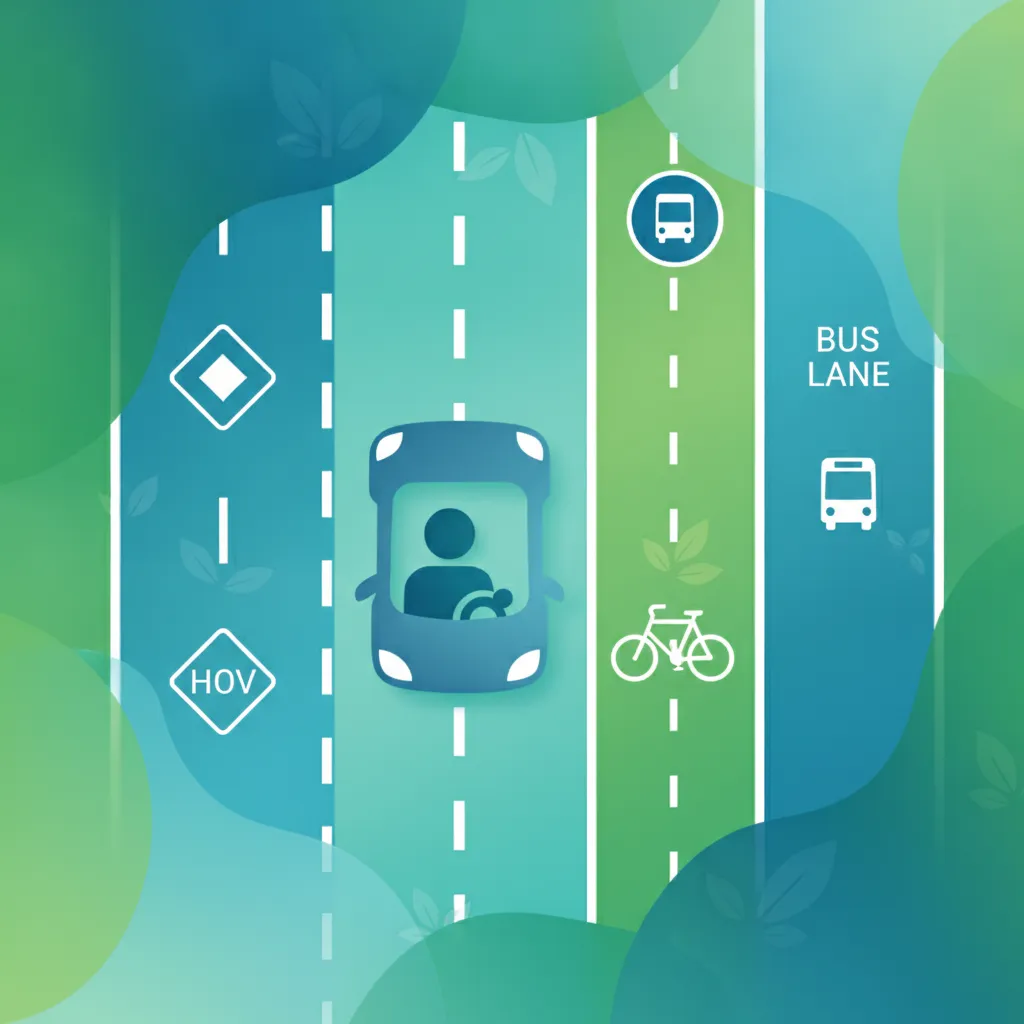
This lesson covers lanes designated for specific types of traffic to improve flow and safety. You will learn to identify mandatory and advisory cycle lanes, and understand the signs indicating the operational hours of bus lanes. The rules governing these lanes are critical for avoiding penalties and ensuring the safety of all road users.
Find clear answers to common questions learners have about Impact of Vehicle Size on Traffic Flow. Learn how the lesson is structured, which driving theory objectives it supports, and how it fits into the overall learning path of units and curriculum progression in Great Britain. These explanations help you understand key concepts, lesson flow, and exam focused study goals.
Due to your length, width, and turning requirements, other road users may struggle to see around you or pass safely. Your positioning and speed management directly dictate whether you create a moving flow or a stationary bottleneck at junctions.
Maintain a steady, predictable speed and avoid sudden braking. Use proper lane discipline to allow smaller vehicles to pass safely where appropriate and always signal your intentions early to inform other drivers of your path.
Yes, the DVSA theory test often includes situational questions that require you to identify the safest road position for a large vehicle to minimize disruption while prioritizing the safety of vulnerable road users.
Yes, because your vehicle is longer and potentially slower on inclines, it can lead to frustration for following drivers. Planning your route and maintaining consistent speed helps manage this risk and keeps traffic moving.
Dive into our comprehensive question bank to find exactly what you need for your Great Britain theory test. Use our advanced filters to pinpoint specific subjects or test your knowledge on challenging areas, ensuring you're fully prepared for success.