
This lesson guides you through the crucial safety requirement of maintaining adequate space between your vehicle and others. As part of our Category B theory course, you will learn the official French Code de la route standards for distance, ensuring you are prepared for both exam questions and real-world safety.
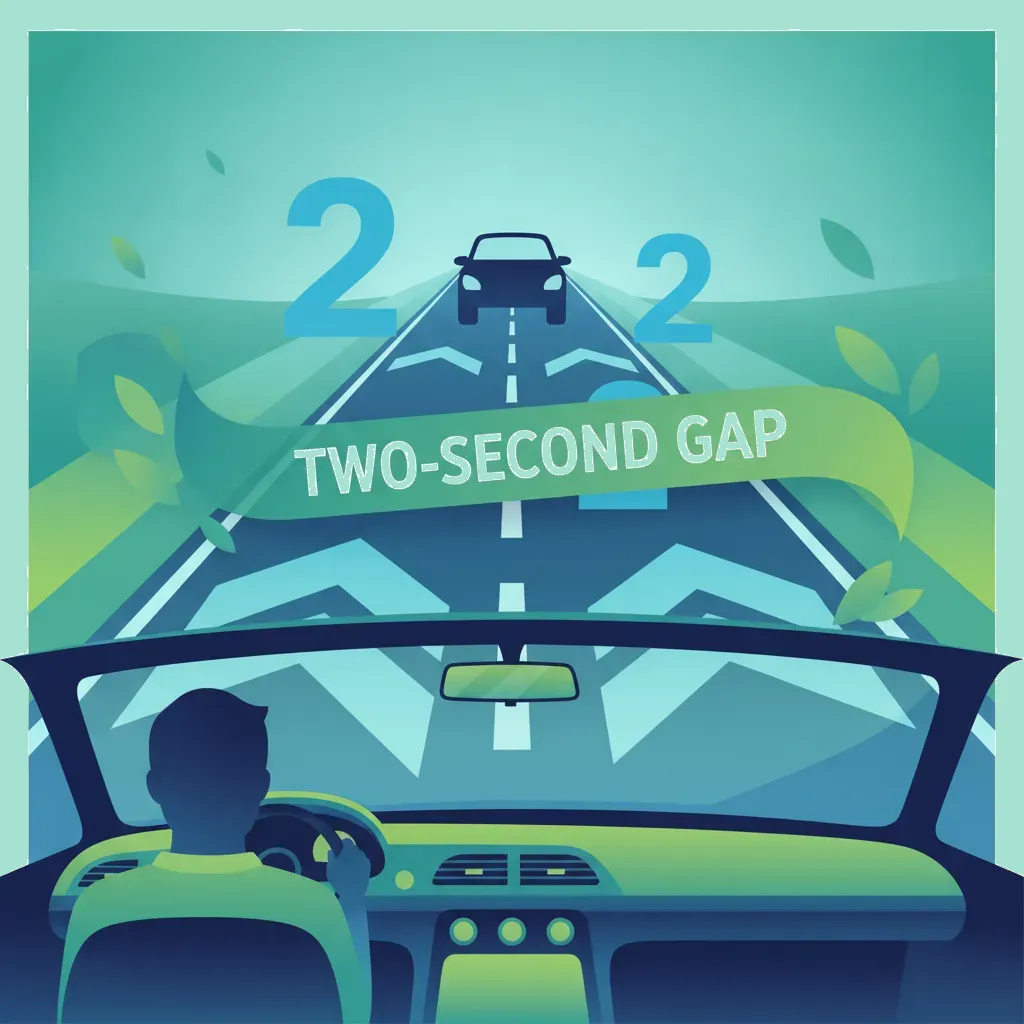
Lesson content overview
Maintaining a safe following distance (distance de sécurité) is one of the most critical aspects of driver safety. In France, rear-end collisions account for a significant portion of daily road accidents, particularly on high-speed motorways (autoroutes) and in heavy commuter traffic.
When preparing for your French Category B driving theory exam (the Examen de l'Éthique Générale or ETG), you must master the mathematical calculations and legal regulations that dictate how much space you must leave between your car and the vehicle ahead. This lesson provides a complete breakdown of the legal requirements, the physics of stopping, the "two-second rule," and how to dynamically adjust your safe buffer under varying driving conditions.
Before you can calculate a safe following distance, you must understand the mechanical and physiological factors that determine how long it takes for a moving vehicle to come to a complete stop.
The overall distance your vehicle covers from the moment you perceive a hazard to the moment your car halts is known as the Total Stopping Distance (distance d'arrêt). It is divided into two distinct phases:
The distance a vehicle travels during the driver's reaction time, which is the interval between detecting a hazard and physically pressing the brake pedal. For an alert driver, the average reaction time is approximately 1 second.
The physical distance a vehicle travels after the brakes have been applied until it comes to a complete standstill. This is determined by the vehicle's speed, weight, braking system efficiency, tyre grip, and road surface conditions.
To quickly estimate these distances during your French driving theory test, you can use highly reliable mental arithmetic shortcuts based on your current speed:
Calculating Reaction Distance in One Second: Take the tens digit of your speed in km/h and multiply it by 3.
Calculating Total Stopping Distance on Dry Roads: Take the tens digit of your speed in km/h and multiply it by itself (square it).
These physical realities are the logical foundation of the following distance regulations. If you follow another vehicle too closely, you eliminate your reaction buffer, making a collision mathematically inevitable if the vehicle ahead brakes suddenly.
Under normal driving conditions (dry roads, clear weather, and daylight), French traffic law (Code de la route) requires drivers of all vehicles to maintain a minimum safety gap equivalent to at least two seconds of travel time behind the vehicle directly ahead.
The two-second rule is not an arbitrary number; it is scientifically calculated based on human physiology and vehicle mechanics:
Because your speed varies, the actual physical gap in metres changes constantly. To find the legal safe distance in metres for any given speed on your exam, use this mental shortcut:
The "Tens Digit Multiplied by 6" Rule: To find the required two-second safety distance in metres, take the tens digit of your speed in km/h and multiply it by 6. (This is simply doubling your 1-second reaction distance calculation).
Using this formula, let us look at standard French speed thresholds under optimal conditions:
| Speed () | 1-Second Reaction Distance () | Required 2-Second Safety Distance () |
|---|---|---|
| (Urban) | ||
| (Two-lane Roads) | ||
| (Secondary Roads) | ||
| (Dual Carriageways) | ||
| (Motorways) |
You cannot measure metres accurately with your eyes while driving at high speed. Instead, use a fixed roadside object (such as a signpost, tree, bridge support, or shadow) to gauge your timing.
On French motorways (autoroutes), the road administration provides a highly practical visual tool painted directly onto the road surface to help drivers maintain their safety distances. This is known as the "two white lines" rule (règle des deux traits).
Along the right-hand edge of the slow lane, the solid white line separating the driving lane from the hard shoulder (bande d'arrêt d'urgence) is broken into highly specific alternating segments:
At the maximum motorway speed limit of , a safe two-second following distance equates to roughly .
Therefore, if you ensure that you can always see at least two white stripes of the shoulder line between your car and the vehicle ahead, you are guaranteed to be maintaining a legal, safe following distance of more than . If you only see one stripe, you are driving dangerously close.
The two-second rule assumes perfect driving conditions. When weather, traction, or road conditions deteriorate, your physical braking distance increases dramatically. As a safe driver, you must dynamically expand your safety gap to compensate.
Water acts as a lubricant between your tyres and the asphalt, which severely reduces friction. On wet roads, your vehicle's braking distance is roughly doubled.
The Wet Weather Rule: In rainy, wet, or damp conditions, French road safety regulations mandate that you must increase your following distance to a minimum of four seconds.
This extra time absorbs the extended braking distance. If we apply the dynamic four-second rule at different speeds, the physical gaps become:
Driving through road tunnels presents severe safety challenges due to confined spaces, limited escape routes, and potential smoke accumulation in an emergency. Because of this, standard time-based rules are superseded in French tunnels by strict, legally mandated Minimum Distance Intervals (MDI) measured in metres.
In most French tunnels, you must maintain a minimum distance of at least from the vehicle in front of you.
Important Legal Detail: This rule applies regardless of your driving speed. Even if you are caught in bumper-to-bumper traffic or if the traffic inside the tunnel comes to a complete standstill, you must stop your vehicle at least (or the designated distance, typically maintaining a massive gap of or at least the visual blue markers) behind the car in front. This ensures that if a fire or accident occurs, emergency vehicles have space to manoeuvre, and drivers have room to turn around or escape.
To help you judge in a dark, enclosed environment, French tunnels feature blue safety lights spaced at regular intervals along the tunnel walls (usually every ).
To comply with the law, you must ensure that there are always at least two blue lights visible on the wall between your vehicle and the vehicle ahead.
A professional driver must constantly adapt their safety margins to the specific types of vehicles they follow or share the road with.
If you are driving behind a heavy goods vehicle (HGV), bus, or utility van, you should increase your following distance to three seconds or more for several reasons:
Two-wheeled vehicles require extra space and vigilance:
In dense urban areas, drivers often reduce their following distance due to pressure from vehicles behind or fear of other cars cutting in. However, the speed limit still requires a gap. Maintaining this gap prevents chain-reaction collisions and actually improves general traffic flow by preventing the necessity for sudden, heavy braking.
Failing to maintain a safe following distance is a serious traffic violation in France (non-respect des distances de sécurité).
If you are caught failing to maintain the legal safety distance (either via automated speed/distance cameras or by police officers), you face strict administrative and financial penalties under Article R412-12 of the Code de la route:
If you commit this offence inside a road tunnel for a second time within a year, the violation is upgraded to a Class 5 offence, carrying a fine of up to €1,500 and an automatic 6-month licence suspension.
To solidify your understanding of road safety dynamics and prepare thoroughly for the French ETG, read the related topics covering braking physics, speed limit variations, and highway signs.
This lesson covers the French legal requirements for safe following distances based on the two-second rule and total stopping distance physics. Learners must master mental shortcuts: reaction distance equals tens digit × 3, while the two-second safety gap equals tens digit × 6. Weather conditions, vehicle type, and road environment (motorways versus tunnels) each mandate specific adjustments to the base calculations. French tunnels replace time-based rules with a mandatory 50m minimum distance marked by blue lights, while motorways provide visual guidance through the two white line system. Failure to maintain these distances results in a Class 4 fine of €135 and 3 licence points under Article R412-12 of the Code de la route.
A short set of high-value points that capture the most important learning from this lesson.
Safe following distance in France is legally mandated as a minimum two-second gap under normal conditions, equivalent to tens digit × 6 in metres.
Total stopping distance equals reaction distance (tens digit × 3) plus braking distance, with human reaction time averaging one second regardless of speed.
On French motorways at 130 km/h, the two white shoulder stripes (38m + 14m + 38m = 90m) visually guarantee you exceed the required 78m safety gap.
Wet roads double braking distance, requiring drivers to extend following distance to a minimum four-second gap.
Tunnel safety supersedes time-based rules with a strict 50-metre minimum distance, marked by two blue safety lights visible between vehicles.
Explore all units and lessons included in this driving theory course.
Tens digit × 6 gives the two-second safety distance in metres on dry roads; wet conditions require doubling this to a four-second minimum.
The 50 km/h urban limit requires a 30m gap, while motorway at 130 km/h demands approximately 78m under normal conditions.
French tunnels mandate at least two blue lights of distance (spaced every 25m) between vehicles, regardless of speed or traffic flow.
Snow, ice, fog, heavy loads, or towing all require expanding following distance beyond the standard two-second rule.
The two white motorway dashes (38m stripe + 14m gap) provide a visual shortcut: keep at least two full dash-gap-dash sequences between you and the vehicle ahead.
Assuming following distance only matters on motorways; urban rear-end collisions at 50 km/h still require the full 30m legal gap.
Forgetting to increase following distance in wet weather, effectively halving available braking distance without adjustment.
Using one white dash instead of two as a motorway reference, resulting in a gap of only 52m rather than the required 78m at 130 km/h.
Confusing tunnel minimum distance intervals with the general two-second rule; tunnels require a fixed 50m regardless of speed.
Believing reaction time is faster with experience; the legal calculation always assumes the standard one-second reaction time for all drivers.
Lesson content overview
A short set of high-value points that capture the most important learning from this lesson.
Safe following distance in France is legally mandated as a minimum two-second gap under normal conditions, equivalent to tens digit × 6 in metres.
Total stopping distance equals reaction distance (tens digit × 3) plus braking distance, with human reaction time averaging one second regardless of speed.
On French motorways at 130 km/h, the two white shoulder stripes (38m + 14m + 38m = 90m) visually guarantee you exceed the required 78m safety gap.
Wet roads double braking distance, requiring drivers to extend following distance to a minimum four-second gap.
Tunnel safety supersedes time-based rules with a strict 50-metre minimum distance, marked by two blue safety lights visible between vehicles.
Explore all units and lessons included in this driving theory course.
Tens digit × 6 gives the two-second safety distance in metres on dry roads; wet conditions require doubling this to a four-second minimum.
The 50 km/h urban limit requires a 30m gap, while motorway at 130 km/h demands approximately 78m under normal conditions.
French tunnels mandate at least two blue lights of distance (spaced every 25m) between vehicles, regardless of speed or traffic flow.
Snow, ice, fog, heavy loads, or towing all require expanding following distance beyond the standard two-second rule.
The two white motorway dashes (38m stripe + 14m gap) provide a visual shortcut: keep at least two full dash-gap-dash sequences between you and the vehicle ahead.
Assuming following distance only matters on motorways; urban rear-end collisions at 50 km/h still require the full 30m legal gap.
Forgetting to increase following distance in wet weather, effectively halving available braking distance without adjustment.
Using one white dash instead of two as a motorway reference, resulting in a gap of only 52m rather than the required 78m at 130 km/h.
Confusing tunnel minimum distance intervals with the general two-second rule; tunnels require a fixed 50m regardless of speed.
Believing reaction time is faster with experience; the legal calculation always assumes the standard one-second reaction time for all drivers.
Explore search topics learners often look for when studying Calculating Safe Following Distances. These topics reflect common questions about road rules, driving situations, safety guidance, and lesson level theory preparation for learners in France.
Browse additional driving theory lessons that cover connected traffic rules, road signs, and common driving situations related to this topic. Improve your understanding of how different rules interact across everyday traffic scenarios.
Learn the mechanics of stopping a vehicle including how reaction time and braking distance impact your overall safety. This lesson breaks down the physical variables like speed and surface traction that dictate your total stopping distance according to the Code de la route.
Total stopping distance is calculated as the sum of your reaction distance and the physical braking distance of the car. This lesson explains how reaction time is affected by driver focus and how speed exponentially increases the braking distance. You will learn how tire condition and slippery road surfaces degrade braking adhesion, requiring drivers to recognize and counteract these physical limits.
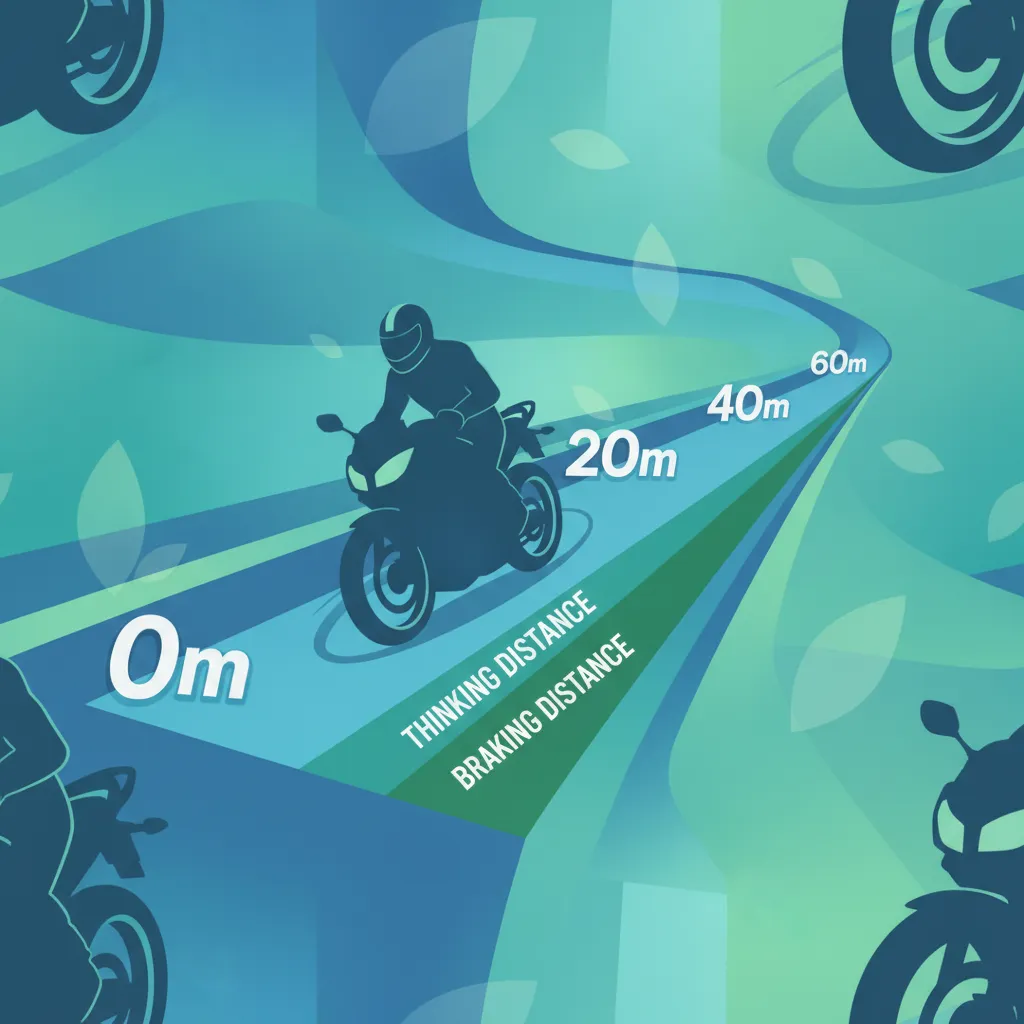
This lesson breaks down the physics of stopping a motorcycle, exploring how kinetic energy varies with the square of your speed. You will learn the mathematical components of total stopping distance, which includes both perception-reaction distance and physical braking distance. The lesson also explains how forward weight transfer during heavy braking increases traction on the front tire while reducing rear-wheel load.
Improve your ability to identify and respond to road hazards before they become critical situations. Discover how to apply systematic observation and anticipation techniques to navigate complex road environments while maintaining appropriate safety margins from vulnerable road users and unexpected traffic obstacles.

Proactive drivers scan the road constantly, detecting potential dangers before they turn into real-world emergency situations. This lesson teaches scanning techniques, the use of rear-view mirrors, and the interpretation of visual cues from other road users. You will learn to anticipate hazards like child play near roads, merging vehicles, and sudden lane changes, helping you drive defensively.

Learners will develop the ability to anticipate potential hazards on the road, enhancing reaction times and defensive riding strategies. The lesson emphasizes constant scanning, early identification of threats such as sudden stops, pedestrian crossings, or unexpected lane changes, and appropriate response measures. By cultivating proactive risk assessment, AM riders can significantly reduce accident likelihood.

In this lesson, drivers will learn strategies to avoid conflicts with smaller vehicles, such as cars and vans, which may not be as visible in large vehicle blind spots. The content emphasizes maintaining adequate spacing, using proper lane discipline, and being aware of small vehicles' behavior during lane changes and turns. Learners will also be introduced to communication techniques, such as signalling and eye contact.

This lesson teaches specific visual scanning methods to detect vulnerable road users, such as children, elderly individuals, and cyclists near stops. Drivers will learn to anticipate sudden movements, like a passenger running to catch a bus or stepping off a sidewalk unexpectedly. Managing the massive blind spots around the front and right-hand sides of passenger vehicles is highlighted as a critical safety duty.
Warning signs on French roads are triangular with a red border, designed to alert drivers to upcoming dangers. This lesson teaches you how to interpret warnings for sharp curves, slippery surfaces, narrowing lanes, and wildlife or animal crossing hazards. You will understand the safety adjustments needed when approaching school zones, active roadworks, or crossings where vulnerable pedestrians are present.
Find clear answers to common questions learners have about Calculating Safe Following Distances. Learn how the lesson is structured, which driving theory objectives it supports, and how it fits into the overall learning path of units and curriculum progression in France. These explanations help you understand key concepts, lesson flow, and exam focused study goals.
The two-second rule is the recommended minimum time gap between you and the vehicle in front. In dry conditions, you should be at least two seconds behind the lead car to ensure you have enough time to react and stop if they brake suddenly.
Yes. Under the Code de la route, you must significantly increase your following distance on wet roads, as your tires have less grip and braking distances are substantially longer than on dry pavement.
Yes, tunnels often have specific regulatory signage indicating a minimum distance in meters that must be maintained between vehicles. Always look for these signs, as they take precedence over general safety guidelines.
The higher your speed, the greater the distance you travel during your reaction time. Therefore, your physical following distance in meters must increase proportionally with your speed to maintain that vital two-second safety window.
Ready to focus your study? Use the practice search to find exactly the French driving theory questions you need for the Code de la route and permis de conduire ETG. Refine your knowledge on specific topics or challenging rules to boost your confidence and exam readiness.