
This lesson explores the essential physics of motorcycle control, detailing how to manage stopping distances and weight transfer. Understanding these mechanics is vital for your safety on French roads and a core component of the category A, A1, and A2 theory exam.
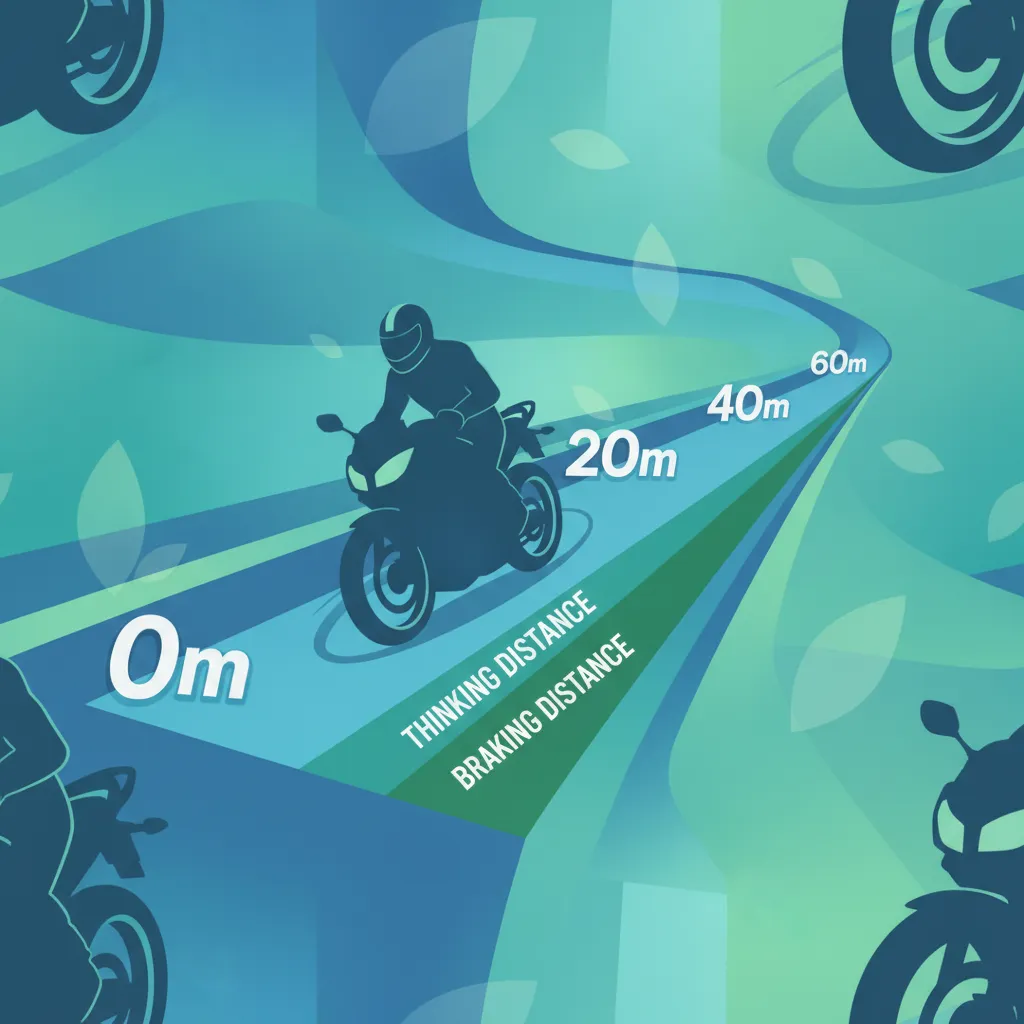
Lesson content overview
Operating a motorcycle safely requires a deep, intuitive understanding of physics, human biology, and machine dynamics. Unlike driving a car, where braking primarily involves pressing a single pedal, stopping a motorcycle is a highly active, skill-intensive process. A rider must independently manage two separate braking systems while balancing the dynamic forces that govern a two-wheeled vehicle.
This lesson covers the core physical principles of braking, the mathematical components that make up your total stopping distance (la distance d'arrêt), and the critical role of weight transfer. Mastering these concepts is essential for passing the French motorcycle theory exam (Épreuve Théorique Moto - ETM) and ensuring your survival on the road.
To understand why motorcycles cannot stop instantly, we must examine the physical laws governing motion. Every moving motorcycle possesses kinetic energy—the energy of motion. To bring the motorcycle to a complete stop, this kinetic energy must be entirely converted into thermal energy (heat) through the friction created between the brake pads, brake discs, and the road surface.
The mathematical formula for kinetic energy is:
Where:
The most critical takeaway from this formula is that kinetic energy is proportional to the square of the velocity (). This quadratic relationship means that speed has a compounding effect on your stopping capability.
If you double your speed, your kinetic energy does not simply double; it quadruples. Consequently, under identical road conditions, the physical distance required to dissipate this energy and stop the vehicle also increases by a factor of four.
For example, if a motorcycle traveling at 50 km/h requires approximately 14 metres of physical braking distance to stop on dry asphalt, doubling that speed to 100 km/h increases the physical braking distance to approximately 56 metres. Understanding this exponential curve is a fundamental safety requirement under the French Code de la route.
When an unexpected hazard appears, your motorcycle does not begin to slow down the moment your eyes register the danger. The total distance your vehicle travels from the instant you spot a hazard to the moment you come to a complete stop is called the Total Stopping Distance (TSD), or la distance d'arrêt.
Total Stopping Distance is the sum of two distinct phases:
The perception-reaction time (PRT) is the interval between the rider perceiving a hazard and physically initiating brake application. Even for a highly alert, healthy rider, this process is not instantaneous.
To quickly estimate the distance traveled during your reaction time in metres per second, you can use a simple rule of thumb: multiply the tens digit of your speed by 3.
Let us look at a concrete physical example:
If you are riding at 80 km/h and have a slightly delayed reaction time of 1.5 seconds (perhaps due to mild fatigue), your motorcycle will travel approximately 33 metres before your fingers even begin to squeeze the brake lever.
Once the brakes are applied, the mechanical systems of the motorcycle take over to decelerate the vehicle. Physical braking distance is determined by the mechanical efficiency of your brakes, tire grip, suspension performance, and the surface condition of the road.
Unlike the reaction distance (which increases linearly with speed), the physical braking distance increases quadratically with speed, as dictated by kinetic energy.
One of the most complex aspects of motorcycle braking is the phenomenon of dynamic weight transfer. When you apply the brakes, the forward deceleration force causes a massive shift of the motorcycle's effective mass from the rear wheel to the front wheel.
This weight transfer fundamentally alters the traction dynamics of both tires:
Because of dynamic weight transfer, a rider cannot distribute braking force equally between the front and rear wheels.
The physical grip between your motorcycle tires and the road is defined by the friction coefficient (). This coefficient is a ratio of the frictional force resisting motion to the downward load exerted by the tire.
The practical effect of a reduced friction coefficient on stopping distances is dramatic:
When the braking force applied to a wheel exceeds the available traction (determined by the friction coefficient and dynamic weight transfer), the wheel will stop rotating and enter a slide. This is known as wheel lock-up or skidding.
A front-wheel lock-up is highly dangerous and requires immediate correction. Because the front wheel controls the direction and balance of the motorcycle, a locked front wheel loses all lateral stability.
If the front wheel locks up while the motorcycle is moving, the steering will instantly flop to one side, leading to an almost immediate crash (known as a "low-side" fall). If you feel or hear the front tire skid, you must instantly and smoothly release the front brake lever to allow the wheel to resume rotation and restore gyroscopic stability, before reapplying pressure more progressively.
A rear-wheel lock-up occurs when too much pressure is applied to the rear brake pedal, especially as weight transfers forward. Because the rear tire has been unloaded, it requires very little braking force to lock.
Modern motorcycle technology features electronic rider aids designed to mitigate the dangers of wheel lock-up. The most critical of these is the Anti-lock Braking System (ABS).
[Wheel Speed Sensors] ---> [ABS Control Unit (ECU)] ---> [Hydraulic Valve Modulator]
       |                            |                                |
  Monitors wheel               Detects rapid                  Rapidly pulses
  rotation speed               deceleration /                brake pressure to
                              imminent lock-up               prevent skidding
ABS works by utilizing electromagnetic sensors on the wheel hubs to constantly monitor the rotational speed of both wheels. If the ABS control unit detects that a wheel is decelerating at a rate that indicates imminent lock-up, it activates hydraulic valves to rapidly pulse (release and reapply) the brake pressure to that wheel. This occurs dozens of times per second.
Important ABS Misconception: ABS is designed to preserve steering control and lateral stability during maximum deceleration. It does not guarantee a shorter stopping distance on all surfaces. In fact, on loose surfaces like gravel or deep snow, ABS can actually increase stopping distances because it prevents the tire from digging into the loose material to create a stopping wedge.
In France, ABS has been mandatory on all new motorcycles with an engine capacity over 125cc since the introduction of the Euro 4 emissions and safety standards in 2016. However, riders training for category A1, A2, and A licenses must never rely on ABS as a substitute for proper, progressive braking techniques.
To compensate for human reaction times and physical stopping dynamics, the French Code de la route establishes strict laws regarding safe following distances (les distances de sécurité).
According to Article R412-12 of the French Code de la route, when two vehicles are traveling in the same direction, the driver or rider behind must maintain a safe distance sufficient to avoid a collision in the event of a sudden slowdown or stop by the leading vehicle.
This safe distance is legally defined as the distance covered by the vehicle in at least two seconds.
Choose a fixed, stationary object on the side of the road ahead, such as a road sign, a tree, or a lamppost.
As the vehicle directly in front of you passes this object, begin counting: "one thousand and one, one thousand and two" (or in French, "une seconde, deux secondes").
If your motorcycle passes the same stationary object before you finish counting to two, you are following too closely and must back off to increase your safety margin.
On French motorways (autoroutes), safe following distances are visually simplified using the painted white lines on the right-hand shoulder (the emergency lane, or bande d'arrêt d'urgence).
At the maximum motorway speed limit of 130 km/h, your total stopping distance is approximately 150 metres under dry conditions. To maintain a safe two-second gap at this speed, the Code de la route dictates that you must keep a distance of at least two white stripes (deux bandes de peinture) between your motorcycle and the vehicle ahead.
As a motorcycle rider, your braking dynamics will shift constantly depending on external variables. You must learn to proactively adjust your riding behavior to these changing factors:
Adding a passenger or heavy luggage increases the total mass () of your vehicle.
If the road surface is bumpy, potholed, or uneven, your motorcycle suspension will work dynamically to keep the tires in contact with the ground.
Braking while leaned over in a corner is exceptionally risky. A motorcycle tire has a finite amount of total traction, often visualized as a "circle of traction." This grip must be shared between cornering forces (lateral grip) and braking forces (longitudinal grip).
If you use 90% of your tire's traction to maintain a lean angle through a turn, you only have 10% of traction remaining for braking. Exceeding this limit will cause an immediate slide.
Furthermore, applying the front brake while leaned over creates a self-righting moment, forcing the motorcycle to stand up and track wide, straight out of the corner into oncoming traffic or off the road. The optimal technique is to finish all major braking in a straight line before entering the turn.
To safely navigate French roads and pass your theory exam, memorize these core relationships:
This lesson covers the physics of motorcycle braking essential for the French ETM exam and road safety. You learned that kinetic energy scales with speed squared, meaning doubling speed quadruples braking distance, not doubling it. Total stopping distance combines a reaction phase (averaging one second, calculable by multiplying speed tens digit by 3) with physical braking distance determined by friction and vehicle dynamics. Forward weight transfer during deceleration loads the front wheel with 70-80% of available traction while unloading the rear, making progressive front-brake application your primary stopping tool. The French Code de la route enforces a two-second minimum following distance, which must be extended in rain as wet asphalt reduces grip by roughly half and doubles braking distance.
A short set of high-value points that capture the most important learning from this lesson.
Kinetic energy increases with the square of speed, so doubling your speed quadruples your braking distance and stopping capability.
Total stopping distance equals perception-reaction distance plus physical braking distance; both must be accounted for when assessing safety margins.
Under hard braking, 70-80% of stopping power comes from the front wheel due to forward weight transfer, while the rear wheel unloads and loses traction.
Wet road surfaces cut traction roughly in half (friction coefficient drops from ~0.8 to ~0.4), nearly doubling your required braking distance.
The French Code de la route (Article R412-12) mandates maintaining at least a two-second gap behind the vehicle ahead on all roads.
Explore all units and lessons included in this driving theory course.
Estimate reaction distance by multiplying the tens digit of your speed (in km/h) by 3 to get metres traveled during one second of reaction time.
On dry asphalt at 50 km/h, physical braking distance is approximately 14 metres; at 100 km/h it rises to approximately 56 metres due to the quadratic relationship.
ABS prevents wheel lock-up but does not always shorten stopping distance, particularly on loose surfaces like gravel or snow.
Braking while leaned over in a curve divides tire traction between cornering and braking forces, making it highly dangerous.
When carrying a passenger or cargo, the rearward-shifted center of gravity requires increased rear brake application to compensate for reduced rear-wheel unloading.
Assuming braking distance increases linearly with speed, when it actually increases quadratically due to kinetic energy physics.
Applying equal brake force to front and rear wheels, forgetting that weight transfer dramatically reduces rear-wheel traction.
Believing ABS always provides shorter stopping distances; on low-grip surfaces it can increase stopping distance by preventing tire digging.
Attempting to brake heavily while already leaned over in a corner, exhausting available tire traction and causing a slide.
Following too closely in wet conditions without increasing the two-second gap to account for reduced friction coefficients.
Lesson content overview
A short set of high-value points that capture the most important learning from this lesson.
Kinetic energy increases with the square of speed, so doubling your speed quadruples your braking distance and stopping capability.
Total stopping distance equals perception-reaction distance plus physical braking distance; both must be accounted for when assessing safety margins.
Under hard braking, 70-80% of stopping power comes from the front wheel due to forward weight transfer, while the rear wheel unloads and loses traction.
Wet road surfaces cut traction roughly in half (friction coefficient drops from ~0.8 to ~0.4), nearly doubling your required braking distance.
The French Code de la route (Article R412-12) mandates maintaining at least a two-second gap behind the vehicle ahead on all roads.
Explore all units and lessons included in this driving theory course.
Estimate reaction distance by multiplying the tens digit of your speed (in km/h) by 3 to get metres traveled during one second of reaction time.
On dry asphalt at 50 km/h, physical braking distance is approximately 14 metres; at 100 km/h it rises to approximately 56 metres due to the quadratic relationship.
ABS prevents wheel lock-up but does not always shorten stopping distance, particularly on loose surfaces like gravel or snow.
Braking while leaned over in a curve divides tire traction between cornering and braking forces, making it highly dangerous.
When carrying a passenger or cargo, the rearward-shifted center of gravity requires increased rear brake application to compensate for reduced rear-wheel unloading.
Assuming braking distance increases linearly with speed, when it actually increases quadratically due to kinetic energy physics.
Applying equal brake force to front and rear wheels, forgetting that weight transfer dramatically reduces rear-wheel traction.
Believing ABS always provides shorter stopping distances; on low-grip surfaces it can increase stopping distance by preventing tire digging.
Attempting to brake heavily while already leaned over in a corner, exhausting available tire traction and causing a slide.
Following too closely in wet conditions without increasing the two-second gap to account for reduced friction coefficients.
Explore search topics learners often look for when studying Principles of Motorcycle Braking and Stopping Distances. These topics reflect common questions about road rules, driving situations, safety guidance, and lesson level theory preparation for learners in France.
Browse additional driving theory lessons that cover connected traffic rules, road signs, and common driving situations related to this topic. Improve your understanding of how different rules interact across everyday traffic scenarios.
Learn how to manage emergency stops and high-risk situations on a motorcycle. This guide covers rider behavior, accident response procedures, and defensive techniques to maintain stability during sudden deceleration and hazard avoidance according to French Code de la route safety requirements for category A licensing.

This lesson teaches critical emergency response maneuvers to help you avoid sudden, unexpected obstacles on the roadway. You will learn the exact step-by-step process of executing a rapid, controlled swerve, keeping braking forces separate from steering inputs to prevent a slide. Additionally, the lesson addresses the psychological challenge of 'target fixation' and provides techniques to keep your eyes focused on your clear escape route.

This lesson provides a clear, step-by-step procedure to follow if you witness or are involved in a traffic accident in France. You will learn how to secure the scene using your mandatory hazard triangle and yellow vest to prevent secondary collisions. Crucially, it explains how to contact emergency services via 112 and covers basic first-aid rules, including the absolute ban on removing an injured rider's helmet unless necessary.

This lesson teaches you how to establish and preserve a dynamic cushion of safety on all sides of your motorcycle. You will study how to apply the 'two-second rule' to keep a safe following distance, extending it to three or more seconds in adverse weather. Additionally, you will discover how to manage tailgating motorists safely without resorting to dangerous speed increases, ensuring you always maintain a clear escape route.

Learners will develop the ability to anticipate potential hazards on the road, enhancing reaction times and defensive riding strategies. The lesson emphasizes constant scanning, early identification of threats such as sudden stops, pedestrian crossings, or unexpected lane changes, and appropriate response measures. By cultivating proactive risk assessment, AM riders can significantly reduce accident likelihood.

This lesson details how to safely enter, cruise on, and exit French motorways, known as autoroutes, which feature high-speed traffic flows. You will master the process of matching highway speeds in the acceleration lane and performing blind spot checks before merging. The lesson also explains correct lane positioning to avoid aerodynamic turbulences from large semi-trucks, and how to safely prepare for decelerating at exit ramps.

This lesson covers the operational logic of traffic light signals in France, emphasizing the legal implications of the red, amber, and green cycles. You will study how to safely manage the amber phase to avoid rear-end collisions from vehicles behind while maintaining control. Additionally, you will discover the unique challenge of electromagnetic induction loops, which sometimes fail to detect lightweight motorcycles at quiet intersections.

This lesson covers the strict legal conditions under which you may overtake other vehicles on French roads, including necessary visibility criteria. You will master the step-by-step process of checking rearview mirrors, performing head checks, signaling, and maintaining a safe speed differential during the pass. It also details when overtaking is strictly forbidden, such as before intersections, near pedestrian crossings, or across solid lines.

This lesson covers the physical mechanics of cornering, highlighting the technique of countersteering to initiate and control lean angles. You will learn to divide bends into distinct entry, apex, and exit phases, choosing the safest path that maximizes your visibility and grip reserves. Finally, the lesson explains the concept of the traction circle, helping you manage the division of tire grip between lateral cornering forces and acceleration.

Learners will explore techniques for maintaining control and safety while riding in rain, focusing on reduced braking efficiency, hydroplaning prevention, and visibility challenges. The lesson emphasizes appropriate speed reduction, tire condition checks, and the use of rain gear to enhance rider comfort and protection. By mastering these adaptations, riders can navigate wet French conditions with confidence.

Learners will learn the immediate steps to take following an accident or vehicle breakdown, including contacting emergency services (112), providing first aid, and securing the accident scene. The lesson also covers the necessary administrative actions such as completing the official French 'constat amiable' and reporting the incident to insurance providers. Knowing these procedures ensures that riders respond effectively in emergencies.
Explore the physics of motorcycle cornering, including lean angles and the traction circle. This lesson explains how to manage grip limits on different road surfaces, understand weight transfer in curves, and safely navigate turns by balancing longitudinal and lateral forces as required for the French ETM exam.
This lesson covers the physical mechanics of cornering, highlighting the technique of countersteering to initiate and control lean angles. You will learn to divide bends into distinct entry, apex, and exit phases, choosing the safest path that maximizes your visibility and grip reserves. Finally, the lesson explains the concept of the traction circle, helping you manage the division of tire grip between lateral cornering forces and acceleration.
This lesson examines how different road surfaces affect tire grip and vehicle stability. Learners will explore strategies for maintaining traction on wet surfaces, gravel, and irregular roadways, including appropriate lean angles and smooth throttle control under French road conditions. Understanding these principles helps riders avoid slip incidents and preserve control during cornering and braking.

This lesson teaches riders how to negotiate loose surfaces such as gravel, sand, and poorly maintained urban asphalt without dropping the motorcycle. You will study correct body positioning, focusing on keeping your weight centered and your grip relaxed on the handlebars. The lesson also highlights why smooth, constant throttle delivery and avoiding abrupt front braking are essential to prevent the front wheel from washing out.

This lesson addresses the unique hazards of riding a motorcycle in wet conditions, emphasizing the danger of aquaplaning. You will learn how water pooling on the asphalt can cause tires to lose direct contact with the road, leading to a complete loss of steering control. The lesson offers practical advice on reducing your speed, using smooth throttle and brake inputs, and ensuring your tires have adequate tread depth to clear water.

This lesson focuses on identifying and managing the wide range of road surface grip levels encountered on French highways. You will learn to recognize hazardous low-traction situations, such as tar strips ('tar snakes'), wet manhole covers, gravel patches, and diesel spills at roundabouts. The lesson provides strategies for adjusting your throttle and lean angle in advance to prevent sudden, dangerous slides on compromised pavement.
This lesson teaches critical emergency response maneuvers to help you avoid sudden, unexpected obstacles on the roadway. You will learn the exact step-by-step process of executing a rapid, controlled swerve, keeping braking forces separate from steering inputs to prevent a slide. Additionally, the lesson addresses the psychological challenge of 'target fixation' and provides techniques to keep your eyes focused on your clear escape route.

This lesson explains how to coordinate your front and rear brake controls to achieve maximum stopping power without compromising your lateral stability. You will study how to progressively squeeze the front brake lever to prevent sudden wheel lockup, while using the rear brake for stabilization. The lesson also highlights the function of Anti-Lock Braking Systems (ABS) and how they help you maintain steering control during emergency stops.

This lesson provides practical strategies for managing the physical demands of slow, heavily congested city traffic. You will learn how to maintain excellent low-speed balance through correct body posture, rear brake modulation, and smooth clutch control. It also emphasizes the importance of preserving an adequate safety buffer when stopping behind other vehicles, allowing an immediate escape route if you face a rear-end threat.
This lesson teaches you how to establish and preserve a dynamic cushion of safety on all sides of your motorcycle. You will study how to apply the 'two-second rule' to keep a safe following distance, extending it to three or more seconds in adverse weather. Additionally, you will discover how to manage tailgating motorists safely without resorting to dangerous speed increases, ensuring you always maintain a clear escape route.

This lesson explores how dividing your travel lane into three distinct vertical zones allows you to adjust your positioning for optimal safety. You will learn to shift your line to avoid oil slicks in the lane center, road debris at the edges, and wind blasts from passing trucks. Crucially, the lesson covers how to adapt your lane position on blind bends to widen your field of vision and stay clear of oncoming traffic.
Find clear answers to common questions learners have about Principles of Motorcycle Braking and Stopping Distances. Learn how the lesson is structured, which driving theory objectives it supports, and how it fits into the overall learning path of units and curriculum progression in France. These explanations help you understand key concepts, lesson flow, and exam focused study goals.
Because the kinetic energy of a motorcycle is proportional to the square of its velocity. If you double your speed, your motorcycle has four times the kinetic energy, meaning your brakes must dissipate four times more energy to stop, resulting in a significantly longer distance.
During heavy braking, weight is transferred from the rear wheel to the front wheel due to inertia. This creates more grip on the front tire, which is why the front brake provides the majority of your stopping power, provided it is applied with progressive pressure.
The exam typically presents scenarios where you must estimate if you have enough space to stop safely. You are often asked to consider factors like reaction time, current speed, and road surface conditions to determine if a collision is avoidable.
No, reaction distance depends on the rider's condition, including fatigue, distraction, and reaction time. The French theory exam emphasizes that while you can reduce braking distance with good technique, you must always account for a variable reaction delay before the brakes even engage.
Ready to focus your study? Use the practice search to find exactly the French driving theory questions you need for the Code de la route and permis de conduire ETG. Refine your knowledge on specific topics or challenging rules to boost your confidence and exam readiness.