
This lesson guides you through the official speed limits defined by the French Code de la route for Category B drivers. You will explore how environmental conditions and your license status impact your legal speed, ensuring you are prepared for both the ETG exam and safe real-world driving.
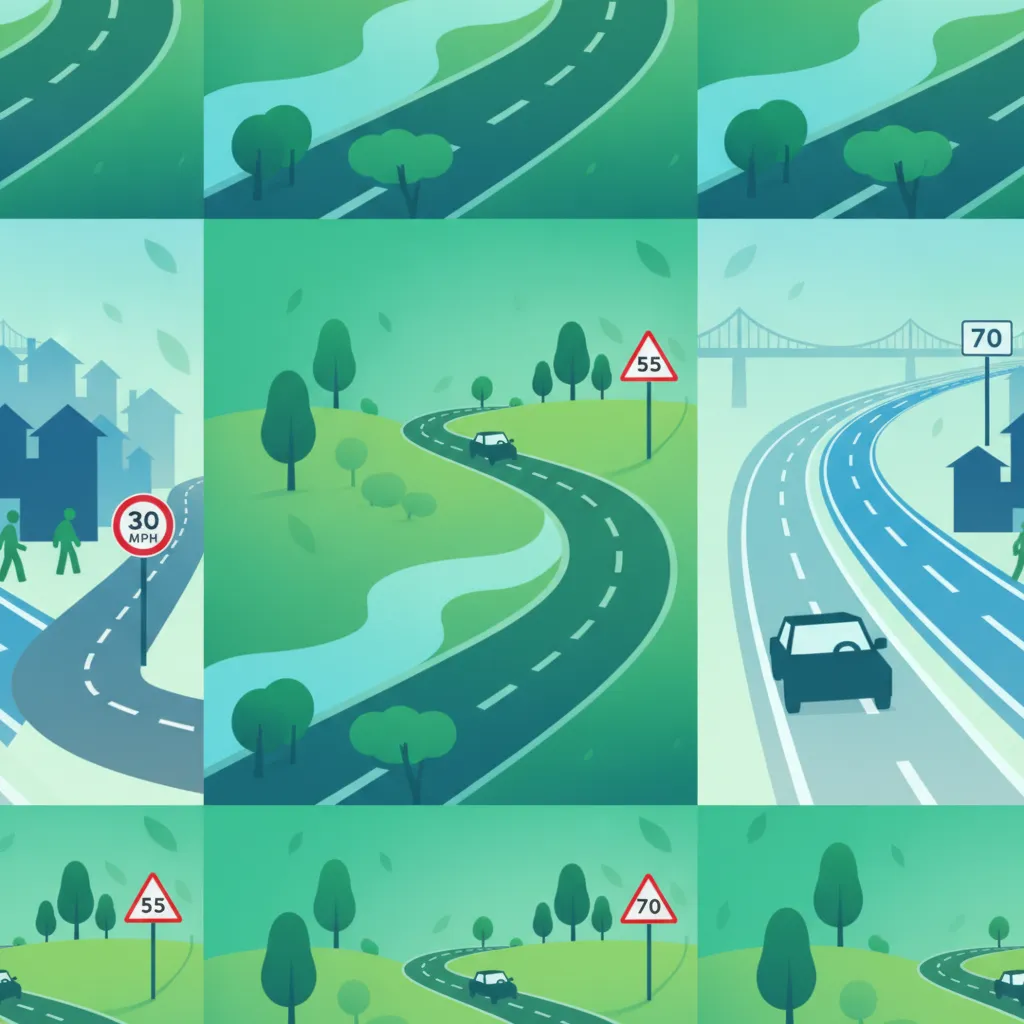
Lesson content overview
Navigating the French road network safely and legally requires a precise understanding of speed limits, which are strictly regulated under the Code de la route (French Traffic Law). Unlike in some countries where speed limits are primarily indicated by roadside signs, France relies heavily on a system of default speed limits determined by road classification, weather conditions, and the driver's licensing status.
Exceeding these limits is not only a severe traffic violation resulting in fines and point deductions but also drastically increases the risk of serious accidents. This lesson covers the regulatory framework governing speed limits in France, ensuring you are fully prepared for both the French Category B driving theory exam (Examen de l'Éthique Générale or ETG) and real-world driving.
The maximum safe speed on any French road is dictated by the road's design, its location, and the presence of physical dividers between opposing lanes of traffic. In dry, optimal conditions, the default speed limits for fully licensed drivers of Category B vehicles are categorized into four distinct road types.
Within built-up areas, municipalities, and cities, the default speed limit is 50 km/h. This limit is automatically triggered when passing a white rectangular sign with a red border containing the name of the town or city, which marks the entrance to the urban zone.
The urban speed limit applies to all streets within the municipal boundary unless a specific sign explicitly permits a higher or lower speed (such as a designated 30 km/h zone or a zone de rencontre restricted to 20 km/h).
Outside of urban areas, standard two-lane roads without a physical central reservation (such as a concrete barrier or guardrail) have a default speed limit of 80 km/h. These are typically designated as routes départementales (D-roads) or routes nationales (N-roads).
In 2018, the French national default for bidirectional rural roads without a central divider was lowered from 90 km/h to 80 km/h to reduce head-on collisions. While some local departments (conseils départementaux) have selectively reverted specific stretches of roads back to 90 km/h, 80 km/h remains the official national default tested on the ETG exam unless roadside signs explicitly state otherwise.
Dual carriageways are multi-lane roads where opposing directions of traffic are physically separated by a central reservation (terre-plein central), such as a concrete wall or crash barrier. Under dry conditions, the maximum speed limit on these roads is 110 km/h. These roads are often marked by a blue sign depicting a car, indicating a road restricted to motor vehicles (voie rapide or route pour automobiles).
Motorways in France are high-speed, controlled-access roadways designed for rapid transit between regions. They are characterized by grade-separated junctions (on-ramps and off-ramps), emergency lanes (bande d'arrêt d'urgence), and a physical central divider. The default dry speed limit on motorways is 130 km/h. Entry onto an autoroute is signaled by a blue square sign featuring a motorway symbol.
The Principle of Conditional Reduction states that maximum speed limits must be reduced during adverse weather conditions. Rain, drizzle, snow, and fog decrease tire-to-road friction and impair visibility. To offset these hazards, the Code de la route mandates automatic speed reductions during precipitation.
The mandatory lowering of maximum legal speed limits during adverse weather (such as rain, snow, or fog) to compensate for reduced traction and compromised visibility.
When it is raining or the road surface is wet, speed limits are reduced across major road networks as follows:
Drivers must proactively reduce their speed to these levels as soon as precipitation begins or when the road surface is clearly wet; you do not need to wait for a physical electronic matrix sign or variable speed sign to change.
Heavy fog, active snowfalls, and severe ice storms can reduce visibility to extremely hazardous levels. Under Article R413-3 of the Code de la route, a uniform safety rule applies:
If horizontal visibility drops below 50 metres due to any weather phenomenon, the maximum legal speed limit is capped at 50 km/h on all public roads.
This 50 km/h cap applies universally, meaning that even on a major motorway where the limit is normally 130 km/h, you must not exceed 50 km/h if you cannot see more than 50 metres ahead. This ensures that your total stopping distance remains within your field of vision.
In France, newly licensed drivers are subject to a probationary period known as the permis probatoire. This period typically lasts for three years (reduced to two years if the driver completed the supervised driving program, apprentissage anticipé de la conduite or AAC).
To give novice drivers a larger safety margin while they gain experience, the law imposes lower maximum speed limits. These limits apply at all times during the probationary period, regardless of whether the weather is dry or wet.
Motorways: Limited to a maximum of 110 km/h (instead of 130 km/h).
Dual Carriageways: Limited to a maximum of 100 km/h (instead of 110 km/h).
Rural Roads: Limited to a maximum of 70 km/h (instead of 80 km/h).
Urban Areas: Limited to 50 km/h (identical to fully licensed drivers).
Probationary drivers must display a circular red sticker containing a capital white letter "A" (representing Apprenti or apprentice) on the rear of their vehicle. This alerts other road users to the driver's status and potential lower traveling speeds.
The lower speed limits apply to the probationary driver legally and automatically. Failing to display the "A" sticker is an independent traffic infraction resulting in a fixed fine, but it does not excuse a probationary driver from adhering to the reduced speeds.
While default speeds govern most of the network, specific speed limits are established and indicated by standardized circular signs.
Speed limits are not arbitrary; they are calculated based on human reaction times, vehicle braking capabilities, and the laws of physics. Understanding the relationship between speed and stopping distance is critical to safe driving.
A vehicle's kinetic energy () is proportional to the square of its velocity ():
If you double your speed, your kinetic energy does not double—it quadruples. Because a car's brakes must dissipate this kinetic energy to bring the vehicle to a stop, the braking distance also increases quadratically.
On wet roads, water acts as a lubricant between the tyre tread and the asphalt, cutting the coefficient of friction roughly in half.
This physical reality is the scientific basis for the mandatory speed drops during rain. By reducing your speed from 130 km/h to 110 km/h on a wet motorway, you counteract the increased braking distance caused by the wet road surface, keeping your stopping distance comparable to dry conditions.
To help solidify these rules, let us review how these variables interact in real-world scenarios on French roads.
| Road Category | Dry (Full Licence) | Wet/Rain (Full Licence) | Dry & Wet (Probationary Driver) | Severe Visibility (< 50m) |
|---|---|---|---|---|
| Urban Area (En Agglomération) | 50 km/h | 50 km/h | 50 km/h | 50 km/h |
| Two-lane Rural Road (Route Bidirectionnelle) | 80 km/h | 70 km/h | 70 km/h | 50 km/h |
| Dual Carriageway (Route à Chaussées Séparées) | 110 km/h | 100 km/h | 100 km/h | 50 km/h |
| Motorway (Autoroute) | 130 km/h | 110 km/h | 110 km/h | 50 km/h |
This lesson establishes France's default speed limit system, which assigns different maximum speeds to road categories: 50 km/h in urban areas, 80 km/h on two-lane rural roads, 110 km/h on dual carriageways, and 130 km/h on motorways. Weather conditions trigger automatic reductions on most roads during rain, while a universal 50 km/h cap applies whenever visibility falls below 50 metres. Probationary drivers must observe lower maximum speeds regardless of weather, with motorway and dual carriageway limits capped at 110 and 100 km/h respectively. Understanding when each rule takes precedence—including how to handle scenarios where rain and probationary status both apply—is essential for both passing the ETG exam and driving safely on French roads.
A short set of high-value points that capture the most important learning from this lesson.
Urban areas default to 50 km/h, two-lane rural roads to 80 km/h, dual carriageways to 110 km/h, and motorways to 130 km/h under dry conditions.
Rain automatically reduces motorway limits to 110 km/h, dual carriageways to 100 km/h, and rural roads to 70 km/h, while urban limits stay at 50 km/h.
When visibility drops below 50 metres from fog, snow, or heavy rain, a universal 50 km/h cap applies on all roads regardless of other posted limits.
Probationary drivers face lower maximum speeds (110/100/70/50 km/h) that apply in both dry and wet conditions, unlike fully licensed drivers.
Speed limits on French roads are primarily determined by default rules tied to road classification rather than signs on every stretch of road.
Explore all units and lessons included in this driving theory course.
Probationary driver speed limits are identical for dry and wet conditions, whereas fully licensed drivers get rain reductions on non-urban roads.
The 2018 change from 90 to 80 km/h on bidirectional rural roads remains the national default unless local signs indicate otherwise.
Even on a motorway where 130 km/h is normal, thick fog with under 50-metre visibility legally caps your speed at 50 km/h.
The 'A' sticker (red circle with white A) must be displayed by probationary drivers but does not exempt them from the reduced speed limits.
Kinetic energy increases with the square of speed, meaning doubling your speed quadruples braking distance—this is why rain mandates speed reductions.
Assuming probationary drivers get a double reduction (e.g., 90 km/h on wet motorways) when rain and probationary status both apply; in reality, the lower limit is used once.
Confusing the urban speed limit with the 50-metre visibility rule—both say 50 km/h but apply in different situations.
Believing speed limit reductions during rain only apply when electronic variable signs display them; reductions are mandatory automatically when conditions are wet.
Forgetting that rural roads reduced from 90 to 80 km/h in 2018 and may have reverted locally, but 80 km/h is the safe default answer on exams.
Thinking an 80 km/h rural road limit applies even in heavy fog with poor visibility; the 50-metre rule overrides category defaults.
Lesson content overview
A short set of high-value points that capture the most important learning from this lesson.
Urban areas default to 50 km/h, two-lane rural roads to 80 km/h, dual carriageways to 110 km/h, and motorways to 130 km/h under dry conditions.
Rain automatically reduces motorway limits to 110 km/h, dual carriageways to 100 km/h, and rural roads to 70 km/h, while urban limits stay at 50 km/h.
When visibility drops below 50 metres from fog, snow, or heavy rain, a universal 50 km/h cap applies on all roads regardless of other posted limits.
Probationary drivers face lower maximum speeds (110/100/70/50 km/h) that apply in both dry and wet conditions, unlike fully licensed drivers.
Speed limits on French roads are primarily determined by default rules tied to road classification rather than signs on every stretch of road.
Explore all units and lessons included in this driving theory course.
Probationary driver speed limits are identical for dry and wet conditions, whereas fully licensed drivers get rain reductions on non-urban roads.
The 2018 change from 90 to 80 km/h on bidirectional rural roads remains the national default unless local signs indicate otherwise.
Even on a motorway where 130 km/h is normal, thick fog with under 50-metre visibility legally caps your speed at 50 km/h.
The 'A' sticker (red circle with white A) must be displayed by probationary drivers but does not exempt them from the reduced speed limits.
Kinetic energy increases with the square of speed, meaning doubling your speed quadruples braking distance—this is why rain mandates speed reductions.
Assuming probationary drivers get a double reduction (e.g., 90 km/h on wet motorways) when rain and probationary status both apply; in reality, the lower limit is used once.
Confusing the urban speed limit with the 50-metre visibility rule—both say 50 km/h but apply in different situations.
Believing speed limit reductions during rain only apply when electronic variable signs display them; reductions are mandatory automatically when conditions are wet.
Forgetting that rural roads reduced from 90 to 80 km/h in 2018 and may have reverted locally, but 80 km/h is the safe default answer on exams.
Thinking an 80 km/h rural road limit applies even in heavy fog with poor visibility; the 50-metre rule overrides category defaults.
Explore search topics learners often look for when studying Speed Limits by Road Type and Conditions. These topics reflect common questions about road rules, driving situations, safety guidance, and lesson level theory preparation for learners in France.
Browse additional driving theory lessons that cover connected traffic rules, road signs, and common driving situations related to this topic. Improve your understanding of how different rules interact across everyday traffic scenarios.
Learn the relationship between vehicle speed and braking distance, including the quadratic effect of velocity on kinetic energy. This lesson explains the factors that increase stopping distance, such as reaction time and road surface conditions, providing a solid foundation for understanding road safety requirements in the French driving code.
Total stopping distance is calculated as the sum of your reaction distance and the physical braking distance of the car. This lesson explains how reaction time is affected by driver focus and how speed exponentially increases the braking distance. You will learn how tire condition and slippery road surfaces degrade braking adhesion, requiring drivers to recognize and counteract these physical limits.
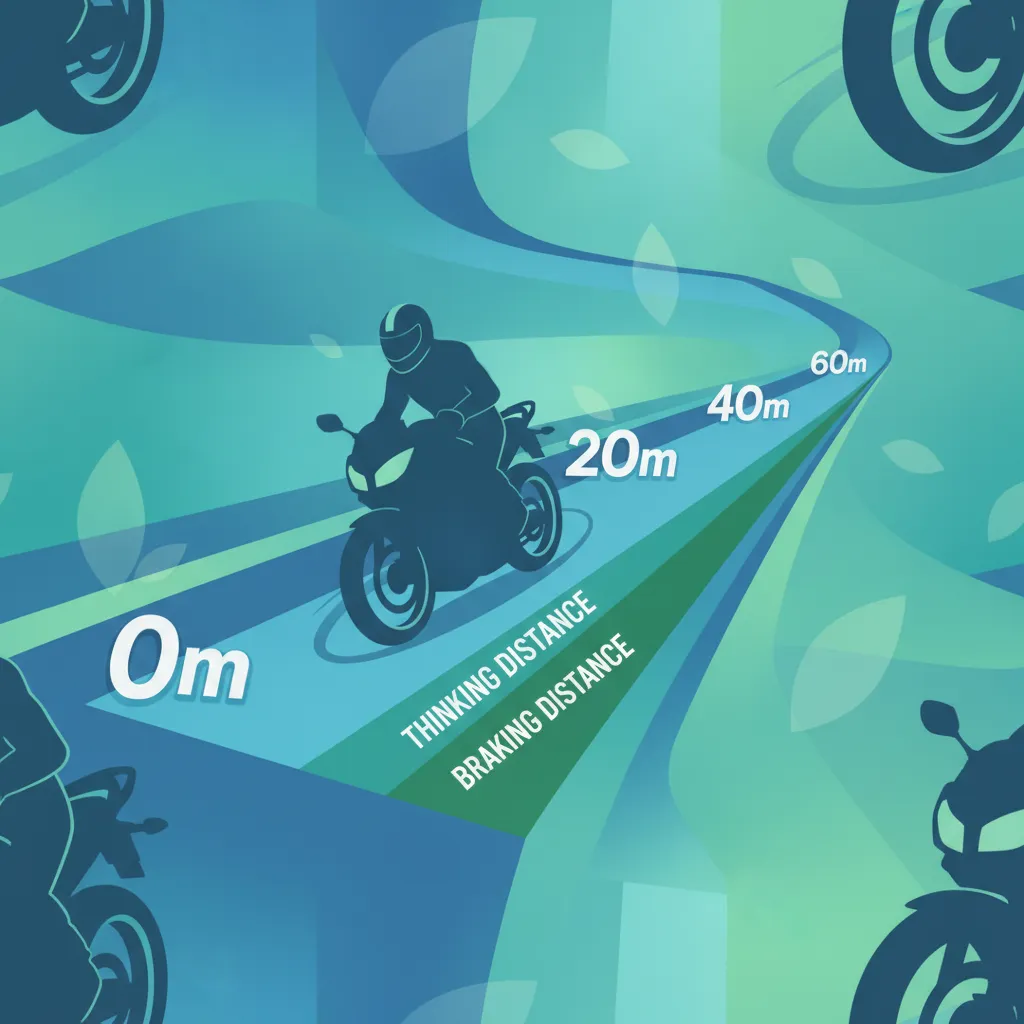
This lesson breaks down the physics of stopping a motorcycle, exploring how kinetic energy varies with the square of your speed. You will learn the mathematical components of total stopping distance, which includes both perception-reaction distance and physical braking distance. The lesson also explains how forward weight transfer during heavy braking increases traction on the front tire while reducing rear-wheel load.
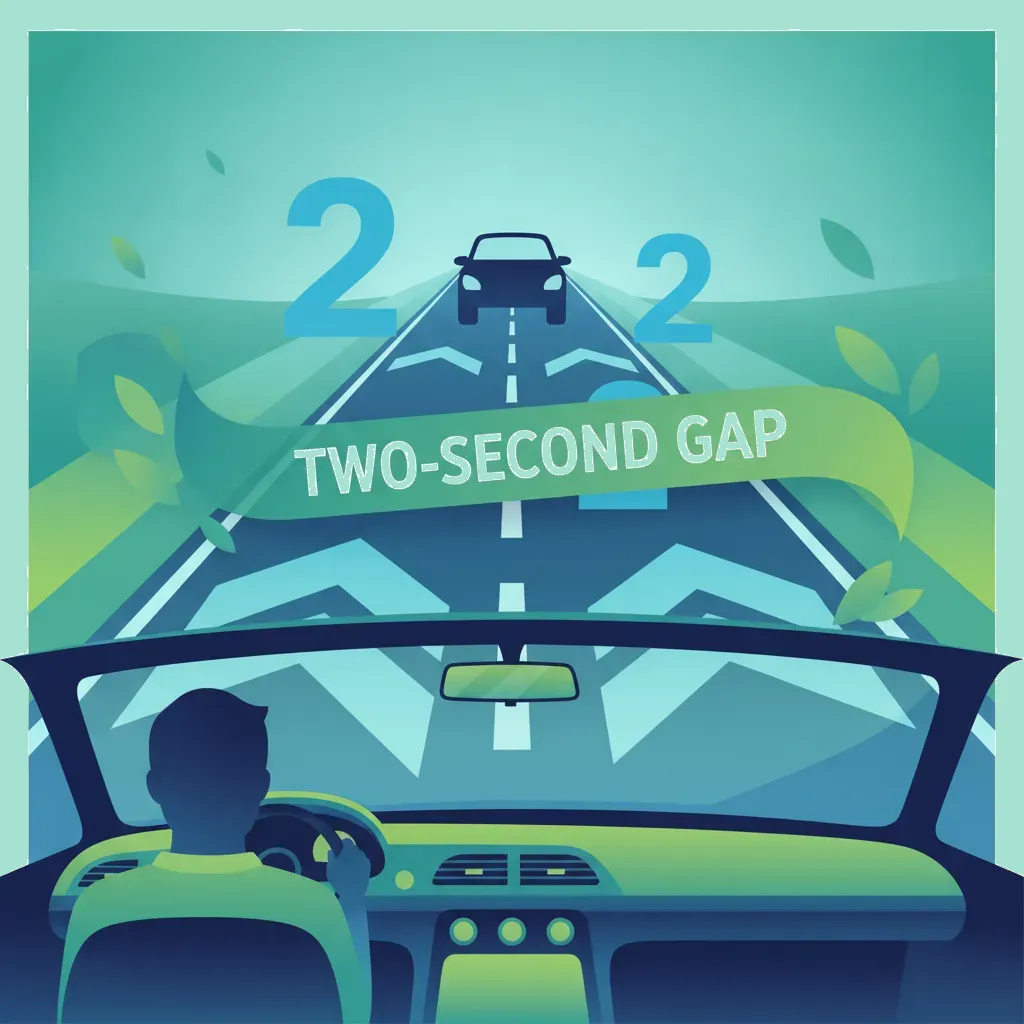
Maintaining a safe distance behind the lead vehicle is essential to prevent rear-end collisions during sudden braking maneuvers. This lesson teaches you the two-second safety rule and how to calculate this gap at different highway speeds. You will also study unique safety margin requirements, such as maintaining minimum distance intervals in road tunnels or doubling your following distance on wet roads.

In this lesson, drivers will learn how to calculate safe following distances based on vehicle speed, load, road conditions, and traffic density. The content explains the components of total stopping distance, including reaction time and braking distance, and how these are affected by factors such as wet road surfaces and heavy loads. Learners will also be introduced to French road safety guidelines for maintaining appropriate gaps to ensure sufficient time to react.

Learners will be introduced to effective braking techniques tailored for AM vehicles, emphasizing progressive pressure application and the importance of maintaining grip. The lesson covers how to estimate stopping distances, execute emergency stops safely, and understand the limitations of light vehicle braking systems in France. Mastery of these techniques ensures riders can stop promptly and maintain control in various traffic scenarios.

This lesson emphasizes the critical importance of maintaining a safe following distance when carrying dozens of passengers. Learners will study how vehicle weight and passenger load dynamically extend braking and total stopping distances compared to standard passenger cars. The lesson provides concrete spacing rules, such as adjusted safety gaps for highway driving and increased distances on slippery roads.

This lesson teaches advanced braking strategies, highlighting the correct application of progressive friction braking and auxiliary retardation systems like electric or hydraulic retarders. Drivers will learn to avoid abrupt braking inputs that could compromise passenger balance, particularly for standing passengers. It also covers emergency stop procedures, showing how to balance maximum deceleration with vehicle stability.

This lesson explains how to coordinate your front and rear brake controls to achieve maximum stopping power without compromising your lateral stability. You will study how to progressively squeeze the front brake lever to prevent sudden wheel lockup, while using the rear brake for stabilization. The lesson also highlights the function of Anti-Lock Braking Systems (ABS) and how they help you maintain steering control during emergency stops.

Carrying heavy loads or pulling trailers significantly alters a passenger vehicle's braking distances and stability characteristics. This lesson covers how to read weight limits (like gross vehicle weight ratings), distribute cargo weight evenly, and secure items inside the boot or on roof racks. You will learn to use specialized cargo straps and understand the risks of overloading your suspension and tyres.

Adverse weather reduces tyre traction and limits visibility, dramatically raising the risk of multi-car accidents on highways. This lesson details speed reductions required during rainfall, techniques for avoiding aquaplaning, and demisting windshields for visibility. You will learn how to maintain extra stopping distance on snow-covered roads and the correct headlight adjustments to make during fog.
Understand the specific driving strategies required for fog, heavy rain, and snow on French roads. This guide covers mandatory speed limit reductions, the 50-metre visibility rule, and techniques for maintaining control of your vehicle when road surface friction is significantly compromised by environmental factors.
Adverse weather reduces tyre traction and limits visibility, dramatically raising the risk of multi-car accidents on highways. This lesson details speed reductions required during rainfall, techniques for avoiding aquaplaning, and demisting windshields for visibility. You will learn how to maintain extra stopping distance on snow-covered roads and the correct headlight adjustments to make during fog.
This lesson covers the mechanical and physical adaptations required to drive a passenger coach in rain, heavy fog, snow, and crosswinds. Drivers will learn to recognize signs of aquaplaning and understand the dramatic traction loss associated with wet or icy roads. It also details French winter equipment regulations (Loi Montagne) requiring snow tires or chains in designated mountainous regions.
In this lesson, drivers will learn how to adjust their driving techniques in response to adverse weather conditions such as rain, fog, snow, ice, and strong winds. The content covers strategies for maintaining visibility, managing reduced traction on wet or icy surfaces, and adjusting speed and braking distances accordingly. Learners will also be introduced to the use of anti-skid and stability control systems under challenging weather.

Learners will explore techniques for maintaining control and safety while riding in rain, focusing on reduced braking efficiency, hydroplaning prevention, and visibility challenges. The lesson emphasizes appropriate speed reduction, tire condition checks, and the use of rain gear to enhance rider comfort and protection. By mastering these adaptations, riders can navigate wet French conditions with confidence.

This lesson focuses on adapting your riding behavior to sudden environmental shifts, such as heavy fog or strong crosswinds on exposed bridges. You will learn specific technical adjustments, including leaning slightly into crosswinds and widening your safety margins during low-visibility fog. The lesson also highlights how seasonal temperature drops affect your tires' ability to warm up and achieve reliable, safe levels of road adhesion.

In this lesson, drivers will explore the specific challenges presented by rural road environments, including narrower lanes, shared space with agricultural vehicles, and frequent wildlife crossings. The content emphasizes adapting speed to road curvature, surface conditions, and visibility while navigating hills and bends. Learners will also learn to interpret rural road signage and understand the importance of maintaining vigilance.

Rural roads account for a high percentage of severe accidents due to narrow widths, winding geometries, and sudden hazards. This lesson teaches strategies for negotiating sharp bends, handling agricultural machinery, and reacting to wildlife warning signs. You will learn to manage your vehicle's lane placement on roads with soft shoulders and understand speed limits on rural networks.

Driving at night introduces serious safety challenges, such as reduced visual range, headlight glare, and fatigue. This lesson explains how to correctly transition from high beams to low beams to avoid blinding oncoming traffic. You will learn to look toward the right-side edge line to minimize headlight glare and recognize signs of visual tiredness that necessitate immediate rest breaks.
Find clear answers to common questions learners have about Speed Limits by Road Type and Conditions. Learn how the lesson is structured, which driving theory objectives it supports, and how it fits into the overall learning path of units and curriculum progression in France. These explanations help you understand key concepts, lesson flow, and exam focused study goals.
Yes, when it is raining or the road is wet, speed limits on motorways and dual carriageways are reduced. For example, the 130 km/h limit on motorways typically drops to 110 km/h in wet conditions to ensure safety.
Yes, drivers in their probationary period (permis probatoire) must adhere to stricter speed limits compared to experienced drivers on certain roads, such as a 110 km/h limit on motorways instead of the standard 130 km/h.
The general speed limit in built-up areas (agglomération) in France is 50 km/h, unless specific road signs indicate a different limit, such as 30 km/h zones.
Yes, if visibility is significantly reduced due to fog, the law mandates a general speed reduction for all vehicles to ensure you can stop within the distance of your visibility.
Ready to focus your study? Use the practice search to find exactly the French driving theory questions you need for the Code de la route and permis de conduire ETG. Refine your knowledge on specific topics or challenging rules to boost your confidence and exam readiness.