
This lesson explores the critical challenge of blind spots when operating heavy goods vehicles, a key component of our Category C and CE theory course. You will learn professional techniques for mirror management and visual verification to ensure safety for yourself and other road users.

Lesson content overview
Operating heavy goods vehicles (HGVs) in Category C (rigid trucks) and Category CE (articulated vehicles with trailers) requires an advanced understanding of spatial awareness and defensive driving. Because of their sheer size, elevated cabs, and long body structures, large commercial vehicles possess extensive blind spots—known in France as les angles morts.
Managing these blind spots is not merely a practical skill; it is a strict legal requirement under the French Code de la route. Failure to identify and mitigate these obscured zones is a leading cause of severe accidents involving vulnerable road users, such as pedestrians, cyclists, and motorcyclists. This lesson provides a comprehensive breakdown of blind spot geometry, mirror adjustment, supplemental visual checks, electronic monitoring systems, and the legal obligations of professional drivers in France.
To safely operate a goods vehicle, you must understand the geometry of the space surrounding it. Due to the physical construction of large vehicles—including high seating positions, structural pillars, cargo boxes, and trailers—a driver’s direct line of sight is highly restricted. This creates distinct "danger zones" where smaller vehicles or pedestrians can become completely invisible.
There are four primary blind spot zones around a standard heavy goods vehicle:
The spatial area adjacent to a vehicle that is not captured by the driver's standard direct field of view or through standard side and rearview mirrors.
When towing a trailer, blind spot geometry changes dynamically. As the tractor unit turns, the trailer does not follow the exact track of the front wheels; it cuts the corner—a phenomenon known as off-tracking or le porte-à-faux.
During a turn, the angle between the tractor and the trailer creates a dynamic blind spot. If you turn right, the trailer body swings across the right-side viewing path, temporarily blocking the view provided by your right side mirrors. Any cyclist or vehicle caught in the "inside" of that turn is placed in extreme danger as the trailer squeezes the space near the curb.
To minimize these massive blind spots, European and French regulations require commercial vehicles to be fitted with a highly specialized set of mirrors. Under the Code de la route, a driver must know how to adjust and utilize each class of mirror to achieve the maximum field of vision.
Modern heavy goods vehicles in Category C and CE are equipped with up to six different mirrors, categorized by European standards:
Establish Your Seating Position First: Before touching any mirror controls, adjust your driving seat, steering wheel, and lumbar support. If your posture changes later, your mirror adjustments will be incorrect.
Adjust Class II (Main Side Mirrors): Angle them so that you can just see a sliver of the edge of your vehicle or trailer on the inner edge of the mirror. The horizon line should be positioned roughly in the vertical center of the mirror. This ensures you can monitor both the rear of your vehicle and the road far behind.
Adjust Class IV (Wide-Angle Mirrors): Position these convex mirrors to cover the wide lateral lanes next to your truck. The view should overlap slightly with the Class II mirrors to ensure there are no gaps between the narrow and wide-angle fields of view.
Adjust Class V (Curb Mirror): Position this mirror so that the entire passenger-side front wheel and the area stretching 2 metres outwards from the passenger door are visible.
Adjust Class VI (Front Mirror): Adjust the front mirror so that the area from the front bumper up to 2 metres ahead of the vehicle is fully visible.
Mirrors must be checked and re-adjusted every single time you change your load, hook up a new trailer, or carry out a shift change. A slight shift in cargo or vehicle height can radically alter your mirror angles and expand your blind spots.
Standard flat mirrors are insufficient for managing the massive volume of a heavy goods vehicle. For this reason, the installation of auxiliary convex mirrors is strictly regulated under French law.
Convex mirrors use curved glass to bend light and capture a wider field of view. While they are highly effective at revealing hidden vehicles, they introduce a critical optical distortion: objects in convex mirrors appear smaller and farther away than they actually are.
According to Article R412-12 of the Code de la route, all vehicles in Categories C and CE must be equipped with mandatory external side mirrors (Class II and Class IV wide-angle) on both the driver and passenger sides. These must be adjusted to provide a continuous view of the lane immediately adjacent to the vehicle.
Additionally, vehicles over a certain weight classification must be equipped with Class V (curb) and Class VI (front) mirrors to completely eliminate near-field blind spots around the cab. If a vehicle's structure prevents direct mounting of these mirrors, supplementary electronic visual aids (such as camera-monitor systems) must be installed.
No matter how advanced your mirror system is, you must never rely on mirrors alone. Mirrors have inherent limitations, and dirt, rain, or vibration can impair their effectiveness. To safely execute any lateral maneuver—such as changing lanes, merging, turning, or entering roundabouts—you must perform a physical visual check, commonly referred to as a shoulder check.
Because of the solid cabin walls of a goods vehicle, a simple glance over your shoulder does not work the same way it does in a passenger car. Instead, a professional driver must perform an active posture shift. This involves leaning forward in the seat, moving your head toward the side window, and peering through the side glass at different angles to look around the cabin’s A-pillars and door frames.
Under Article R432-10 of the Code de la route, any driver intending to change direction or move laterally must first ensure they can do so without danger to other road users. This legally requires the driver to verify all blind spots via physical visual checks (shoulder checks) prior to initiating the movement. Failing to do so is a serious traffic violation and carries severe penalties, especially if an accident occurs.
In recent years, vehicle manufacturers have integrated electronic driving aids to help drivers identify objects in their blind spots. Known as Blind Spot Monitoring Systems (BSM) or Systèmes de détection d'angles morts, these technologies use sensors, radar, and cameras to provide real-time alerts.
Electronic BSM systems typically utilize one or more of the following interfaces:
While BSM is an invaluable safety aid, it must never replace physical checks.
Electronic driver aids are legally classified as supplementary assistance tools. The driver remains solely responsible for the safety of any maneuver. You cannot defend a collision in a French court by claiming your blind spot monitoring system failed to beep.
Some of the known limitations of BSM systems include:
Operating an articulated vehicle or a road train (Category CE) introduces a massive set of blind spot challenges. Because of the jointed connection between the tractor unit and the trailer, the vehicle does not move as a single rigid block.
When negotiating tight curves or roundabouts, the trailer cuts inward. The driver must rely on the Class IV wide-angle mirrors to track the rear of the trailer. However, as the tractor unit turns, the mirrors temporarily point away from the path of the trailer, creating a temporary, moving blind spot on the inside of the turn.
When turning with a trailer, slow down significantly. This gives you more time to scan your mirrors repeatedly as the angle of the truck changes, allowing you to catch any road users who might enter the blind spot area during the turn.
Before setting off with a trailer:
Reversing a heavy goods vehicle is one of the most hazardous maneuvers a driver can perform. Because there is a total blind spot directly behind the vehicle, reversing must be handled with extreme care.
According to French safety guidelines, reversing should only be carried out when absolutely necessary, and always at low speeds. The driver must maintain a direct line of sight on the area behind the vehicle, using all available mirrors and rearview cameras as supplementary aids.
If your vehicle is equipped with a rearview camera, use it to check for obstacles directly behind the trailer. However, never stare solely at the camera screen. You must look back and forth between your left mirror, right mirror, and camera screen to maintain situational awareness.
If visibility is severely restricted, or if you are reversing in a congested urban delivery zone, you are highly encouraged to use a banksman (guide de manœuvre). The banksman must stand in a safe position where they have a clear view of the rear of the vehicle and are fully visible in your side mirrors at all times. If you lose sight of your banksman in your mirrors, stop the vehicle immediately.
A commercial driver's field of vision is highly dependent on environmental conditions. Weather and road grime can rapidly degrade the effectiveness of your mirrors, expanding your blind spots.
The French Code de la route takes a strict stance on blind spot management. Violating these laws can result in heavy fines, loss of license points, and severe civil or criminal liability in the event of an accident.
This article mandates that all goods vehicles must be equipped with approved mirror systems matching their weight and dimension specifications. Driving a vehicle with damaged, missing, or improperly adjusted mirrors is a punishable offense.
This article outlines the requirement to ensure any planned maneuver can be executed safely without obstructing or endangering other road users. Under this rule, failing to check mirrors and perform shoulder checks before changing lanes is treated as a serious driving infraction.
Since January 1, 2021, French law requires all heavy vehicles over 3.5 tonnes (including foreign vehicles operating in France) to display visual blind spot warning stickers. This regulation, codified under Article R313-32-1, aims to warn pedestrians, cyclists, and personal mobility device users of the vehicle’s blind spot zones.
The stickers must be placed on both sides of the front cab (within 1 metre of the front bumper) and on the rear of the vehicle, at a height between 0.9 and 1.5 metres from the ground. For articulated vehicles (CE), stickers must also be affixed to both the left and right sides of the semi-trailer.
To solidify your understanding, let us explore how these principles are applied in daily driving operations.
This lesson addresses the critical challenge of managing extensive blind spots in Category C and CE heavy goods vehicles, which possess four distinct danger zones due to their elevated cabs and long body structures. Proper mirror adjustment using European-standard Class II, IV, V, and VI mirrors is essential to minimize these blind spots, with specific procedures for each mirror type to achieve maximum coverage. French law mandates physical shoulder checks before any lateral maneuver under Article R432-10, and electronic blind spot monitoring systems are legally classified as supplementary aids that cannot substitute for visual verification. When operating articulated vehicles (Category CE), drivers must account for dynamic off-tracking during turns and continuously monitor mirrors as the trailer angle changes.
A short set of high-value points that capture the most important learning from this lesson.
HGVs have four primary blind spot zones: front (1-2m), rear, left-side, and right-side (the largest and most dangerous)
Proper mirror setup requires using all four European mirror classes (II, IV, V, VI) to achieve continuous coverage around the vehicle
Physical shoulder checks are legally mandatory under Article R432-10 and must involve an active posture shift, not just a glance
Blind spot monitoring systems are supplementary aids only; they cannot replace physical visual verification
Trailers create dynamic blind spots during turns due to off-tracking (porte-à-faux), requiring repeated mirror checks throughout the maneuver
Explore all units and lessons included in this driving theory course.
Class V mirrors show the area immediately beside the passenger-side wheels; Class VI mirrors show the area directly in front of the front bumper
Re-adjust all mirrors every time you change load, hook up a new trailer, or after loading/unloading cargo
The French Angles Morts sticker mandate (Article R313-32-1) requires warning stickers at 0.9-1.5m height on vehicles over 3.5 tonnes
When reversing, maintain alternating eye contact between mirrors, camera, and direct view; use a banksman if visibility is severely restricted
Mirrors must be cleaned at every rest stop in winter; road salt and grime rapidly reduce their effectiveness
Relying solely on electronic blind spot monitoring systems without performing manual shoulder checks, especially in adverse weather
Failing to re-adjust mirrors after loading cargo, which changes vehicle height and suspension, altering mirror angles
Driving into a turn with a trailer at normal speed, not allowing time to monitor the swinging blind spot on the inside of the turn
Staring at the rearview camera screen while reversing instead of continuously scanning all mirrors and looking behind
Assuming the Class IV wide-angle convex mirror shows objects at their true distance; objects appear smaller and farther away than they actually are
Lesson content overview
A short set of high-value points that capture the most important learning from this lesson.
HGVs have four primary blind spot zones: front (1-2m), rear, left-side, and right-side (the largest and most dangerous)
Proper mirror setup requires using all four European mirror classes (II, IV, V, VI) to achieve continuous coverage around the vehicle
Physical shoulder checks are legally mandatory under Article R432-10 and must involve an active posture shift, not just a glance
Blind spot monitoring systems are supplementary aids only; they cannot replace physical visual verification
Trailers create dynamic blind spots during turns due to off-tracking (porte-à-faux), requiring repeated mirror checks throughout the maneuver
Explore all units and lessons included in this driving theory course.
Class V mirrors show the area immediately beside the passenger-side wheels; Class VI mirrors show the area directly in front of the front bumper
Re-adjust all mirrors every time you change load, hook up a new trailer, or after loading/unloading cargo
The French Angles Morts sticker mandate (Article R313-32-1) requires warning stickers at 0.9-1.5m height on vehicles over 3.5 tonnes
When reversing, maintain alternating eye contact between mirrors, camera, and direct view; use a banksman if visibility is severely restricted
Mirrors must be cleaned at every rest stop in winter; road salt and grime rapidly reduce their effectiveness
Relying solely on electronic blind spot monitoring systems without performing manual shoulder checks, especially in adverse weather
Failing to re-adjust mirrors after loading cargo, which changes vehicle height and suspension, altering mirror angles
Driving into a turn with a trailer at normal speed, not allowing time to monitor the swinging blind spot on the inside of the turn
Staring at the rearview camera screen while reversing instead of continuously scanning all mirrors and looking behind
Assuming the Class IV wide-angle convex mirror shows objects at their true distance; objects appear smaller and farther away than they actually are
Explore search topics learners often look for when studying Identifying and Mitigating Blind Spots. These topics reflect common questions about road rules, driving situations, safety guidance, and lesson level theory preparation for learners in France.
Browse additional driving theory lessons that cover connected traffic rules, road signs, and common driving situations related to this topic. Improve your understanding of how different rules interact across everyday traffic scenarios.
Understand the specific challenges of maneuvering large vehicles in dense urban environments. This guide explains how to manage traffic density, pedestrian interactions, and delivery zone risks according to the French Code de la route to enhance your defensive driving skills behind the wheel of a heavy goods vehicle.
In this lesson, drivers will learn how to navigate urban delivery zones, understanding the rules surrounding loading bays, time windows, and restricted access areas. The content includes the process for obtaining delivery permits, strategies for safe maneuvering in congested city streets, and best practices for minimizing impact on pedestrian traffic. Learners will also be introduced to French city-specific regulations that govern goods vehicle deliveries.

This lesson focuses on the unique challenges of performing deliveries in dense urban areas. Learners will explore best practices for loading and unloading safely, navigating traffic congestion, and minimizing risks to pedestrians and cyclists. The content also covers compliance with city regulations for delivery zones, scheduling considerations, and the importance of careful maneuvering to avoid accidents.

This lesson analyzes the various traffic challenges unique to operating large passenger vehicles in historic and modern French urban areas. Drivers will learn to manage narrow street layouts, double-parked delivery trucks, and high-density multi-lane roundabouts safely. The lesson emphasizes defensive driving strategies, route adjustments, and maintaining mental focus under severe schedule and time pressures.

This lesson examines the specific challenges and responsibilities goods vehicle drivers face when interacting with pedestrians and cyclists in urban environments. Learners will understand right-of-way rules, the importance of yielding at pedestrian crossings, and safe turning practices that protect cyclists. The content emphasizes heightened driver vigilance, especially when navigating bike lanes and crowded sidewalks.

This lesson examines the regulatory limits and environmental controls applied to large passenger vehicles operating in dense French urban centers. Drivers will study the Crit'Air clean air sticker system and low-emission zones (ZFE) that restrict access for older, high-polluting vehicles. It also addresses navigating physical constraints, such as narrow streets, tight turning radii, and strict municipal weight limits.

This lesson focuses on maneuvering in extremely crowded areas, passenger terminals, or narrow streets blocked by parked vehicles and obstacles. Drivers will learn to assess clearance distances precisely before committing to narrow pathways. The content teaches steering techniques that maintain stability, optimize space usage, and prioritize public safety during slow-speed, high-difficulty maneuvers.

In this lesson, drivers will learn strategies to avoid conflicts with smaller vehicles, such as cars and vans, which may not be as visible in large vehicle blind spots. The content emphasizes maintaining adequate spacing, using proper lane discipline, and being aware of small vehicles' behavior during lane changes and turns. Learners will also be introduced to communication techniques, such as signalling and eye contact.
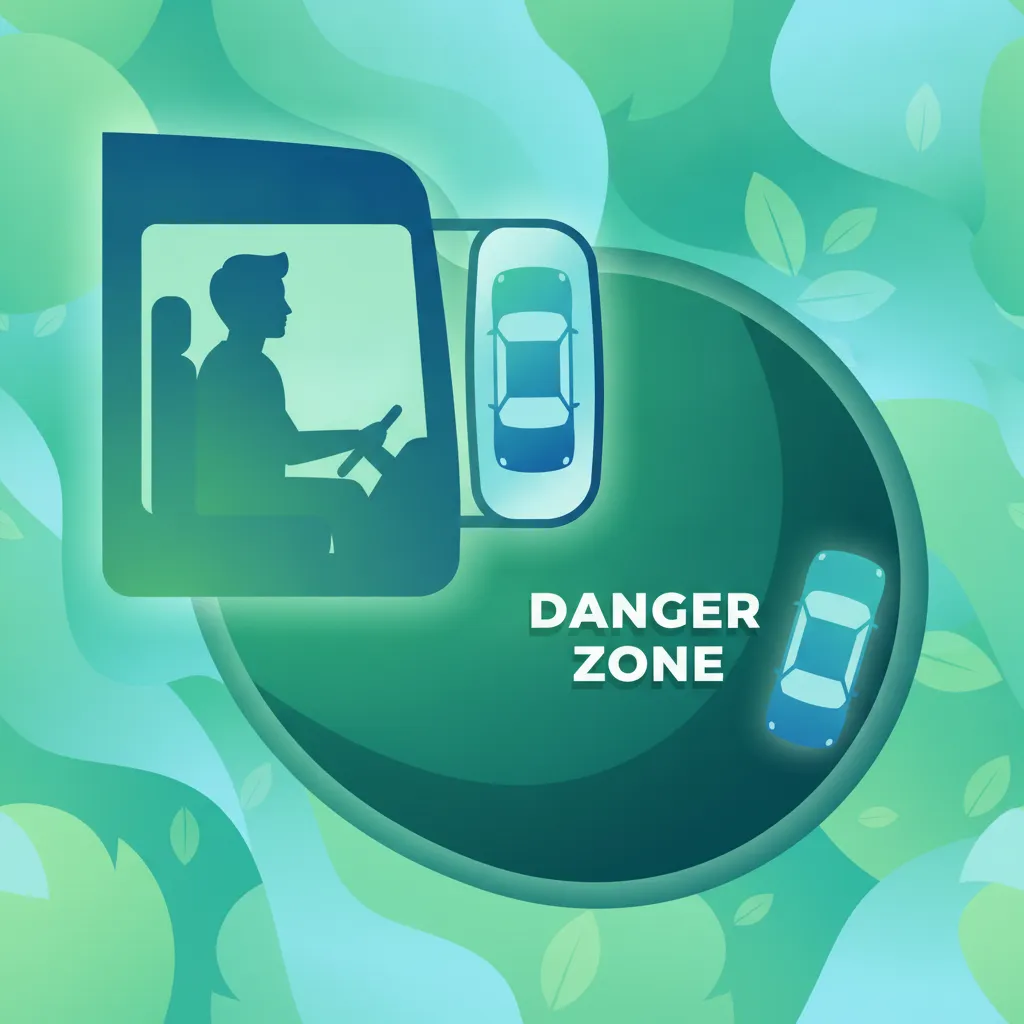
This lesson details the location and scale of blind spots around passenger cars and heavy goods vehicles, often referred to as the 'no-zone' or 'angles morts'. You will learn why truck drivers cannot see you directly behind or immediately adjacent to their cab doors. The lesson provides actionable strategies to minimize the time you spend in these dangerous zones, ensuring you always pass quickly and safely.

This lesson covers the physical dimensions of passenger vehicles and how their high profile, length, and width alter spatial awareness on the road. Learners will study tail-swing mechanics and track the path of the rear wheels during sharp turns to avoid hitting roadside obstacles. Accurate measurement of overhead structures, bridges, and underpass clearances is taught to prevent catastrophic structural collisions.

In this lesson, drivers will learn best practices for manoeuvring goods vehicles into loading docks and other confined spaces. The content covers the use of spotting aids, guidance markings, and reverse assistance technologies. Learners will understand how to align the vehicle and trailer correctly with dock doors, maintain situational awareness, and use proper signaling for safety. The lesson also emphasizes the importance of communication with dock personnel.
Explore the principles of safe reversing and wide-turn execution for articulated vehicles. This theory lesson provides detailed explanations on managing off-tracking, trailer stability, and the use of banksmen to maintain situational awareness during complex manoeuvres in restricted spaces, aligning with professional French driving licence standards.

This lesson focuses on techniques for reversing safely with a trailer attached, including the use of spotters, mirrors, and backup cameras to mitigate blind spots. Learners will understand the steps for proper trailer coupling before reversing, how to control trailer sway, and the importance of using reverse gear properly. The content also covers safety checks to perform before reversing, such as ensuring the area is clear.
In this lesson, drivers will learn best practices for manoeuvring goods vehicles into loading docks and other confined spaces. The content covers the use of spotting aids, guidance markings, and reverse assistance technologies. Learners will understand how to align the vehicle and trailer correctly with dock doors, maintain situational awareness, and use proper signaling for safety. The lesson also emphasizes the importance of communication with dock personnel.

Reversing (marche arriere) is a slow-speed maneuver that presents significant visibility challenges due to rear vehicle blind spots. This lesson covers proper driver posture, direct over-the-shoulder viewing, and the effective use of mirrors while backing up. You will learn how to reverse safely out of driveways or parking bays and how to yield to pedestrians who might cross your path.

This lesson outlines the step-by-step safety checks and physical controls required to reverse a bus or coach in confined areas. Learners will study the use of rear-view cameras, mirror angles, and acoustic backing alarms to detect obstacles. It highlights the mandatory use of a trained ground guide (guide de manoeuvre) to assist in blind zones, ensuring zero contact with structures or people.

In this lesson, drivers will learn how to plan and execute wide turns with goods vehicles, taking into account turning radius, pivot points, and articulation angles. The content emphasizes the necessity of using the full width of the lane, correctly aligning the vehicle through the turn, and anticipating the movement of the trailer. Learners will also explore road marking guidelines for turning and the importance of giving clear signals to surrounding traffic.

This lesson covers the specific lane usage rules and best practices for articulated goods vehicles, emphasizing the correct positioning within lane markings and the impact of vehicle length on lane width. Learners will understand how to navigate lane changes safely, the importance of maintaining appropriate gaps with other road users, and the challenges posed by narrow lanes in urban environments. The content also addresses the French road markings standard.

This lesson analyzes the technical path a long wheelbase vehicle must take when turning at intersections and navigating roundabouts. Drivers will learn to calculate tail swing and rear-wheel tracking, intentionally swinging wide to clear roadside curbs and poles safely. The lesson emphasizes yielding protocols for pedestrians and cyclists who may be crossing the target street during the turn.
This lesson covers the physical dimensions of passenger vehicles and how their high profile, length, and width alter spatial awareness on the road. Learners will study tail-swing mechanics and track the path of the rear wheels during sharp turns to avoid hitting roadside obstacles. Accurate measurement of overhead structures, bridges, and underpass clearances is taught to prevent catastrophic structural collisions.

This lesson provides a detailed guide on the proper procedures for coupling and uncoupling a trailer to a goods vehicle. Learners will explore the different types of coupling systems, including magnetic and pneumatic devices, and understand the critical safety checks required before and after connection. The content also covers the verification of trailer lighting, brake connections, and the use of quick-release mechanisms to ensure a secure hitch.

This lesson covers techniques for managing gradients while driving goods vehicles, focusing on downhill control, engine braking, and appropriate gear selection. Learners will understand how load distribution and vehicle dynamics affect descending performance and the importance of avoiding brake overheating. The content includes practical advice on using hill start assistance systems and maintaining safe speeds on steep slopes.
Find clear answers to common questions learners have about Identifying and Mitigating Blind Spots. Learn how the lesson is structured, which driving theory objectives it supports, and how it fits into the overall learning path of units and curriculum progression in France. These explanations help you understand key concepts, lesson flow, and exam focused study goals.
Due to the increased length, width, and height of goods vehicles, the distance from the driver to the extremities of the vehicle is much greater. This creates large areas behind, in front of, and alongside the vehicle that cannot be seen through standard window views, requiring specialized mirror setups.
No. While electronic systems are helpful aids, they are not foolproof and can suffer from sensor limitations. You must always perform physical mirror checks and direct observations before changing lanes or turning to ensure total safety.
Mirrors must be adjusted while the vehicle and trailer are perfectly aligned. You should set the wide-angle and curb-view mirrors so that you can see the side of the trailer and the road surface near the rear wheels, reducing the hidden area during turns.
The biggest risk is the presence of vulnerable road users, such as cyclists or pedestrians, who may move into your blind spots at intersections. Always check all mirrors repeatedly before starting a turn to ensure no one has entered your danger zone.
Ready to focus your study? Use the practice search to find exactly the French driving theory questions you need for the Code de la route and permis de conduire ETG. Refine your knowledge on specific topics or challenging rules to boost your confidence and exam readiness.