
Reaction distance is the initial part of your total stopping distance, covering the time it takes to perceive a hazard and initiate braking. In Germany, mastering this concept is vital for understanding safe following distances and hazard response, particularly given varied road conditions from Autobahns to urban areas. Factors such as speed, distractions, and fatigue significantly extend this distance, increasing accident risk. This page clarifies its definition, calculation, and importance for your German driving license.
Theory topic content overview
Read the full theory topic guide for Reaction Distance Explained with structured, easy-to-scan content built for learners in Germany. This detailed section explains the exact rule, meaning, traffic context, comparison points, and exam logic behind this German driving theory topic so you can study faster, understand the concept more clearly, and avoid common interpretation mistakes on the theory test.
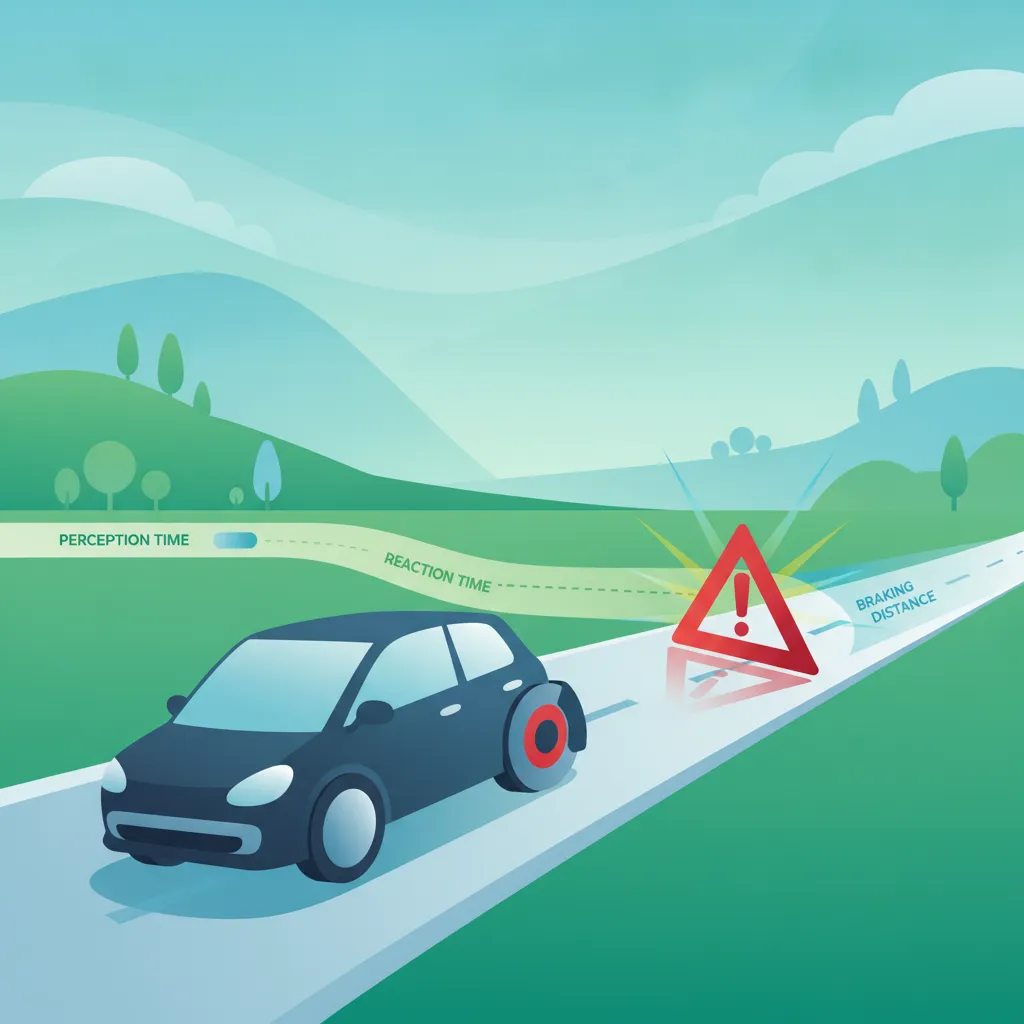
Reaction distance, known as Reaktionsweg in German driving theory, is a fundamental concept for understanding road safety and a key component of your total stopping distance. It is the distance your vehicle travels during the precise time it takes you, the driver, to perceive a hazard and then physically begin the braking process. During this critical interval, your car continues to move at its current speed, unaffected by any braking effort.
This distance is not negligible; it significantly contributes to the overall length required to bring a vehicle to a complete stop (Anhalteweg). Mastering the concept of Reaktionsweg is crucial not only for passing your German driving theory exam but more importantly, for making safe decisions on German roads, from bustling urban areas to high-speed Autobahns.
Understanding reaction distance goes beyond mere theoretical knowledge; it directly impacts your ability to drive safely in Germany and avoid collisions.
Reaktionsweg highlights the unavoidable delay inherent in this human process.Reaktionsweg is a core factor in calculating and intuitively understanding why adequate space is necessary, especially at higher speeds on the Autobahn where stopping distances are dramatically extended.Reaktionsweg are common in the German theory test, often involving calculations or scenarios where factors like speed, driver condition, or visibility are altered.The Reaktionsweg is essentially the distance covered during your "reaction time." This reaction time can be broken down into three main phases:
For an attentive driver under ideal conditions, this entire process usually takes approximately one second. During this one second, your vehicle travels a significant distance. This 1-second rule is a critical benchmark in German driving theory.
In the German driving theory exam, a widely used rule of thumb to estimate Reaktionsweg is:
Reaktionsweg (in meters) = (Speed in km/h / 10) × 3
Let's look at some examples:
This formula clearly demonstrates the direct relationship: if you double your speed, you double your Reaktionsweg. This is because the reaction time (the one second) remains constant, but the distance covered within that second increases proportionally with speed.
While the 1-second rule is a good general guideline for an alert driver, many factors can significantly prolong your reaction time and, consequently, your Reaktionsweg.
Reaktionsweg. In Germany, using a handheld mobile phone while driving is strictly prohibited and heavily penalized.Nebel), heavy rain (Starkregen), or snow (Schnee) reduce visibility, meaning hazards are perceived later, extending Reaktionsweg before a driver even processes the situation.It's crucial for your German theory exam and practical driving to understand the distinct components of stopping distance:
Reaktionsweg (Reaction Distance): As explained, this is the distance traveled during the driver's reaction time (perception, decision, physical action). The car is still traveling at full speed.Bremsweg (Braking Distance): This is the distance the vehicle travels from the moment the brakes are actually applied until the vehicle comes to a complete stop. This distance is affected by speed, road conditions (dry, wet, icy), vehicle condition (tyres, brakes), and the effectiveness of braking systems.Anhalteweg (Total Stopping Distance): This is the sum of both distances.
Anhalteweg = Reaktionsweg + BremswegIn German driving theory, the Bremsweg is typically calculated with a different rule of thumb: Bremsweg (in meters) = (Speed in km/h / 10) * (Speed in km/h / 10) or (Speed / 10) ^ 2.
For example, at 100 km/h:
Reaktionsweg = (100/10) * 3 = 30 metersBremsweg = (100/10) * (100/10) = 10 * 10 = 100 metersAnhalteweg = 30 + 100 = 130 metersThis distinction is vital because Reaktionsweg is primarily about the driver's state and speed, while Bremsweg involves vehicle and environmental factors in addition to speed. Both contribute significantly to the Anhalteweg.
Understanding Reaktionsweg is vital across various German road environments:
Reaktionsweg alone can be over 40 meters. If a vehicle ahead brakes suddenly, this initial distance means you've covered the length of several cars before your brakes even begin to work. This underscores why the "half-the-speed-in-meters" rule for Sicherheitsabstand (e.g., 65 meters at 130 km/h) is critical.Reaktionsweg is around 15 meters. In busy city traffic with pedestrians, cyclists, and sudden stops, this distance can be the difference between avoiding a collision and an accident, especially near schools or intersections.Reaktionsweg due to distraction or speed increases the risk significantly.Bremsweg. An extended Reaktionsweg due to slower hazard perception in these conditions further compounds the danger, making safe following distances even more critical.Learners and even experienced drivers often make these errors related to Reaktionsweg:
Reaktionsweg is often longer than anticipated, especially under stress.Reaktionsweg.Reaktionsweg calculation with the Bremsweg or emergency braking formulas during the German theory test.Reaktionsweg: Failing to account for the direct proportionality of Reaktionsweg to speed. A higher speed means a proportionally longer Reaktionsweg.Sicherheitsabstand: Not leaving enough space to account for their Reaktionsweg plus the Bremsweg for various conditions.The German driving license theory (Theoretische Fahrerlaubnisprüfung) places a strong emphasis on hazard perception (Gefahrenwahrnehmung or Verkehrswahrnehmung). Understanding Reaktionsweg is central to this. The official Straßenverkehrs-Ordnung (StVO) regulations implicitly demand that drivers anticipate hazards and maintain speeds that allow them to react safely within their Anhalteweg.
The 1-second reaction time is a foundational concept taught in German driving schools and tested in exams. This baseline helps learners internalize why maintaining focus and avoiding distractions is paramount. The practical implication is that a driver must always be bremsbereit (ready to brake) and vorausschauend (driving with foresight and anticipation) to minimize the impact of their Reaktionsweg.
Your Reaktionsweg is an unavoidable part of driving. To ensure safety on German roads and confidently pass your theory exam:
perception phase of your reaction time.Sicherheitsabstand according to conditions (weather, traffic, road type) and your own ability, recognizing how your Reaktionsweg extends with speed.By deeply understanding and respecting the Reaktionsweg, you equip yourself with a crucial mindset for responsible and safe driving in Germany.
Reaction distance (Reaktionsweg) represents the distance your vehicle travels during the time it takes you to perceive a hazard and begin braking, typically about 1 second. It is calculated using the formula (Speed ÷ 10) × 3, resulting in 15 meters at 50 km/h, 30 meters at 100 km/h, and 39 meters at 130 km/h. Factors such as fatigue, distraction, alcohol, and poor visibility can substantially increase this distance beyond the baseline. Understanding Reaktionsweg is essential because it combines with braking distance (Bremsweg) to form the total stopping distance (Anhalteweg), and mastering this concept is crucial for both safe driving in Germany and passing the theory exam.
A short set of high-value points that capture the most important ideas from this theory explanation.
Reaction distance (Reaktionsweg) is the distance traveled during the ~1 second it takes to perceive a hazard and physically apply the brakes
Reaction distance increases directly with speed: doubling your speed doubles your reaction distance
The formula for calculating reaction distance is: (Speed in km/h ÷ 10) × 3
Factors like fatigue, distraction, alcohol, and poor visibility can significantly extend reaction time beyond the 1-second baseline
Reaction distance is only one component of total stopping distance (Anhalteweg), which also includes braking distance
The standard reaction time baseline is approximately 1 second for an alert driver under ideal conditions
At 50 km/h: 15 meters; at 100 km/h: 30 meters; at 130 km/h: 39 meters of reaction distance
Anhalteweg = Reaktionsweg + Bremsweg: both distances must be considered for safe following distance
Fatigue, mobile phone use, alcohol, and poor visibility all extend reaction time and increase accident risk
Higher speed means proportionally longer reaction distance before any braking effect begins
Assuming reaction is instantaneous rather than recognizing the ~1 second baseline
Confusing the Reaktionsweg formula (÷10 × 3) with the Bremsweg formula ((÷10)²) during the theory exam
Not accounting for how fatigue, distraction, or emotional state extends reaction time beyond normal
Failing to adjust following distance when conditions like fog or rain reduce visibility and slow hazard perception
Underestimating how significantly speed affects reaction distance on high-speed roads like the Autobahn
Start with a short, direct summary of Reaction Distance Explained before reading the full explanation below.
Reaction distance is the distance your vehicle travels from the moment you detect a hazard to the instant you physically apply the brakes. Even under ideal conditions, this takes about one second, and during this time your car continues at its current speed. In German driving theory, understanding this gap is essential for safe driving, as factors like distraction, fatigue, or speed dramatically increase the distance covered before any braking effect. It is the first critical component of your total stopping distance.
Review the most important terms, rule signals, and traffic concepts linked to Reaction Distance Explained.
Explore related theory topic pages connected to Reaction Distance Explained and continue with the next useful rule explanation.
See the common search queries learners use when trying to understand Reaction Distance Explained in Germany.

Solidify your understanding of German road rules. Explore specific theory topics in detail, from priority rules to complex Autobahn situations. Review key concepts and prepare thoroughly for every aspect of your official driving license theory examination.
German Driving Theory TopicsTheory topic content overview
A short set of high-value points that capture the most important ideas from this theory explanation.
Reaction distance (Reaktionsweg) is the distance traveled during the ~1 second it takes to perceive a hazard and physically apply the brakes
Reaction distance increases directly with speed: doubling your speed doubles your reaction distance
The formula for calculating reaction distance is: (Speed in km/h ÷ 10) × 3
Factors like fatigue, distraction, alcohol, and poor visibility can significantly extend reaction time beyond the 1-second baseline
Reaction distance is only one component of total stopping distance (Anhalteweg), which also includes braking distance
The standard reaction time baseline is approximately 1 second for an alert driver under ideal conditions
At 50 km/h: 15 meters; at 100 km/h: 30 meters; at 130 km/h: 39 meters of reaction distance
Anhalteweg = Reaktionsweg + Bremsweg: both distances must be considered for safe following distance
Fatigue, mobile phone use, alcohol, and poor visibility all extend reaction time and increase accident risk
Higher speed means proportionally longer reaction distance before any braking effect begins
Assuming reaction is instantaneous rather than recognizing the ~1 second baseline
Confusing the Reaktionsweg formula (÷10 × 3) with the Bremsweg formula ((÷10)²) during the theory exam
Not accounting for how fatigue, distraction, or emotional state extends reaction time beyond normal
Failing to adjust following distance when conditions like fog or rain reduce visibility and slow hazard perception
Underestimating how significantly speed affects reaction distance on high-speed roads like the Autobahn
Start with a short, direct summary of Reaction Distance Explained before reading the full explanation below.
Reaction distance is the distance your vehicle travels from the moment you detect a hazard to the instant you physically apply the brakes. Even under ideal conditions, this takes about one second, and during this time your car continues at its current speed. In German driving theory, understanding this gap is essential for safe driving, as factors like distraction, fatigue, or speed dramatically increase the distance covered before any braking effect. It is the first critical component of your total stopping distance.
Review the most important terms, rule signals, and traffic concepts linked to Reaction Distance Explained.
Explore related theory topic pages connected to Reaction Distance Explained and continue with the next useful rule explanation.
See the common search queries learners use when trying to understand Reaction Distance Explained in Germany.
Solidify your understanding of German road rules. Explore specific theory topics in detail, from priority rules to complex Autobahn situations. Review key concepts and prepare thoroughly for every aspect of your official driving license theory examination.
German Driving Theory TopicsUse this exam-focused revision tip to understand how Reaction Distance Explained is likely to appear in theory questions for learners in Germany. This section helps you identify the most testable part of the rule, avoid common traps, and remember the concept more effectively during German driving theory exam preparation.
In German theory exams, remember that reaction distance (Reaktionsweg) is directly proportional to speed: double the speed, double the reaction distance. Pay close attention to questions involving speed changes, driver condition, or external factors like weather, as these directly impact your reaction time and, consequently, the distance traveled before braking.
Read direct answers to the most common learner questions about Reaction Distance Explained in Germany. This FAQ focuses on rule confusion, practical meaning, comparison with similar concepts, and the exact uncertainties that appear most often in German driving theory revision and exam preparation.
Reaction distance is the path your vehicle covers during the time it takes for you to notice a danger, decide to brake, and move your foot to the brake pedal. This period occurs before the brakes are physically engaged.
For a rough estimate in German driving theory, you can use the 'speed divided by 10, then multiplied by 3' rule (Geschwindigkeit : 10 x 3). For example, at 50 km/h, the reaction distance is approximately 15 meters.
Reaction distance is the distance covered before braking begins, while braking distance (Bremsweg) is the distance covered from the moment the brakes are applied until the vehicle stops completely. Together, they make up the total stopping distance (Anhalteweg).
Factors such as fatigue, distraction (e.g., mobile phone use), alcohol or drugs, stress, and poor visibility significantly extend your reaction time and thus your reaction distance. Driver inexperience can also play a role.
The German theory test frequently includes questions on how speed, attention, and various conditions affect stopping distances. Understanding reaction distance is fundamental to correctly answering these questions and for demonstrating a solid grasp of road safety principles in Germany.
While more experienced drivers might react slightly faster due to better hazard anticipation and routine, even they are susceptible to increased reaction times caused by fatigue, distractions, or external factors like poor weather conditions.
Begin your targeted revision now. Use our practice search to quickly find specific German driving theory questions. Filter by StVO rules, road signs, or hazard perception to create your focused study plan. Master challenging areas and prepare confidently for your theoretical driving test.