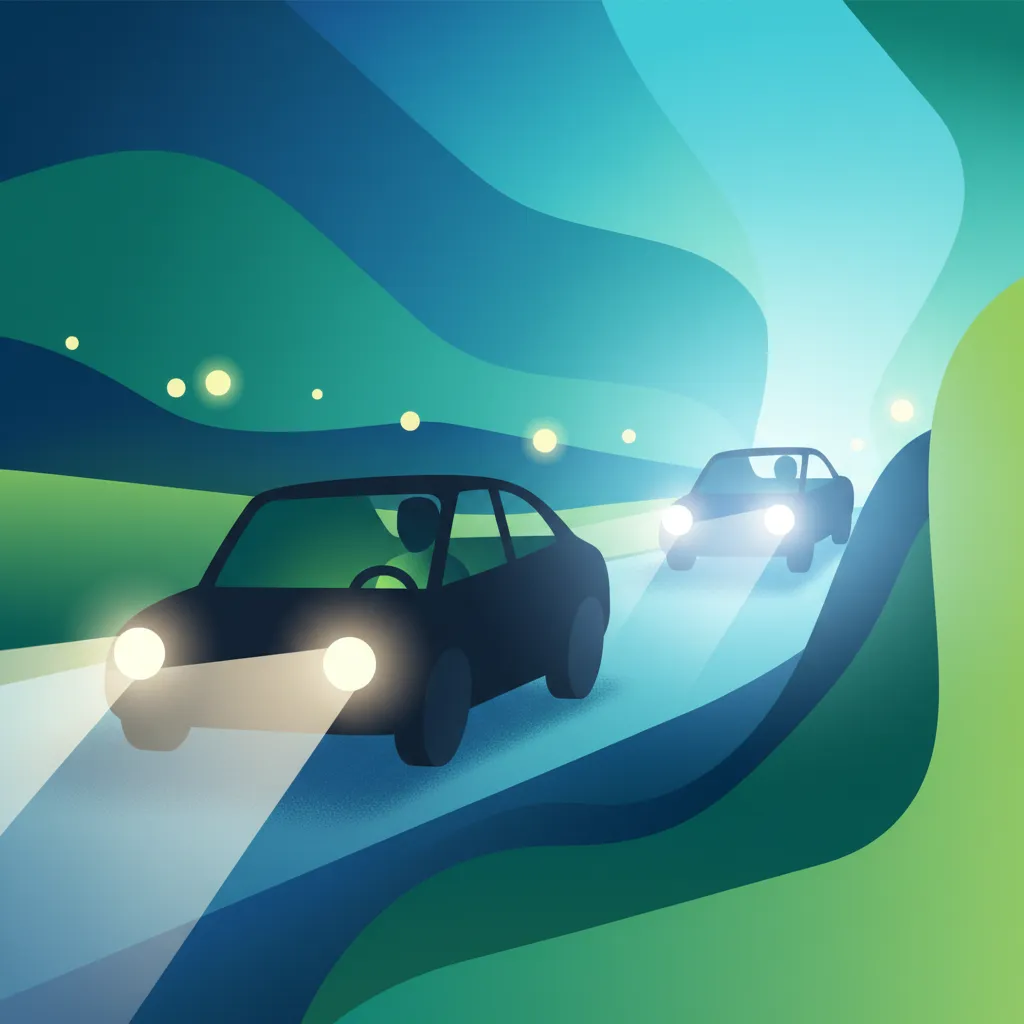
Driving at night presents a different set of challenges compared to daytime conditions. In Poland, you must adapt your driving style to account for significantly reduced visibility, the impact of headlight glare, and the increased likelihood of fatigue. Understanding these factors and knowing how to respond is crucial for your safety and the safety of other road users. This section covers key rules and practical tips for navigating Polish roads after dusk.
Theory topic content overview
Read the full theory topic guide for Night Driving Safety with structured, easy-to-scan content built for learners in Poland. This detailed section explains the exact rule, meaning, traffic context, comparison points, and exam logic behind this Polish driving theory topic so you can study faster, understand the concept more clearly, and avoid common interpretation mistakes on the theory test.
Driving at night fundamentally alters the driving environment by significantly reducing natural light and narrowing your field of vision. This isn't just about darkness; it's about the limited visibility your vehicle's headlights provide, which drastically reduces the distance at which you can identify hazards, react, and safely stop. Unlike driving in daylight, where a broad landscape is visible, night driving confines your sight to the illuminated cone ahead, creating unique risks on Polish roads.
The challenges of driving at night are not merely inconvenient; they are a major contributing factor to road accidents. In Poland, where road lighting can vary dramatically between well-lit urban centers (obszar zabudowany) and often completely unlit rural routes (obszar niezabudowany), understanding and adapting to these conditions is vital.
Your ability to detect hazards depends entirely on how far ahead you can see and identify potential dangers. At night, your headlights illuminate only a finite stretch of road. This means:
Headlights, while essential, also create one of night driving's biggest challenges: glare.
światła drogowe (high beams) or even światła mijania (low beams) of oncoming vehicles can temporarily impair your vision, a phenomenon known as oślepianie światłami (headlight glare). This glare can momentarily blind you, leaving you driving "blind" for several seconds.Driving at night naturally aligns with the body's circadian rhythm, which promotes sleep. This makes fatigue a much greater risk factor.
Safe night driving in Poland requires conscious adaptations to your driving technique.
światła mijania): Use these in all situations where high beams would dazzle others, including when driving in built-up areas (obszar zabudowany), when following another vehicle closely, or when meeting oncoming traffic.światła drogowe): Use high beams only on unlit roads outside built-up areas when there are no oncoming vehicles or vehicles directly ahead of you. Switch to low beams immediately if you see an oncoming vehicle, or when you are within approximately 100 meters of a vehicle you are following.prawe pobocze (right shoulder/edge of the road). This helps you maintain orientation and reduce the blinding effect, while still allowing you to monitor their position in your peripheral vision.bezpieczna prędkość (safe speed) will almost always be lower than the posted limit due to visibility constraints.światła przeciwmgłowe (fog lights), which are not generally used purely for darkness. High beams are never to be used in fog, as they reflect off the moisture and worsen visibility.droga niezabudowana): As you approach a sharp bend on a road with no streetlights, you must significantly reduce your speed before entering the curve. Your headlights only illuminate the road directly ahead, not around the bend. You must anticipate potential hazards (e.g., an animal, a slow-moving farm vehicle, or debris) that may become visible only at the last moment. You should use high beams until you see oncoming lights or the curve limits their effectiveness.światła mijania. Look towards the right edge of the jezdnia (carriageway) or prawe pobocze to avoid being blinded. Maintain your lane position and be prepared for a temporary reduction in your own vision after the other vehicle has passed.światła drogowe ): Not switching from high beams to low beams in time when encountering other road users is both dangerous and illegal. This oślepianie (dazzling) can cause accidents.Safe night driving in Poland hinges on one core principle: drive only as fast as your visibility allows. This means constantly assessing the reach of your headlights and reducing speed significantly on unlit roads, in adverse weather, or whenever your line of sight is restricted. Master the correct use of światła mijania and światła drogowe, learn to manage glare effectively, and prioritize rest to combat fatigue. These adaptations are not just good practice; they are essential for passing your Polish driving theory exam and for your safety on the road after dark.
Night driving in Poland requires significant adaptations because darkness limits visibility to the cone illuminated by your headlights, reducing reaction time and hazard detection. The core principle is that your speed must always allow you to stop safely within the distance you can see. Correct use of low beams and high beams is essential: low beams are mandatory in built-up areas and when meeting traffic, while high beams should only be used on unlit roads with no nearby vehicles. Managing glare by looking toward the right road edge, maintaining clean lights and windshield, and combating fatigue through regular breaks are all critical skills for safe night driving and for passing the Polish theory exam.
A short set of high-value points that capture the most important ideas from this theory explanation.
Your speed at night must always match the distance your headlights allow you to see and stop safely, not the posted speed limit
Use low beams (światła mijania) in built-up areas, when following other vehicles, and whenever oncoming traffic is present
Reserve high beams (światła drogowe) for unlit roads outside built-up areas only when no other vehicles are nearby
When meeting oncoming bright headlights, look toward the right edge of your lane to avoid temporary blindness
Night driving fatigue is a serious hazard; microsleeps can cause loss of control for several seconds
The speed limit is a maximum legal speed under ideal conditions, not a safe speed for night driving
Dark objects against dark backgrounds create a camouflage effect; pedestrians in dark clothing are nearly invisible
Switch from high beams to low beams when within approximately 100 meters of oncoming vehicles
A dirty windshield or headlights scatters light and significantly worsens visibility
Fatigue from driving at night aligns with your body's natural sleep rhythm, making it harder to stay alert
Driving at the speed limit regardless of how far headlights illuminate the road ahead
Failing to switch from high beams to low beams quickly enough when encountering oncoming traffic, causing dangerous dazzle
Staring directly into oncoming headlights instead of shifting gaze to the right edge of the lane
Pushing through tiredness rather than stopping for a rest when fatigue sets in
Neglecting to keep headlights and windshield clean, which drastically reduces effective visibility
Start with a short, direct summary of Night Driving Safety before reading the full explanation below.
Driving at night fundamentally alters your perception of the road, primarily due to reduced visibility and the stark contrast created by vehicle lights. Drivers must significantly lower their speed, increase observation, and be prepared for slower reaction times. Managing glare from oncoming headlights and recognizing the signs of fatigue are critical for safe navigation on Polish roads after dark.
Review the most important terms, rule signals, and traffic concepts linked to Night Driving Safety.
Explore related theory topic pages connected to Night Driving Safety and continue with the next useful rule explanation.
See the common search queries learners use when trying to understand Night Driving Safety in Poland.

Continue your preparation by exploring specific Polish driving theory topics in detail. Review each section to reinforce your understanding of traffic rules, road signs, and safe driving practices. Our comprehensive explanations are structured to support your learning journey and help you confidently approach the official driving licence theory exam.
Polish Driving Theory TopicsTheory topic content overview
A short set of high-value points that capture the most important ideas from this theory explanation.
Your speed at night must always match the distance your headlights allow you to see and stop safely, not the posted speed limit
Use low beams (światła mijania) in built-up areas, when following other vehicles, and whenever oncoming traffic is present
Reserve high beams (światła drogowe) for unlit roads outside built-up areas only when no other vehicles are nearby
When meeting oncoming bright headlights, look toward the right edge of your lane to avoid temporary blindness
Night driving fatigue is a serious hazard; microsleeps can cause loss of control for several seconds
The speed limit is a maximum legal speed under ideal conditions, not a safe speed for night driving
Dark objects against dark backgrounds create a camouflage effect; pedestrians in dark clothing are nearly invisible
Switch from high beams to low beams when within approximately 100 meters of oncoming vehicles
A dirty windshield or headlights scatters light and significantly worsens visibility
Fatigue from driving at night aligns with your body's natural sleep rhythm, making it harder to stay alert
Driving at the speed limit regardless of how far headlights illuminate the road ahead
Failing to switch from high beams to low beams quickly enough when encountering oncoming traffic, causing dangerous dazzle
Staring directly into oncoming headlights instead of shifting gaze to the right edge of the lane
Pushing through tiredness rather than stopping for a rest when fatigue sets in
Neglecting to keep headlights and windshield clean, which drastically reduces effective visibility
Start with a short, direct summary of Night Driving Safety before reading the full explanation below.
Driving at night fundamentally alters your perception of the road, primarily due to reduced visibility and the stark contrast created by vehicle lights. Drivers must significantly lower their speed, increase observation, and be prepared for slower reaction times. Managing glare from oncoming headlights and recognizing the signs of fatigue are critical for safe navigation on Polish roads after dark.
Review the most important terms, rule signals, and traffic concepts linked to Night Driving Safety.
Explore related theory topic pages connected to Night Driving Safety and continue with the next useful rule explanation.
See the common search queries learners use when trying to understand Night Driving Safety in Poland.
Continue your preparation by exploring specific Polish driving theory topics in detail. Review each section to reinforce your understanding of traffic rules, road signs, and safe driving practices. Our comprehensive explanations are structured to support your learning journey and help you confidently approach the official driving licence theory exam.
Polish Driving Theory TopicsUse this exam-focused revision tip to understand how Night Driving Safety is likely to appear in theory questions for learners in Poland. This section helps you identify the most testable part of the rule, avoid common traps, and remember the concept more effectively during Polish driving theory exam preparation.
On the Polish driving theory test, remember that driving speed at night must always be adjusted to the visibility provided by your headlights, not just the speed limit. Always be prepared to reduce speed significantly, especially on unlit or winding roads, and know how to avoid blinding other drivers or being blinded yourself.
Read direct answers to the most common learner questions about Night Driving Safety in Poland. This FAQ focuses on rule confusion, practical meaning, comparison with similar concepts, and the exact uncertainties that appear most often in Polish driving theory revision and exam preparation.
The primary dangers include severely reduced visibility, making it harder to spot hazards like pedestrians or unlit obstacles; blinding glare from oncoming headlights; and an increased risk of driver fatigue due to prolonged concentration in darkness.
Reduced visibility means you have less time to react to hazards. Your stopping distance at night should never exceed the distance illuminated by your headlights, requiring you to drive slower than during the day, especially on unlit roads.
To minimize the effects of glare, avoid looking directly into the headlights. Instead, focus your gaze slightly towards the right edge of the road or the right-hand white line until the vehicle has passed. You may also briefly adjust your interior rearview mirror to avoid glare from behind.
In Poland, you must switch from high beams to low beams when you are approaching an oncoming vehicle, following another vehicle closely, or when you are driving in built-up areas with sufficient street lighting. Switch to low beams early enough to avoid dazzling other drivers.
Maintain a clean windshield and properly adjusted headlights. Scan the road ahead and the verges for any movement or reflections. Reduce your speed significantly to give yourself more time to react, as your effective field of vision is much smaller.
Fatigue is a major risk factor at night, as the body naturally wants to rest. Tiredness impairs judgment, slows reaction times, and reduces concentration, making you more prone to accidents. If you feel drowsy, stop immediately and rest.
Yes, pedestrians and cyclists, especially outside built-up areas, are required to wear reflective elements at night to be visible. Drivers should always assume they might encounter unlit or poorly visible road users and adjust their speed and attention accordingly.
Build custom practice sessions tailored precisely to your needs. Focus on areas requiring improvement, review specific Polish road signs, or master complex traffic rules to ensure full preparation for your official driving license exam.