
Turning is a fundamental driving maneuver that requires careful attention and coordination. In Poland, adhering to precise rules for observation, signalling, and lane positioning is paramount to navigating intersections and changing direction without creating hazards. This page clarifies the steps involved in performing safe turns, emphasizing common scenarios and crucial yielding requirements.
Theory topic content overview
Read the full theory topic guide for Safe Turning with structured, easy-to-scan content built for learners in Poland. This detailed section explains the exact rule, meaning, traffic context, comparison points, and exam logic behind this Polish driving theory topic so you can study faster, understand the concept more clearly, and avoid common interpretation mistakes on the theory test.
Safe turning maneuvers encompass the systematic procedure drivers must follow when changing direction at intersections, junctions, or when entering another road. It's a fundamental driving skill that involves a series of coordinated actions: careful observation, timely signalling, precise lane positioning, and appropriate yielding to other road users, especially vulnerable ones like pedestrians and cyclists.
The goal of a safe turn is to complete the maneuver smoothly and without creating a hazard or conflict with other traffic. In Polish driving, this requires strict adherence to specific rules designed to maintain continuous traffic flow and prevent collisions.
Mastering safe turning is not just about convenience; it's a cornerstone of road safety and a critical element in the Polish driving theory exam. Misunderstanding or incorrectly executing turns is a common cause of accidents, particularly involving pedestrians and cyclists, who often have priority at intersections where vehicles are turning.
For drivers in Poland, understanding these procedures is vital because:
Executing a safe turn is a sequential process requiring concentration and anticipation. Each step is crucial for preventing conflicts.
Before you even think about turning, a thorough observation of your surroundings is paramount. This includes:
Your signal is your communication to other road users. It must be:
Proper lane positioning clarifies your intention and helps prevent other drivers from misinterpreting your actions.
Several factors influence how safely a turn can be executed:
In Poland, a crucial aspect of safe turning, particularly at intersections, involves understanding and respecting priority rules. While general right-of-way rules apply, specific scenarios during turns place a significant responsibility on the turning driver.
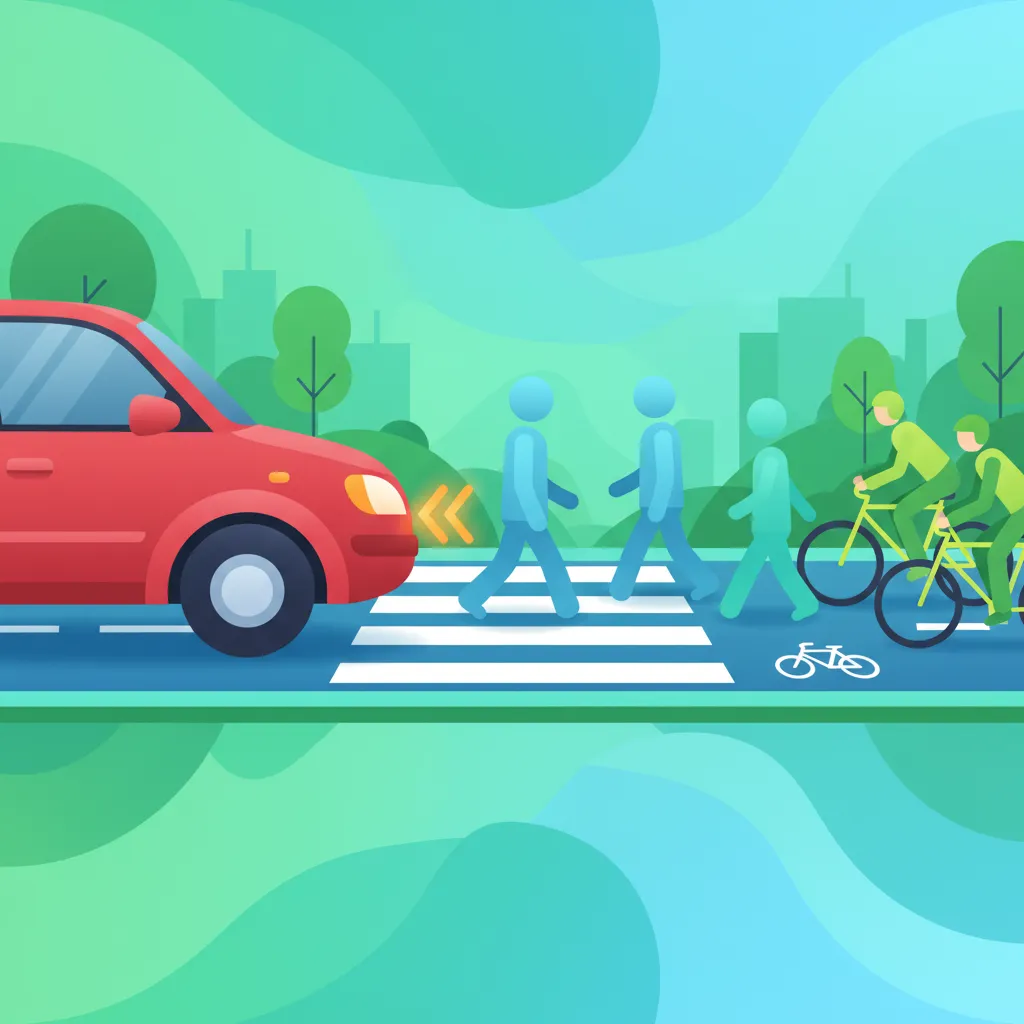
Pieszy)When turning, you must yield to pedestrians who are crossing or about to cross the road you are entering. This rule is especially critical for right turns, where a pedestrian crossing on a zebra crossing (marked przejście dla pieszych) or even an unmarked but frequented crossing point on the street you are turning into, has priority. Even if there is no specific yield sign, the turning vehicle must give way. This is a common point of emphasis in Polish driving exams.
Rowerzysta)You must also yield to cyclists who are travelling straight ahead on a cycle path or in a designated lane that runs alongside the road you are turning into. This applies whether you are turning right or left. For instance, if you are turning right and a cyclist is continuing straight on a bike path parallel to the main road, the cyclist has priority. This rule is often tested and can be a point of confusion for new drivers.
General priority rules apply:
ustąp pierwszeństwa) or stop signs (STOP).Consider these common scenarios in Poland:
Learners and even experienced drivers often make mistakes when turning, leading to dangerous situations or failed exam attempts in Poland:
The Polish driving theory exam places a strong emphasis on turning procedures, particularly regarding priority for vulnerable road users. You can expect questions that test your knowledge of:
Remember, the exam often includes visual questions (pictures or animations) of intersections, requiring you to correctly identify the safe action, especially when it involves giving way to pieszy (pedestrian) or rowerzysta (cyclist).
To ensure every turn you make is a safe one on Polish roads, remember this essential mental checklist:
Safe turning in Polish traffic is a systematic four-step process involving observation, signalling, lane positioning, and yielding. Critical exam content focuses on the mandatory yielding to pedestrians and cyclists when turning, as these vulnerable road users always have priority even without explicit signs. Correct lane positioning varies by turn direction, and observation must include mirrors, blind spots, and a broad scan of the environment. The step-by-step procedure, combined with awareness of priority rules and common mistakes, forms the core knowledge tested in the Polish driving theory exam.
A short set of high-value points that capture the most important ideas from this theory explanation.
A safe turn requires four sequential steps: thorough observation, timely signalling, correct lane positioning, and smooth execution while yielding to others.
When turning in Poland, you must always yield to pedestrians crossing the road you are entering, even without a specific yield sign.
Cyclists traveling on a bike path parallel to your road have priority over your turn, regardless of whether you are turning right or left.
Proper lane positioning differs by turn direction: position right for right turns, towards the centerline for left turns.
Mirror checks, blind spot inspections, and scanning for vulnerable road users are mandatory before and during any turn.
Signal at least 30 meters before turning in urban areas to give other road users adequate time to react.
Right turns: position close to the right edge; Left turns: position towards the centerline or dedicated left-turn lane.
Turning drivers must yield to pedestrians on zebra crossings (przejście dla pieszych) and cyclists on parallel bike paths crossing their path.
After completing a turn, cancel your indicator if it does not automatically switch off.
In poor visibility or adverse weather conditions, reduce speed significantly and increase observation intensity.
Failing to check blind spots, particularly for cyclists and motorcyclists who may be hidden from mirrors.
Signalling too late or not at all, which gives other road users insufficient time to react to your intentions.
Incorrect lane positioning, such as turning from the center of the lane on a right turn, which can conflict with adjacent lane traffic.
Assuming only oncoming traffic poses a hazard while neglecting pedestrians, cyclists, and parked vehicles (tunnel vision).
Disregarding the mandatory yield to pedestrians and cyclists when turning, a frequent exam pitfall.
Start with a short, direct summary of Safe Turning before reading the full explanation below.
Safe turning in Poland involves a systematic procedure: first, observe your surroundings, check mirrors, and look for vulnerable road users. Second, clearly signal your intention well in advance. Third, position your vehicle correctly within the lane for the turn. Finally, execute the turn smoothly and always yield to pedestrians and cyclists crossing the road you intend to enter, as well as to other vehicles with priority.
Review the most important terms, rule signals, and traffic concepts linked to Safe Turning.
Explore related theory topic pages connected to Safe Turning and continue with the next useful rule explanation.
See the common search queries learners use when trying to understand Safe Turning in Poland.

Continue your preparation by exploring specific Polish driving theory topics in detail. Review each section to reinforce your understanding of traffic rules, road signs, and safe driving practices. Our comprehensive explanations are structured to support your learning journey and help you confidently approach the official driving licence theory exam.
Polish Driving Theory TopicsTheory topic content overview
A short set of high-value points that capture the most important ideas from this theory explanation.
A safe turn requires four sequential steps: thorough observation, timely signalling, correct lane positioning, and smooth execution while yielding to others.
When turning in Poland, you must always yield to pedestrians crossing the road you are entering, even without a specific yield sign.
Cyclists traveling on a bike path parallel to your road have priority over your turn, regardless of whether you are turning right or left.
Proper lane positioning differs by turn direction: position right for right turns, towards the centerline for left turns.
Mirror checks, blind spot inspections, and scanning for vulnerable road users are mandatory before and during any turn.
Signal at least 30 meters before turning in urban areas to give other road users adequate time to react.
Right turns: position close to the right edge; Left turns: position towards the centerline or dedicated left-turn lane.
Turning drivers must yield to pedestrians on zebra crossings (przejście dla pieszych) and cyclists on parallel bike paths crossing their path.
After completing a turn, cancel your indicator if it does not automatically switch off.
In poor visibility or adverse weather conditions, reduce speed significantly and increase observation intensity.
Failing to check blind spots, particularly for cyclists and motorcyclists who may be hidden from mirrors.
Signalling too late or not at all, which gives other road users insufficient time to react to your intentions.
Incorrect lane positioning, such as turning from the center of the lane on a right turn, which can conflict with adjacent lane traffic.
Assuming only oncoming traffic poses a hazard while neglecting pedestrians, cyclists, and parked vehicles (tunnel vision).
Disregarding the mandatory yield to pedestrians and cyclists when turning, a frequent exam pitfall.
Start with a short, direct summary of Safe Turning before reading the full explanation below.
Safe turning in Poland involves a systematic procedure: first, observe your surroundings, check mirrors, and look for vulnerable road users. Second, clearly signal your intention well in advance. Third, position your vehicle correctly within the lane for the turn. Finally, execute the turn smoothly and always yield to pedestrians and cyclists crossing the road you intend to enter, as well as to other vehicles with priority.
Review the most important terms, rule signals, and traffic concepts linked to Safe Turning.
Explore related theory topic pages connected to Safe Turning and continue with the next useful rule explanation.
See the common search queries learners use when trying to understand Safe Turning in Poland.
Continue your preparation by exploring specific Polish driving theory topics in detail. Review each section to reinforce your understanding of traffic rules, road signs, and safe driving practices. Our comprehensive explanations are structured to support your learning journey and help you confidently approach the official driving licence theory exam.
Polish Driving Theory TopicsUse this exam-focused revision tip to understand how Safe Turning is likely to appear in theory questions for learners in Poland. This section helps you identify the most testable part of the rule, avoid common traps, and remember the concept more effectively during Polish driving theory exam preparation.
In the Polish driving theory exam, pay close attention to questions involving turning and priority, especially concerning pedestrians and cyclists. Remember that you must always yield to these vulnerable road users when turning, even if there isn't a specific 'yield' sign. Correct lane positioning and timely signalling are also frequent exam topics.
Read direct answers to the most common learner questions about Safe Turning in Poland. This FAQ focuses on rule confusion, practical meaning, comparison with similar concepts, and the exact uncertainties that appear most often in Polish driving theory revision and exam preparation.
The key steps are observing your surroundings, signalling your intentions, positioning your vehicle correctly, checking blind spots, and yielding to any road users with priority before executing the turn smoothly.
Signalling informs other road users of your intention to turn, allowing them to anticipate your maneuver and adjust their speed or position, thereby preventing potential conflicts.
When turning right, you generally must yield to pedestrians and cyclists who are crossing the road you intend to enter, as they typically have priority.
Correct lane positioning clarifies your turning intent to other drivers and helps prevent conflicts, especially in situations with multiple lanes or complex intersections.
Common mistakes include failing to check blind spots for cyclists, not yielding to pedestrians, signalling too late, or turning at an inappropriate speed.
While the general procedure is similar, yielding requirements often differ. Turning left often involves yielding to oncoming traffic and vulnerable road users, while turning right primarily involves yielding to pedestrians and cyclists crossing the path of the turn.
Always be highly aware of pedestrians and cyclists. Assume they might not see you and be prepared to yield to them, especially when they are crossing the road you are turning into. Maintain eye contact if possible.
You should reduce your speed before entering a turn to maintain control, respond to unexpected hazards, and avoid skidding, especially in wet or slippery conditions. The appropriate speed will depend on road conditions and visibility.
Build custom practice sessions tailored precisely to your needs. Focus on areas requiring improvement, review specific Polish road signs, or master complex traffic rules to ensure full preparation for your official driving license exam.