
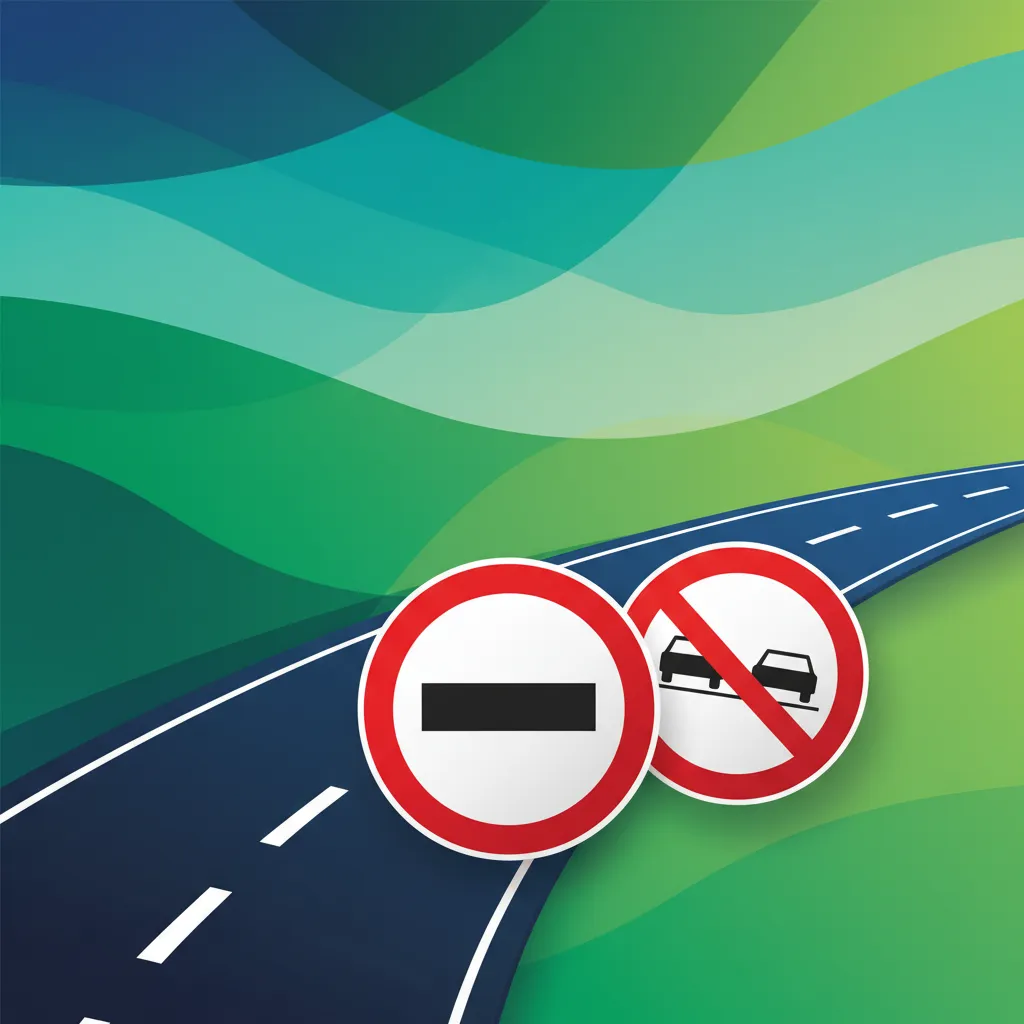
Prohibition signs, known as `Znaki Zakazu` in Poland, are a fundamental category of traffic signs that legally forbid specific actions to maintain safety and regulate traffic flow. These signs are instantly recognizable, typically featuring a circular shape with a red border, and are crucial for all drivers to understand and obey. Correctly interpreting them helps prevent dangerous situations and ensures predictable road behavior across Poland.
Theory topic content overview
Read the full theory topic guide for Prohibition Signs with structured, easy-to-scan content built for learners in Poland. This detailed section explains the exact rule, meaning, traffic context, comparison points, and exam logic behind this Polish driving theory topic so you can study faster, understand the concept more clearly, and avoid common interpretation mistakes on the theory test.
Znaki Zakazu) on Polish RoadsProhibition signs, known as Znaki Zakazu in Polish road law, are a fundamental category of traffic signs designed to legally forbid specific actions or manoeuvres. These signs are critical for maintaining road safety, regulating traffic flow, and preventing dangerous situations across Poland's diverse road network. For anyone learning to drive in Poland, mastering the interpretation of Znaki Zakazu is not just crucial for passing the driving theory exam but essential for safe and compliant driving every day.
Znaki Zakazu? The Core ConceptAt their core, Znaki Zakazu communicate a clear "do not" message to drivers. They legally prohibit certain actions, such as entering a road, turning, overtaking, or exceeding a specified speed. In Poland, these signs are instantly recognisable by their distinctive appearance: they are almost always circular with a red border and a black symbol or text on a white or blue background, clearly indicating a restriction.
Understanding Znaki Zakazu means recognising not just the symbol, but also appreciating the legal weight behind them. Ignoring these signs is not only dangerous but carries legal consequences, including fines and penalty points.
Znaki Zakazu Matter for Polish DriversThe importance of Znaki Zakazu extends beyond mere compliance:
Znaki Zakazu are legally binding instruments of the Prawo o ruchu drogowym (Road Traffic Law). Non-compliance can lead to significant penalties.Znaki Zakazu are a heavily tested area in the Polish driving theory exam. Questions often focus on their specific meanings, exceptions, the influence of accompanying panels (tabliczki), and their duration of validity.Znaki Zakazu Work in Practice on Polish RoadsWhen you encounter a Znak Zakazu, it mandates a specific restriction. Here's how they generally operate:
B-25 Zakaz wyprzedzania).tabliczka (information panel), the prohibition begins directly at the point where the sign is placed.Znak Zakazu typically remains valid until one of the following occurs:
B-42 Koniec zakazów - End of all prohibitions, or a specific end sign like B-34 Koniec ograniczenia prędkości - End of speed limit).obszar zabudowany) or residential zone (strefa zamieszkania), if the sign applies to that specific zone.Znaki Zakazu:B-1 Zakaz ruchu w obu kierunkach (No entry for all vehicles): Prohibits traffic in both directions.B-2 Zakaz wjazdu (No entry): Prohibits entry into a street or road section for vehicles from the direction of the sign.B-23 Zakaz zawracania (No U-turn): Forbids making a U-turn.B-33 Ograniczenie prędkości (Speed Limit): Indicates the maximum permissible speed.B-35 Zakaz postoju (No Waiting): Prohibits stopping a vehicle for longer than one minute.B-36 Zakaz zatrzymywania się (No Stopping): Prohibits stopping or waiting, even briefly, except due to traffic conditions or regulations.Tabliczki that Modify Znaki ZakazuIn Poland, Znaki Zakazu are frequently accompanied by tabliczki (information panels) that clarify or modify the scope of the prohibition. Understanding these panels is crucial:
Tabliczki can indicate the distance over which the prohibition applies (e.g., T-2 showing distance) or from which point the prohibition begins (e.g., T-1 for start of prohibition).tabliczki below the main sign (e.g., "7-18" or "Pon-Pt" for Monday-Friday).tabliczka might specify that the prohibition applies only to certain types of vehicles, for example, limiting a speed restriction to lorries or buses, or exempting local residents.(F-10) can indicate that the prohibition applies only to a specific lane.Polish road rules feature several distinctions crucial for avoiding common mistakes:
B-1 Zakaz ruchu w obu kierunkach vs. B-2 Zakaz wjazdu:
B-1 (a red circle with a white horizontal bar) means no entry for any road users (vehicles, pedestrians, cyclists) in both directions. It often marks a completely closed road.B-2 (a red circle with a white vertical bar) means "No Entry" from your direction. It typically marks the entry point of a one-way street, where traffic flows towards you. You can exit from such a street, but not enter it.B-35 Zakaz postoju (No Waiting) vs. B-36 Zakaz zatrzymywania się (No Stopping):
B-35 (red circle, blue background, red diagonal line) allows stopping briefly (up to 1 minute) for passenger pick-up/drop-off or goods loading/unloading, if the driver remains with the vehicle.B-36 (red circle, blue background, red 'X') is much stricter. It prohibits any stopping or waiting, even for a moment, unless forced by traffic conditions (e.g., red light, traffic jam).Znaki Zakazu vs. Znaki Ostrzegawcze (Warning Signs): Warning signs (Znaki Ostrzegawcze) are typically yellow triangles with a red border and advise of potential hazards ahead, requiring caution. Znaki Zakazu are red circles and legally forbid actions.Znaki Zakazu vs. Znaki Nakazu (Mandatory Signs): Mandatory signs (Znaki Nakazu) are blue circles with white symbols that oblige drivers to perform a specific action or follow a direction (e.g., "Turn Left Ahead"). Znaki Zakazu forbid, Znaki Nakazu command.Znaki Zakazu in PolandB-2 Zakaz wjazdu sign at the entrance to a narrow, historic street in Gdańsk. This tells you that vehicle entry from your direction is forbidden, likely because it's a one-way street flowing the other way, or reserved for specific vehicles.obszar zabudowany): You pass a B-33 Ograniczenie prędkości sign displaying "50" km/h. This speed limit remains in effect until you either pass a B-34 Koniec ograniczenia prędkości sign, the next intersection, or leave the obszar zabudowany area (indicated by D-43 Koniec obszaru zabudowanego).B-36 Zakaz zatrzymywania się sign near a bus stop in Poznań. This means you cannot stop your vehicle there for any reason, even to quickly drop off a passenger, as it would obstruct public transport.Znaki Zakazutabliczki: Many learners focus only on the main sign, overlooking the crucial details provided by accompanying panels which can drastically alter the sign's meaning or applicability (e.g., specific times, vehicle types).B-1 and B-2: This is a classic exam trap. Remember, B-1 blocks all traffic in both directions, while B-2 blocks entry from your direction into what might be a one-way street.Zakaz postoju and Zakaz zatrzymywania się: Incorrectly assuming "no parking" means "no stopping at all" or vice-versa, leading to potential fines.B-33 is a legal maximum, not a target speed, and drivers must always adjust their speed to conditions, even if it means driving below the posted limit.Znaki Zakazu in the Polish Driving Theory ExamSuccess in the Polish driving theory exam requires more than just memorising Znaki Zakazu symbols. You need to:
tabliczki: Exam questions frequently use tabliczki to add complexity. Always consider them.B-1 and B-2, or parking/stopping prohibitions.Znaki Zakazu are your legal guide to what you cannot do on Polish roads. Always respect the red circle as a clear signal of a restriction. Before acting, quickly interpret the main symbol and any accompanying tabliczki. Remember that these signs are designed for your safety and the safety of others, ensuring predictable and orderly traffic flow across Poland. By mastering Znaki Zakazu, you demonstrate a fundamental understanding of Polish road rules, which is vital for both your exam success and your journey as a responsible driver.
Znaki Zakazu (Prohibition Signs) are fundamental to Polish road safety, legally forbidding specific actions through clear visual codes. These signs feature a red circle design and include important distinctions such as B-1 blocking all traffic in both directions versus B-2 blocking entry only from the sign's direction, and B-35 allowing brief stops versus B-36 prohibiting any stopping. Tabliczki (information panels) frequently modify these signs by adding time restrictions, vehicle-specific exceptions, or distance parameters, making them essential to interpret correctly. A prohibition remains valid from the sign's location until the next intersection, a cancellation sign, or leaving a built-up area. For the Polish driving theory exam, learners must focus on precise sign meanings, tabliczki modifiers, and validity rules while avoiding common confusions between visually similar but legally distinct signs.
A short set of high-value points that capture the most important ideas from this theory explanation.
Prohibition signs (Znaki Zakazu) are legally binding restrictions indicated by a red circle with a black symbol or text on white/blue background
Sign codes B-1 and B-2 are often confused: B-1 blocks all traffic in both directions, while B-2 blocks only entry from your direction
Tabliczki (information panels) beneath a sign can modify its meaning by adding time restrictions, vehicle type exceptions, or distance parameters
A prohibition sign remains valid until the next intersection, an end sign, or leaving a built-up area/zone
B-35 allows stopping up to 1 minute (no waiting), while B-36 prohibits any stopping including momentary pauses (no stopping)
The prohibition begins at the sign's location unless a tabliczka specifies otherwise
B-1 (red circle, white horizontal bar) prohibits all road users in both directions; B-2 (red circle, white vertical bar) prohibits entry only from the sign's direction
B-35 (blue background, red diagonal line) permits brief stops if the driver stays with the vehicle; B-36 (blue background, red X) permits no stopping at all
Warning signs (Znaki Ostrzegawcze) are yellow triangles with red border; Mandatory signs (Znaki Nakazu) are blue circles with white symbols
The prohibition ends at the next intersection, a cancellation sign like B-42 (Koniec zakazów), or when leaving the applicable zone
Ignoring tabliczki and missing crucial modifiers like time restrictions, vehicle exceptions, or distance information
Confusing B-1 and B-2 in exam questions, particularly misinterpreting B-2 as blocking an entire street rather than entry from one direction
Assuming B-35 (no waiting) means no stopping at all, or that B-36 (no stopping) allows brief passenger drop-offs
Forgetting that prohibition ends at intersections and continuing restrictions beyond their valid scope
Assuming speed limit signs (B-33) are target speeds rather than legal maximums that still require adjustment for conditions
Start with a short, direct summary of Prohibition Signs before reading the full explanation below.
Prohibition signs are road signs that indicate actions drivers are legally not allowed to perform. In Poland, these are called `Znaki Zakazu` and are usually circular with a red border and a black symbol or text. They are essential for road safety, preventing specific maneuvers like entering a street, overtaking, or parking, and are legally binding from their placement until lifted by another sign or an intersection.
Review the most important terms, rule signals, and traffic concepts linked to Prohibition Signs.
Explore related theory topic pages connected to Prohibition Signs and continue with the next useful rule explanation.
See the common search queries learners use when trying to understand Prohibition Signs in Poland.

Continue your preparation by exploring specific Polish driving theory topics in detail. Review each section to reinforce your understanding of traffic rules, road signs, and safe driving practices. Our comprehensive explanations are structured to support your learning journey and help you confidently approach the official driving licence theory exam.
Polish Driving Theory TopicsTheory topic content overview
A short set of high-value points that capture the most important ideas from this theory explanation.
Prohibition signs (Znaki Zakazu) are legally binding restrictions indicated by a red circle with a black symbol or text on white/blue background
Sign codes B-1 and B-2 are often confused: B-1 blocks all traffic in both directions, while B-2 blocks only entry from your direction
Tabliczki (information panels) beneath a sign can modify its meaning by adding time restrictions, vehicle type exceptions, or distance parameters
A prohibition sign remains valid until the next intersection, an end sign, or leaving a built-up area/zone
B-35 allows stopping up to 1 minute (no waiting), while B-36 prohibits any stopping including momentary pauses (no stopping)
The prohibition begins at the sign's location unless a tabliczka specifies otherwise
B-1 (red circle, white horizontal bar) prohibits all road users in both directions; B-2 (red circle, white vertical bar) prohibits entry only from the sign's direction
B-35 (blue background, red diagonal line) permits brief stops if the driver stays with the vehicle; B-36 (blue background, red X) permits no stopping at all
Warning signs (Znaki Ostrzegawcze) are yellow triangles with red border; Mandatory signs (Znaki Nakazu) are blue circles with white symbols
The prohibition ends at the next intersection, a cancellation sign like B-42 (Koniec zakazów), or when leaving the applicable zone
Ignoring tabliczki and missing crucial modifiers like time restrictions, vehicle exceptions, or distance information
Confusing B-1 and B-2 in exam questions, particularly misinterpreting B-2 as blocking an entire street rather than entry from one direction
Assuming B-35 (no waiting) means no stopping at all, or that B-36 (no stopping) allows brief passenger drop-offs
Forgetting that prohibition ends at intersections and continuing restrictions beyond their valid scope
Assuming speed limit signs (B-33) are target speeds rather than legal maximums that still require adjustment for conditions
Start with a short, direct summary of Prohibition Signs before reading the full explanation below.
Prohibition signs are road signs that indicate actions drivers are legally not allowed to perform. In Poland, these are called `Znaki Zakazu` and are usually circular with a red border and a black symbol or text. They are essential for road safety, preventing specific maneuvers like entering a street, overtaking, or parking, and are legally binding from their placement until lifted by another sign or an intersection.
Review the most important terms, rule signals, and traffic concepts linked to Prohibition Signs.
Explore related theory topic pages connected to Prohibition Signs and continue with the next useful rule explanation.
See the common search queries learners use when trying to understand Prohibition Signs in Poland.
Continue your preparation by exploring specific Polish driving theory topics in detail. Review each section to reinforce your understanding of traffic rules, road signs, and safe driving practices. Our comprehensive explanations are structured to support your learning journey and help you confidently approach the official driving licence theory exam.
Polish Driving Theory TopicsUse this exam-focused revision tip to understand how Prohibition Signs is likely to appear in theory questions for learners in Poland. This section helps you identify the most testable part of the rule, avoid common traps, and remember the concept more effectively during Polish driving theory exam preparation.
In the Polish driving theory exam, be careful not to confuse prohibition signs with warning or mandatory signs. Pay close attention to the specific symbol and any accompanying `tabliczki` (panels), as these can modify the prohibition's scope or duration. Remember that 'no entry' (B-2) is different from 'no vehicles' (B-1).
Read direct answers to the most common learner questions about Prohibition Signs in Poland. This FAQ focuses on rule confusion, practical meaning, comparison with similar concepts, and the exact uncertainties that appear most often in Polish driving theory revision and exam preparation.
Prohibition signs are traffic signs that indicate actions or behaviors that road users are legally forbidden from performing. They are crucial for maintaining order and safety on the road.
In Poland, prohibition signs (`Znaki Zakazu`) are generally circular with a red border and a black symbol or text on a white or blue background. The red border signifies a prohibition.
Common examples include 'No Entry' (B-2), 'No Overtaking' (B-25), 'No Parking' (B-35), 'No Stopping' (B-36), and 'Speed Limit' (B-33).
Not necessarily. While many apply continuously, some prohibition signs may have specific conditions or times of application, which can be indicated by additional panels (tabliczki) below the main sign.
Ignoring a prohibition sign in Poland can lead to legal penalties, including fines and penalty points, and can also contribute to dangerous traffic situations or accidents.
In Poland, a prohibition typically begins at the point where the sign is placed and remains in effect until the next intersection, until a specific 'end of prohibition' sign, or until another sign introduces a different regulation.
Prohibition signs (`Znaki Zakazu`) forbid actions, while warning signs (`Znaki Ostrzegawcze`) alert drivers to potential dangers ahead. Warning signs are typically triangular with a red border, whereas prohibition signs are mostly circular with a red border.
Build custom practice sessions tailored precisely to your needs. Focus on areas requiring improvement, review specific Polish road signs, or master complex traffic rules to ensure full preparation for your official driving license exam.