
In Poland, correct vehicle lighting is not just about seeing; it's also about being seen. This page details the mandatory use of headlights and other lights under specific conditions, from daily driving to challenging weather. Mastering these rules ensures your safety and compliance with Polish traffic law.
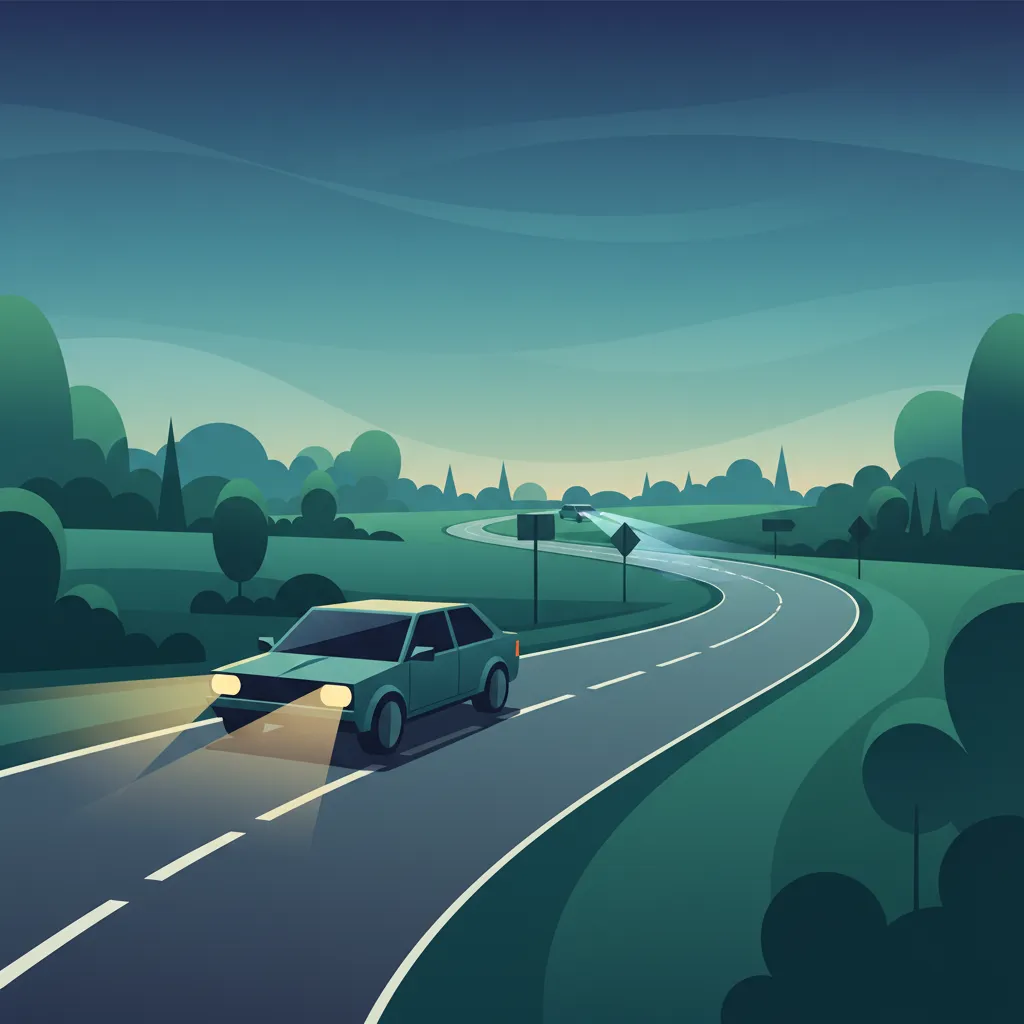
Theory topic content overview
Read the full theory topic guide for Headlight Rules with structured, easy-to-scan content built for learners in Poland. This detailed section explains the exact rule, meaning, traffic context, comparison points, and exam logic behind this Polish driving theory topic so you can study faster, understand the concept more clearly, and avoid common interpretation mistakes on the theory test.
In Poland, understanding vehicle lighting, particularly headlights, is fundamental for both road safety and successfully navigating the driving theory exam. Vehicle lights serve a dual purpose: they allow you, the driver, to see the road and potential hazards ahead, and equally importantly, they ensure your vehicle is seen by other road users, preventing collisions. This concept of "seeing and being seen" (widzieć i być widzianym) is central to Polish traffic law concerning oświetlenie pojazdu (vehicle lighting).
Proper use of headlights and other lights is not merely a courtesy; it's a legal obligation (obowiązek prawny) under the Polish Road Traffic Law (Prawo o ruchu drogowym) that directly impacts accident prevention, especially in Poland's varied weather conditions, from clear summer nights to dense winter fogs.
Misinterpreting lighting rules is a frequent cause of errors in the Polish driving theory exam and contributes to real-world road incidents. The exam specifically tests your knowledge of:
oślepienie (blinding).Mastering these distinctions is crucial for demonstrating your readiness to drive safely on Polish roads.
Polish regulations specify several types of lights, each with a distinct purpose and set of rules:
Światła do jazdy dziennej)od świtu do zmierzchu) if there is normal air transparency (normalna przejrzystość powietrza).Światła mijania)Światła drogowe)światła drogowe, often called długie światła) only from dusk to dawn (od zmierzchu do świtu) on unlit roads, provided you do not dazzle (oślepiać) other drivers or pedestrians.Światła przeciwmgłowe przednie)mgła - fog, heavy rain, snow).Światła przeciwmgłowe tylne)mgła, heavy snow, or rain).Your choice of lights in Poland depends on several factors:
Mgła (fog), deszcz (rain), śnieg (snow) significantly reduce visibility and demand appropriate lighting.oślepiać) others.Learners in Poland often confuse the appropriate use of different lights. Here are key distinctions to remember:
światła mijania (low beams) to avoid dazzling.autostrada) in sudden thick fog: If visibility drops below 50 meters, you must activate your światła przeciwmgłowe tylne (rear fog lights) to make your vehicle visible from behind. Reduce speed significantly. You may also activate światła przeciwmgłowe przednie (front fog lights).droga kręta) at 8 PM in July (clear visibility): Even though visibility is good, because it's from zmierzch do świtu (dusk to dawn) and on a winding road with appropriate signage, you may activate your front fog lights to improve cornering visibility.światła mijania (low beam headlights).Always remember the "See and Be Seen" principle in Poland. The correct use of headlights and other vehicle lighting is a cornerstone of safe driving and a critical part of Polish road regulations. Adapt your lighting instantly to changing conditions, prioritize not dazzling others, and be vigilant about the 50-meter rule for rear fog lights. Your awareness and correct actions directly contribute to your safety and the safety of all road users in Poland.
Polish vehicle lighting regulations are built on the principle of 'seeing and being seen' and require drivers to use appropriate lights based on time of day, weather, and road conditions. Low beam headlights are the baseline requirement at all times, with daytime running lights only permitted as an alternative during daylight hours with normal visibility. High beam headlights are restricted to unlit roads at night when alone, and are never permitted in fog. Rear fog lights have a strict 50-meter visibility threshold that determines both activation and deactivation, while front fog lights also serve a specific function on sign-posted winding roads from dusk to dawn. Understanding these distinctions and the mandatory conditions for each light type is essential for both passing the Polish driving theory exam and safe practical driving.
A short set of high-value points that capture the most important ideas from this theory explanation.
Vehicle lights serve a dual purpose: they allow you to see the road ahead and ensure your vehicle is seen by other road users
Low beam headlights are mandatory at all times under normal visibility, day and night, with the only daytime exception being daytime running lights from dawn to dusk
High beam headlights may only be used from dusk to dawn on unlit roads when you are alone and cannot dazzle other road users
Rear fog lights must be activated when visibility drops below 50 meters and switched off immediately once visibility improves beyond 50 meters
Front fog lights can be used in reduced visibility conditions or on sign-posted winding roads from dusk to dawn even with normal visibility
The 50-meter threshold for rear fog lights: mandatory below 50m visibility, must be deactivated above 50m
Daytime running lights are never a substitute for low beams in tunnels, rain, fog, snow, or after dusk
High beams are never permitted in fog because light reflects off water droplets and worsens visibility
Low beam headlights are mandatory in all tunnels regardless of time of day or external visibility conditions
On winding roads with appropriate signage, front fog lights may be used from dusk to dawn even in clear conditions
Using high beam headlights in fog conditions, which is ineffective and actually reduces visibility by reflecting light back toward the driver
Forgetting to switch off rear fog lights once visibility improves beyond 50 meters, causing dazzle to drivers following behind
Relying on daytime running lights in conditions of reduced visibility such as rain, heavy cloud, snow, or tunnels
Not switching from high beam to low beam early enough when approaching oncoming vehicles or when following other vehicles
Forgetting that front fog lights are permitted on winding roads from dusk to dawn even when visibility is otherwise normal
Start with a short, direct summary of Headlight Rules before reading the full explanation below.
Drivers in Poland must use vehicle headlights and other appropriate lights whenever natural light is insufficient or visibility is reduced, such as at night, in tunnels, rain, or fog. This includes mandatory use of low-beam headlights during daytime under normal visibility. High-beam lights should only be used on unlit roads when no other vehicles are nearby to prevent blinding. Fog lights have specific usage rules based on visibility distance.
Review the most important terms, rule signals, and traffic concepts linked to Headlight Rules.
Explore related theory topic pages connected to Headlight Rules and continue with the next useful rule explanation.
See the common search queries learners use when trying to understand Headlight Rules in Poland.

Continue your preparation by exploring specific Polish driving theory topics in detail. Review each section to reinforce your understanding of traffic rules, road signs, and safe driving practices. Our comprehensive explanations are structured to support your learning journey and help you confidently approach the official driving licence theory exam.
Polish Driving Theory TopicsTheory topic content overview
A short set of high-value points that capture the most important ideas from this theory explanation.
Vehicle lights serve a dual purpose: they allow you to see the road ahead and ensure your vehicle is seen by other road users
Low beam headlights are mandatory at all times under normal visibility, day and night, with the only daytime exception being daytime running lights from dawn to dusk
High beam headlights may only be used from dusk to dawn on unlit roads when you are alone and cannot dazzle other road users
Rear fog lights must be activated when visibility drops below 50 meters and switched off immediately once visibility improves beyond 50 meters
Front fog lights can be used in reduced visibility conditions or on sign-posted winding roads from dusk to dawn even with normal visibility
The 50-meter threshold for rear fog lights: mandatory below 50m visibility, must be deactivated above 50m
Daytime running lights are never a substitute for low beams in tunnels, rain, fog, snow, or after dusk
High beams are never permitted in fog because light reflects off water droplets and worsens visibility
Low beam headlights are mandatory in all tunnels regardless of time of day or external visibility conditions
On winding roads with appropriate signage, front fog lights may be used from dusk to dawn even in clear conditions
Using high beam headlights in fog conditions, which is ineffective and actually reduces visibility by reflecting light back toward the driver
Forgetting to switch off rear fog lights once visibility improves beyond 50 meters, causing dazzle to drivers following behind
Relying on daytime running lights in conditions of reduced visibility such as rain, heavy cloud, snow, or tunnels
Not switching from high beam to low beam early enough when approaching oncoming vehicles or when following other vehicles
Forgetting that front fog lights are permitted on winding roads from dusk to dawn even when visibility is otherwise normal
Start with a short, direct summary of Headlight Rules before reading the full explanation below.
Drivers in Poland must use vehicle headlights and other appropriate lights whenever natural light is insufficient or visibility is reduced, such as at night, in tunnels, rain, or fog. This includes mandatory use of low-beam headlights during daytime under normal visibility. High-beam lights should only be used on unlit roads when no other vehicles are nearby to prevent blinding. Fog lights have specific usage rules based on visibility distance.
Review the most important terms, rule signals, and traffic concepts linked to Headlight Rules.
Explore related theory topic pages connected to Headlight Rules and continue with the next useful rule explanation.
See the common search queries learners use when trying to understand Headlight Rules in Poland.
Continue your preparation by exploring specific Polish driving theory topics in detail. Review each section to reinforce your understanding of traffic rules, road signs, and safe driving practices. Our comprehensive explanations are structured to support your learning journey and help you confidently approach the official driving licence theory exam.
Polish Driving Theory TopicsUse this exam-focused revision tip to understand how Headlight Rules is likely to appear in theory questions for learners in Poland. This section helps you identify the most testable part of the rule, avoid common traps, and remember the concept more effectively during Polish driving theory exam preparation.
A common mistake in the Polish theory exam is confusing when to use high beams versus fog lights. Remember: high beams are for unlit roads when alone, never in fog. Fog lights are specifically for low visibility conditions, with rear fog lights having a strict 50-meter visibility threshold for activation and deactivation.
Read direct answers to the most common learner questions about Headlight Rules in Poland. This FAQ focuses on rule confusion, practical meaning, comparison with similar concepts, and the exact uncertainties that appear most often in Polish driving theory revision and exam preparation.
Low-beam headlights are mandatory in Poland at all times, day and night, under normal visibility conditions. From dawn to dusk, daytime running lights can be used instead of low beams, provided visibility is good.
Low-beam headlights provide illumination for at least 40 meters ahead without causing glare to other drivers. High-beam headlights provide stronger illumination for at least 100 meters but must only be used when there's no risk of blinding other drivers or pedestrians.
You must switch from high-beam to low-beam headlights when another vehicle approaches from the opposite direction, when following another vehicle, or when there is a risk of blinding pedestrians or drivers of trams or trains.
Front fog lights can be used in reduced visibility due to fog, heavy rain, or snow. They can also be used from dusk to dawn on winding roads marked with appropriate signs, even in normal visibility. Rear fog lights are mandatory when visibility is reduced to 50 meters or less. They must be switched off once visibility improves beyond 50 meters to avoid dazzling following drivers.
No, using high-beam lights in fog is prohibited and counterproductive. The strong light stream reflects off fog particles, worsening visibility for the driver and potentially blinding others.
Daytime running lights (DRL), or 'światła do jazdy dziennej', are specific lights designed for use during daylight hours to make your vehicle more visible. In Poland, you can use DRLs instead of low-beam headlights between dawn and dusk, provided there are normal air transparency conditions.
If an oncoming vehicle's high beams are blinding you, look towards the right edge of the road, away from the light source, and reduce your speed. Never flash your high beams back in retaliation as this can increase danger.
Build custom practice sessions tailored precisely to your needs. Focus on areas requiring improvement, review specific Polish road signs, or master complex traffic rules to ensure full preparation for your official driving license exam.