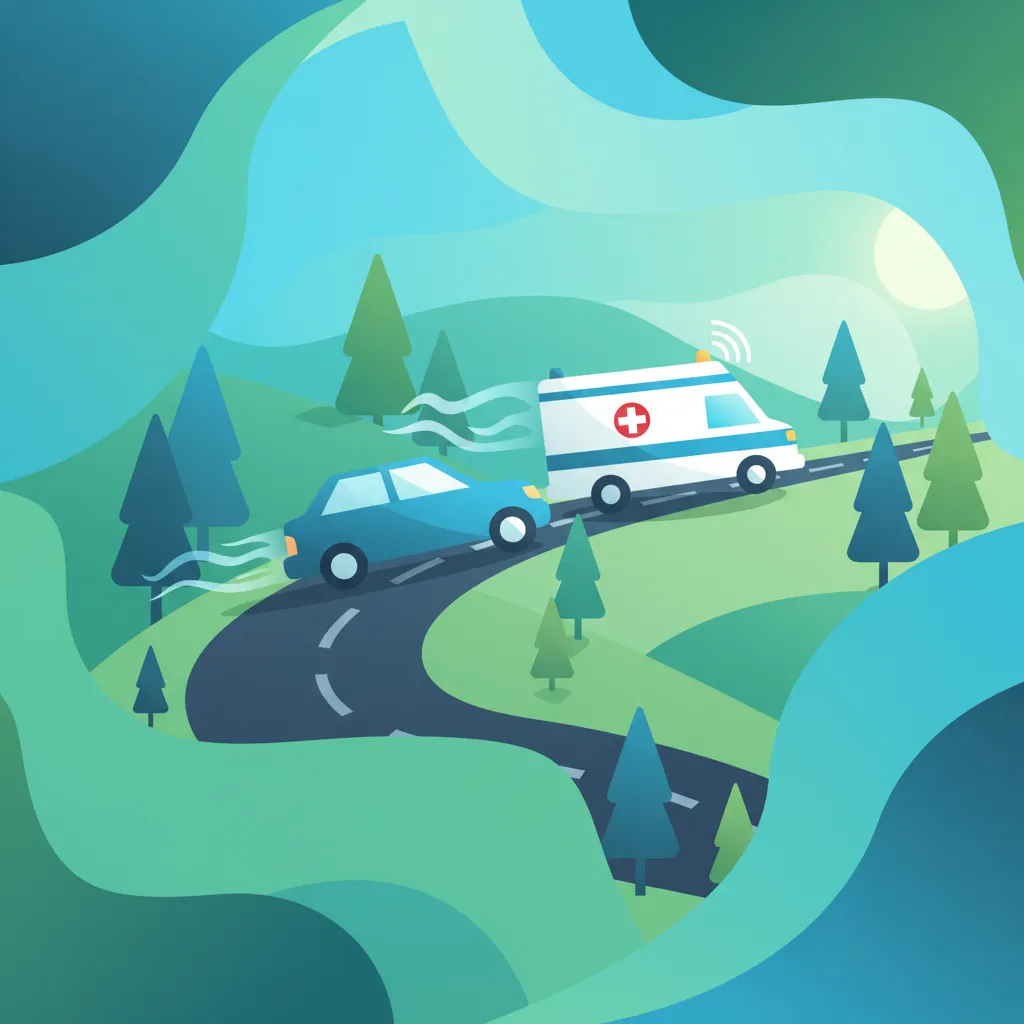
When an emergency vehicle, such as an ambulance, police car, or fire truck, is on an urgent mission, it often uses flashing blue lights and/or sirens. As a driver in Sweden, it is your responsibility to give these vehicles immediate priority. This means you must take all necessary steps to allow them to pass safely and without delay, adapting your driving to create a clear path.
Theory topic content overview
Read the full theory topic guide for Emergency Vehicle Priority with structured, easy-to-scan content built for learners in Sweden. This detailed section explains the exact rule, meaning, traffic context, comparison points, and exam logic behind this Swedish driving theory topic so you can study faster, understand the concept more clearly, and avoid common interpretation mistakes on the theory test.
In Sweden, the ability to react correctly and safely to emergency vehicles (utryckningsfordon) is not just a matter of road safety; it's a legal obligation and a critical component of the Swedish driving licence theory exam. Emergency vehicle priority means you must take immediate and appropriate action to give a clear path to vehicles such as ambulances, police cars, and fire trucks when they are on an urgent mission (brådskande uppdrag).
These vehicles signal their urgent status by using flashing blue lights (blåa blinkande ljus) and/or sounding sirens. Your primary responsibility as a driver is to facilitate their passage without delay, ensuring they can reach their destination quickly and safely.
The rules around emergency vehicle priority are designed to save lives, prevent injury, and limit damage to property. Any delay in an emergency response can have severe consequences.
When you see or hear an emergency vehicle approaching with flashing blue lights and/or sirens, your response must be immediate, safe, and predictable.
Observe and Identify:
Plan Your Action:
Creating a Rescue Lane (Räddningsgata) on Multi-Lane Roads: This is a vital rule in Sweden, especially on motorways (motorvägar) and other multi-lane roads with two or more lanes in the same direction. The aim is to create a free lane in the middle for emergency vehicles.
At Intersections:
Predictability is Key:
Your decision-making should adapt to the specific traffic situation:
räddningsgata is essential.räddningsgata (rescue lane) down the middle.räddningsgata formation is required.The concept of giving way to utryckningsfordon is deeply embedded in Swedish traffic culture and law. The Trafikförordningen forms the basis, granting specific exemptions for emergency vehicles only when they are on an urgent mission and using their signals. This means they can, for instance, exceed speed limits, disregard certain road signs, or pass through red lights – but always with the utmost care. Your role as a driver is to enable this flexibility by giving them an immediate and clear path.
The räddningsgata (rescue lane) is a particularly important Swedish rule on roads with two or more lanes in each direction. It is regularly tested in the theory exam and is critical for emergency services to quickly navigate congested motorways and major roads. Understanding how to form this lane correctly is as important as knowing that you should form one.
Always assume that an emergency vehicle's mission is critical. Your quick, safe, and predictable actions can make a real difference. Cultivate a habit of being aware of your surroundings, both visually and audibly. When you see or hear those blue lights and sirens, think: "Clear path, safe path, immediate path."
In Sweden, drivers must immediately clear the path for emergency vehicles displaying blue flashing lights and/or sirens—this is both a legal requirement under Trafikförordningen and essential for public safety. The standard response involves reducing speed smoothly, moving to the far right side of the road, and stopping if necessary to create an unobstructed passage. On multi-lane roads, drivers must form a Räddningsgata by moving left-lane traffic to the far left and all other lanes to the far right, leaving a clear center lane for emergency responders. At intersections, drivers must yield to emergency vehicles even when they have a green light, never entering or blocking the crossing. Only blue flashing lights indicate an emergency vehicle on an urgent mission; orange or yellow lights signal hazards but do not grant priority.
A short set of high-value points that capture the most important ideas from this theory explanation.
Drivers are legally obligated to give immediate priority to emergency vehicles with active blue flashing lights and/or sirens under Swedish traffic law.
When an emergency vehicle approaches, reduce speed smoothly, move to the far side of the road, and stop completely if needed to create a clear path.
On multi-lane roads, create a Räddningsgata (rescue lane) by vehicles in the left lane moving left and all others moving right.
At intersections, always yield to emergency vehicles even with a green light—do not enter or block the crossing.
Only blue flashing lights indicate emergency priority; orange or yellow lights signal hazards but do not grant priority over traffic rules.
Emergency vehicles demanding priority use blue rotating/blinking lights and/or sirens—this is the signal that requires your immediate action.
Räddningsgata formation: on two or more lanes, left lane moves to far left, all other lanes move to far right, leaving a clear center lane.
Blue lights = emergency priority; orange/yellow lights = slow vehicle or roadwork with no special priority.
At any intersection, stop before entering if an emergency vehicle is approaching, regardless of your traffic light status.
Emergency responders depend on predictable driver movements—signal clearly and avoid sudden or erratic maneuvers.
Panicking and making sudden braking or swerving movements, which creates additional danger for other road users.
Stopping in the middle of the driving lane instead of moving to the shoulder or far side of the road.
Forgetting the Räddningsgata rule on multi-lane roads and simply moving to the right instead of creating a central rescue corridor.
Re-entering traffic too soon after an emergency vehicle passes, without checking for additional following emergency vehicles.
Failing to notice emergency signals early due to distractions such as phones, loud music, or poor visibility conditions.
Start with a short, direct summary of Emergency Vehicle Priority before reading the full explanation below.
In Sweden, drivers must always give immediate priority to emergency vehicles displaying blue flashing lights and/or sounding sirens. This involves slowing down, moving safely to the side of the road, or stopping completely to create an unobstructed path. Your actions should be predictable and safe to ensure the emergency vehicle can pass quickly and without creating further hazards.
Review the most important terms, rule signals, and traffic concepts linked to Emergency Vehicle Priority.
Explore related theory topic pages connected to Emergency Vehicle Priority and continue with the next useful rule explanation.
See the common search queries learners use when trying to understand Emergency Vehicle Priority in Sweden.

Dive deeper into specific theory topics, review detailed explanations of road rules, and reinforce your understanding of Swedish traffic regulations. Continue your preparation for the driving licence exam by exploring each core concept in detail.
Explore Driving Theory TopicsTheory topic content overview
A short set of high-value points that capture the most important ideas from this theory explanation.
Drivers are legally obligated to give immediate priority to emergency vehicles with active blue flashing lights and/or sirens under Swedish traffic law.
When an emergency vehicle approaches, reduce speed smoothly, move to the far side of the road, and stop completely if needed to create a clear path.
On multi-lane roads, create a Räddningsgata (rescue lane) by vehicles in the left lane moving left and all others moving right.
At intersections, always yield to emergency vehicles even with a green light—do not enter or block the crossing.
Only blue flashing lights indicate emergency priority; orange or yellow lights signal hazards but do not grant priority over traffic rules.
Emergency vehicles demanding priority use blue rotating/blinking lights and/or sirens—this is the signal that requires your immediate action.
Räddningsgata formation: on two or more lanes, left lane moves to far left, all other lanes move to far right, leaving a clear center lane.
Blue lights = emergency priority; orange/yellow lights = slow vehicle or roadwork with no special priority.
At any intersection, stop before entering if an emergency vehicle is approaching, regardless of your traffic light status.
Emergency responders depend on predictable driver movements—signal clearly and avoid sudden or erratic maneuvers.
Panicking and making sudden braking or swerving movements, which creates additional danger for other road users.
Stopping in the middle of the driving lane instead of moving to the shoulder or far side of the road.
Forgetting the Räddningsgata rule on multi-lane roads and simply moving to the right instead of creating a central rescue corridor.
Re-entering traffic too soon after an emergency vehicle passes, without checking for additional following emergency vehicles.
Failing to notice emergency signals early due to distractions such as phones, loud music, or poor visibility conditions.
Start with a short, direct summary of Emergency Vehicle Priority before reading the full explanation below.
In Sweden, drivers must always give immediate priority to emergency vehicles displaying blue flashing lights and/or sounding sirens. This involves slowing down, moving safely to the side of the road, or stopping completely to create an unobstructed path. Your actions should be predictable and safe to ensure the emergency vehicle can pass quickly and without creating further hazards.
Review the most important terms, rule signals, and traffic concepts linked to Emergency Vehicle Priority.
Explore related theory topic pages connected to Emergency Vehicle Priority and continue with the next useful rule explanation.
See the common search queries learners use when trying to understand Emergency Vehicle Priority in Sweden.
Dive deeper into specific theory topics, review detailed explanations of road rules, and reinforce your understanding of Swedish traffic regulations. Continue your preparation for the driving licence exam by exploring each core concept in detail.
Explore Driving Theory TopicsUse this exam-focused revision tip to understand how Emergency Vehicle Priority is likely to appear in theory questions for learners in Sweden. This section helps you identify the most testable part of the rule, avoid common traps, and remember the concept more effectively during Swedish driving theory exam preparation.
The Swedish driving theory exam frequently tests your understanding of how to react to emergency vehicles in various scenarios, including at intersections or on motorways. Remember that the main goal is always to create a clear, safe, and immediate path. Pay close attention to questions involving multi-lane roads where creating a 'rescue lane' is often required.
Read direct answers to the most common learner questions about Emergency Vehicle Priority in Sweden. This FAQ focuses on rule confusion, practical meaning, comparison with similar concepts, and the exact uncertainties that appear most often in Swedish driving theory revision and exam preparation.
Emergency vehicles typically use blue flashing lights and/or loud sirens to signal that they are on an urgent mission and require immediate priority in traffic.
If an emergency vehicle approaches from behind with signals, you should safely move to the right side of your lane or pull over to the shoulder if possible, then stop to create a clear path.
Even if you have a green light, you must yield to an approaching emergency vehicle at an intersection. Stop safely and wait for it to pass before proceeding.
Emergency vehicles on urgent missions are granted certain exemptions from normal traffic rules, such as speed limits or red lights, to perform their duties efficiently. However, they must still drive safely and responsibly.
On multi-lane roads, drivers should create a 'rescue lane' (räddningsfil) in the middle, between the leftmost and adjacent lanes, to allow emergency vehicles to pass. On two-lane roads, move as far right as safely possible.
Avoid sudden braking or unpredictable lane changes. Do not follow emergency vehicles too closely, and never block their path or drive into the space they've just cleared.
If you see blue flashing lights, assume the vehicle is on an urgent mission and requires priority, even if you can't hear a siren due to noise or distance. React safely to create a clear path.
Refine your study plan by exploring practice sets on specific Swedish traffic rules, road signs, or driving situations. Use the search to quickly access relevant questions and focus your preparation for the official driving licence theory exam.