
The Give Way sign, officially called Väjningsplikt in Sweden, is a fundamental priority sign that instructs drivers to yield to traffic on the intersecting road or from a specific direction. It requires you to slow down, observe, and only proceed when doing so will not force other drivers to brake or change course. This rule is crucial for maintaining a smooth and safe traffic flow, especially at junctions.
Theory topic content overview
Read the full theory topic guide for Give Way Sign (Väjningsplikt) with structured, easy-to-scan content built for learners in Sweden. This detailed section explains the exact rule, meaning, traffic context, comparison points, and exam logic behind this Swedish driving theory topic so you can study faster, understand the concept more clearly, and avoid common interpretation mistakes on the theory test.
The Give Way sign, known in Sweden as Väjningsplikt (often translated as "obligation to yield"), is a fundamental priority sign in Swedish traffic. It instructs drivers to yield priority to all traffic on the intersecting road or from the direction indicated before proceeding.
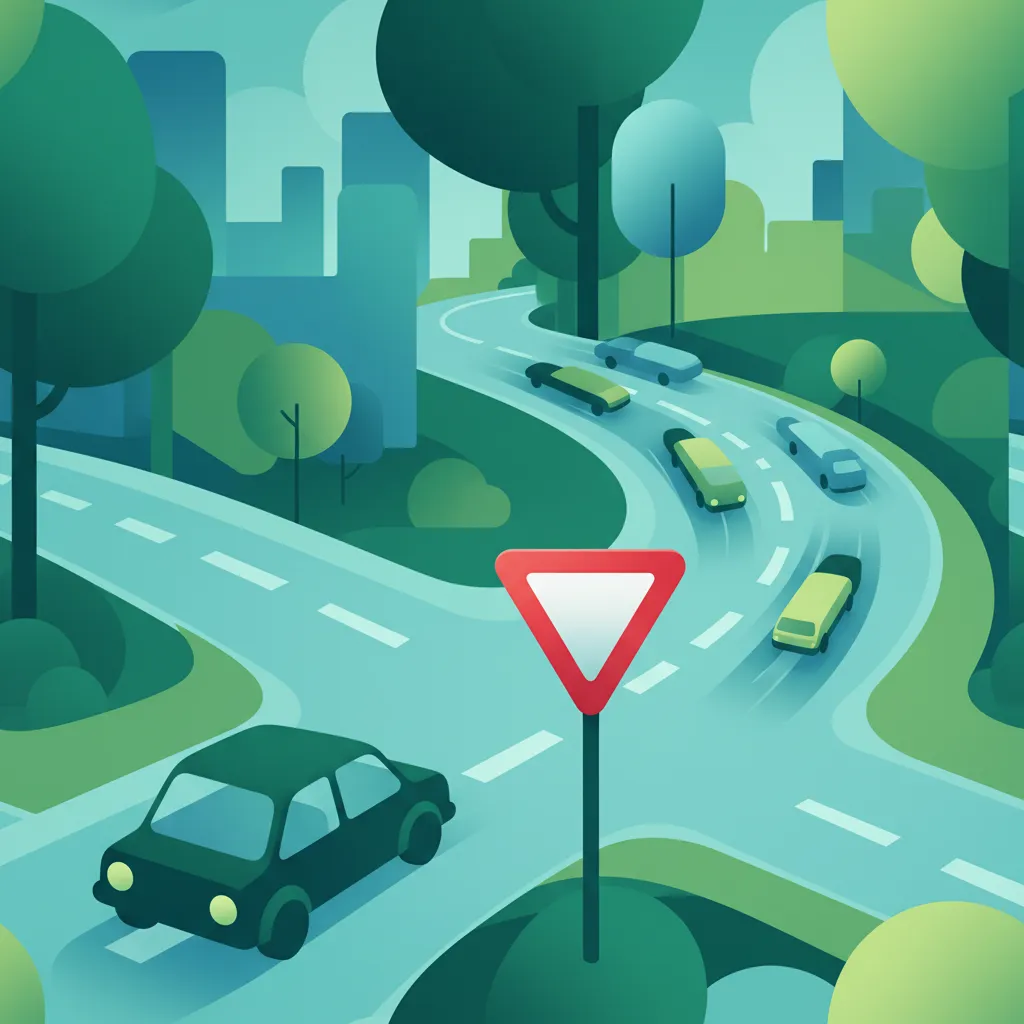
Visually, the Väjningsplikt sign is an inverted equilateral triangle with a red border and a white background. This distinctive shape ensures it's easily recognisable, even if obscured or covered in snow, making it a critical sign for all Swedish drivers to understand.
Fundamentally, giving way means that you must not cause any priority traffic to brake, swerve, or otherwise adjust their speed or direction because of your manoeuvre. Your obligation is to ensure their unimpeded passage.
Understanding the Väjningsplikt sign is not just about avoiding collisions; it's central to maintaining smooth traffic flow and demonstrating competence for the Swedish driving licence theory exam. In Sweden, priority rules are a cornerstone of safe driving, and junctions are frequent points of conflict.
Approaching a Väjningsplikt sign requires a systematic approach to ensure safety and compliance with Swedish traffic rules:
The key distinction from a stop sign (Stopplikt) is that you are not always required to come to a complete stop. If the path is entirely clear and you can proceed safely without hindering anyone, you may do so without stopping your vehicle completely.
One of the most common areas of confusion for Swedish driving licence candidates is the difference between the Väjningsplikt (Give Way) sign and the Stopplikt (Stop) sign. Mastering this distinction is crucial for both the theory exam and safe driving.
Why this distinction matters in Sweden: Swedish roads feature both signs, and misinterpreting them can lead to dangerous situations or unnecessary delays. Failing to stop at a Stopplikt sign is a serious offence. Stopping unnecessarily at a Väjningsplikt sign when the path is clear can impede traffic flow, especially if you have a long queue behind you. The theory exam frequently tests this exact difference.
Several factors influence how you should approach and respond to a Väjningsplikt situation on Swedish roads:
To illustrate the practical application of the Väjningsplikt sign, consider these typical scenarios in Sweden:
Learners taking the Swedish driving licence often make specific errors when encountering the Väjningsplikt sign:
The Väjningsplikt sign is more than just a rule; it's a call for situational awareness and defensive driving. When you see this inverted triangle, remember your obligation to yield (väjningsplikt). Always approach with caution, scan thoroughly, and be ready to stop if necessary. Your primary goal is to ensure that no priority traffic is hindered. By mastering the Give Way sign and its distinction from the Stop sign, you demonstrate a deep understanding of Swedish traffic rules, crucial for both passing your Swedish driving theory exam and becoming a safe and considerate driver on Swedish roads.
The Give Way sign (Väjningsplikt) is a priority sign in Sweden instructing drivers to yield to all traffic on intersecting roads. It requires slowing down, observing approaching traffic from all directions, and being prepared to stop if necessary, but a complete stop is only mandatory when priority traffic is actually present. The key distinction from Stopplikt is that Väjningsplikt allows proceeding without stopping when the path is clear. This sign is visually identified by its inverted red-bordered triangular shape and is commonly found at roundabouts and minor road junctions. Understanding Väjningsplikt is essential for safe driving and is frequently tested in the Swedish driving theory exam.
A short set of high-value points that capture the most important ideas from this theory explanation.
The Väjningsplikt sign means you must yield to all traffic on the intersecting road without necessarily stopping if the path is clear
The sign is visually distinct as an inverted equilateral triangle with a red border and white background
Giving way means not causing any priority traffic to brake, swerve, or adjust their speed or direction
Unlike Stopplikt, you may proceed without a complete stop if no priority traffic is approaching
Cyclists and pedestrians with priority on intersecting roads must also be yielded to
The Väjningsplikt sign shape: inverted red-bordered equilateral triangle (distinct from Stopplikt's octagon)
You must be prepared to stop but only stop if priority traffic is actually present
Visibility, speed, road conditions, vehicle type, and intersection layout all affect how you give way
Swedish roundabouts frequently use Väjningsplikt at entry points, requiring yield to all circulating traffic
The sign indicates an obligation to yield, not a guarantee that all intersecting traffic has priority
Stopping completely when the intersecting road is empty, treating Väjningsplikt like Stopplikt
Failing to thoroughly scan for traffic from all relevant directions before proceeding
Misjudging the speed and distance of approaching vehicles, especially on high-speed roads
Creeping or inching into the intersection, which is confusing and potentially dangerous for priority drivers
Focusing only on cars and failing to check for cyclists or pedestrians who may have priority
Start with a short, direct summary of Give Way Sign (Väjningsplikt) before reading the full explanation below.
The Give Way sign (Väjningsplikt) means you must yield to all traffic on the intersecting road or from the direction indicated. This involves slowing down and being prepared to stop if necessary to allow priority traffic to pass without hindrance. Unlike a stop sign, you are not always required to come to a complete stop if the path is clear and safe to proceed.
Review the most important terms, rule signals, and traffic concepts linked to Give Way Sign (Väjningsplikt).
Explore related theory topic pages connected to Give Way Sign (Väjningsplikt) and continue with the next useful rule explanation.
See the common search queries learners use when trying to understand Give Way Sign (Väjningsplikt) in Sweden.

Dive deeper into specific theory topics, review detailed explanations of road rules, and reinforce your understanding of Swedish traffic regulations. Continue your preparation for the driving licence exam by exploring each core concept in detail.
Explore Driving Theory TopicsTheory topic content overview
A short set of high-value points that capture the most important ideas from this theory explanation.
The Väjningsplikt sign means you must yield to all traffic on the intersecting road without necessarily stopping if the path is clear
The sign is visually distinct as an inverted equilateral triangle with a red border and white background
Giving way means not causing any priority traffic to brake, swerve, or adjust their speed or direction
Unlike Stopplikt, you may proceed without a complete stop if no priority traffic is approaching
Cyclists and pedestrians with priority on intersecting roads must also be yielded to
The Väjningsplikt sign shape: inverted red-bordered equilateral triangle (distinct from Stopplikt's octagon)
You must be prepared to stop but only stop if priority traffic is actually present
Visibility, speed, road conditions, vehicle type, and intersection layout all affect how you give way
Swedish roundabouts frequently use Väjningsplikt at entry points, requiring yield to all circulating traffic
The sign indicates an obligation to yield, not a guarantee that all intersecting traffic has priority
Stopping completely when the intersecting road is empty, treating Väjningsplikt like Stopplikt
Failing to thoroughly scan for traffic from all relevant directions before proceeding
Misjudging the speed and distance of approaching vehicles, especially on high-speed roads
Creeping or inching into the intersection, which is confusing and potentially dangerous for priority drivers
Focusing only on cars and failing to check for cyclists or pedestrians who may have priority
Start with a short, direct summary of Give Way Sign (Väjningsplikt) before reading the full explanation below.
The Give Way sign (Väjningsplikt) means you must yield to all traffic on the intersecting road or from the direction indicated. This involves slowing down and being prepared to stop if necessary to allow priority traffic to pass without hindrance. Unlike a stop sign, you are not always required to come to a complete stop if the path is clear and safe to proceed.
Review the most important terms, rule signals, and traffic concepts linked to Give Way Sign (Väjningsplikt).
Explore related theory topic pages connected to Give Way Sign (Väjningsplikt) and continue with the next useful rule explanation.
See the common search queries learners use when trying to understand Give Way Sign (Väjningsplikt) in Sweden.
Dive deeper into specific theory topics, review detailed explanations of road rules, and reinforce your understanding of Swedish traffic regulations. Continue your preparation for the driving licence exam by exploring each core concept in detail.
Explore Driving Theory TopicsUse this exam-focused revision tip to understand how Give Way Sign (Väjningsplikt) is likely to appear in theory questions for learners in Sweden. This section helps you identify the most testable part of the rule, avoid common traps, and remember the concept more effectively during Swedish driving theory exam preparation.
A common mistake in the Swedish theory exam is confusing the Give Way sign (Väjningsplikt) with the Stop sign (Stopplikt). Remember that Väjningsplikt means you *must be prepared to stop* and *yield*, but a full stop is only required if there is priority traffic. Stopplikt, however, always demands a complete stop before the stop line, regardless of traffic.
Read direct answers to the most common learner questions about Give Way Sign (Väjningsplikt) in Sweden. This FAQ focuses on rule confusion, practical meaning, comparison with similar concepts, and the exact uncertainties that appear most often in Swedish driving theory revision and exam preparation.
The primary purpose of the Give Way sign (Väjningsplikt) is to ensure that drivers yield priority to traffic on the road they are entering or crossing, preventing collisions and maintaining smooth traffic flow.
A Give Way sign (Väjningsplikt) requires you to yield, meaning you must be prepared to stop but only do so if there is priority traffic. A Stop sign (Stopplikt) requires you to come to a complete stop before the stop line, regardless of whether there is oncoming traffic.
No, you do not always have to stop. You must slow down and be prepared to stop, but if the intersecting road is clear of traffic and you can proceed safely without hindering anyone, you may continue without coming to a complete stop.
Yielding to traffic means allowing vehicles with priority to pass first. You must not enter the intersection or cross their path if it would cause them to slow down, swerve, or take any evasive action.
If there is no traffic on the priority road that you would need to yield to, you may proceed through the intersection without stopping, provided it is safe to do so. Always reduce your speed and observe carefully.
The Swedish Give Way sign (Väjningsplikt) is an inverted white triangle with a red border. Its distinctive shape helps drivers recognize it even if it's obscured or partially visible.
Give Way signs are commonly found where a minor road meets a major road, at the entrance to roundabouts, or at certain complex intersections to regulate priority flow.
Refine your study plan by exploring practice sets on specific Swedish traffic rules, road signs, or driving situations. Use the search to quickly access relevant questions and focus your preparation for the official driving licence theory exam.